
How we decide what is safe to publish
A mistaken mushroom identification can be fatal. Our editorial standards require reliable sources, cautious edibility ratings, and independent review of safety claims.
Why we hold this to a higher standard
Most food writing can afford to be wrong at the edges because a bad substitution ratio costs you a mediocre dinner, not your health.
Mushroom identification has no such margin. The gap between a choice edible and a lethal Amanita can be one feature at the base of the stem.
So we treat every edibility claim as a safety claim. The process is built to catch mistakes before they reach you, not after.
The rule that shapes everything: the person who writes a page never signs off on its safety. A reviewing mycologist does, independently.
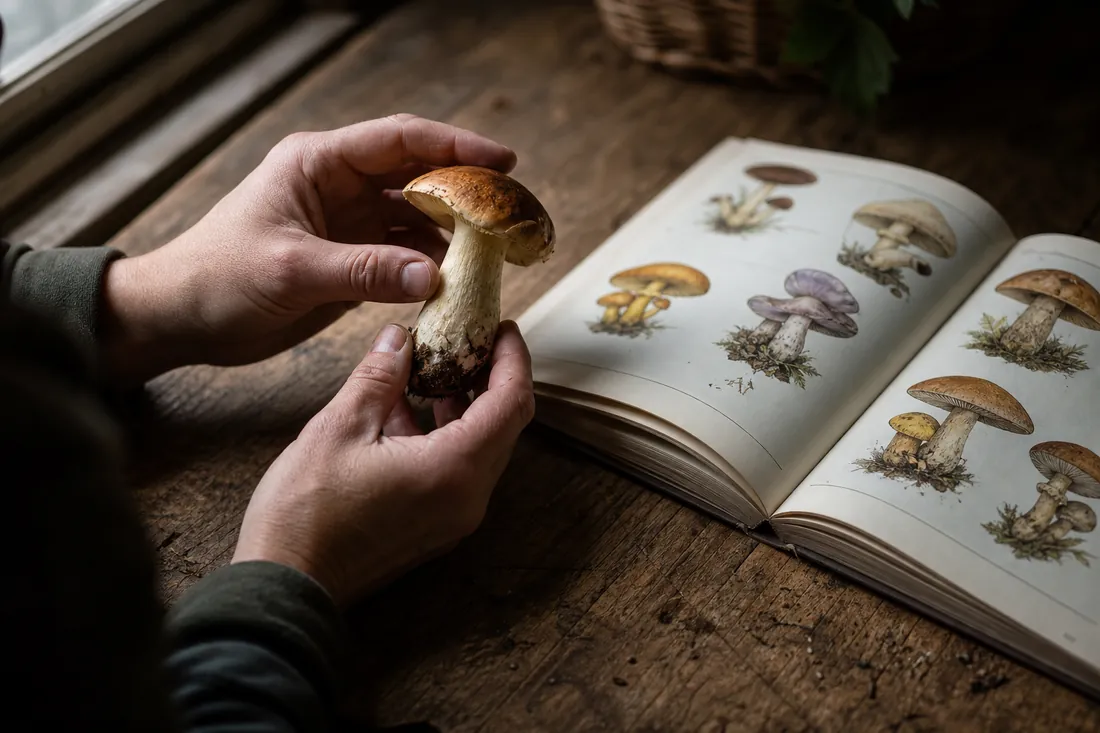
Two sets of eyes, never one
A writer can know a species well and still miss the one feature that matters, so the writer never gets the last word on safety.
A reviewing mycologist checks the identification, the edibility call, and the lookalikes on their own. Only then does a page publish, with the reviewer named and the review date shown.
Four principles behind every page
These principles guide our sourcing, safety ratings, and corrections.
- Author is not reviewer. Writers draft; a reviewing mycologist independently checks every identification, edibility, and safety claim before it publishes.
- When in doubt, rate down. If sources disagree or a species has a serious lookalike, we mark it more cautious, never less.
- Show the lookalikes. No edible is published without documenting the toxic species it is confused with.
- Correct fast. Safety errors are fixed immediately and material changes are noted.
How an edibility rating is made
A rating is the end of a chain, not a first impression. Every step has to hold before the next begins.
Verify identity
The accepted name and family are fixed against MycoBank and Index Fungorum first.
Assemble field marks
Cap, gills or pores, stem, spore print, habitat, and odor are cross-checked across references.
Map the lookalikes
Every dangerous confusion pair is documented before an edibility rating is assigned.
Expert sign-off
A qualified mycologist reviews the page and dates the review before it goes live.
How we differ from a typical food site
Plenty of sites will tell you a mushroom tastes great. Far fewer are built to tell you, first, whether it can hurt you.
Here is where our process diverges.
| Typical food or garden site | KnowTheSpore | |
|---|---|---|
| Expert review | Rare, or none | Mycologist signs off every safety page |
| Sourcing | Often seed catalogues and blogs | MycoBank, Index Fungorum, iNaturalist |
| Lookalikes | Usually omitted | Required on every edible |
| When sources conflict | Pick the appealing answer | Rate down and flag the risk |
| Corrections | Ad hoc | Prioritised, and dated |
Conflicts of interest
Some outbound links, like grow kits or field guides, are affiliate links that may earn us a small commission. They never move a rating, a ranking, or whether a species is called edible.
Edibility is a safety judgement, and safety judgements are not for sale.
We do not publish sponsored identification or safety content. If that ever changes, it gets a clear label and still passes the same mycologist review.
Corrections
Accuracy matters most on a safety site. If we get something wrong, we fix it fast and note material changes.
Report an error through contact. Safety corrections are prioritised above everything else, including new content.