Why does the blackening waxcap change color?
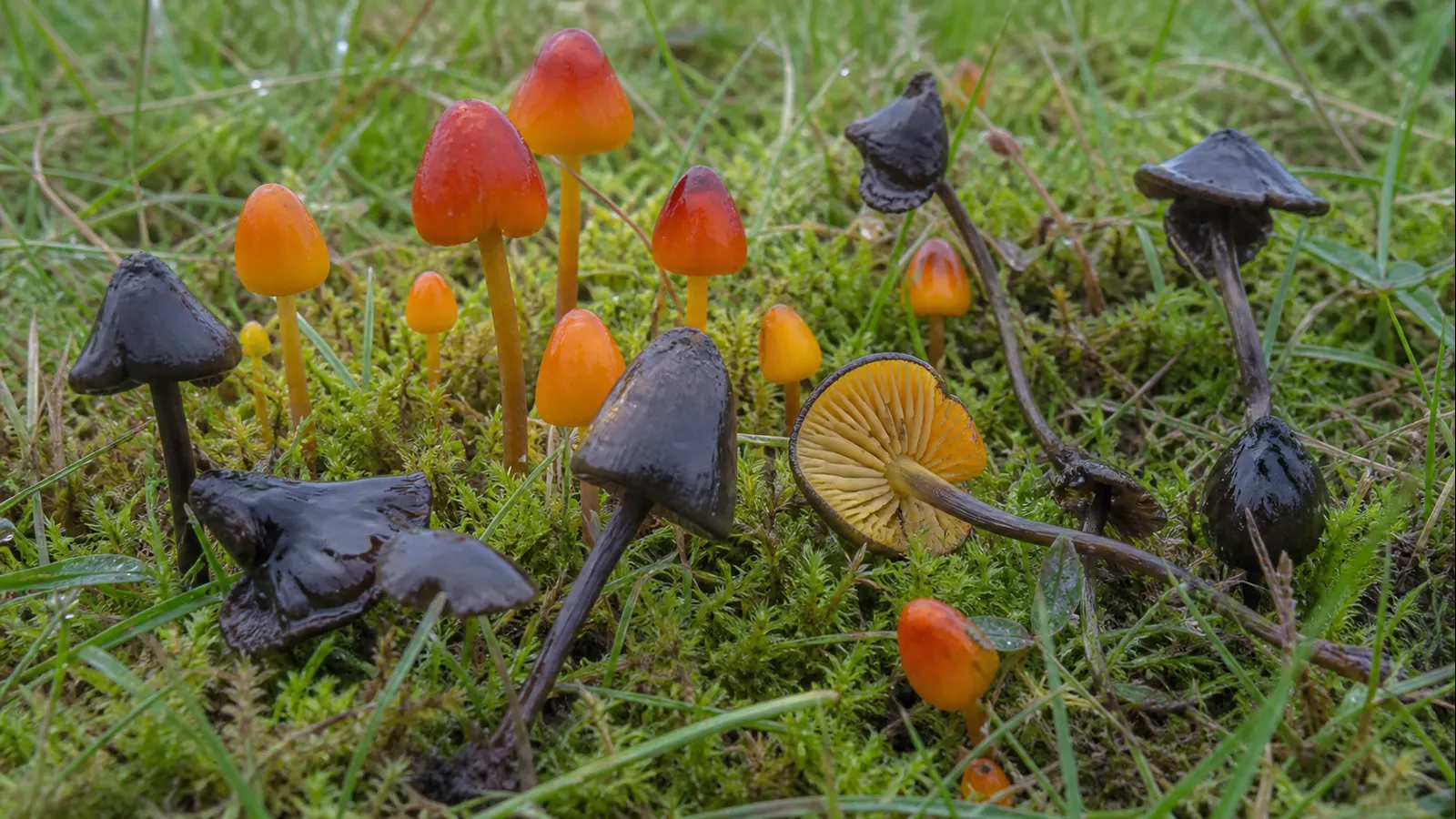
A fresh blackening waxcap can be one of the brightest mushrooms in old grassland. Its sharply pointed cap glows yellow, orange, or red before handling, weather, and age spread gray and black through the tissue.
The color change is progressive rather than a painted surface. A bruise often begins dull gray, deepens through charcoal tones, and eventually leaves the cap, gills, and stem almost entirely black.
Record both states. The original color and the timed transition carry more identification value than a photograph taken after the fruiting body has already collapsed into black tissue.
The cap is conical when young and may split or flatten while retaining a raised center. Its surface ranges from slightly greasy to dry depending on weather and which lineage in the complex is present.
Waxy gills are broader and more widely spaced than the thin crowded blades of many small grassland agarics.
They begin pale or yellowish and develop dark bruises where fingers, insects, or rain have damaged them.
The stem often looks twisted, flattened, or longitudinally fibrous. It has no ring, and blackening can climb upward from the base or appear in isolated pressure marks.
The name witch's hat describes the pointed silhouette, while blackening waxcap describes the most memorable process. Neither common name proves the narrow species because several related taxa share part of the appearance.
Waxcaps are field indicators as well as mushrooms.
A fruiting in long-undisturbed, low-nutrient turf can signal a diverse grassland fungal community that ordinary lawn management overlooks.
This ecological role changes the reader decision. The best response is usually to document the fruiting and protect the site, not to pick every specimen or treat it as an edible novelty.
How do you document the blackening reaction?
Sharply conical to bell-shaped, commonly 2 to 7 cm, yellow, orange, or red when young, becoming streaked and eventually black after handling or age.
Waxy, rather broad, pale yellow to orange-gray, narrowly attached or nearly free, and blackening after bruising or decay.
Slender, often twisted or compressed, yellow to orange with longitudinal fibers, lacking a ring, and blackening from the base or bruised areas.
Thin, waxy, yellowish flesh without a distinctive odor, turning gray and black after damage.
Photograph a young undamaged cap before touching it. Include the grass height, surrounding plants, slope, moisture, and neighboring waxcaps because the habitat record may outlast the short-lived fruiting body.
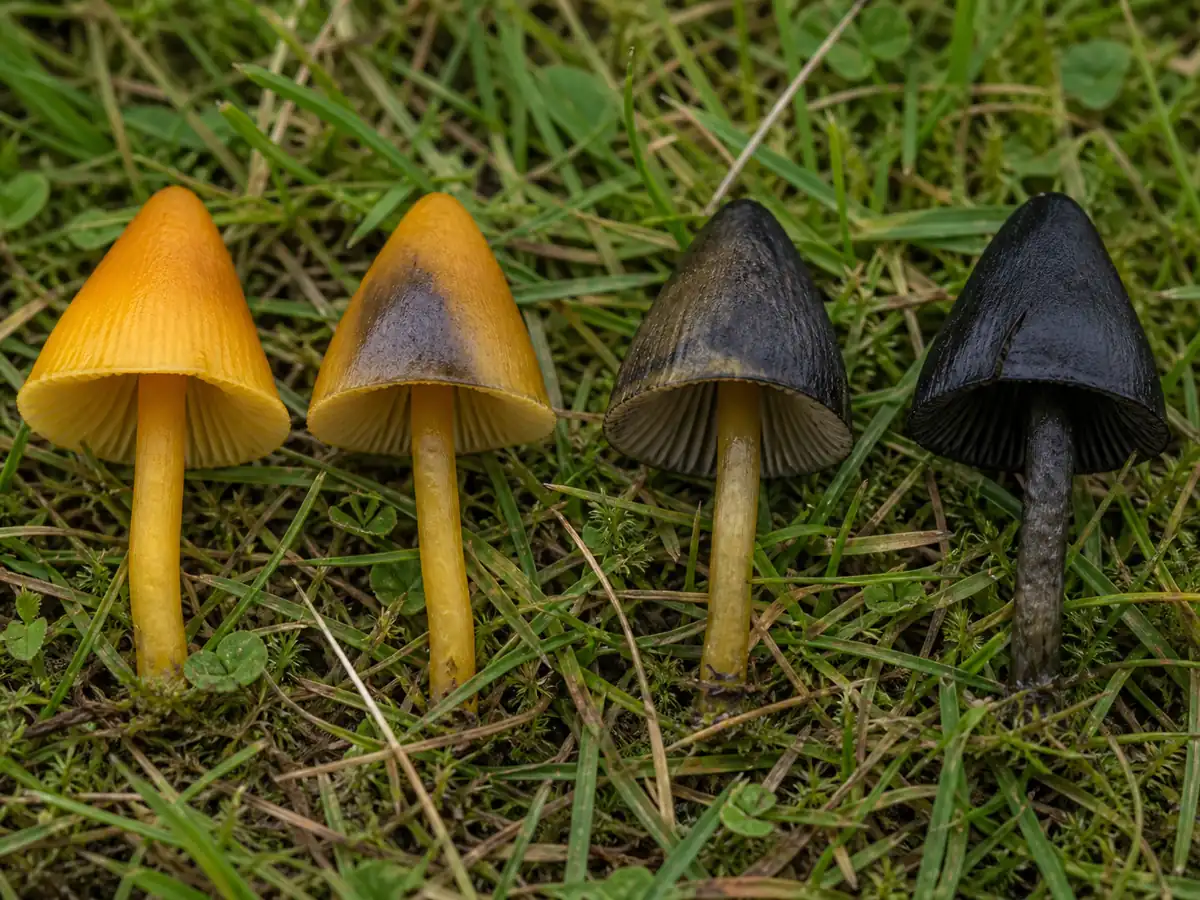

Choose one specimen for a controlled bruise rather than crushing the patch. Press a small cap area, expose a short gill section, and photograph at the start, after several minutes, and again when the reaction has developed.
Capture fresh color
Record the unhandled yellow, orange, or red fruiting body in its turf.
Time one bruise
Test a limited area and time the change instead of relying on old black tissue.
Check the structures
Examine gill attachment, stem viscosity, and the complete ringless base.
Resolve the regional name
Produce a white print and use a regional waxcap key before assigning a narrow species.
A white deposit supports Hygrocybe but does not separate conical waxcaps.
Spore size and shape, basidia, clamp connections, pileipellis structure, and the degree of cap or stem viscosity may be needed.
Fresh gill color helps with comparisons. Yellowish gray gills differ from the pink-orange tones often discussed for dune waxcap, but intermediate color and old blackening make that distinction unreliable by itself.
The cap surface should be described before drying. Moisture can make a slightly viscid cap look strongly slimy, while sun can remove the sheen from a lineage normally recorded as lubricous.
Measure cap width, fruiting height, and stem proportions from several specimens. Species-complex work needs a population range because one stunted or water-swollen fruiting can distort the apparent form.
Document the vegetation without naming the fungus from habitat alone.
Waxcap-rich turf often supports mosses and fine grasses, yet a single fruiting can also appear in a lawn where fertilizer or soil disturbance has changed the broader community.
Old jet-black fruiting bodies sometimes remain upright after the bright stage has vanished. They can lead a surveyor back to the patch, but they contain less reliable color and texture evidence than fresh material.

A voucher should include a young colored fruiting, an intermediate bruised specimen, and a mature dark specimen when collection is permitted. Drying preserves microscopic material while photographs preserve the color sequence that the dried voucher loses.
Cap viscosity should be tested without pouring water onto a dry specimen. Touch a naturally moist margin with a clean tool, note whether fibers lift or a gelatinous layer stretches, and compare the stem separately.
Microscopic sampling must preserve location. Take spores from a mature deposit, cap-surface tissue from the center and margin, and gill tissue from an undamaged fruiting rather than mixing every structure in one mount.
Clamp connections and basidial spore number can support regional keys.
Record them only after scanning enough tissue because one missing clamp in a crushed mount is not evidence that the character is absent.
The specimen needs a before-and-after record. Fresh morphology, the timed bruise series, dried voucher, and habitat notes together preserve information that no single stage contains.
If only old blackened mushrooms remain, record the aggregate conservatively and return after the next rain. Waiting for fresh material is stronger practice than inventing the lost yellow, orange, or red stage.
Which conical waxcaps can look similar?
Several conical yellow, orange, or red waxcaps occur in the same turf. The blackening reaction is important, but rate, extent, habitat, gill color, surface texture, and microscopic evidence are needed because Hygrocybe conica is a species complex.
Do not eat a conical waxcap. The group contains closely related species that are difficult to separate, and blackening is an identification reaction rather than a food-safety test.
| Candidate | Blackening behavior | Habitat or structural clue |
|---|---|---|
| Hygrocybe conica complex | Strong gray-to-black change across cap, gills, and stem | Short grassland, conical cap, white spores |
| Hygrocybe acutoconica | Usually does not blacken strongly | Similar pointed yellow-orange cap |
| Hygrocybe conicoides | May blacken slowly or incompletely | Coastal dunes, often pinkish or orange gills |
| Hygrocybe singeri complex | Blackening waxcap from western North America | Slimy stem and regional microscopic characters |
| Hygrocybe nigrescens concepts | Large blackening forms in older literature | Often included within or separated from H. conica depending on treatment |
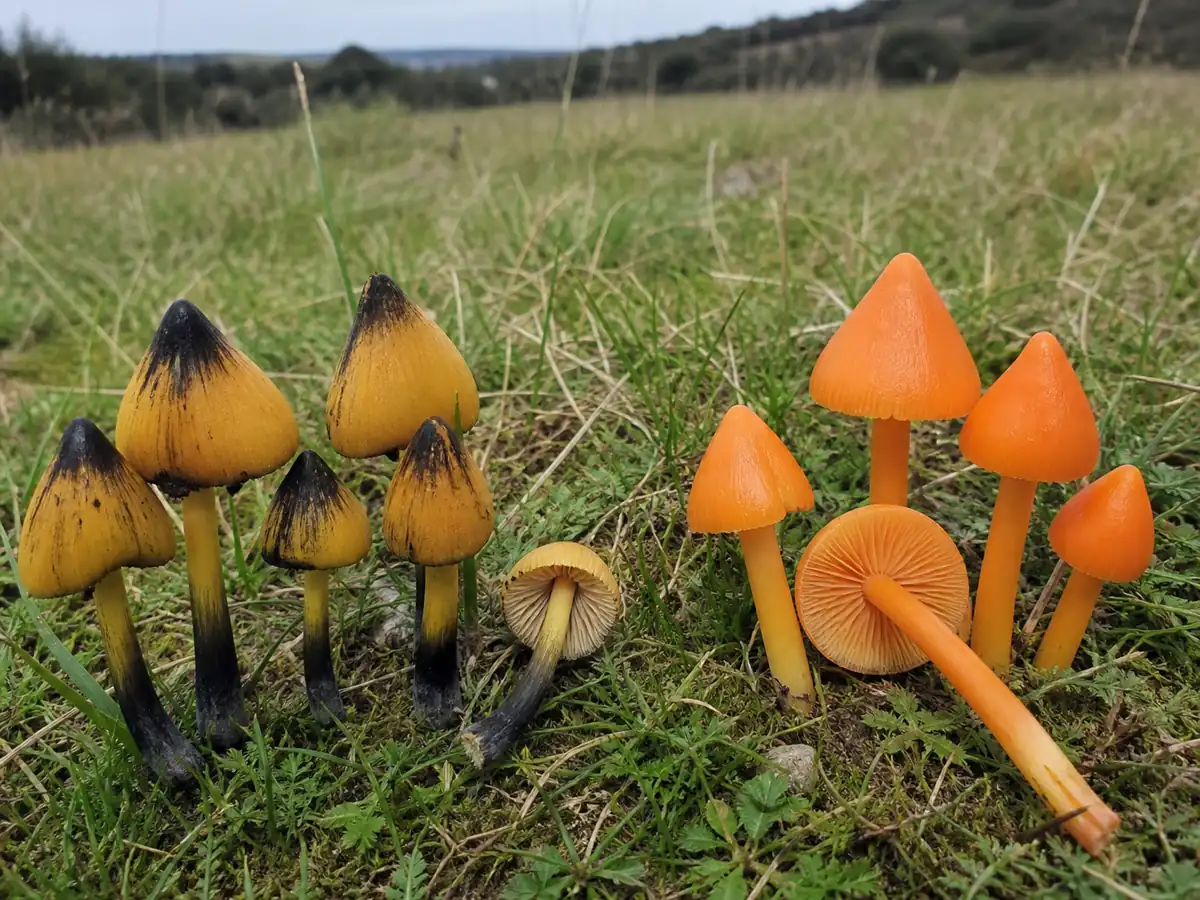
Test the reaction by photographing an intact specimen, then pressing one small area of the cap margin and gill edge.
Record the first gray mark and the later black state rather than presenting only the final damaged mushroom.
Hygrocybe acutoconica can share a pointed yellow or orange cap, but it usually retains color rather than turning black throughout. An old waterlogged specimen may darken through decay, so genuine blackening needs a fresh controlled observation.
Dune waxcap, H. conicoides, occupies sandy coastal grassland and can show orange or pinkish gills. It may darken, but habitat and the slower or incomplete response help separate a regional candidate.
North American field guides have applied H. conica broadly to multiple lineages. A western specimen with a very viscid stem may belong near H. singeri, and a formal name should use current regional work.
- Reject final black color alone because rot, frost, and age can blacken unrelated tissue.
- Reject bright young cap alone because yellow, orange, and red occur across many waxcaps.
- Record a timed bruise sequence that follows fresh color through gray to black.
- Record vegetation, soil, management, and associated waxcaps across the unimproved turf.
What does it reveal about old grassland?
Blackening waxcaps are characteristic of short grassland with low nutrient inputs and limited soil disturbance. Sites include old pastures, churchyards, lawns, heaths, and dune grassland, depending on region and lineage.
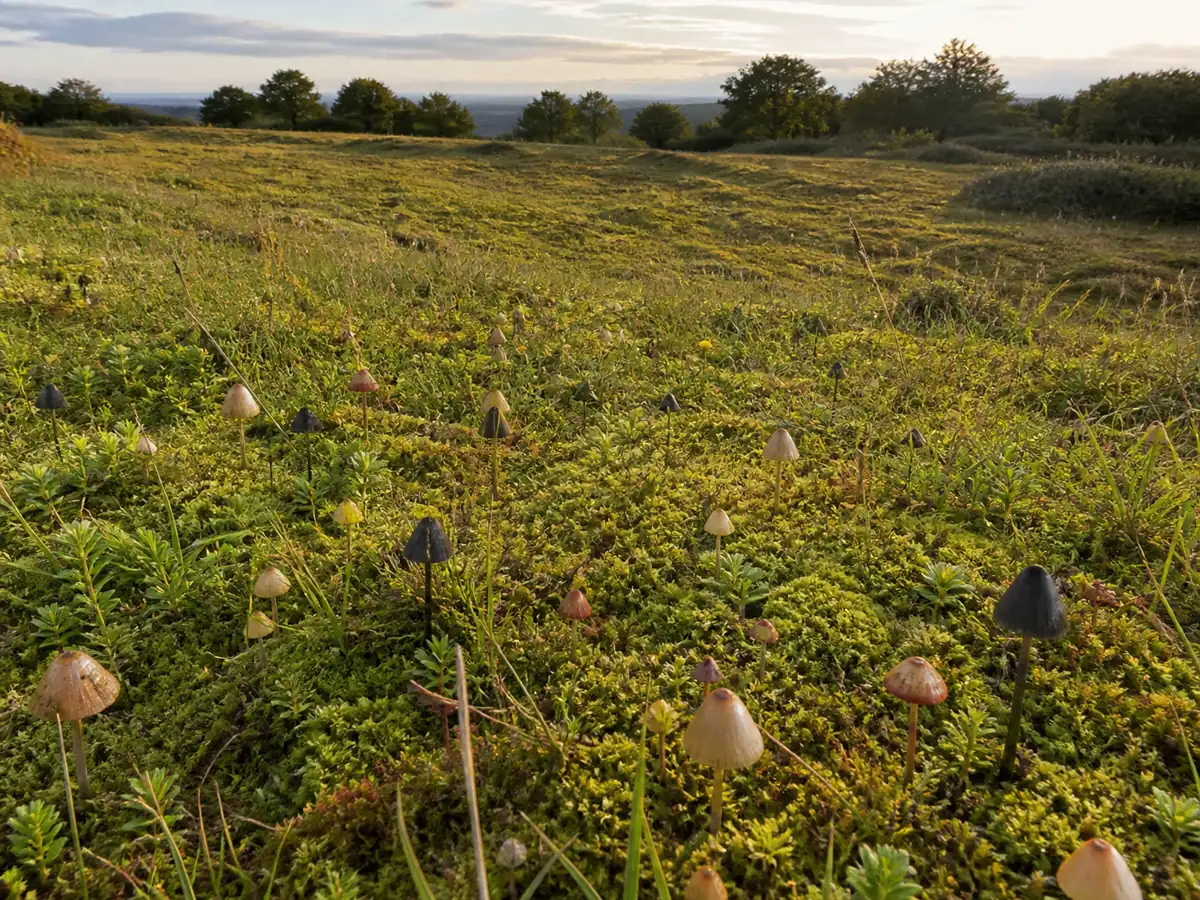
Waxcap ecology is more complex than ordinary leaf-litter decay. Research on grassland fungi points to close associations with plants and soil processes, and the visible fruiting should not be treated as an isolated cap fed by dead grass.
Note
One blackening waxcap does not prove an exceptional grassland. A diverse repeated waxcap assemblage can support conservation assessment, while heavy fertilizer, reseeding, plowing, fungicide, and prolonged compaction usually work against waxcap-rich turf.
Mowing can maintain the short sward these fungi fruit through, but timing matters. Cutting every fruiting before it matures removes the visible survey window and may reduce spore production.
Leave clippings off nutrient-poor conservation turf when that practice matches the site's management plan. Accumulated cut material can enrich and smother the surface that supports small fruiting bodies.
Do not transfer a generic lawn recipe to a cemetery, dune, or species-rich pasture. Soil, cultural use, legal protection, grazing, drainage, and the wider fungal assemblage require site-specific decisions.
Late-summer and autumn rainfall often triggers fruiting after the soil profile has rehydrated.
A patch may remain invisible in a dry year, so one negative visit cannot establish absence.
The blackened remnants can persist longer than many waxcaps and help locate a colony after bright caps have aged. Surveyors should still return during fresh fruiting because microscopic and macroscopic identification needs the original colors and textures.
A useful site record includes management history, fertilizer use, soil disturbance, sward height, moss cover, associated waxcap species, and repeat dates.

These facts give the identification ecological meaning without assuming that every blackening fruiting belongs to one global species.
Survey the same route at comparable intervals through the fruiting season. Waxcap species peak at different times, so one visit can understate diversity and overemphasize the durable black remnants.
Record abundance in repeatable bands rather than picking every mushroom to count it. Photographs and mapped groups can document a patch while leaving most fruiting bodies intact.
Management history explains more than one cap. Years without fertilizer, low soil disturbance, and suitable mowing or grazing create the context in which a waxcap assemblage becomes meaningful.
Before changing a cemetery or pasture, consult the land manager and a local conservation specialist. A well-meant application of lime, seed, topsoil, irrigation, or herbicide can alter the fungal community the survey was meant to protect.
Is Hygrocybe conica one species?
Hygrocybe conica is the type species of Hygrocybe and has carried many names since its first description in the eighteenth century. Current broad usage often treats blackening conical waxcaps as an aggregate rather than one visually uniform species.
Molecular studies and regional projects have found multiple lineages within the H. conica concept. The exact number and names depend on geography and taxonomic treatment, so recognizing the complex does not by itself establish the exact species.
- Broad label
- Hygrocybe conica sensu lato is appropriate for a blackening conical waxcap that lacks decisive regional evidence.
- Narrow record
- Microscopy, ecology, fresh viscosity, and DNA may support H. conica sensu stricto or a related taxon.
- Historical name
- Hygrocybe nigrescens has sometimes been separated for larger forms and sometimes included in the broader concept.
This uncertainty is not a reason to ignore the mushroom. A well-documented aggregate record can be revisited when regional sequence data and morphological boundaries improve, while a confident unsupported species label cannot recover missing field observations.
Species-complex work depends on linking names to type concepts and sequence-backed vouchers. An environmental sequence from grassland soil can reveal diversity but cannot replace the fresh colors, bruise reaction, gills, and stem of a fruiting body.
Regional authors may split coastal, montane, slimy-stemmed, or large forms differently. Use the treatment that covers the collection area and state when the aggregate name is being used.
Sensu lato is an honest identification level. It tells readers that the recognizable blackening complex is supported while the narrow lineage remains unresolved.
Future taxonomic changes can improve an old record only if photographs, measurements, habitat, and a voucher survive. A bare name in a spreadsheet contains nothing that can be reinterpreted.
Can you grow it in a lawn?
Blackening waxcap is not a conventional home-cultivation species. Its grassland ecology depends on long-term soil, plant, microbial, moisture, and management relationships that cannot be reproduced by placing spores on potting mix.
The useful cultivation action is habitat care. Avoid fertilizer and fungicide, reduce compaction, retain appropriate mowing or grazing, and consult local conservation guidance before changing a waxcap-rich site.
Moving turf or fruiting bodies can damage the source and spread soil organisms without establishing the target. Protect the known patch instead of attempting a transplant.
Is blackening waxcap edible?
Do not cook blackening waxcaps. They have no established food role that justifies consuming a difficult species complex from conservation-sensitive grassland.
Blackening during cooking would also erase the fresh characters needed to reconstruct an error. Keep waxcaps out of mixed baskets and photograph them where they grow.
A small size or pleasant color does not reduce uncertainty. Food decisions need positive evidence of an accepted edible species, not the absence of a famous deadly lookalike.
Blackening waxcap field questions
Is blackening waxcap edible?
How quickly does it turn black?
What color is the spore print?
Where does it grow?
Is Hygrocybe conica a species complex?
Should I pick blackened specimens?
Sources & References
- EPPO Global Database Accepted name, family, and common names.
- Royal Botanic Gardens Kew waxcap research Grassland fungal ecology and conservation context.
- Pembrokeshire Fungus Recording Network Regional molecular project on the H. conica aggregate.
- British Mycological Society Regional recording practices and waxcap field context.