
 Poisonous

What kind of mushroom is club foot?
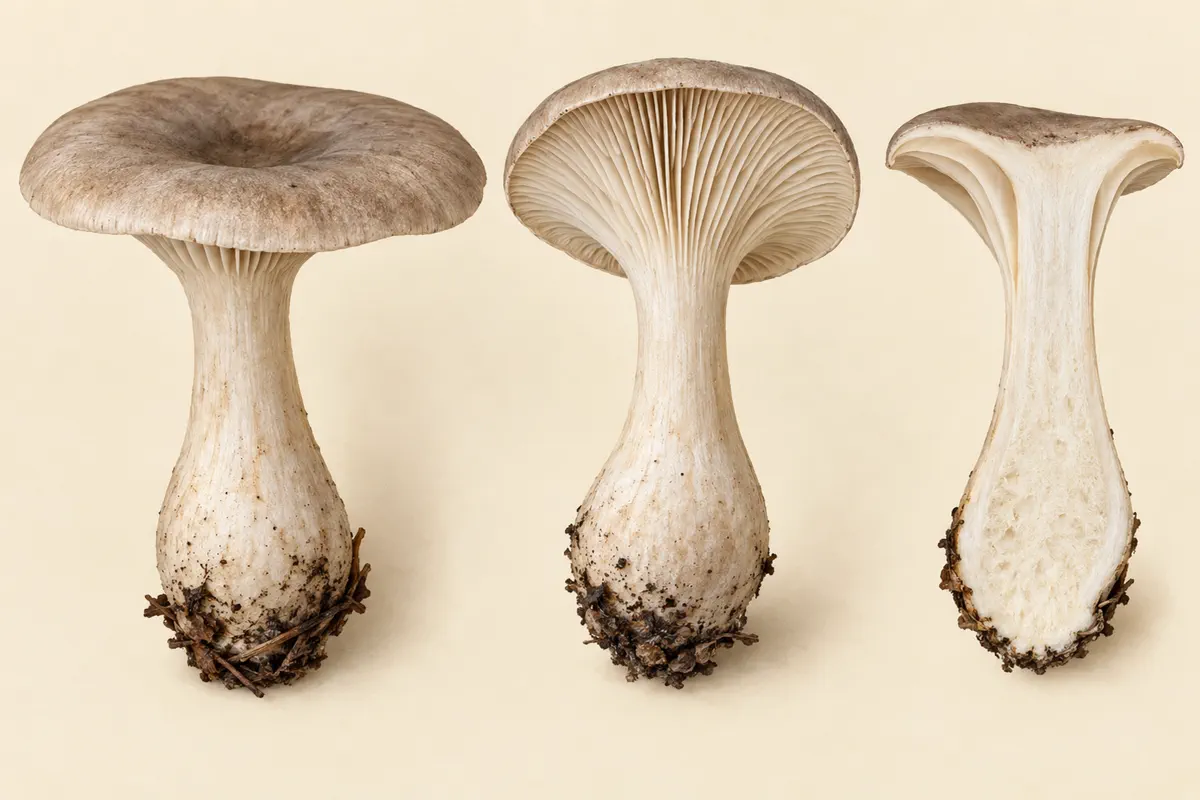
Club foot takes its name from the broad lower stem that gives many specimens a bottle or club outline. That shape sticks in memory, but the species makes more sense once you see how the cap, gills, and soft stem develop together. Its cap starts convex and can flatten or sink slightly in the center. Moisture deepens the brown or olive-gray tones, while drying can make the same cap look paler and less glossy.
Underneath, the pale gills run down the stem and do not end squarely at it. That decurrent attachment gives you an observation separate from the clubbed base and places the mushroom among the clitocyboid forms. The current name puts the species in Ampulloclitocybe, within Hygrophoraceae. Older guides often call it Clitocybe clavipes, so field records and toxicology papers may use either name for the same species.
How can you identify club foot as a complete mushroom?
Start with an intact mushroom, never a cropped cap photograph. With the whole specimen you can trace the cap edge to the gills and see how they meet the stem. You can also confirm that the broad base belongs to the same fruit body. Young caps are convex and may keep a low central rise. They broaden toward flat or shallowly depressed, usually in muted gray-brown, yellow-gray, or ochre-brown tones and seldom a clean white or bright orange.
The surface can be moist and finely fibrillose. Weather changes both color and sheen, so a dry pale cap and a damp darker cap can fit the same description. The gills start white and commonly age toward cream or yellowish cream. Their most telling trait is that they continue visibly down the upper stem. How far and how clearly they run varies with age and viewing angle.
The lower stem is often swollen, curved, and soft. Cut it lengthwise and you may see pale spongy tissue, with none of the cup-like volva found at the base of certain Amanita species. There is no ring. Soil and litter can fake a boundary on the stem, so brush the surface gently enough to tell attached tissue from debris without stripping features away.
Mature caps can leave a white spore deposit. Treat that result as one part of a complete mushroom description, because many unrelated pale-gilled mushrooms also have light spores. Smell descriptions vary widely between sources and observers. Sweet, spicy, or almond-like impressions may support a documented collection, but odor never overrides contradictory gills, base, or spore color.
When those observations disagree or a crucial structure is missing, stop at a broader identification. No second photograph can rebuild a discarded stem base or prove how an old waterlogged specimen felt.
Why does alcohol change the safety question?
The warning rests on evidence about club foot itself. One published case report under the former name Clitocybe clavipes documents an Antabuse-like reaction, and a peer-reviewed Hygrophoraceae review reports a coprine-like aldehyde dehydrogenase inhibitor. That enzyme breaks down acetaldehyde, which the body makes from ethanol. Blocking that step explains why a drink can turn an earlier mushroom meal into a medical problem, much as it can with common inkcap.
The evidence supplies no universally safe delay, mushroom portion, or alcohol amount. Remembering one symptom-free meal cannot show that another specimen, dose, or later drink will be safe. If someone may have eaten club foot, contact Poison Control in the United States at 1-800-222-1222 or the local poison service. Mention the mushroom, meal time, preparation, amount, alcohol exposure, and any medicines or products that contain alcohol.
Do not wait for symptoms, a point Poison Control's wild-mushroom guidance also stresses. Do not induce vomiting unless a poison specialist directs it. Call emergency services immediately for collapse, seizure, trouble breathing, or a person you cannot wake.
Where and when does club foot grow?
Club foot fruits in woodland litter, often in coniferous settings and sometimes in deciduous woods. Institutional field records describe it breaking down the woody organic matter in that litter. That setting supports a woodland-litter comparison but cannot name the species. Any conifer stand can produce many gray-brown gilled mushrooms in the same wet spell.
The mushroom you see is temporary, while the fungus lives in material below or within the litter. Fruit bodies that seem to rise from bare soil may still connect to fine woody debris hidden underneath. European records commonly describe fruiting from midsummer into late autumn. Your local elevation, rainfall, and temperature can shift that window, so a July-to-November record gives regional context and no universal calendar.
If a find falls outside the expected season, keep the observation and don't force the name. Unusual timing may reflect local conditions, or it may point to another species worth comparing.
Does avoiding alcohol make club foot edible?
Some field references call club foot conditionally edible, usually on the view that people can avoid the alcohol reaction. That label leaves the real questions about a wild collection open. Is the identification correct, how much active compound does the specimen hold, and how long does someone stay susceptible?
The direct case report and the mechanism review give a reason for caution and no safe plan. No cooking method reviewed here neutralizes the alcohol interaction, and no waiting schedule turns this page into permission to eat the mushroom. Sources also describe the mushroom as soft or spongy, and it can break down further with age. That texture may explain its small culinary appeal, but poor eating quality ranks well behind the toxicology and the identification risk.
Warning
Do not taste to identify
Tasting cannot measure the active compound, distinguish every clitocyboid lookalike or predict how alcohol will affect you.
If an exposure has already happened, poison-center advice comes next, and an improvised meal experiment has no place. Keep the remaining uncooked specimen apart from cooked leftovers so an expert can tell which material came from where.
Why do field guides use different scientific names?
Older books place club foot in Clitocybe as Clitocybe clavipes. Molecular and morphological work later moved it to Ampulloclitocybe, and the current taxonomic treatment keeps the former name as a synonym. That change explains why the case report and the modern profile use different genus names. The reported alcohol reaction still belongs to this mushroom.
Name history cannot identify a specimen, either. You still need the mushroom's own structures, habitat, region, and any microscopic characters a regional key requires.
Do its studied compounds make it medicinal?
Chemists have reported bioactive compounds from A. clavipes, including the aldehyde dehydrogenase inhibitor and clavilactones that showed cytotoxic activity against tumour cell lines in laboratory tests. Activity against a laboratory target does not show that the mushroom treats any human condition. Our sources establish no standardized preparation, clinical benefit, therapeutic dose, or safe supplement. The reaction with alcohol gives you a concrete reason to keep mechanistic research out of home medicine.


 Inedible