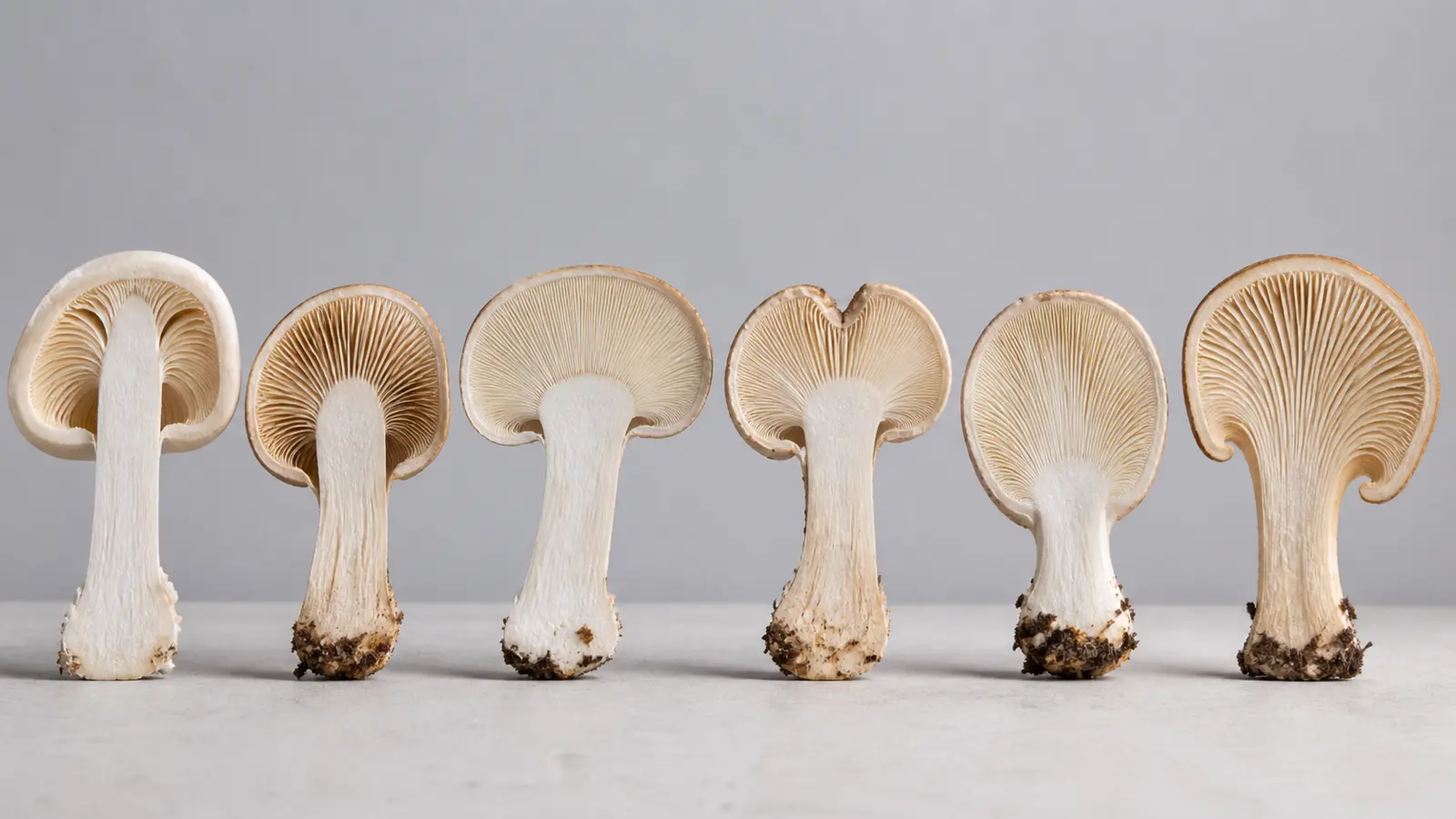
Judge gill attachment where a mature gill meets the stem. Free gills stop short, adnexed gills attach narrowly, adnate gills attach broadly, notched gills narrow abruptly, and decurrent gills run down the stem.
Mushroom gill attachment describes the inner edge of a true gill where it approaches or meets the stem. Look at that junction from the side, ideally in a clean radial section, rather than judging the broad face of the gill.
Confirm true gills, expose one intact junction, classify the contact, then compare another stage.
Attachment is geometry, not an edibility signal.
Prepare a Gill Junction You Can Actually Read
True gills are thin plates of spore-bearing tissue with two faces and a distinct edge. They radiate beneath a cap, and many include shorter plates that begin at the margin but do not reach the stem.
Trace one full-length plate from the cap margin toward the stem before judging its inner end. Short gills terminate naturally between the margin and stem, so their endpoint cannot show attachment.
Chanterelle-like false gills are blunt ridges formed from the fruit body's flesh. They can fork and cross-connect, but they do not separate into the same thin blade-like plates.
Note
Do not apply free, adnate, or decurrent to pores, teeth, folds, wrinkles, or an enclosed spore mass. First choose the correct fertile-surface branch, then use attachment terms only for true gills.
Pores are the mouths of tubes while teeth hang as individual spines, and forcing either surface into gill language discards its useful characters.
Check a fresh area because insects and decay can remove the inner gill ends, creating a false gap around the stem that resembles free attachment.
How to Expose the Gill-Stem Junction
Select a mature but firm specimen whose cap has expanded enough to reveal the underside. Very young caps compress the junction, while old caps can pull or tear the gills away.
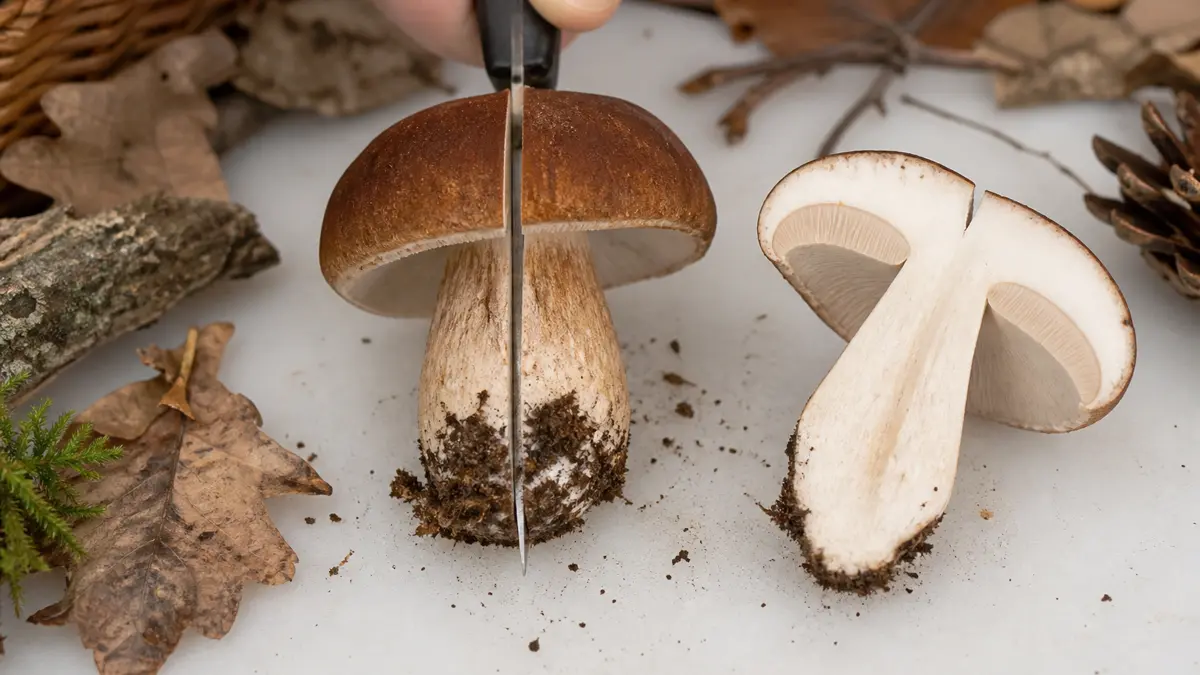
The cut face must preserve both the cap radius and the intact inner gill edge before the procedure begins.
Do not slice parallel to the gills.
That view shows broad tissue faces but can remove the edge profile that distinguishes a notch from a narrow attachment.
Use a firm mature cap and a clean blade. Soft old tissue compresses under the knife, while a sawing motion tears the few millimeters where adnexed, adnate, and notched attachments differ.
You can also bend the cap gently or remove one wedge to open a crowded underside, but stop before the gill tears from the stem. A clean cut records the natural junction more reliably than pulling tissue apart.
Make a close side photograph with the stem vertical and the cap profile visible. An extreme camera angle can turn a broad attachment into a thin line or hide a genuine gap.
IdentificationWhat Are the Tiny Bird's Nest Fungi in Your Mulch?The Six Practical Gill Attachment Types
The main terms describe a continuum from no contact to a long descent down the stem, and intermediate boundaries are better recorded with a qualified phrase than forced precision.
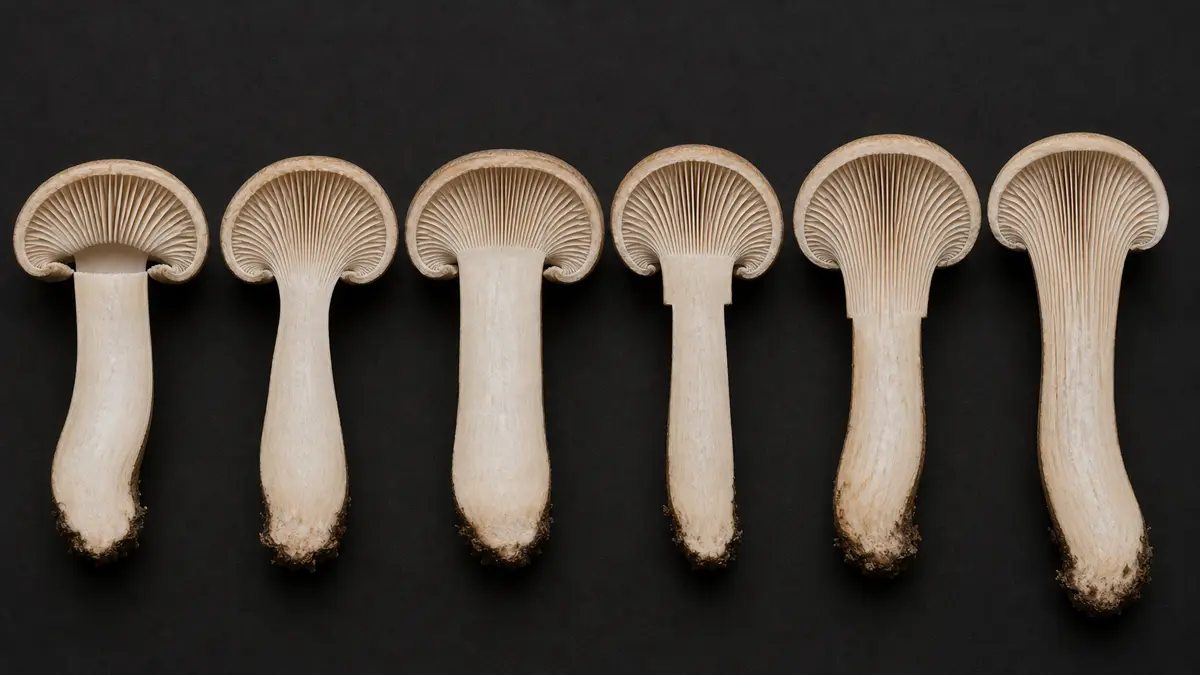
Read the lineup from no contact to descent, then use the table to name the junction rather than the overall direction of the gill.
| Type | Contact with stem | Side-profile cue | Closest confusion |
|---|---|---|---|
| Free | No contact | Gill ends before the stem and leaves a channel | Seceding gills that detached with age |
| Adnexed | Narrow contact | Gill tapers before touching a small part of the stem | Nearly free or narrowly adnate |
| Adnate | Broad contact | Much of the gill depth meets the stem directly | Slightly decurrent when the cap angle slopes |
| Notched or sinuate | Attached after an indentation | Gill narrows abruptly or curves upward before contact | Adnexed when the notch is shallow |
| Subdecurrent | Descends a short distance | Inner edge continues just below the cap-stem junction | Adnate on a sloping cap |
| Decurrent | Descends clearly | Gill tissue runs down the stem for a visible distance | Blunt false gills or folds |
Free is the only primary term that means no attachment. A narrow clear channel should continue around the stem, not appear only where a damaged gill has pulled away.
Adnate comes from broad contact, while adnexed describes a tapering narrow contact.
The question is how much of the gill depth joins the stem, not how crowded the gills are.
Notched attachment requires an abrupt inward curve immediately before contact. A smooth gradual narrowing is better recorded as adnexed, while a groove created by damage should remain unclassified.
Notched, emarginate, and sinuate terminology varies among guides. Record the visible geometry in plain language beside the preferred term, such as “abrupt notch before narrow attachment.â€
Decurrent gills remain gill tissue as they descend. The length can vary, which is why subdecurrent is useful for a short run that is more than a direct attachment but less than a sustained descent.
Free, Narrowly Attached, or Broadly Attached
These three categories cause frequent uncertainty because the difference occupies only a few millimeters, so use the cap-stem channel and the depth of actual tissue contact rather than the apparent direction of the whole gill.

The macro view isolates the contact width before the compact facts summarize each boundary.
- gap
- Free | Confirm a real space between gill and stem on several intact plates
- triangle
- Adnexed | Follow the gill as it tapers to a narrow point of contact
- equal
- Adnate | Look for a broad inner edge joined through much of its depth
Remote is a useful qualifier when free gills stop an obvious distance from the stem. It describes the width of the gap, not a separate mechanism.
Use subadnexed or subdecurrent only when a key or reference uses that intermediate term consistently. In ordinary field notes, a measured description such as narrowly attached or running 2 mm down the stem often preserves the observation more clearly.
A gill that was attached when young but has pulled away later is seceding. Look for torn tissue, a line on the stem, or younger specimens that retain the original contact.
Compare several plates around the cap instead of deciding from one gill whose edge is eaten or split because local damage and asymmetric growth can alter a single junction.
The cap angle can also mislead because on a strongly domed cap, a broadly attached gill may approach the stem on a slope but remains adnate unless tissue continues downward below the junction.
How Age Changes Gill Attachment and How Much to Trust It
Cap expansion alters the angle between cap, gills, and stem. A compressed young junction becomes easier to see at maturity, then can distort as the cap uplifts or dries.
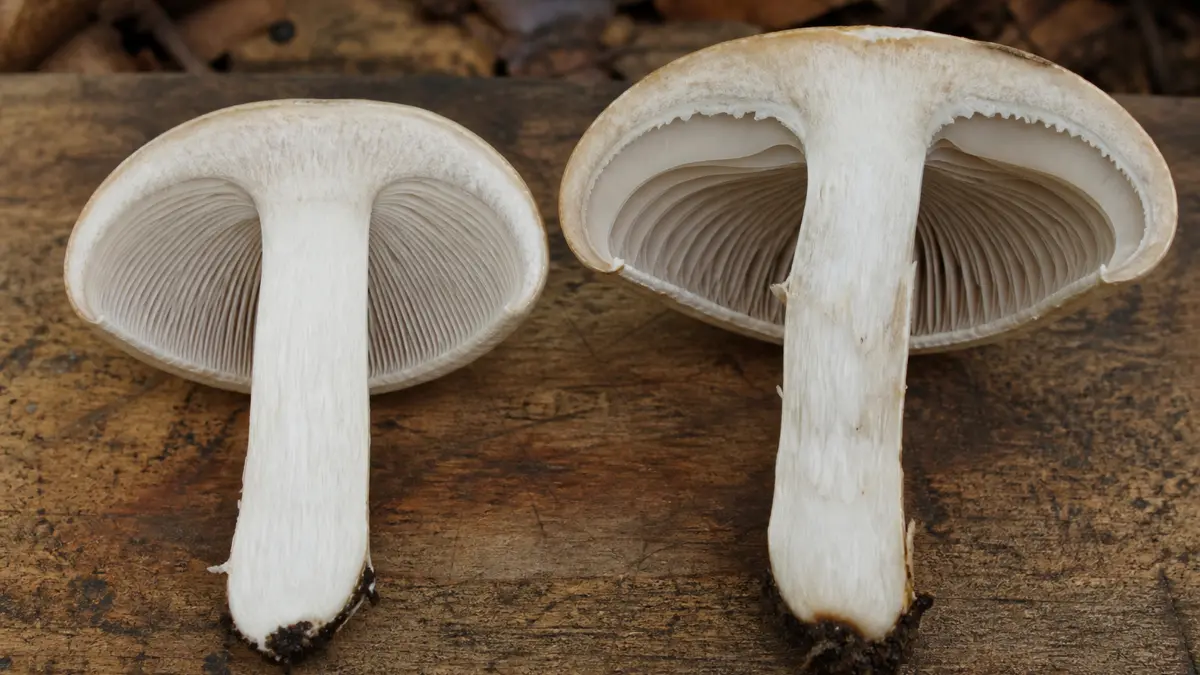
Compare the residual line and cap angle before calling the older junction free.
As the cap widens, the inner gill edge can stretch, curve, or become more exposed. That change can make a narrowly attached gill look notched even when no abrupt indentation was visible earlier.
Some attached gills separate with age.
A mature or old specimen can therefore appear free, but a residual line or younger cap reveals that the original state was seceding.
Drying can shrink gill tissue away from the stem after collection, especially in thin caps. Record the fresh junction before transport and treat a later gap as a changed condition rather than automatically revising the original term.
Old gills also sag, tear, darken under spores, and lose crisp edges to insects. Record the condition before applying a precise term.
Use two or three developmental stages from the same patch when fruit bodies are abundant. Keep substrate, growth pattern, cap surface, spore color, and other characters in view so the stages genuinely belong together.
When only one ambiguous old specimen exists, write “apparently free, possible seceding attachment†because it preserves more information than a confident but unsupported label.
Use Attachment as One Character
Gill attachment can remove candidates from a key, particularly when the alternatives have free versus clearly decurrent gills.
It becomes less decisive when closely related species range from adnexed to adnate or change with maturity.
Write the term with stage and confidence, such as mature, broadly adnate, high confidence, or old, apparently free, possible secession. That notation preserves the observation and its limitation without turning a borderline junction into false precision.
Record gill spacing separately as crowded, close, subdistant, or distant when the guide uses those terms. Spacing describes the intervals among plates, while attachment describes their inner ends.
Add gill thickness, edge shape, tiers of short gills, color, bruising, latex, and changes as spores mature. A pale young underside can darken dramatically without any change in attachment.
Then corroborate the observation with cap profile and surface, complete stem base, ring or cortina, veil remnants, flesh reactions, spore deposit, substrate, nearby trees, region, and season.
Do not infer attachment from a species name in an app and then reinterpret the specimen to fit. Describe the junction before opening candidate pages so the observation remains independent.
If the specimen has blunt ridges descending the stem, record false gills or folds rather than decurrent true gills. That distinction can outweigh the direction shared by both structures.
No attachment type makes a wild mushroom safe to eat. Finish at the narrowest name supported by the whole record, and seek qualified local review when identification affects a consumption decision.