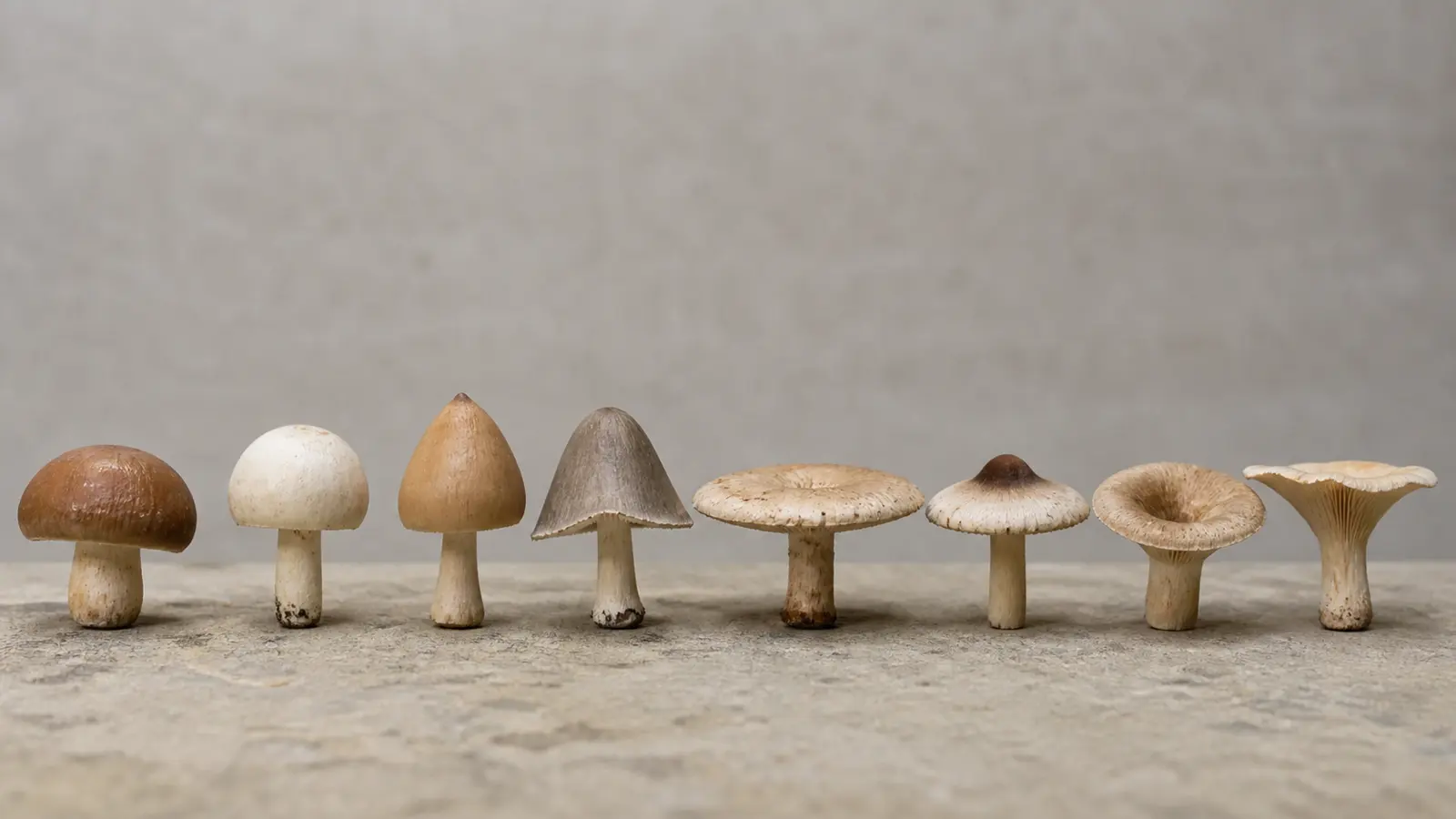
Judge mushroom cap shape from a side profile at a known stage. Convex, conical, bell-shaped, flat, umbonate, depressed, umbilicate, and funnel-shaped describe geometry, but margins, surface, scale, and age must also be recorded.
Mushroom cap shapes are easiest to describe from the side, with the specimen's stage recorded beside the term. A young convex cap can become flat or uplifted as it expands, so one silhouette is not a permanent identity mark.
Describe three things separately: the overall curve, any raised or depressed center, and the margin.
Shape narrows a comparison only when the maturity is clear.
The Main Mushroom Cap Shapes
Start with the curve from the cap center to its edge. Ignore color and surface texture for this first pass, since scales or patches can make a simple profile look more complex than it is.

Compare the lineup at cap height, then keep a familiar silhouette from becoming a species verdict.
Note
Use the closest defensible term and keep the photograph. Real caps often sit between textbook silhouettes, and forcing a precise label adds less information than recording “broadly convex, becoming flat.â€
Convex describes an even outward curve, while hemispherical implies a deeper half-sphere profile. Bell-shaped caps flare more strongly near the margin, and conical caps keep straighter sides that meet at a narrower center.
Flat is also a range rather than a perfectly level plane. Record slightly convex or slightly depressed when the center still differs from the margin, since that modifier preserves more information than forcing the cap into one ideal silhouette.
A hemispherical cap forms roughly half a sphere, while a convex cap has a lower, broader arc. Both can occur early in development, but hemispherical describes the stronger dome.
Conical caps rise toward a relatively pointed center with sides that taper in a straight or gently curved line, while bell-shaped, or campanulate, caps have a rounded top and sides that flare outward more noticeably near the margin.
Flat, also called plane, means the main surface has expanded close to level. It can still carry a raised boss or shallow central depression, which should be added as a modifier.
Depressed caps sit lower at the center than the surrounding disc. Funnel-shaped, or infundibuliform, goes further because the surface descends deeply toward the stem and creates a sustained funnel rather than a shallow dish.
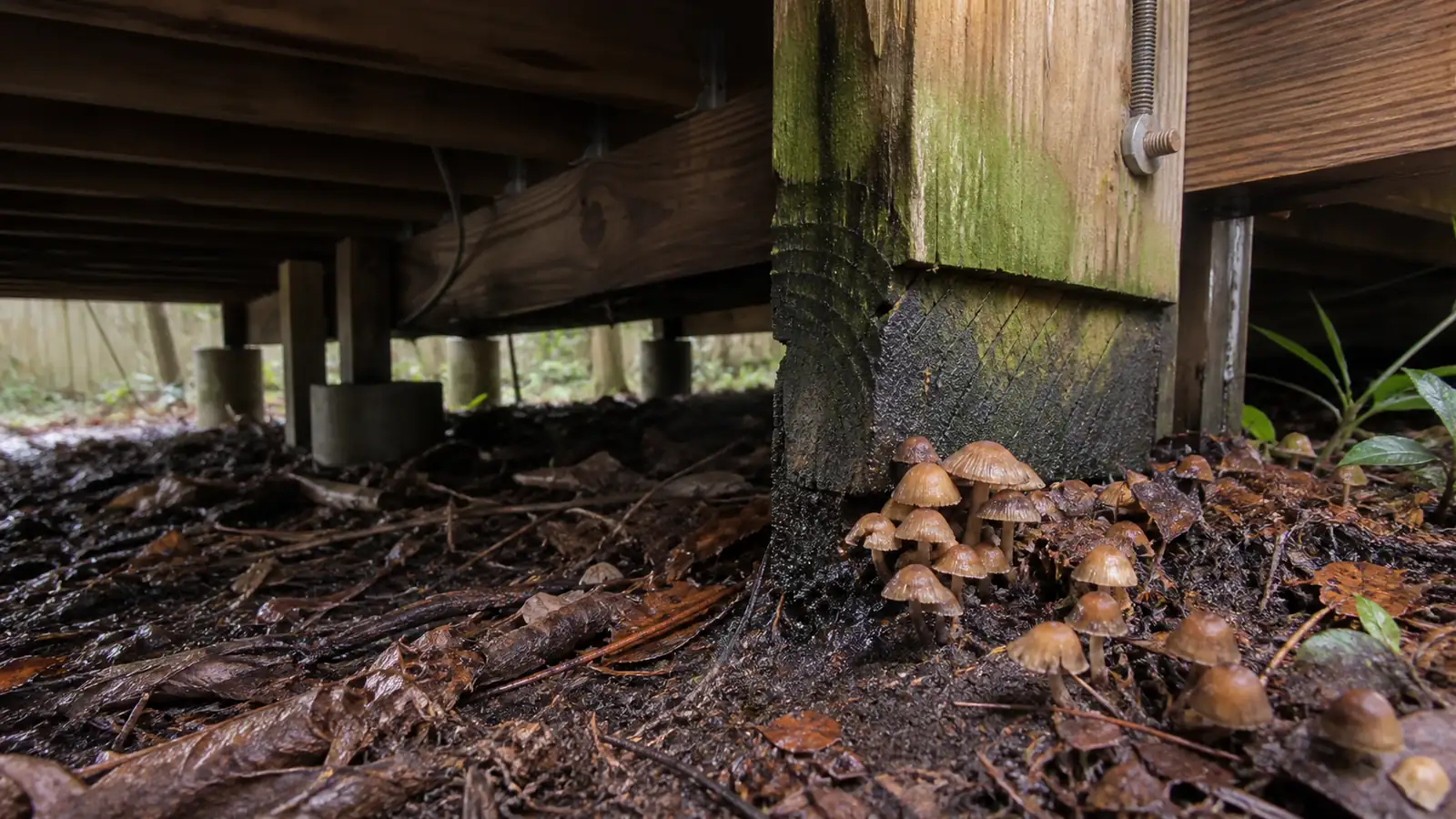
IdentificationWhat Are the Black Artillery Fungus Spots on Siding?Raised and Depressed Centers Need Separate Words
The center can modify almost any broad profile. An otherwise flat cap may be umbonate, while a broadly convex cap may have a small sharp papilla.

The cut surface makes the center-to-margin relation visible before the terms are compared in shared columns.
| Center term | Direction and scale | How it relates to the surrounding cap | Common confusion |
|---|---|---|---|
| Umbonate | Raised, broad, and distinct | A boss rises above a convex or flat disc | Mistaken for the whole cap being conical |
| Papillate | Raised, small, and relatively sharp | A nipple-like point sits at the exact center | Called umbonate when the base is not broad |
| Umbilicate | Depressed, narrow, and navel-like | A small central pit interrupts a flatter surface | Called depressed without recording its narrow width |
| Depressed | Lower across a broad central zone | A shallow dish remains above or near stem level | Called funnel-shaped despite limited depth |
| Funnel-shaped | Deeply descending toward the stem | The cap forms a sustained cone-like hollow | Applied to any old cap with an uplifted margin |
An umbo is a feature on top of the broad shape. Write “flat with a broad umbo†or “convex and umbonate†rather than replacing the entire profile with the single word umbonate.
This two-part method also applies to a narrow umbilicus.
A cap can be broadly flat or convex around a small central pit, and the two-part description preserves both observations.
Measure the width of a raised or depressed area when it occupies a meaningful fraction of the cap. A 3 mm papilla on a 70 mm cap and a 30 mm broad umbo should not receive identical emphasis even though both centers rise.
Cutting vertically through a spare specimen can settle a boundary that surface perspective hides. The section shows whether the center rises through extra flesh, dips narrowly, or continues into a deep funnel.
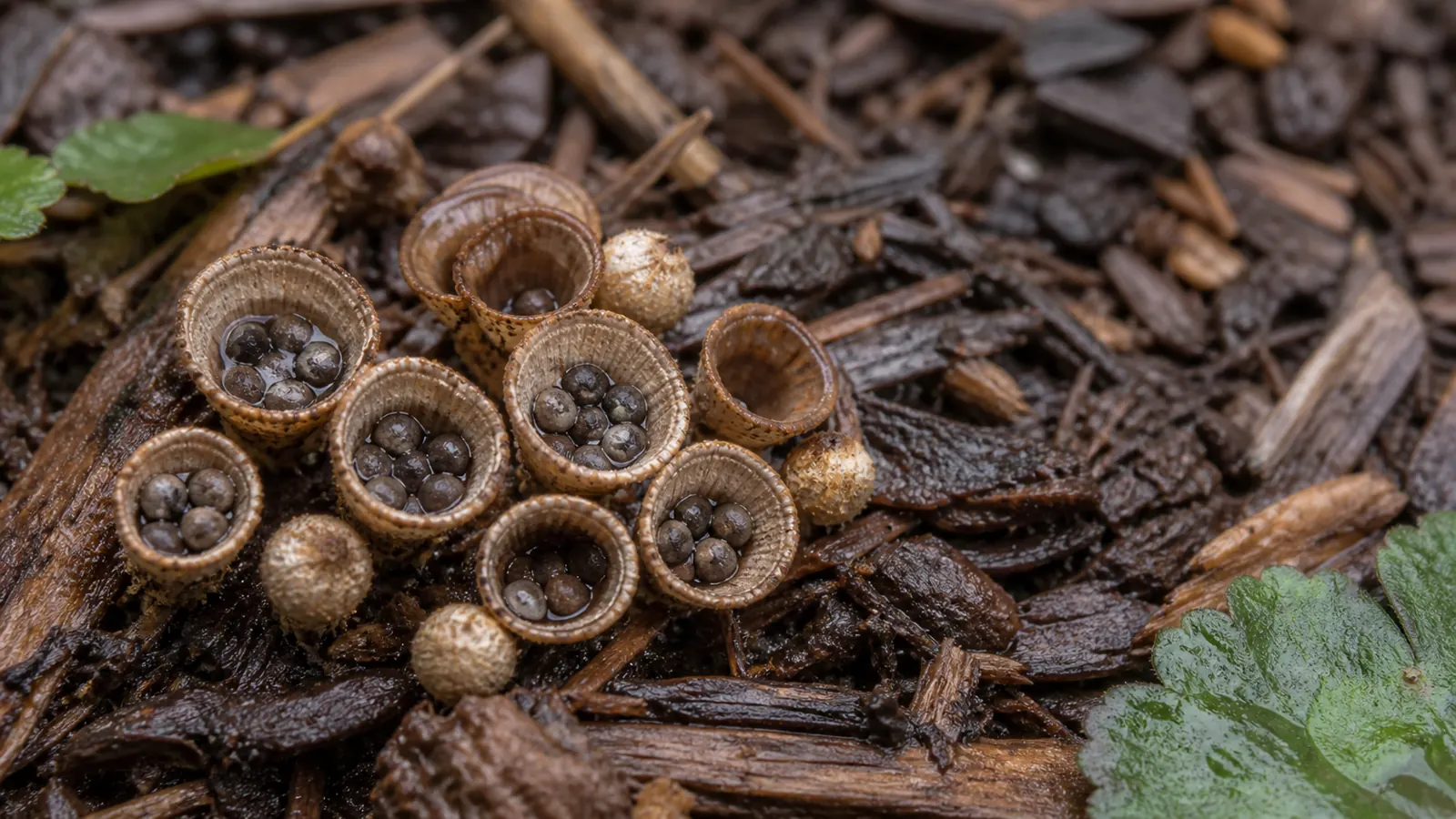
IdentificationWhat Are the Tiny Bird's Nest Fungi in Your Mulch?Read the Margin as Part of the Profile
The margin records the direction and structure of the cap edge.
It often changes before the center, so read the edge separately.
- Inrolled margins curl inward beneath the cap and can conceal the outer gill ends.
- Incurved margins turn inward without forming a tight roll.
- Decurved margins bend downward from the main cap surface.
- Straight margins continue the broad cap plane without a strong turn.
- Uplifted margins rise above the disc and expose more of the underside.
- Striate margins show radial grooves or translucent lines that may reflect underlying gills.
- Split or eroded margins have physical breaks that should not be mistaken for a normal geometric term.
A mature mushroom can have a flat center and uplifted edge, producing a shallow bowl in side profile. Calling that entire cap depressed loses the developmental clue carried by the raised margin.
Margin grooves are not the same as overall shape. Record “bell-shaped, striate margin†because the first phrase describes geometry and the second describes a visible edge structure.
Weather complicates the edge.
Drying can split or curl thin tissue, while rain can make a delicate margin translucent and reveal the gill pattern beneath it.
Record moisture and recent weather beside an unusual edge. That note prevents a temporary split, curl, or translucent groove from being treated as a stable species character.
Cap Shape Changes as the Mushroom Expands
A cap grows by expanding tissue that began wrapped around or above the developing fertile surface. The profile can pass through several standard terms during that expansion.

Read the sequence as one developmental comparison before using the stage table.
| Stage | Typical profile change | Margin change | Evidence to preserve |
|---|---|---|---|
| Button | Closed, ovoid, hemispherical, or strongly convex | Pressed against stem or joined by veil | Universal and partial veil tissue |
| Expanding | Convex, conical, or bell-shaped | Separating and beginning to straighten | Fresh surface texture and attachment geometry |
| Mature | Broadly convex, flat, or centrally modified | Straight, decurved, or lightly uplifted | Full diameter and active spore-bearing surface |
| Old | Flat, uplifted, deeply depressed, collapsed, or irregular | Split, wavy, eroded, or strongly raised | Which changes reflect decay rather than normal form |
Not every mushroom follows the same sequence.
Some remain conical, others become funnel-shaped early, and shelf fungi do not fit a centered cap-and-stem progression.
Use intermediate specimens to test whether extreme profiles belong to one collection. Shared substrate, surface, stem characters, fertile structure, and spore color provide stronger continuity than proximity alone.
Compare several specimens that clearly share a patch, substrate, and other characters. One young cap and one rain-soaked old cap can look like different species when no intermediate stage is present.
Record both observation and direction, such as “convex becoming plane†when the collection supports it. Direction carries more developmental information than choosing one word from the oldest specimen.
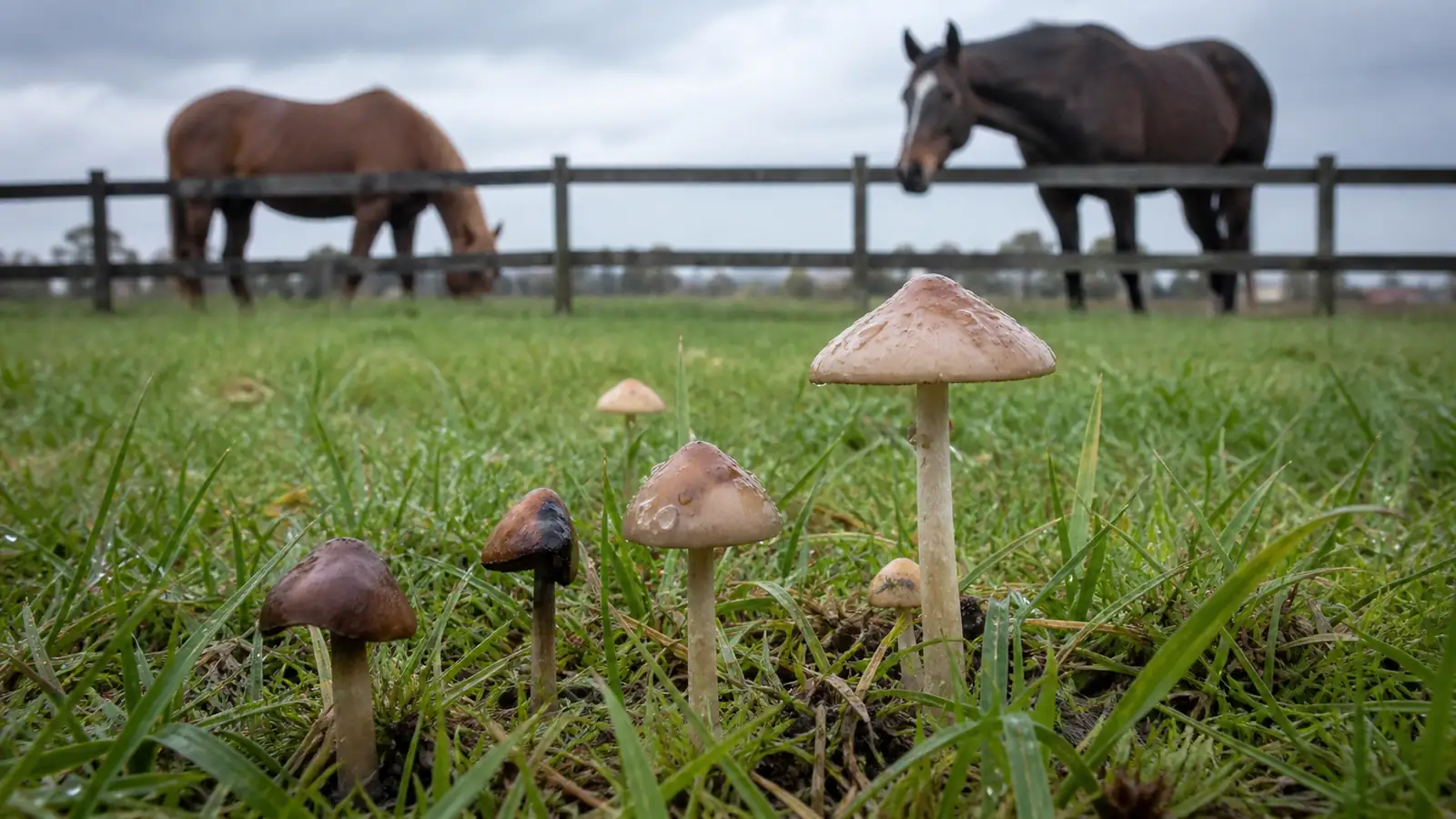
IdentificationWhat Should You Do About Mushrooms in a Horse Pasture?Record Cap Shape in the Field
Place the camera near cap height for a true side profile because an overhead view shows outline and zoning but hides height, central rise, depression depth, and margin direction.

Take a second image directly above the cap to record circular, oval, lobed, kidney-shaped, or irregular outline. Profile and outline answer different questions and should not share one term.
Measure diameter at the widest point and cap height from the margin plane to the center when that distinction matters. A small conical cap and a broad shallow cone can carry the same word but create different candidate sets.
Then write the stage beside the geometry.
“Mature, 62 mm wide, broadly convex with a low broad umbo, margin straight†can be compared with a guide or another collection without relying on the image alone.
Repeat the photograph from the same height when you revisit a patch. A consistent viewpoint turns apparent shape change into comparable evidence instead of a difference caused by camera angle.
When a spare specimen is available, make a clean vertical section through the cap center and stem. This confirms the central profile and can reveal flesh thickness, internal color, chambers, and veil structures.
Avoid tilting the specimen to make the photograph attractive. A low camera exaggerates a dome, while a high oblique view makes a strong umbo appear shallow.
Pair Shape With Independent Characters
Cap geometry is visible and repeatable when stage and viewpoint are recorded.
It remains limited because unrelated mushrooms can share a convex, conical, flat, or funnel profile.
When a key separates candidates by shape, confirm that its term applies to a specimen at the observed stage and size. Leave the character uncertain when the cap is immature, damaged, unusually dry, or missing the margin.
Pair the shape with the fertile surface first. True gills, pores, teeth, ridges, and enclosed spores divide forms that can look similar from above.
For a gilled specimen, add gill attachment, spacing, color, and changes with maturity. Then record stem position, complete base, ring or cortina, cap surface, bruising, odor, spore deposit, substrate, habitat, region, and season.
Cap shape carries more weight when two candidates are otherwise close and the stage is comparable, but less when one description comes from a button and the other from an expanded cap.
Do not use a familiar umbrella profile as evidence of edibility. Toxic and edible mushrooms overlap across the major shape terms, and a cap viewed without its base can omit a critical structure.
The best final description preserves geometry without overstating it. If the specimen falls between convex and flat, say so, keep the side photograph, and let independent characters determine whether that ambiguity matters.