The most serious identification errors begin when missing evidence is treated as a match. Describe before naming, preserve the complete specimen and habitat, distrust one-trait shortcuts, test contradictions, and keep any uncertain identification out of an eating decision.
Mushroom identification mistakes become dangerous when a familiar shape or a confident app result is allowed to stand in for facts that were never recorded.
A plausible name is only a starting proposal until the complete specimen, habitat, developmental stage, and conflicting characters have been checked.
The useful question is not how many traits seem to match. Ask whether the proposed species explains the most diagnostic traits and every serious contradiction.
Why Mushroom Matches Go Wrong
A mushroom can resemble a guide photograph while belonging to a different genus.
Rounded brown caps, white gills, clustered growth, and other broad traits occur in many unrelated groups, so familiarity creates a candidate without establishing an identity.
The larger error appears when absent information is treated as agreement. If the stem base was cut off, for example, the missing base cannot support either candidate even when every visible cap feature seems favorable.
One strong conflict can overturn several weak matches. A different fertile surface, spore color, substrate, geographic range, or stem-base structure deserves more weight than a general likeness.
Key takeaway
A convincing resemblance tells you what to test first. It does not reduce the amount of evidence needed before a species name or an eating decision is defensible.
This distinction matters because identification errors do not stay in a notebook when someone intends to eat the find.
The same unsupported certainty can move directly from a photo match to a meal.
Naming the Mushroom First Changes What You Notice
Writing a species name before describing the specimen creates an anchor.
Once the name is in mind, a shallow groove may start to look like a striation, attached gills may be called nearly free, and an ordinary smell may be bent toward the guide's wording.
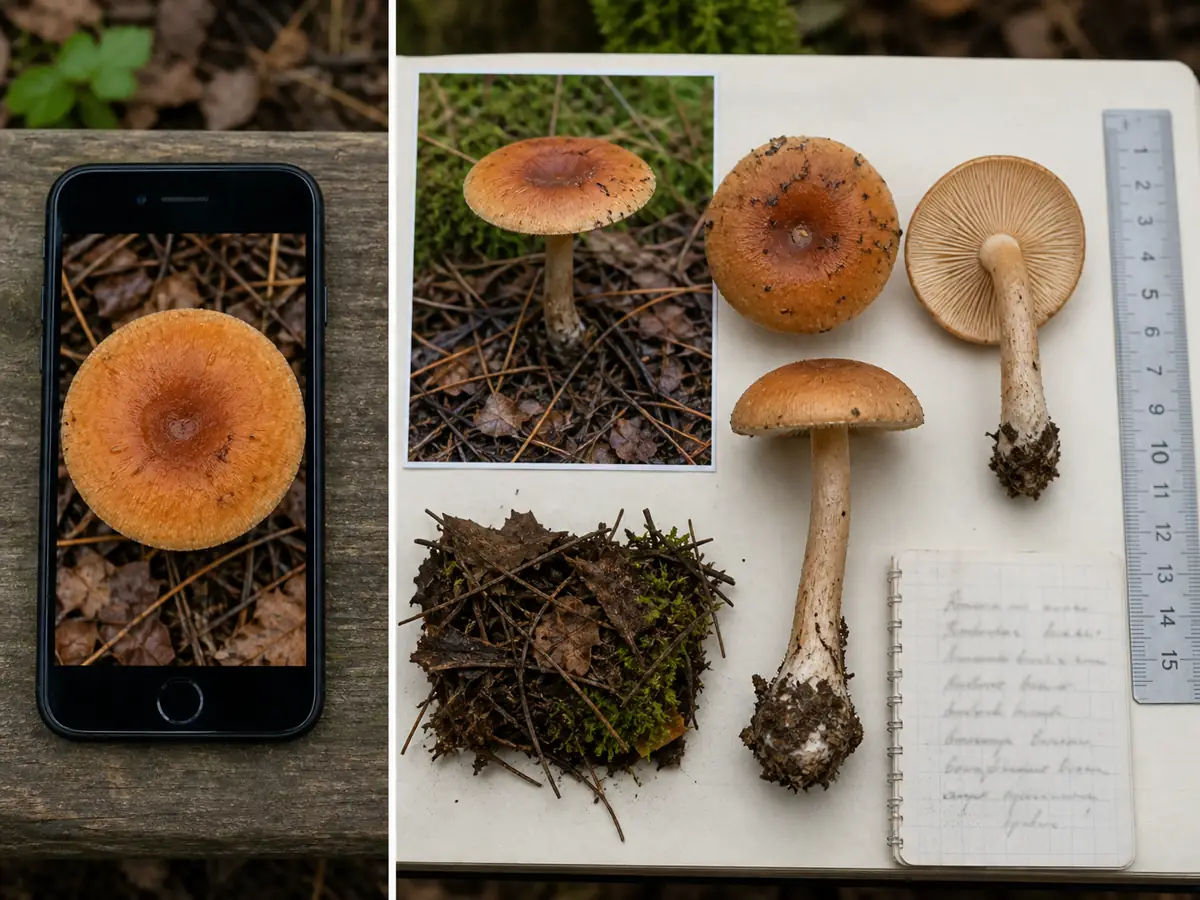
Describe the mushroom in neutral terms before testing names. Record dimensions, cap profile, fertile surface, gill attachment when present, stem interior, veil remnants, base shape, bruising, odor, substrate, nearby trees, and growth pattern without using the proposed species as an adjective.
The description should remain useful if your first name is wrong.
Another identifier must be able to read it and reach a different candidate without undoing loaded phrases such as oyster-like, chanterelle-like, or bolete-like.
If a key branch fails, return to the first choice that was not supported by direct observation. Do not reinterpret the specimen to rescue the name.
An honest genus or species-group label is more informative than a species name held together by guesses. It preserves the unresolved distinction and tells you which character must be collected next time.
A Photograph Can Hide the Character That Disproves the Match
What a Photograph Can Show
A sharp photograph can preserve cap form, visible surface texture, color under known light, growth pattern, and some habitat context. Separate views of the top, side, underside, full stem, and intact base can give an experienced identifier a useful candidate set.
Scale must be visible or recorded. A close crop can make a 12-millimeter bonnet and a 12-centimeter cap look equally large, which removes one of the easiest ways to reject a suggestion.
What the Frame Leaves Out
A photograph cannot recover a base left underground, determine the exact attachment to buried wood, or preserve an odor and texture that were never recorded.
It also cannot show how quickly a cut surface changed color unless the observer documented the reaction over time.
Identification apps compare the information that reaches the camera. Several apps can agree because they respond to the same cap silhouette and color, so repeated votes are not independent confirmation.
NAMA has documented the specific risk of apps suggesting a puffball when a young toxic Amanita was photographed from an unhelpful angle. The correction is to treat the result as a list of names to test, not as permission to eat.

Online help improves when the observation includes the location, substrate, nearby trees, dimensions, several angles, and any fresh reactions. A physical specimen may still be necessary when the distinction depends on microscopy, chemistry, or structures too small or fragile to photograph.
Color and Cap Resemblance Are Weak First Anchors
Cap color changes with moisture, direct sun, age, bruising, camera white balance, and the thickness of surface tissue.
Brown, white, yellow, and orange are broad descriptions shared by too many mushrooms to carry an identification alone.
Cap form is more useful when described as geometry rather than resemblance. Convex, conical, umbonate, depressed, funnel-shaped, and uplifted describe features that another person can check, but even these observations belong in a larger character set.
The underside often creates a more informative early division. True gills, pores, teeth, blunt ridges, and an enclosed spore mass send the specimen toward different groups before fine color language matters.
- palette
- Broad visual clue | Cap color or a familiar silhouette can generate candidates, but weather, age, and lighting make it unstable
- stack
- Structural branch | Gills, pores, teeth, ridges, or enclosed spores narrow the field by physical construction
- layers
- Character combination | Attachment, veil remnants, complete base, substrate, measurements, reactions, and range test the name together
For gilled mushrooms, the way the gills meet the stem can separate candidates with nearly identical caps. A ring, cortina, volva, bulb, rooting base, latex, or timed stain can carry still more weight when the relevant key uses that character.
Do not replace color matching with a different one-trait shortcut. Identification comes from a compatible combination, with stronger characters chosen for the group being examined.
IdentificationWhat Are the Tiny Bird's Nest Fungi in Your Mulch?Evidence Mistakes You Cannot Fix Later
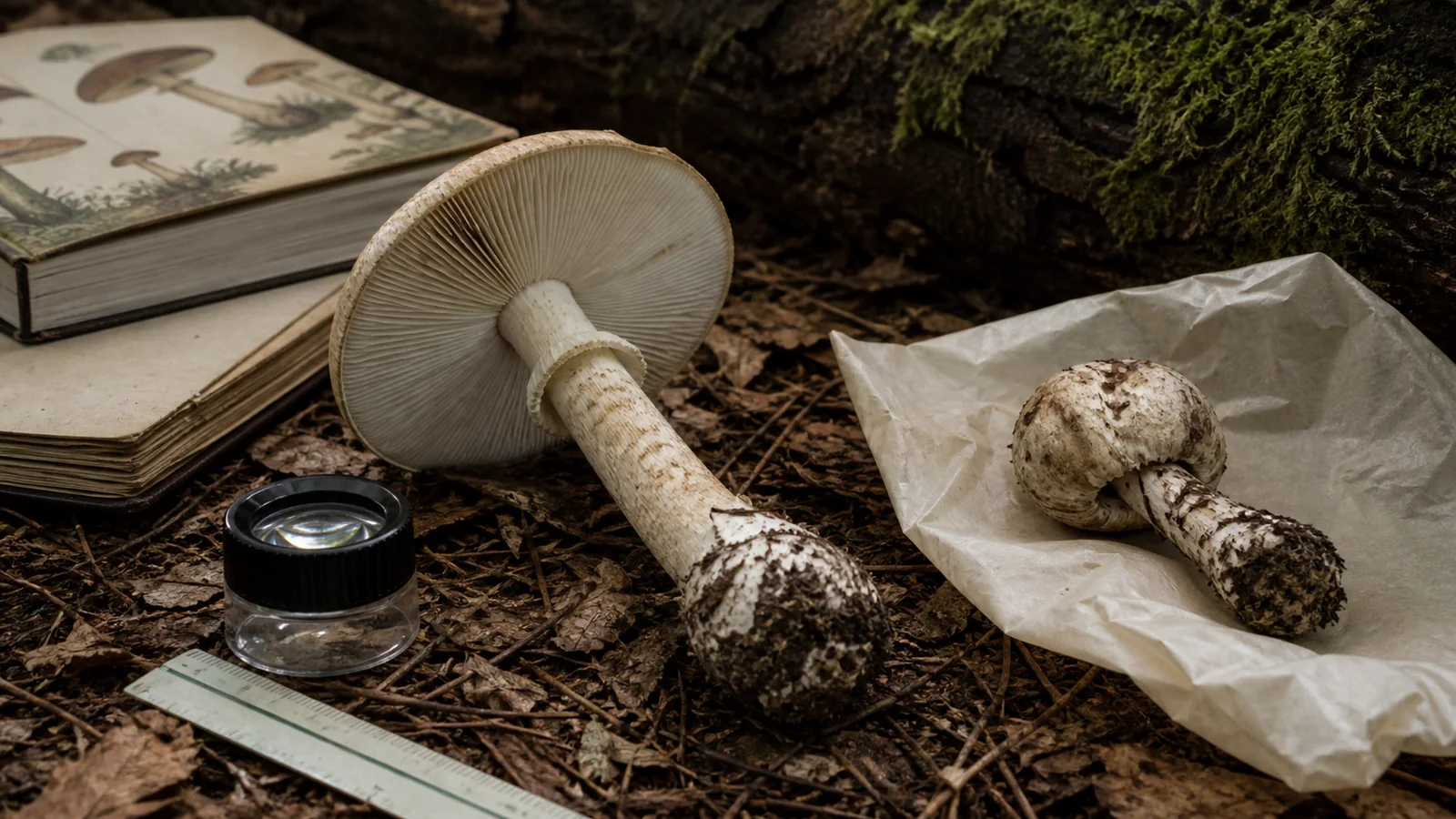
A stem snapped at soil level may leave a cup-like volva, bulb, rooting extension, or attached cords underground. The U.S. Forest Service specifically advises digging mushrooms rather than picking them when a buried Amanita cup could be present.
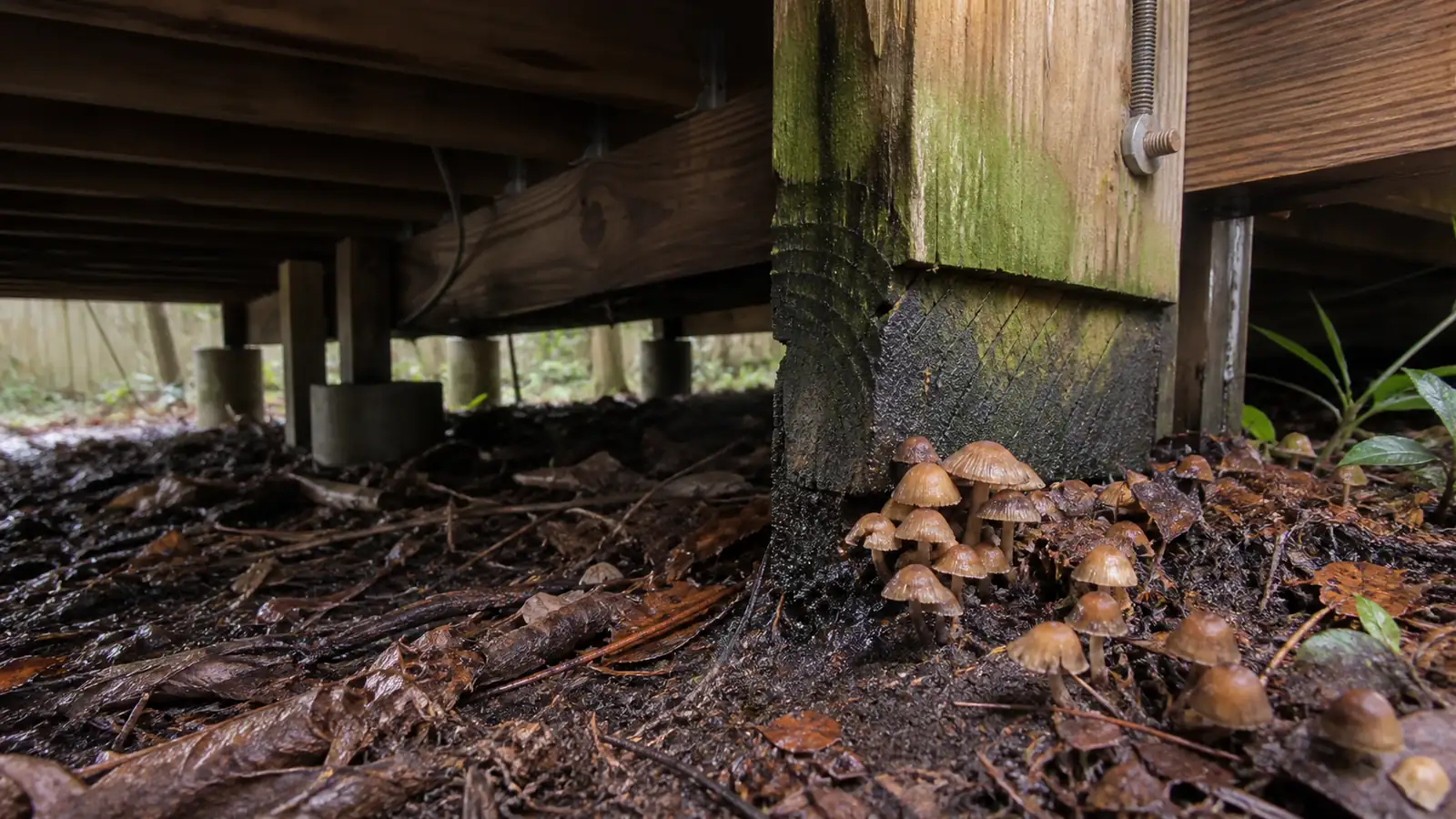
What looks like a soil-dwelling mushroom can rise from buried wood. If the collector does not inspect the attachment point, later habitat notes may place a wood decomposer in the wrong branch of a key.

The site supplies more than a substrate label. Nearby trees, slope, moisture, disturbance, solitary or clustered growth, and the arrangement of several fruit bodies can all support or contradict a proposed species.
Separate different collections in paper or waxed paper and keep one field number with each specimen and photograph. Loose caps, stems, and bases from several kinds can be recombined into a specimen that never existed.
Plastic traps condensation and accelerates decay. Slime disappears, colors bleed, gills collapse, and odors change, so a decomposed collection cannot answer every question the fresh mushroom could.
When important context is already gone, record the limitation instead of inventing it from memory. The most accurate outcome may be a broader identification followed by a plan to collect a complete fresh specimen.
Young and Old Specimens Can Impersonate Different Species
Mushroom characters move as the fruit body develops. A closed cap opens, a partial veil tears into a ring or fibers, gills darken as spores mature, and a once-prominent cap covering may wash away.
An old waterlogged specimen can look smoother, paler, and larger than a fresh one. Insect damage and decay can create false pores, hollow stems, ragged margins, and odors that are unrelated to the intact species.
A dangerous developmental error occurs when a young Amanita button is mistaken for a puffball. The intact exterior can look like a white ball, but a vertical cut through a young Amanita reveals a developing cap, gills, and stem inside while a true puffball has a uniform interior when young and sound.
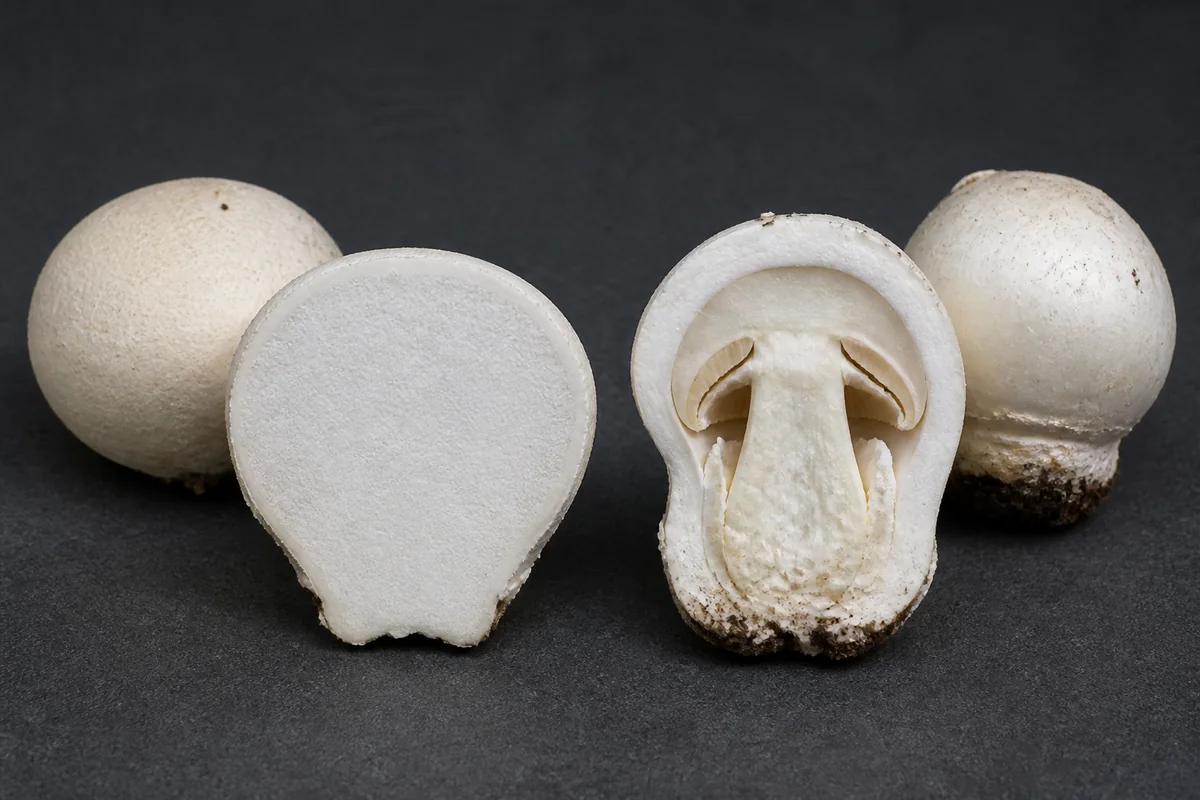
The comparison must use more than one fruit body when the patch allows responsible collection. Young, mature, and older specimens show which features persist and which are products of age.
Do not assume every mushroom in a cluster is the same species. Check that the specimens share the same substrate, growth origin, and structural features before treating them as an age series.
IdentificationWhat Should You Do About Mushrooms in a Horse Pasture?How to Test an Identification Instead of Confirming It
A spore print answers a narrow question about the color of spores deposited in mass. White, cream, pink, brown, rust, purple-brown, and black deposits each occur across multiple groups, so print color narrows candidates without naming one.
A blank surface does not prove that the spores are white. The cap may be immature, too old, dry, damaged, or held in conditions that prevented a visible deposit.
Bruising also needs a controlled record. Note the tissue pressed or cut, the first color, the delay before change, and the final color because an instant blue reaction and a slow brown stain do not describe the same process.
Odor can support a comparison when it is distinctive and recorded fresh, but smell varies among observers and changes in storage. Never taste an unknown mushroom merely because a key mentions taste.
Common names and online consensus are weaker still. One common name can refer to several species, while several people can repeat the same initial suggestion without checking the base, range, or microscopy.
Use each test to resolve one live distinction between plausible candidates. If both candidates share the result, the test supplied no separation and another character must do the work.
Count Contradictions Before You Count Matches
Five broad agreements do not cancel one feature that the proposed species should never have. The right response depends on whether the difference is normal variation, missing evidence, or a blocking conflict.
| Evidence state | Example | What it means | Action |
|---|---|---|---|
| Agreement | Correct fertile surface, substrate, range, and stem-base structure | The candidate remains viable | Continue checking independent characters |
| Explainable variation | Cap is faded after rain but structure and ecology agree | The difference has a documented cause | Record the condition and verify with fresh material |
| Missing character | Base was cut off or mature spores were not obtained | The candidate cannot be fully tested | Stop at the narrowest supported level |
| Blocking conflict | Candidate requires pores but the specimen has true gills | The proposed name cannot explain the specimen | Reject the candidate and return to the last supported branch |
| Advanced requirement | Species separation requires microscopy, chemistry, or DNA | Macroscopic evidence has reached its limit | Seek qualified help or retain a genus or group label |
Geographic range and substrate deserve the same scrutiny as anatomy. An otherwise attractive image match from another continent or a soil species attached to wood is not rescued by the number of color similarities.
Because the decision turns on the strongest evidence, write down the clearest disagreement before listing supporting traits. This ordering makes it harder to bury a disqualifying fact beneath a long inventory of vague matches.
Uncertainty should name the missing work. “Genus likely, species unresolved because the spores were not measured†is a useful conclusion, while “probably safe†converts a knowledge gap into a risk.
Identification Confidence Is Not Permission to Eat
Before Anyone Eats It
A probable species name does not establish edibility. Toxic lookalikes, regional species differences, individual sensitivity, contamination, and preparation requirements create decisions beyond the basic label.
Cooking is not a universal detoxification method. Some mushroom toxins survive ordinary cooking, and no soak, taste test, insect damage, silver spoon, or folk rule can certify an unknown wild mushroom.
Any unresolved toxic lookalike ends the eating decision. Local in-person confirmation from an experienced identifier is appropriate when consumption is being considered, especially for a beginner or a difficult group.
Warning
Do not use this or any online identification as permission to eat a wild mushroom. Keep unknown mushrooms away from children and pets, and wash hands before handling food after a field session.
After a Possible Ingestion
Contact Poison Control or emergency medical services immediately after a suspected mushroom ingestion. Do not wait for symptoms, do not induce vomiting unless a medical professional instructs you, and do not spend the first critical minutes trying to settle the name online.
Save an uncooked specimen from the same collection when this can be done safely. NAMA recommends paper or waxed paper rather than plastic, with refrigeration until the sample can be examined.
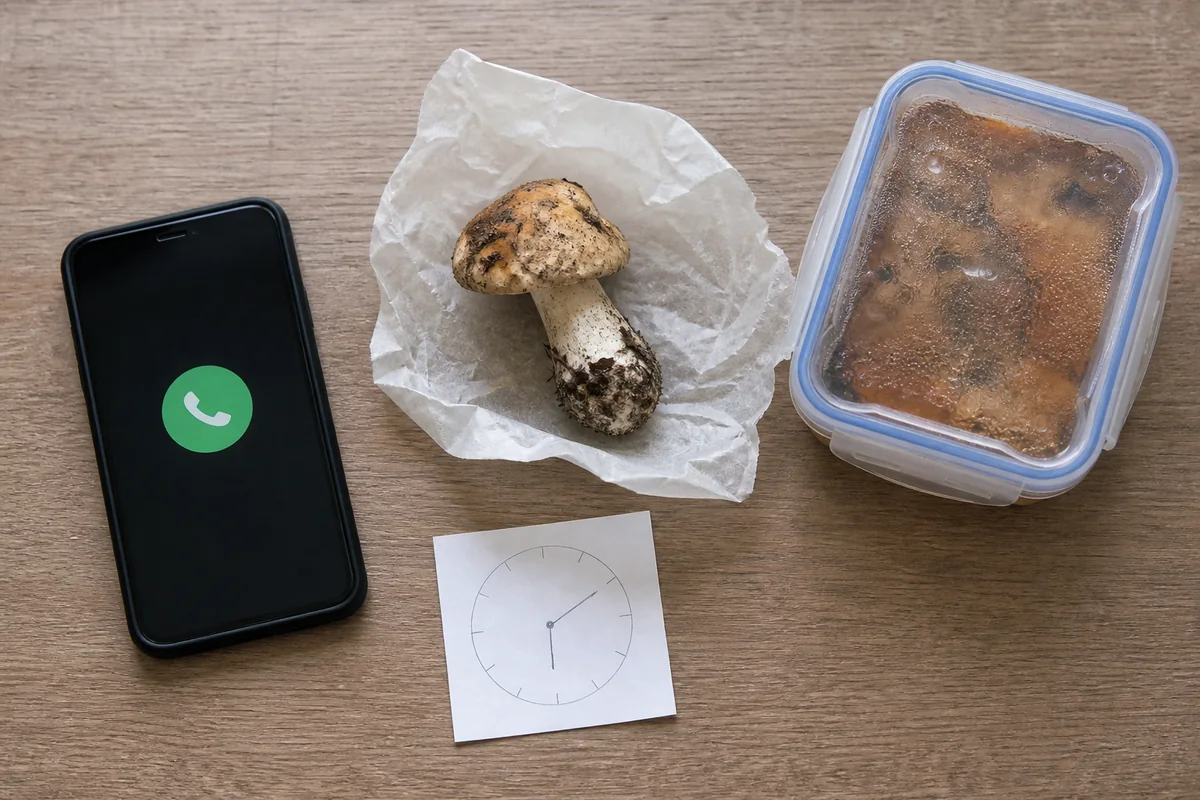
Record who ate it, how much may have been eaten, when it happened, how it was prepared, and where the mushrooms were found. Those facts help poison specialists and mycological consultants work from the exposure rather than from a confident guess.