Why chanterelles demand a careful ID
A chanterelle is worth learning only if you learn the safety split first. The edible signal is not the yellow color. It is the full pattern of blunt false gills, solid flesh, soil growth near trees, pale interior, and a clean fruity smell.
This profile covers the golden chanterelle group that foragers often call chanterelles in North America and Europe. The Latin name on a basket may not always be Cantharellus cibarius, because several related species share the market name. For field safety, the shared structure matters more than forcing one species name onto every golden chanterelle.
The practical question is simple. Can you separate a true chanterelle from a poisonous Jack O'Lantern and from orange mushrooms that only look similar from above? If any key feature fails, the mushroom is not dinner.
Once the ID is solid, chanterelles are a choice edible because they keep a firm bite, smell faintly like apricots, and brown well with butter, eggs, poultry, cream, and mild herbs. That kitchen value never outranks identification. Treat the choice edible rating as the reward for passing the checks, not a reason to relax them.
Key takeaway
Check the underside and the attachment to soil or wood before narrowing the identification. Blunt ridges and soil growth let you keep checking. True gills, hollow flesh, or a tight orange cluster on wood means stop.
How do you identify a real chanterelle?
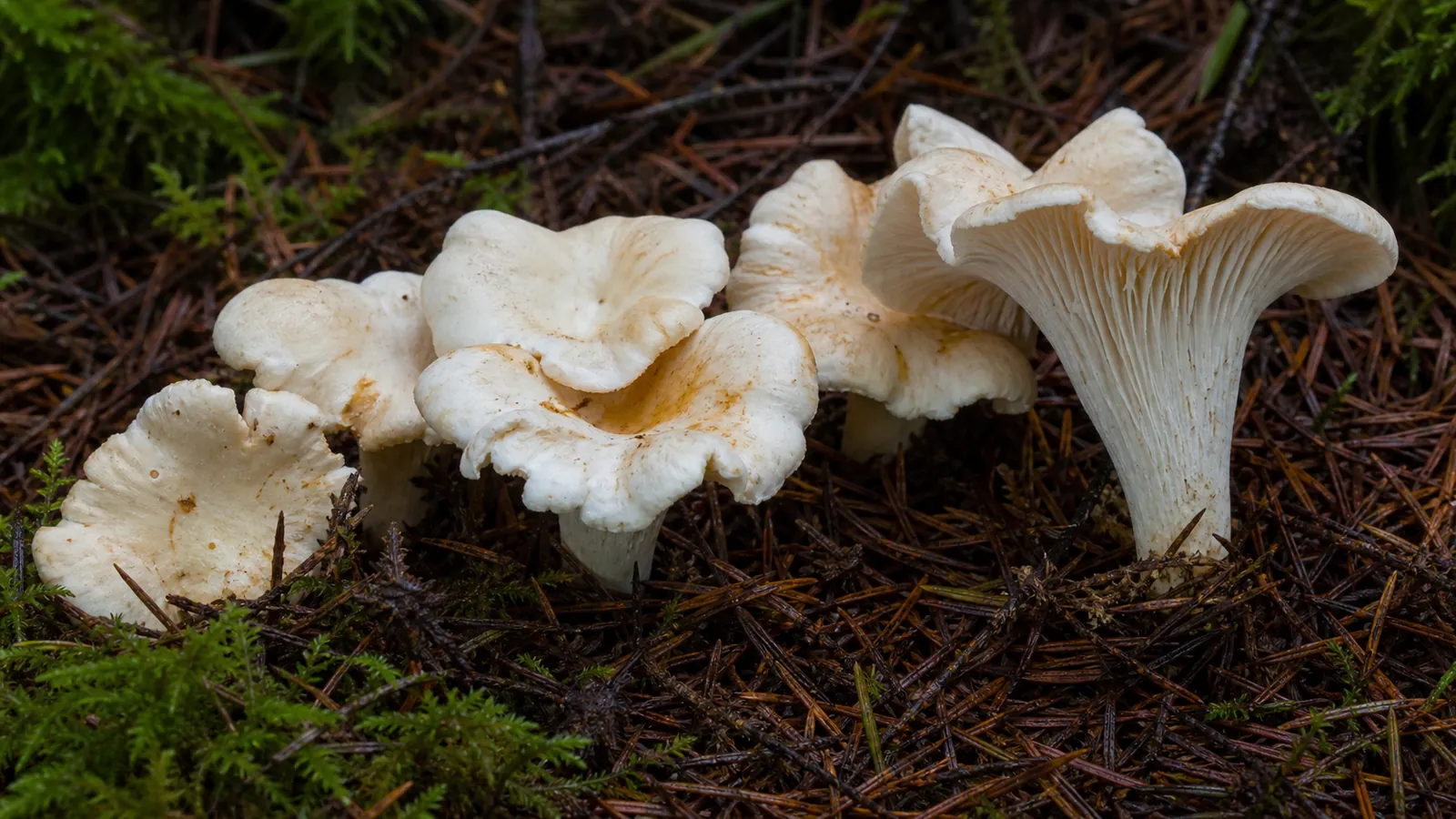
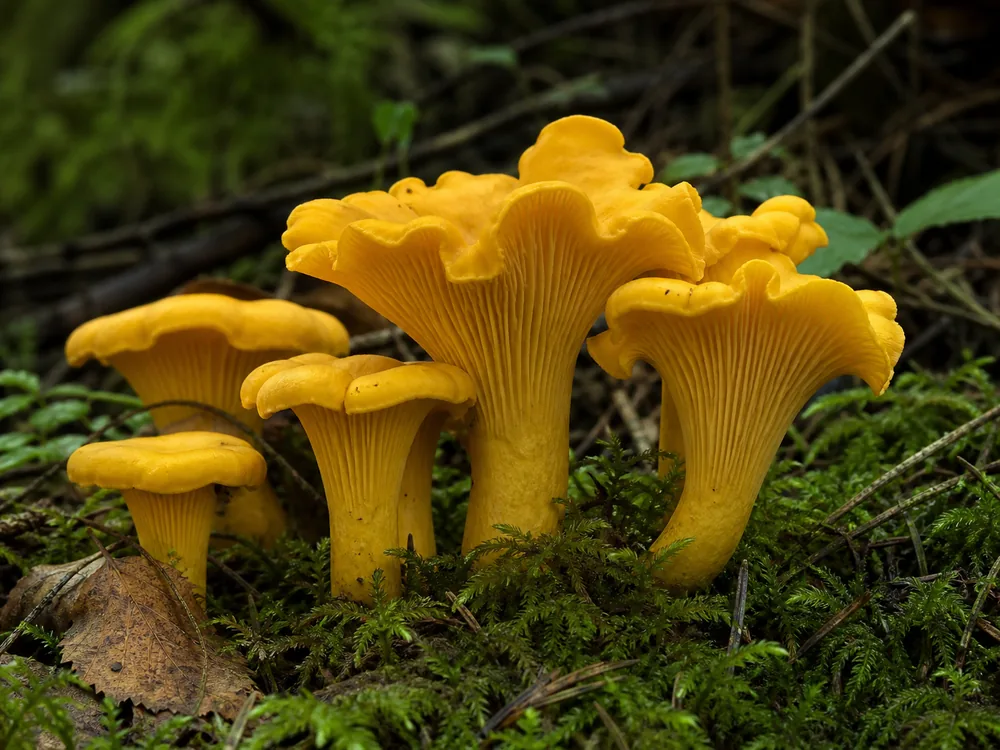
Golden to egg-yellow, 3-10 cm, funnel-shaped with a wavy, irregular margin.
False gills: shallow, forked ridges that run down the stem, not thin blade-like gills. This is the single most useful field character.
Solid (not hollow), tapering downward, the same color as the cap.
Pale, firm, distinct fruity smell often compared to apricots.
Start underneath the cap because the underside carries the safest first split. False gills are blunt ridges, often forked, and they run into the stem as part of the mushroom's flesh. They do not lift away as separate blades.
A true chanterelle should then hold together as one story. The cap is golden to egg-yellow with a wavy margin, the stem is solid, the cut flesh is pale, and the smell is lightly fruity. The mushroom grows from soil near living trees, not as a fused orange bouquet coming out of a stump.
Color helps after structure, not before it. A true chanterelle is usually close to one yellow-gold family through the cap and stem, with white to pale yellow flesh inside. A very orange mushroom with orange flesh deserves extra suspicion because Jack O'Lantern flesh can run orange too.
| Feature | Chanterelle signal | Reject if you see this |
|---|---|---|
| Underside | Blunt ridges that fork and run down the stem | Sharp true gills that look like blades |
| Stem | Solid and continuous with the cap | Hollow, cottony, or thin and fragile |
| Flesh | Pale, firm, and stringy when torn | Orange flesh or a snap-clean break |
| Growth | From soil near living trees | Fused cluster on wood or buried roots |
| Smell | Faintly fruity when fresh | Sour, old, or no longer fresh enough to judge |
Do not use a spore print as the deciding test for chanterelles. A print can support the ID, but it does not fix wrong structure. If the underside is made of true gills, a pale print will not turn the mushroom into a chanterelle.
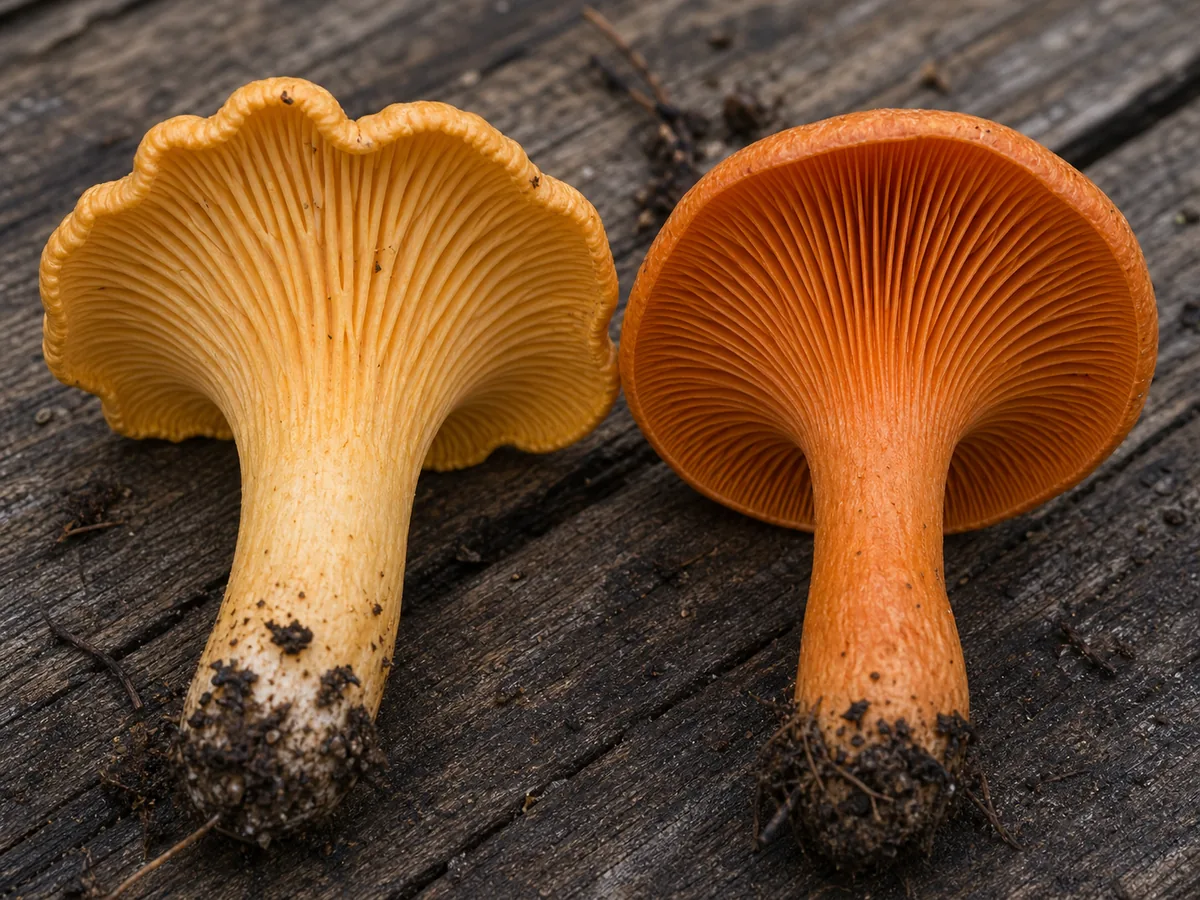
False chanterelle, Hygrophoropsis aurantiaca, adds a second reason to slow down. It has true forking gills that are usually more orange than the cap, and its thinner stem can hollow with age. It is not the same danger as Jack O'Lantern, but its true gills rule it out as a chanterelle.
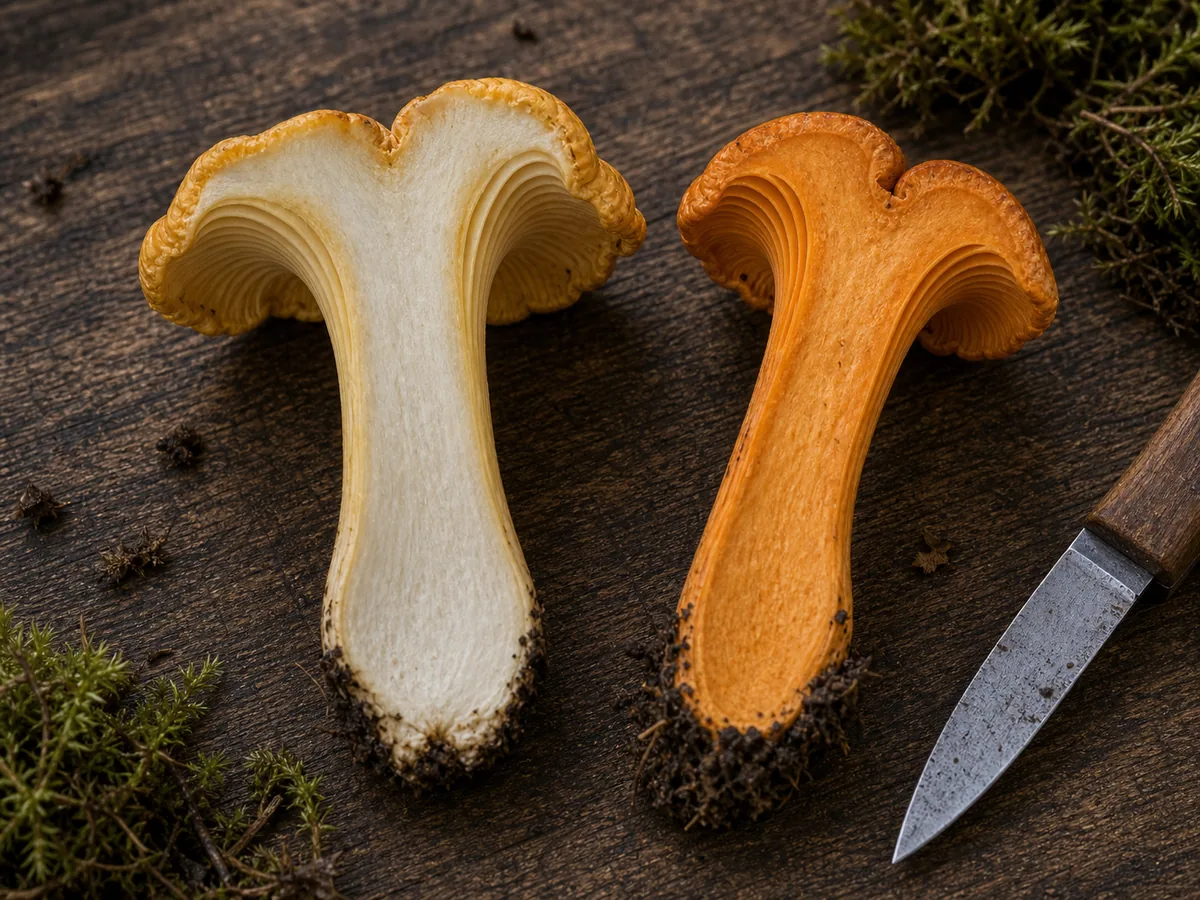
If the underside carries true, sharp blades, it is not a chanterelle. Put it down.
The one test that matters
Check the underside before checking the cap color
Tear one specimen lengthwise to confirm pale, solid flesh
Trace the base to soil and nearby trees
Check any orange cluster against Jack O'Lantern traits
Keep mushrooms with true, sharp gills
Trust a fruity smell without matching structure
Mix several orange mushrooms in one basket before each one is checked
How do you rule out Jack O'Lanterns?
One orange mushroom sends more people to hospital than any other chanterelle mistake, and it grows in the same woods at the same time of year.
Check the underside first. Everything else about the two can look similar under leaf litter and low light.
A chanterelle has blunt false gills, not blades. They look like folds or veins running down into the stem, and they cannot be cleanly peeled away from the flesh.
Jack O'Lantern has true gills, thin and sharp-edged, and they separate from the cap when you push a fingernail under them.
Habit settles most remaining doubt. Chanterelles push up singly or in scattered groups from soil, while Jack O'Lantern erupts in dense clumps from wood, stumps, or buried roots.
How should you cook chanterelles?
Cook chanterelles only after the ID work is finished. Raw chanterelles can be hard to digest, and raw chanterelle safety still depends on heat even after correct identification.
Clean them dry when possible. Brush grit from the ridges, trim dirty stem bases, and use a brief rinse only when debris is trapped. Long soaking makes the flesh hold water, and that water delays browning in the pan.
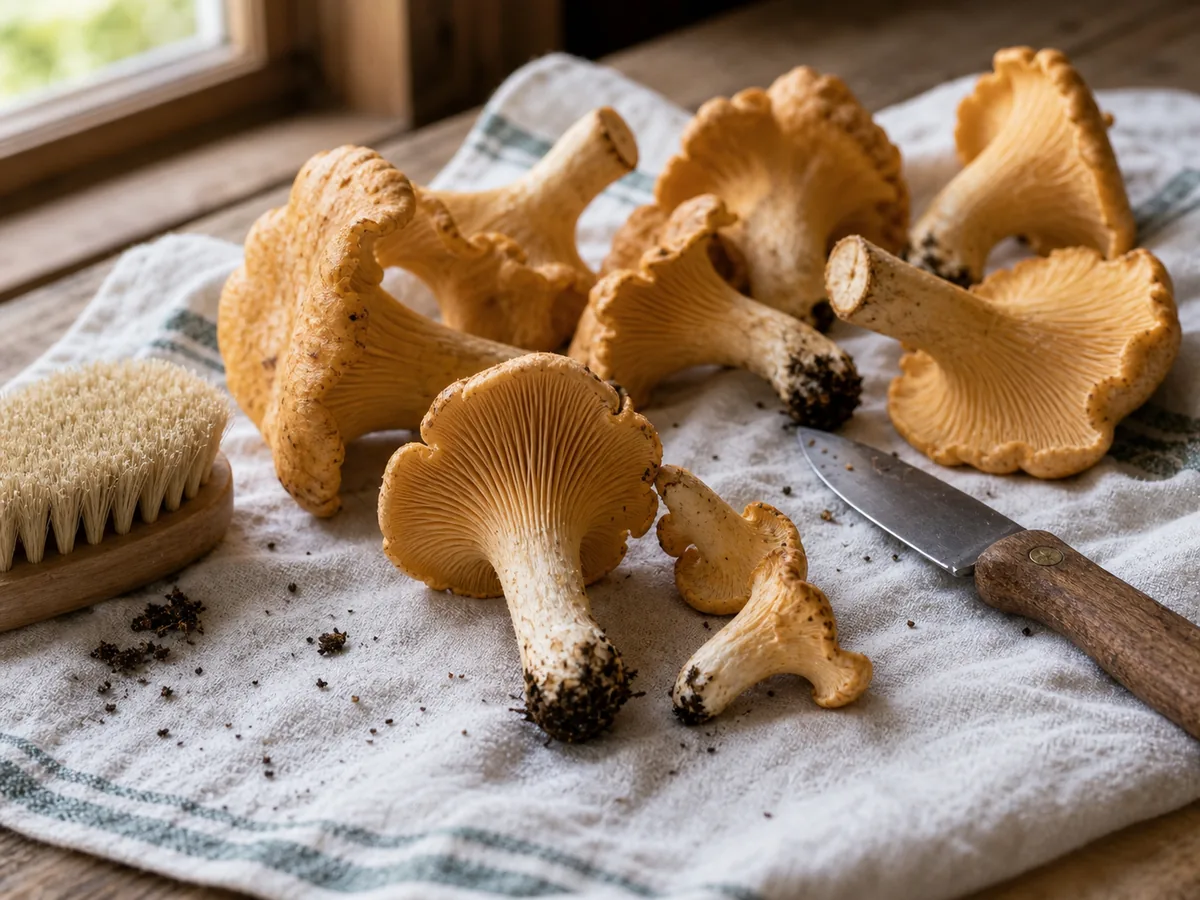
The best first cooking move is a dry saute. Put clean pieces in a warm pan without fat and let their moisture leave first. When the pan quiets down and the liquid cooks away, add butter or oil, then finish with shallot, eggs, chicken, cream, or mild herbs.
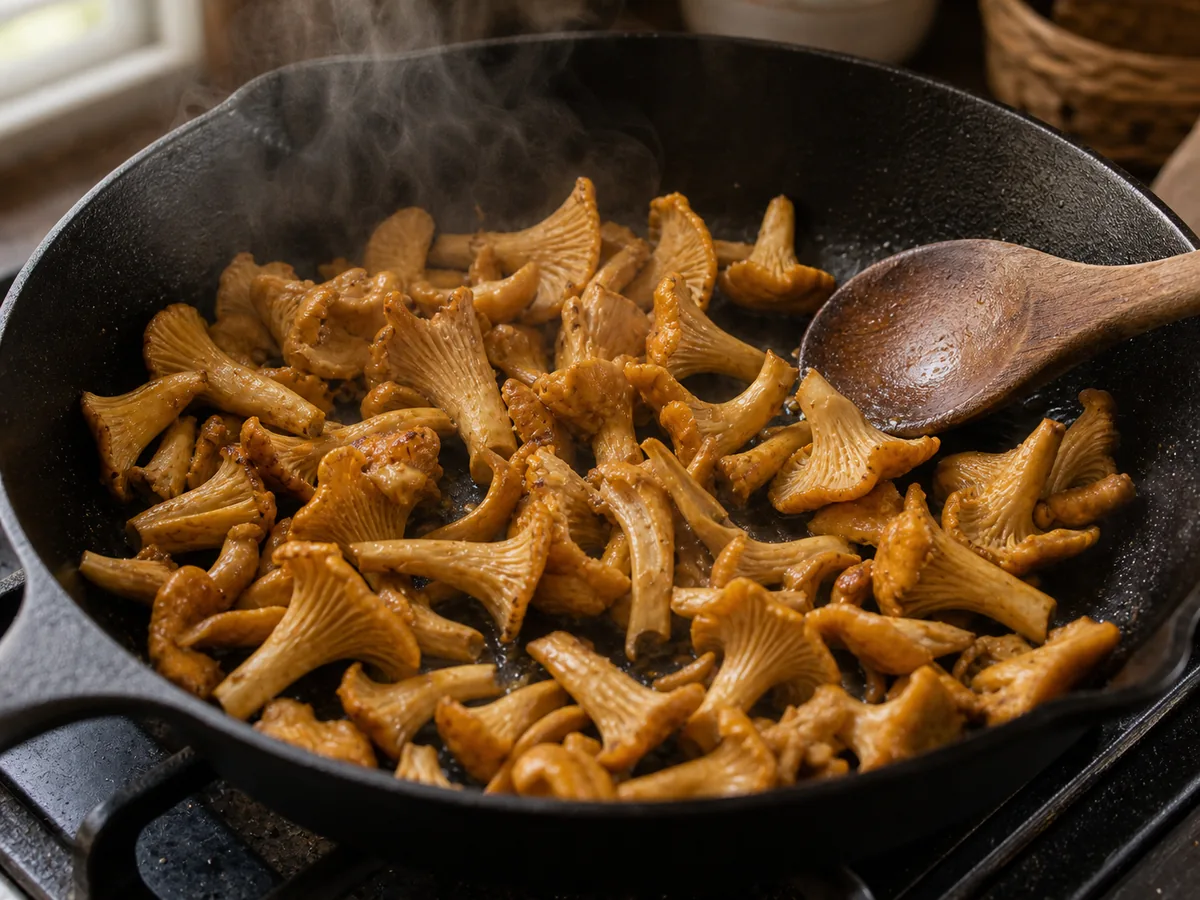
Use simple dishes the first time you cook a new batch. A butter-sauteed chanterelle keeps the method simple. Creamy risotto works better when the mushrooms are browned before they meet the rice.
Fresh chanterelles keep only a few days in a paper bag in the fridge. Avoid sealed plastic because trapped moisture turns the surface slimy. For longer storage, cook them first and freeze the cooked mushrooms. Drying can work, but many cooks find dried chanterelles turn rubbery compared with dried true morels or porcini.
Tip
Chanterelles love fat and eggs. Once the caps are browned, finish with butter and fold them into scrambled eggs, an omelette, or a small cream sauce.
Chanterelles hold more water than they look like they do, so the first move in the pan is to drive it off. Put them in dry over medium heat, wait for the liquid to release and cook away, then add fat once the surface starts to squeak.
Fat added too early traps the water and you end up poaching them.
They keep four to five days in a paper bag in the fridge and go slimy in plastic. For longer storage, cook and freeze rather than drying, because dried chanterelles rehydrate leathery and lose most of the apricot note.
Can you grow chanterelles at home?
Chanterelles need living tree roots, so they are not a normal beginner home-grow project. They are mycorrhizal, which means the fungus trades with a living tree rather than simply eating a block of straw or sawdust.
That difference separates chanterelles from cultivated oyster clusters and from firmer shiitake caps. Oysters can run fast through straw, while a shiitake grow depends on hardwood logs or sawdust blocks. Chanterelles need the right tree relationship, soil setting, and time.
Research projects have produced chanterelles with inoculated seedlings, but that is not the same as a kitchen kit. It takes years, the host tree matters, and fruiting is not reliable enough for a home grower who wants dinner.
Oyster mushroom growing is a cleaner starting point for cultivation than trying to grow chanterelles. Treat chanterelles as a foraged mushroom and keep your indoor crop to species that fruit on demand.
What nutrition do chanterelles add?
Chanterelles are low in calories and mostly water, with small amounts of potassium, B vitamins, fiber, and vitamin D when the mushrooms have seen enough light. That makes them useful as a flavor food, not a main protein source.
Do not forage chanterelles for nutrition alone. The identification risk is too high for a nutrient payoff you can get from ordinary food. Their real value is texture, aroma, and the way they carry fat without collapsing.
Sun exposure changes vitamin D levels in mushrooms, so two chanterelle batches may not match. A shaded forest find can bring less vitamin D than a batch that developed in brighter conditions. Cooking does not make a poorly identified mushroom safe, and it does not turn chanterelles into a supplement.
For food planning, think of chanterelles beside cultivated mushrooms instead of above them. Oysters bring softness, shiitake brings deeper umami, and chanterelles bring a firmer, fruity, golden edge when the ID is certain.
Where do chanterelles grow?
Chanterelles trade with living tree roots, so habitat is part of the identification. Look on mossy, well-drained ground near oak, beech, birch, hemlock, spruce, pine, or other local host trees. The exact partner changes by region, but the soil-and-root relationship stays central.
A patch often fruits after soaking rain once warm-season soil has enough moisture. In many places that means summer through fall, while cooler or wetter regions can shift the timing. Recent rain, local tree partners, and fall fruiting conditions decide where you look.
Chanterelles usually appear singly, scattered, or in loose groups. They can fruit near one another, but they do not normally form a tight fused clump with many stems joined at the base. That clump habit is one reason a wood-rooted orange mushroom should move toward Jack O'Lantern in your mind.
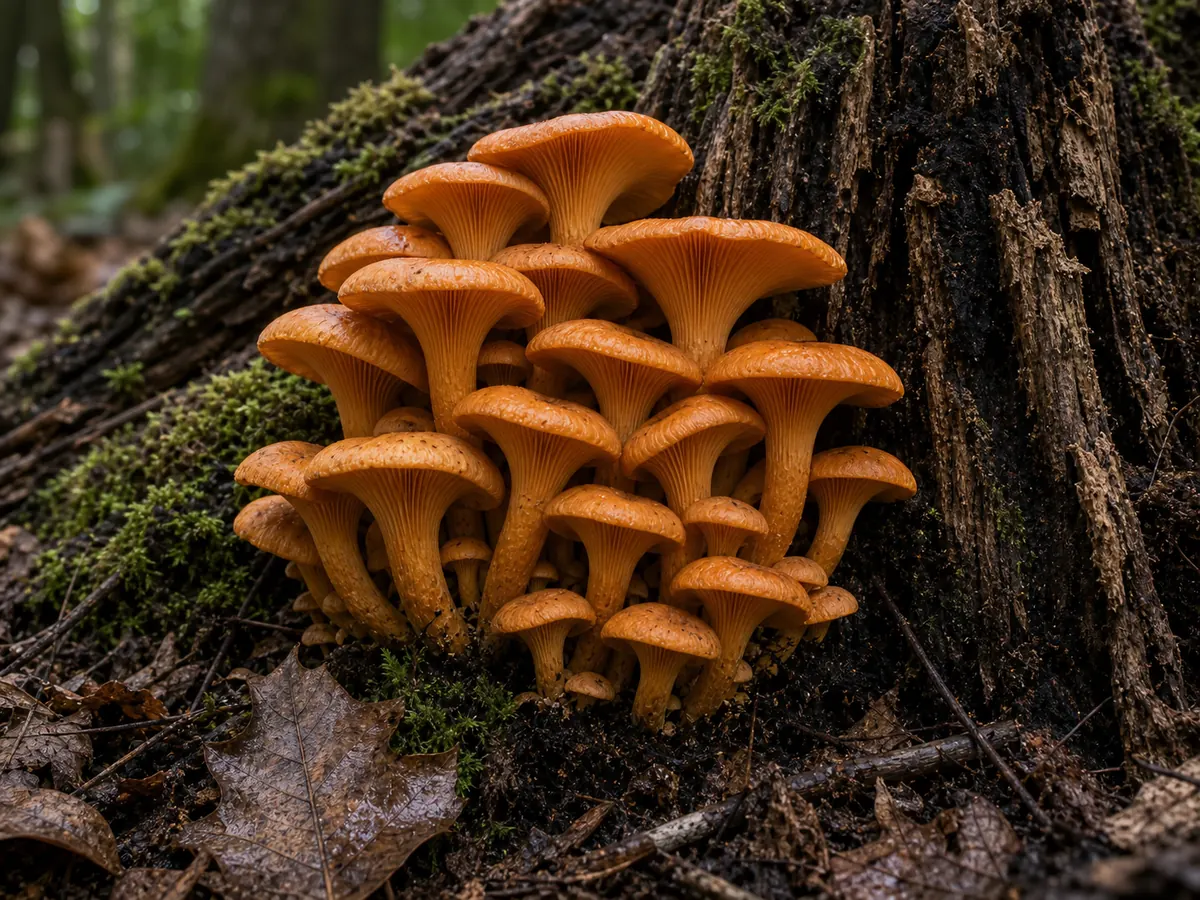
Mark productive ground carefully instead of raking it. Cut or pinch cleanly, leave small and damaged mushrooms, and keep different specimens separated until the ID is finished. Those habits belong with mushroom foraging basics because basket discipline protects both the patch and the later ID. A good patch may return for years when rain, tree health, and soil moisture line up.
For beginners, the habitat lesson is restraint. A yellow mushroom on the forest floor is only a candidate. A yellow mushroom in the right tree setting, with false gills, solid flesh, and no wood-cluster habit, is closer to a decision.
Medicinal Properties
Chanterelles are food rather than medicine, and the honest answer here is short.
They are not part of the functional-mushroom trade. You will not find chanterelle capsules beside the lion's mane and reishi extracts, because nobody has built a supplement case around them.
What they do carry is ordinary nutrition. Wild chanterelles are one of the better dietary sources of vitamin D among mushrooms, since the sterols in the flesh convert under sunlight while the mushroom is still growing.
That amount varies with how much light the patch actually received, so treat it as a pleasant feature of a wild food rather than a reason to eat them for your health.
Taxonomy & Naming
Genus Cantharellus, family Cantharellaceae. Several closely related golden species are sold as chanterelles.
Names in this group keep shifting as DNA work splits old species into new ones. For a forager the lesson is simple. Learn the shared chanterelle structure, the blunt false gills and the solid stem, rather than trusting a single Latin name on a market label.
Chanterelle safety questions
How do I tell a chanterelle from a Jack O'Lantern?
Can you eat chanterelles raw?
Why can't I buy cultivated chanterelles?
What should I do if one ID trait does not fit?
What is the false chanterelle, and is it dangerous?
Do chanterelles really smell like apricots?
Sources & References
- Ohio State University Extension Chanterelle false gills, Jack O'Lantern true gills, and clustered wood growth.