Is white chanterelle poisonous or edible?
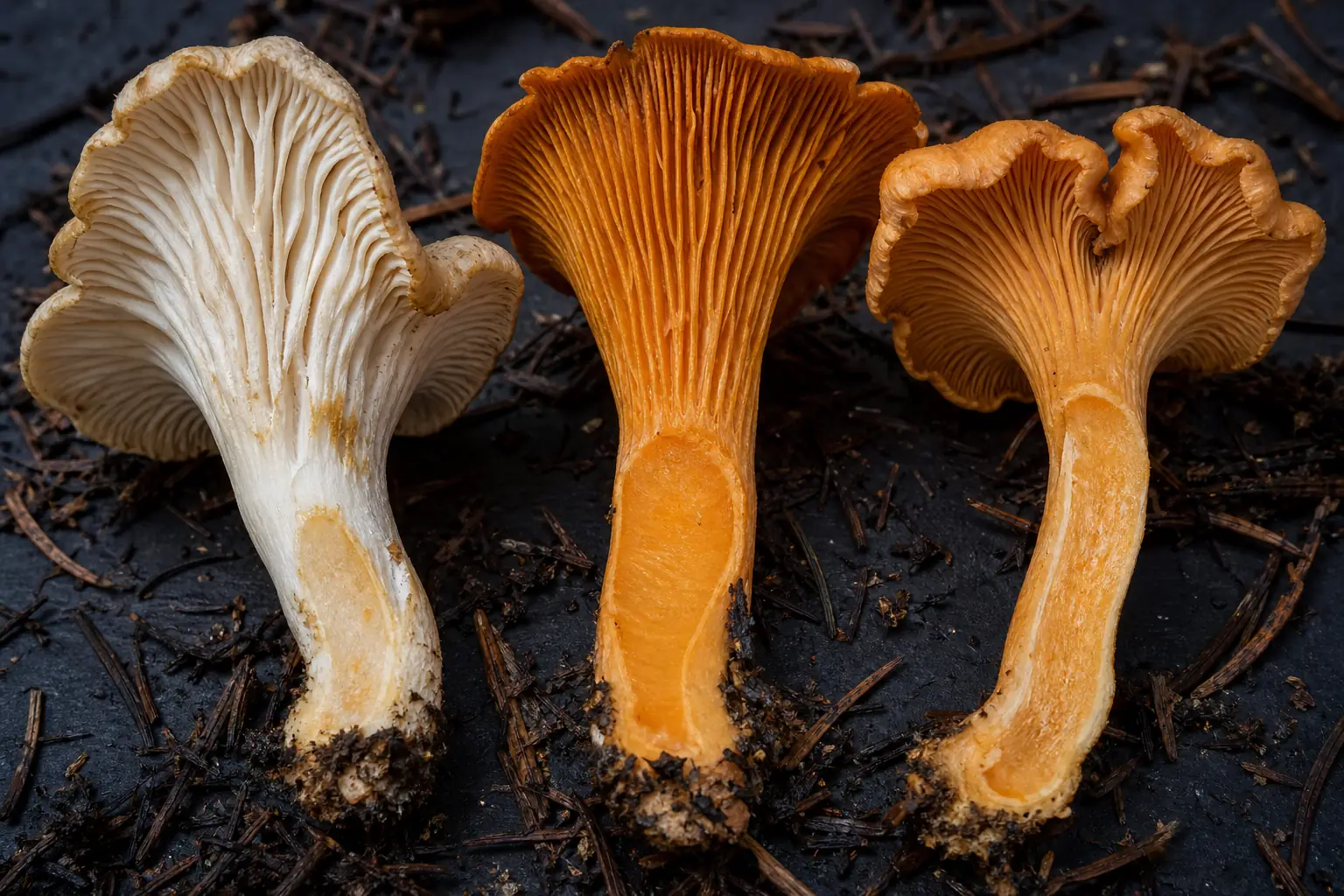
White chanterelles often look less pristine in the basket than they did in the ground. Their ivory surfaces bruise yellow-orange, collect dark soil, and can become rusty as they dry, which masks the color that gave the species its name.
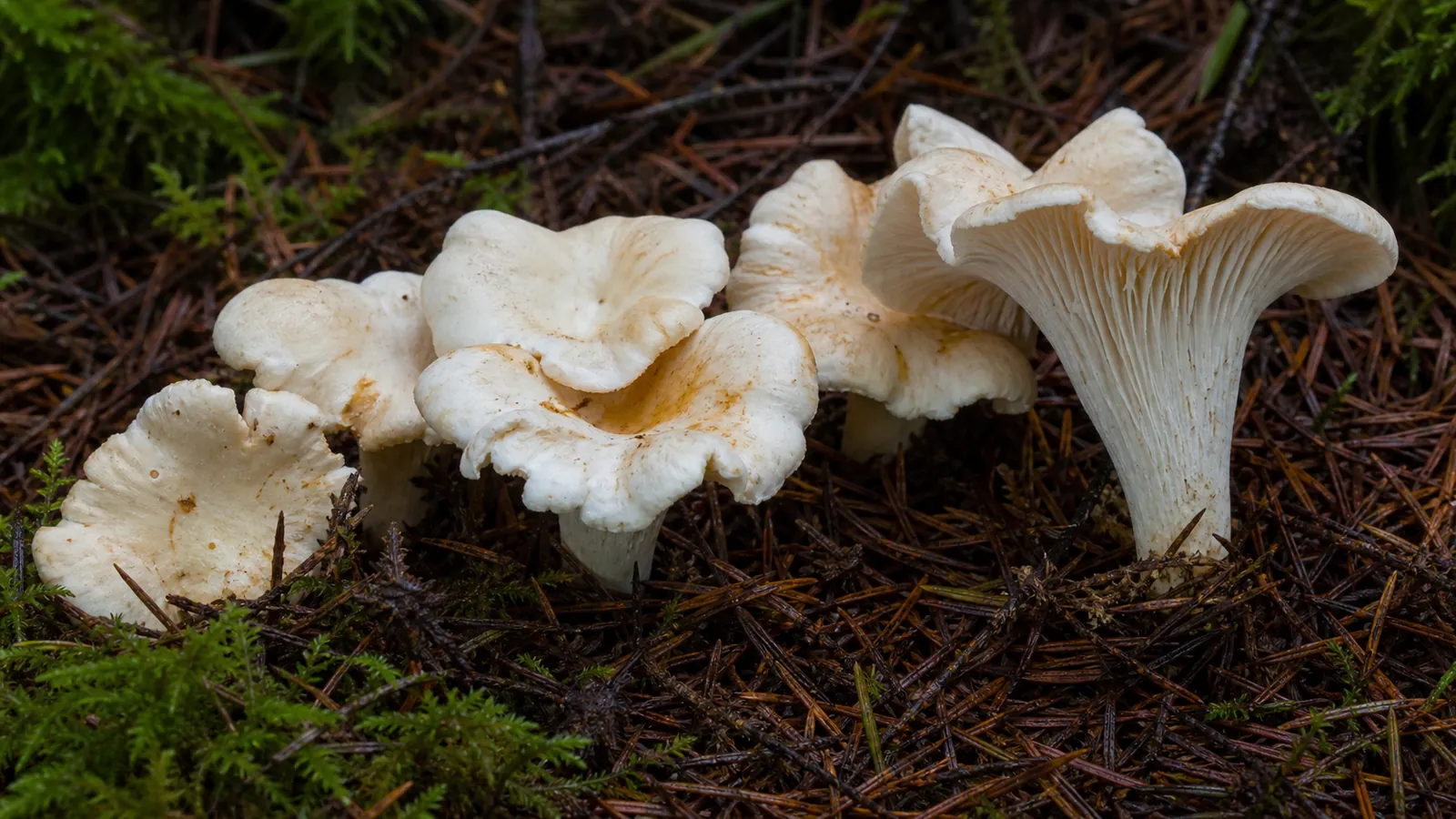
The cap is thick and irregular rather than perfectly circular.
It starts broadly convex or flat, then develops a depressed center and an uplifted, wavy, or lobed edge.
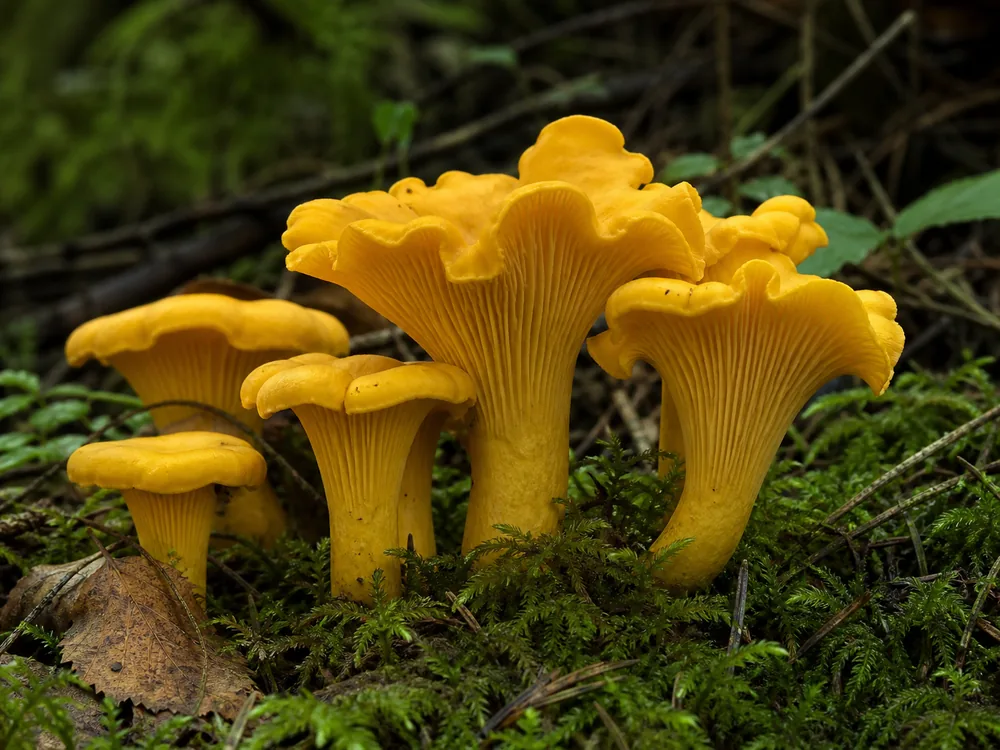
Underneath, blunt ridges extend from the cap onto the stem. They fork, merge, and form cross-veins, and they cannot be flicked away as separate thin blades like true gills.
The stem is solid and fibrous inside. Cut lengthwise, it shows pale stringy flesh continuous with the cap instead of a hollow tube or a sharply separated cap-stem junction.
Fresh specimens can smell fruity, sometimes compared with apricots, while raw flesh may taste peppery. Neither odor nor taste is reliable enough to replace structural identification.
A white chanterelle is a western species. Pale chanterelles elsewhere need identification under their own regional names rather than an assumption that every ivory chanterelle is C. subalbidus.
How do you identify white chanterelle?
Usually 4 to 15 cm across, ivory to cream, dry and irregular, initially flat or shallowly convex, later depressed to funnel-shaped with a wavy lobed margin.
No true gills. Thick blunt forked ridges run down the stem, cross-connect, and bruise yellow to orange-brown.
Solid, dense, white to cream, often tapered downward and continuous with the cap, bruising yellow-orange with handling.
Firm stringy cream flesh, slowly yellowing when bruised, with a pleasant fruity or apricot-like odor in fresh specimens and a peppery raw taste.
Brush away enough soil to see the base, but photograph the undisturbed mushroom first. The relationship between cap, ridges, stem, moss, duff, and nearby conifers carries valuable evidence.
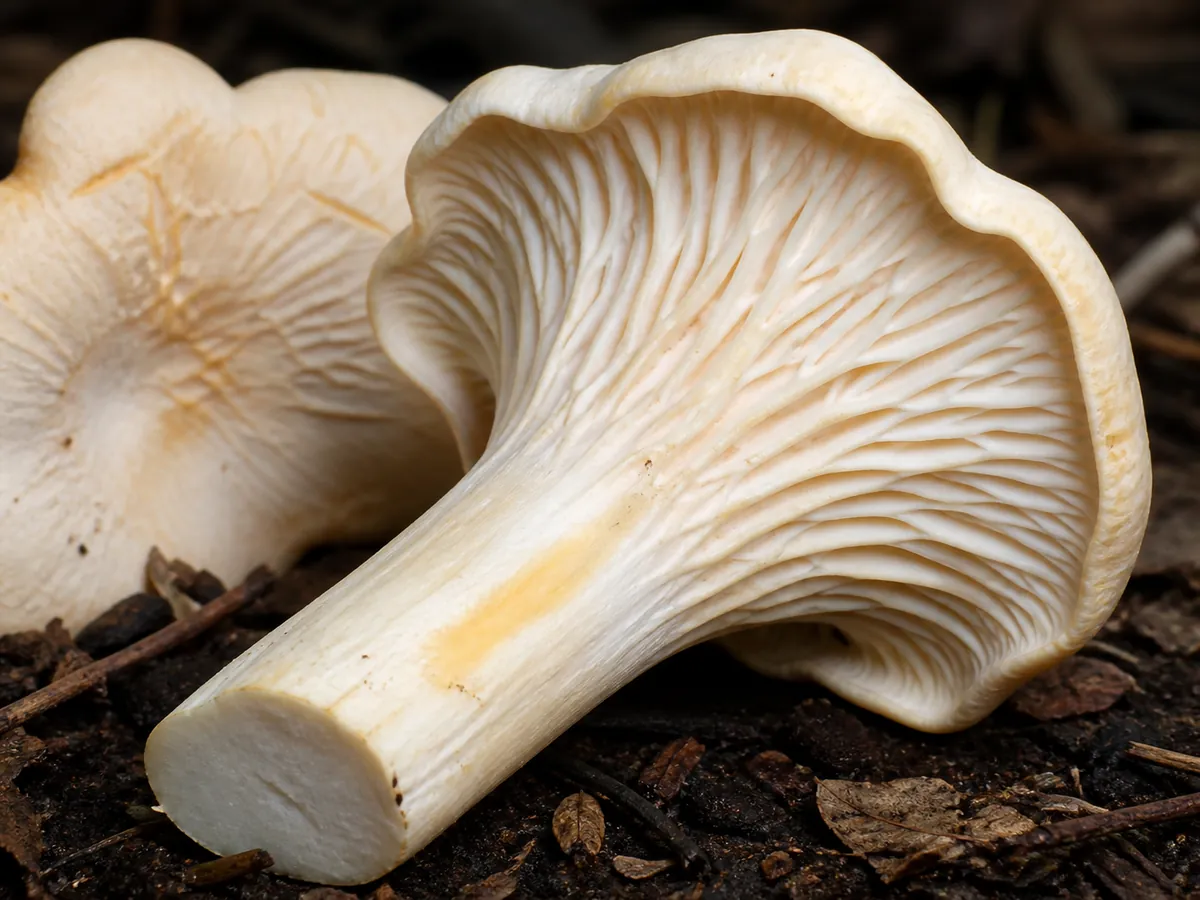
Press one inconspicuous spot and record the color after several minutes. White chanterelles slowly develop yellow, orange, or orange-brown stains, while old dry specimens can become broadly rusty.
A white spore print agrees with chanterelles but cannot distinguish this species from several pale or golden relatives.
Microscopic characters also overlap, so field context and regional expertise remain important.
Slice the mushroom vertically when identification is uncertain. Uniform solid flesh supports a chanterelle, while hidden gills, a hollow stem, soft cottony tissue, or a sharply different internal structure point away.
Do not clean away every bruise before checking it. The orange staining that lowers market appearance can strengthen the identification record.
What must you check before eating white chanterelle?
First-time collectors should have a complete specimen confirmed by an experienced regional identifier. Keep each species separate and retain one uncooked example until everyone who ate the meal remains well.
False gills and solid flesh must be visible before kitchen cleaning begins. Deep brushing, trimming, and slicing can erase the intact evidence needed to correct a mistake.
Start with a modest cooked portion because individual intolerance can occur even with edible mushrooms. Avoid serving a first trial to someone with a known mushroom allergy or a medically vulnerable person.
If illness follows a wild mushroom meal, contact Poison Control or local medical services and save specimens and food remains. Do not assume that an edible species name rules out a mixed basket or spoilage.
When do golden and white chanterelles overlap?
The hardest comparison is often another true chanterelle rather than an obviously unrelated mushroom.
Pacific golden chanterelles can grow nearly white under deep duff and lose color while drying, while white chanterelles darken with handling.
True-gilled orange and pale mushrooms create a separate safety boundary. Structure must outrank color in both comparisons.
Pacific golden chanterelle, Cantharellus formosus, is usually more yellow to orange, but shade and drying narrow the difference. White chanterelle begins ivory and tends to stain orange-brown, with especially dense pale flesh.
False chanterelle has thin crowded true gills and softer orange flesh, while jack-o'-lantern mushrooms have sharp true gills and often grow in dense clusters from buried wood. Both differ from blunt fleshy ridges.
| Candidate | Underside | Context that helps |
|---|---|---|
| White chanterelle | Blunt forked ridges, white then staining | Western conifer forest, dense solid flesh |
| Pacific golden chanterelle | Similar ridges, normally yellow-orange | Same region and habitat, so color may be subtle |
| False chanterelle | Thin crowded true gills | Softer flesh, orange tones, wood-rich ground |
| Jack-o'-lantern | Sharp decurrent true gills | Clusters attached to wood or buried roots |
| Pale oyster-type fungi | True gills and lateral attachment | Grows directly from wood |
The chanterelle profile covers the broader edible pattern, while the chanterelle-type hub groups canonical species pages. Neither link replaces local confirmation of a white western specimen.
Key takeaway
If the underside consists of thin blades rather than blunt ridges, stop treating the mushroom as a chanterelle.
Where do western conifers support this species?
White chanterelle forms ectomycorrhiza with conifers, especially Douglas-fir and western hemlock. The fungus gathers water and mineral nutrients through soil while receiving carbohydrates from its host tree.
It fruits on the ground in coastal and montane forests from California to British Columbia and inland parts of the Northwest. Mature and older stands are recurring habitat, often with a deep layer of needles, moss, and woody debris.

Fruiting can begin in late summer at higher elevation and continue through autumn or winter in mild coastal areas. Rain and soil moisture matter, but the calendar shifts with elevation, snow, and local forest conditions.
Specimens often grow singly or in loose groups rather than from one fused base.
Mark the patch without damaging soil, and cut or lift lightly according to local guidance.
The underground organism remains after harvest. Protecting host roots, coarse woody debris, and forest soil matters more than arguing over whether one careful picker cut or twisted a fruiting body.
How should a productive white chanterelle patch be harvested and recorded?
A white chanterelle is the temporary fruiting body of a fungus living in partnership with conifer roots. The productive place includes the host trees, forest floor, soil moisture, and underground mycelium, so a GPS pin without habitat notes preserves only part of the record.
Photograph the patch before collecting and note the dominant trees, slope position, duff depth, recent weather, and maturity of the mushrooms. Return records should use the same observation area because a larger search after a wet year can look like increased production even when the original patch changed little.

A single season cannot reveal whether picking changed later fruiting because weather and forest conditions vary strongly between years. Long-term records become useful when the same area and method are revisited across multiple seasons.
Harvest the visible crop without dismantling the place that produced it. Careful collection protects the forest floor and gives future observations enough context to mean something.
What does white chanterelle taste like?
White chanterelle has thick flesh and a firm texture that holds up well to sautéing. Its aroma is usually subtler than its golden relatives, while the flavor can read earthy, peppery, and gently fruity.
Dry cleaning works best when mushrooms are only lightly soiled. Deeply embedded specimens can trap needles and grit between lobes, so split them lengthwise and use a damp brush or brief rinse followed by thorough drying.

Sort by condition before heat reaches the pan. Small firm buttons cook more evenly when left whole or halved, while thick mature caps benefit from lengthwise strips that expose insects and keep pieces at a similar thickness.
Cook until the mushrooms release their water and the pan becomes nearly dry, then add fat and aromatics. Crowding a cool pan steams the dense pieces and can leave them rubbery.
A dry sauté works well for a water-heavy batch. Heat the mushrooms without fat until released moisture evaporates, then add butter or oil so the fat coats concentrated flesh rather than floating in mushroom liquid.
Orange-brown bruises are usually cosmetic when the mushroom is fresh and correctly identified. Sliminess, sour odor, extensive insect tunneling, or soft waterlogged flesh indicates deterioration instead.
The dense texture suits eggs, pasta, rice, poultry, and cream sauces, but the mushroom should finish cooking before delicate ingredients are added. Large pieces need enough time for the center to become hot and tender.
Keep seasoning restrained for the first preparation. Butter or olive oil, salt, and a mild herb make it easier to judge the species' own aroma and texture.
For freezing, cook first and cool quickly rather than freezing raw waterlogged pieces. Raw freezing can rupture the firm flesh and create a soft texture after thawing.
Drying is possible, though white chanterelles can become tough and their aroma may not rebound as strongly as some boletes. Thin uniform slices and complete drying reduce storage risk, while any bendable or cool-feeling piece needs more time.
Refrigerate cleaned mushrooms in a breathable container and cook promptly. Do not seal wet chanterelles in plastic, where condensation accelerates softening.
How do you clean a white chanterelle that grew through deep forest duff?
White chanterelles often push through needles and loose forest soil, so grit can lodge between the blunt folds and inside splits near the stem base. Cleaning begins in the field because a dirty base can spread sand across every mushroom in the basket.
Long soaking trades one problem for another. The flesh can absorb water, cool the pan, and steam before browning, while forceful washing can break older caps into grit-covered fragments.
Sort by condition as well as size. Firm clean pieces can stay whole, split caps suit a sauté, and waterlogged, sour, or heavily insect-damaged mushrooms should be discarded rather than rescued by longer cooking.
The final inspection happens after the mushroom is split. A clean exterior can still hide packed duff or decay inside the stem base, and that defect affects both identification evidence and the finished texture.
Can white chanterelles be cultivated at home?
White chanterelles cannot be cultivated like oyster mushrooms on a bag of straw or sawdust. Their mycorrhizal dependence requires living host roots and a functioning forest soil community.
Attempts to move forest soil or fruiting bodies rarely establish a productive patch and can spread pathogens or violate collection rules.
Protect an existing site rather than digging it up.
Commercial cultivation research on chanterelles is scientifically interesting, but there is no dependable home kit for Cantharellus subalbidus. Products claiming easy indoor white chanterelle production deserve skepticism.
What does the mushroom contribute to a meal?
White chanterelles contribute water, fiber, and modest amounts of protein and micronutrients, with values changing by soil, maturity, and cooking method. A species-specific nutrient panel is not established well enough to justify precise promises.
Cooking in butter or cream changes the finished dish more than small differences between wild chanterelle species. Treat it as a flavorful ingredient rather than a supplement.
No nutritional benefit compensates for uncertain identification. The first health decision is confirming the mushroom, not optimizing its micronutrients.
Why was it separated from the European chanterelle?
Alexander Smith and Elizabeth Morse described Cantharellus subalbidus as a separate western species in 1947. Before that work, white chanterelles were often treated as a color form of the European C. cibarius.
The epithet subalbidus means nearly white or approaching white. It refers to the starting color even though handling and drying can turn the mushroom yellow-orange or rusty.
Western chanterelle taxonomy continues to rely on geography, ecology, morphology, and molecular data.
The name identifies a regional lineage, not every pale member of the genus.
White chanterelle questions
Is white chanterelle edible?
Why does it turn orange?
How are false gills different?
Where does it grow?
Can it grow in an indoor kit?
How should it be cleaned?
Sources & References
- US Forest Service, Ecology and Management of Commercially Harvested Chanterelle Mushrooms Morphology, edibility, habitat, season, and comparisons.
- US Forest Service rare fungi handbook Detailed dimensions, ridges, bruising, spores, distribution, and habitat.
- E-Flora BC Regional identification and distribution.
- Mushrooms of British Columbia Current regional field account, host ecology, and history.