A preservation method for drying mushrooms at home, covering what drying creates as well as what it removes, how to prepare and slice the material without washing it first, the four available methods compared on control over temperature and airflow, the single temperature two independent sources agree on, the snap test and the conditioning step that follows it, and how to store and rehydrate the result.
Drying a mushroom does not just remove its water. It manufactures the thing that makes dried mushrooms worth having.
That is not a detail. It is the reason the whole method turns on one number, and the reason a batch dried badly is worse than no batch at all.
What does drying actually do to a mushroom?
Start with the arithmetic, because it explains the disappointment people feel the first time.
A fresh mushroom is roughly ninety percent water. A carrier bag of them becomes a modest jar, and there is no technique that changes that ratio.
- What comes out
- Around ninety percent of the weight, as water
- What stays
- The structural material, the flavor compounds, and any grit you failed to remove
- What is created
- Guanylate, a savory ribonucleotide largely produced by the drying itself
- What that makes it
- A different ingredient from the fresh mushroom rather than a shrunken version of one
Only one of those four rows describes something being added rather than taken away.
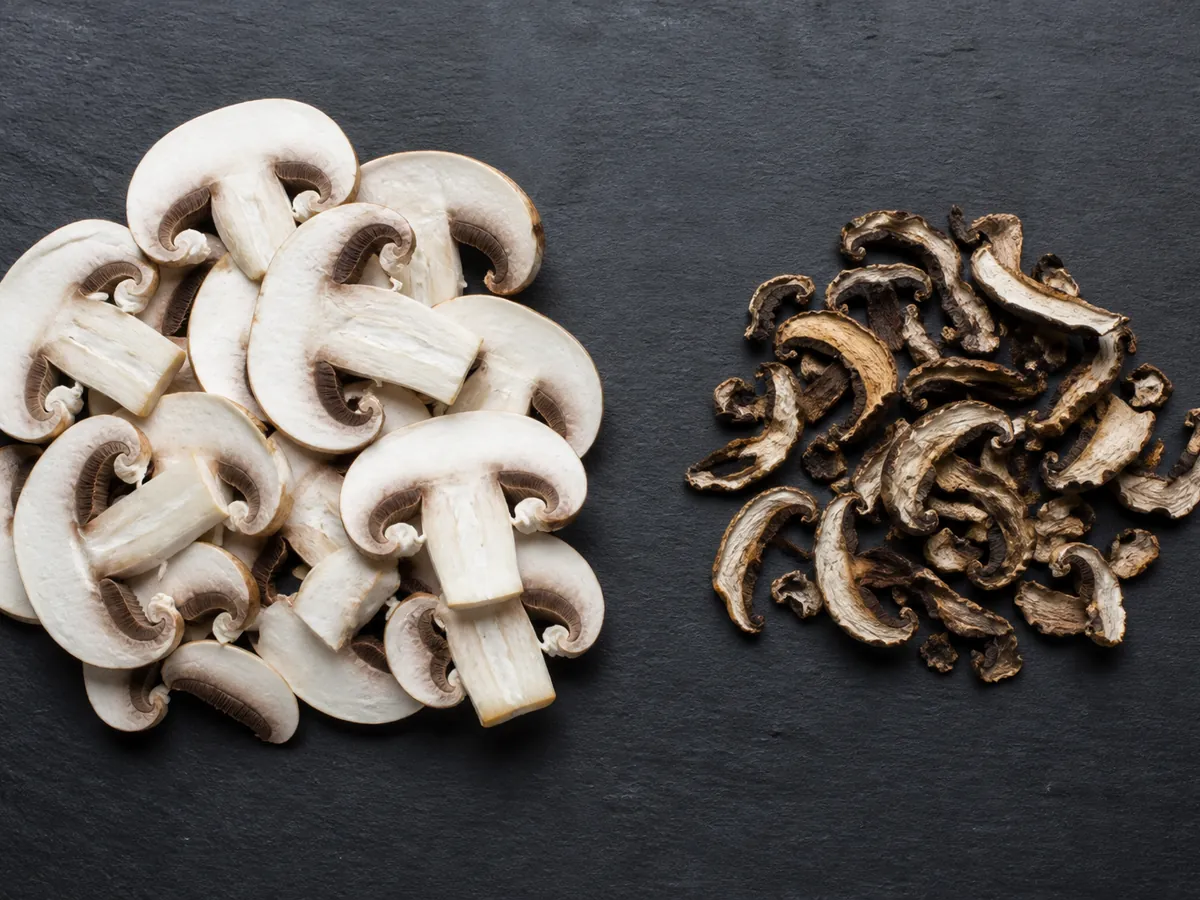
That third row is the interesting one, and it is almost never mentioned anywhere. Drying is a manufacturing step as well as a removal step.
As the cells collapse during drying, an enzyme in the tissue breaks down RNA and produces guanylate. That compound was not there in quantity before, which is why the taste changes rather than merely intensifying.
Guanylate is what makes a dried mushroom taste emphatically savory in a way the fresh one did not.
So the honest framing is that you are not preserving a mushroom. You are converting it into something related, more concentrated, and in some respects more useful.
Cooking MushroomsHow to Cook Cauliflower Mushroom Without Trapping GritHow should you prepare mushrooms for drying?
Drying holds material at the quality it arrives in. It improves nothing, and a soft or waterlogged mushroom becomes a soft waterlogged dried mushroom.
So the first question is whether today is the day, and if it is not, how you store fresh mushrooms overnight matters more than anything else on this page.

That leads directly to the washing question, which most guides answer backwards.
Mushrooms are structurally spongelike and they absorb water readily. Washing them loads them with water in the ten minutes before you spend six hours removing water, which is a strange sequence when you say it out loud.
The cleaning that does work takes about two minutes for a basketful.
- Brush the caps with a soft brush or a dry pastry brush, working from the middle outwards
- Trim the stem base rather than the whole stem, since the woody part is usually only the last centimeter
- Wipe anything a brush will not shift with a barely damp cloth, then let the surface dry before slicing
- Cut away damaged or insect-eaten sections entirely, because drying preserves those too
If material genuinely needs washing because it came out of sand or soil, wash it, then dry it as fast as possible afterwards and accept a longer run.
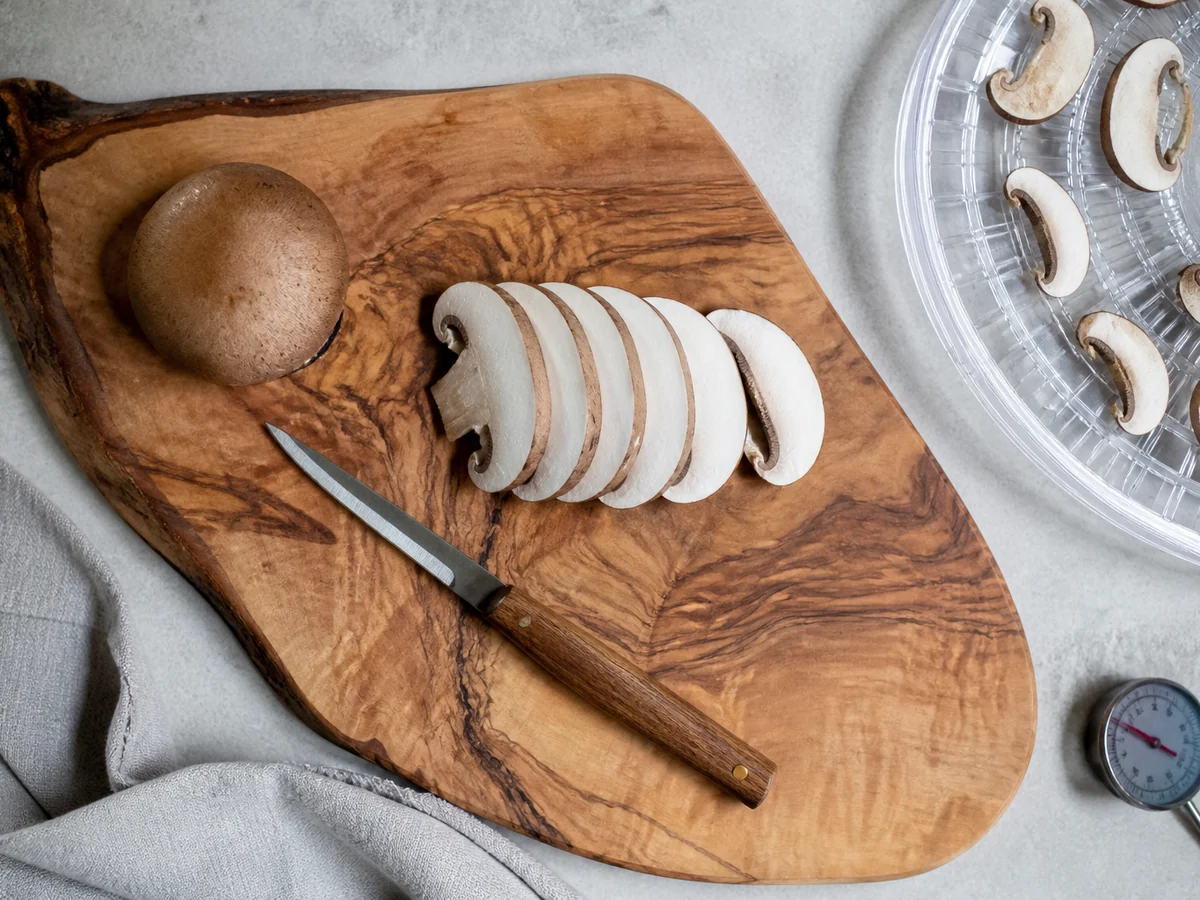
Slicing is where the real decision sits. It is about consistency rather than about a particular measurement.
| Material | How to cut it | What to watch |
|---|---|---|
| Firm-fleshed caps | Slices of even thickness, roughly the width of a pound coin | Thick pieces hold moisture in the middle long after the edges look done |
| Dense stems | Split lengthways or slice thinner than the caps | These are the last things on the tray to finish |
| Thin-fleshed species | Leave whole or halve them | They dry very fast and go brittle before you expect it |
| Small button caps | Halve or quarter rather than slicing | Whole ones trap moisture under the cap |
Thin-fleshed species are the ones to watch, and oyster mushrooms are the common example, since they go from flexible to brittle in the space of half an hour.
The reason evenness matters more than thickness is simple. A tray is only finished when its slowest piece is finished, so a mixture of thick and thin means either overdrying most of it or sealing a jar around the few pieces that were not ready.
Drying is not always the right call for what you have. If the material is waterlogged or already going soft, freezing mushrooms copes with that far better than a dehydrator will.
For small firm caps that would dry to something leathery, pickling mushrooms keeps more of the original texture than drying ever does.
Cooking MushroomsHow to Cook Black Morels: Halve Them, Never Slice ThemWhich drying method should you use?
There are four ways to do this and they are not equivalent. What separates them is control over two variables, which are temperature and airflow.

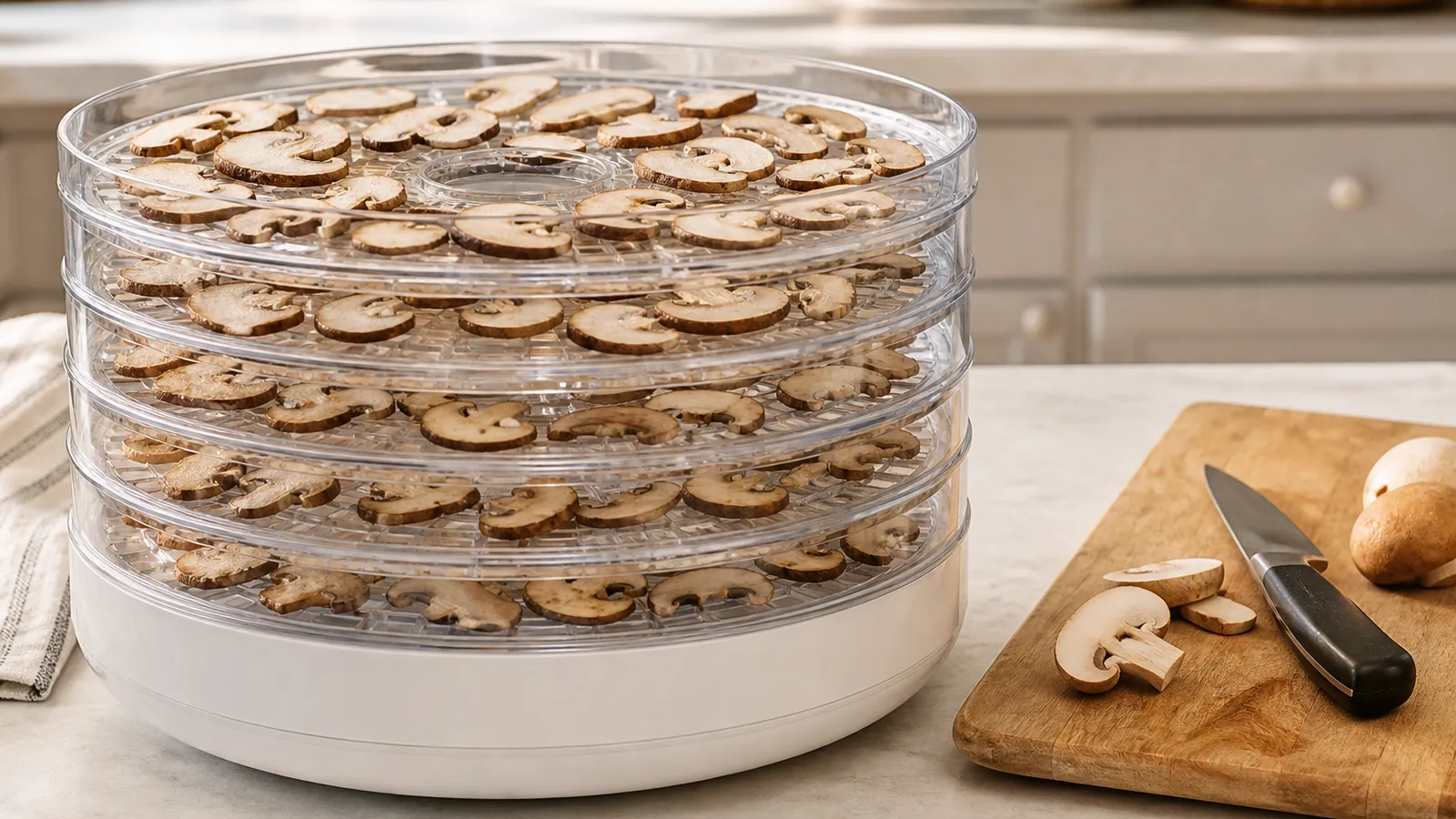
A dehydrator gives you both, holding a set temperature and pushing air across every tray, which is why it is the only method that behaves the same in January and in August.
- Dehydrator: full control of both variables, and the only method that is genuinely repeatable
- Oven: some temperature control, usually starting above the useful range, and no airflow unless you prop the door
- Air drying: no temperature control and airflow only if you provide it, but free and silent
- Sun drying: no control of anything, plus ultraviolet exposure, and entirely at the mercy of the weather
The oven is the method most people reach for, and the one that disappoints most often. Domestic ovens frequently do not go below about seventy degrees Celsius, which is above the range you want, and an oven with the door shut has nowhere for the moisture to go.
Propping the door open with a wooden spoon fixes the airflow and turns a six hour job into a substantial energy bill. It works, and it is worth knowing that it works, and it is not free.
Air drying is genuinely good in a dry climate and genuinely bad in a humid one, because it has no mechanism for removing moisture from the surrounding air. A string of mushrooms in a damp kitchen is a string of mushrooms slowly going moldy.
Warning
Sun drying gives up all temperature control and depends on weather you cannot influence. It is also worth knowing that national home preservation guidance excludes wild mushrooms from its tested recipes entirely, and specifies cultivated material for the methods it does cover.
What temperature should you dry mushrooms at?
Two independent sources point at the same figure, which is a rare and useful thing.
Extension guidance for home food preservation sets the dehydrator temperature for vegetables at 140 degrees Fahrenheit, which is 60 degrees Celsius. That figure comes from drying performance rather than from flavor.
The second source comes at it from the other direction.
That study ran for twenty days and does not describe an afternoon on a tray, so it should not be read as one.
What it establishes is the direction of the effect. The compounds you are trying to keep are heat-labile, and the temperature that a food preservation service recommends for drying performance turns out to be the same one a compositional study recommends for flavor.
Running cooler is not automatically safer. A tray held at thirty degrees in a humid kitchen spends many hours in exactly the conditions that mold likes, which is a different way of losing the batch.
Cooking MushroomsHow to Cook Black Truffle Without Losing Its AromaHow do you know when they are dry enough?
Almost every guide ends at dry them thoroughly, which is not a test.
The test is that a slice cooled to room temperature snaps cleanly rather than bending. Cooling first is not optional, because warm material is pliable whatever its moisture content.
The reason that test matters is a set of numbers no domestic kitchen can measure directly. Water activity below 0.60 stops all microbial growth, and below 0.65 stops the molds that tolerate dry conditions.
Material that shatters sits comfortably below those thresholds and material that bends does not, and the gap between the two states is wider than it feels at the end of a long day.
Then comes the step that mushroom pages leave out and produce guides never do.
Key takeaway
Condition the batch before sealing it. Fill a container about two thirds full with the cooled dried material, cover it loosely, keep it somewhere warm dry and ventilated for four to ten days, and stir or shake it daily. Any moisture left in some pieces is absorbed by the drier ones, and any condensation appearing on the inside of the container means the whole batch goes back to the dryer.
Ten days of doing nothing is a small price for knowing rather than hoping.

Conditioning is not always strictly necessary for vegetables, which dry to a nearly waterless state. It costs a jar and ten days of doing nothing, and it converts a batch you hope is dry into a batch you have checked.
How do you store and rehydrate dried mushrooms?
An airtight jar in a dark cupboard is the whole storage method, and it is worth being fussy about the dark part.
Light costs color and aroma over months rather than days. A jar on a sunny windowsill looks appealing and is quietly losing the thing you spent a day making.
Rehydration is where most of the remaining flavor is either recovered or thrown away.
Warm water rather than boiling, for twenty to thirty minutes, gives a better result than a fast soak in water off the kettle. Boiling water rehydrates faster and pulls more of the flavor out into the liquid.
That soaking liquid is the part people discard, and it should not be. A large share of what came out of the mushroom is in it, and it belongs in whatever you are cooking.
- Strain it through a fine sieve or a coffee filter if the material was gritty
- Use it as part of the cooking liquid rather than in addition to it, or the dish ends up thin
- Reduce it if the volume is awkward, since it concentrates without losing much
- Freeze it in a small container if the dish it belongs in is not being cooked today
Decant it rather than pouring it. Grit settles at the bottom of the bowl during the soak, so the top nine tenths is worth keeping and the last centimeter is not.
If what you actually want is something that dissolves rather than something you rehydrate, dried material is also the starting point for grinding, which is a separate method with its own decisions.
Sources & References
- Utah State University Extension, food preservation drying guidance The dehydrator temperature for vegetables of 140 degrees Fahrenheit.
- Utah State University Extension, Conditioning or Curing of Dried Fruits and Vegetables The conditioning parameters, including the container fill level, the four to ten day period and daily stirring.
- Changes in Physicochemical Characteristics and Antioxidant Activities of Dried Shiitake Mushroom in Dry-Moist-Heat Aging Process, Foods The measured guanylate and glutamic acid figures, their collapse under sustained heat at 80 degrees Celsius, and the identification of 60 degrees as the balance point.
- US Food and Drug Administration, Water Activity (aw) in Foods, Inspection Technical Guide That water activity below 0.60 inhibits all microbial growth and below 0.65 inhibits xerophilic fungi.
- National Center for Home Food Preservation, Mushrooms Whole or Sliced That wild mushrooms are excluded from tested home preservation recipes, which specify cultivated material.