
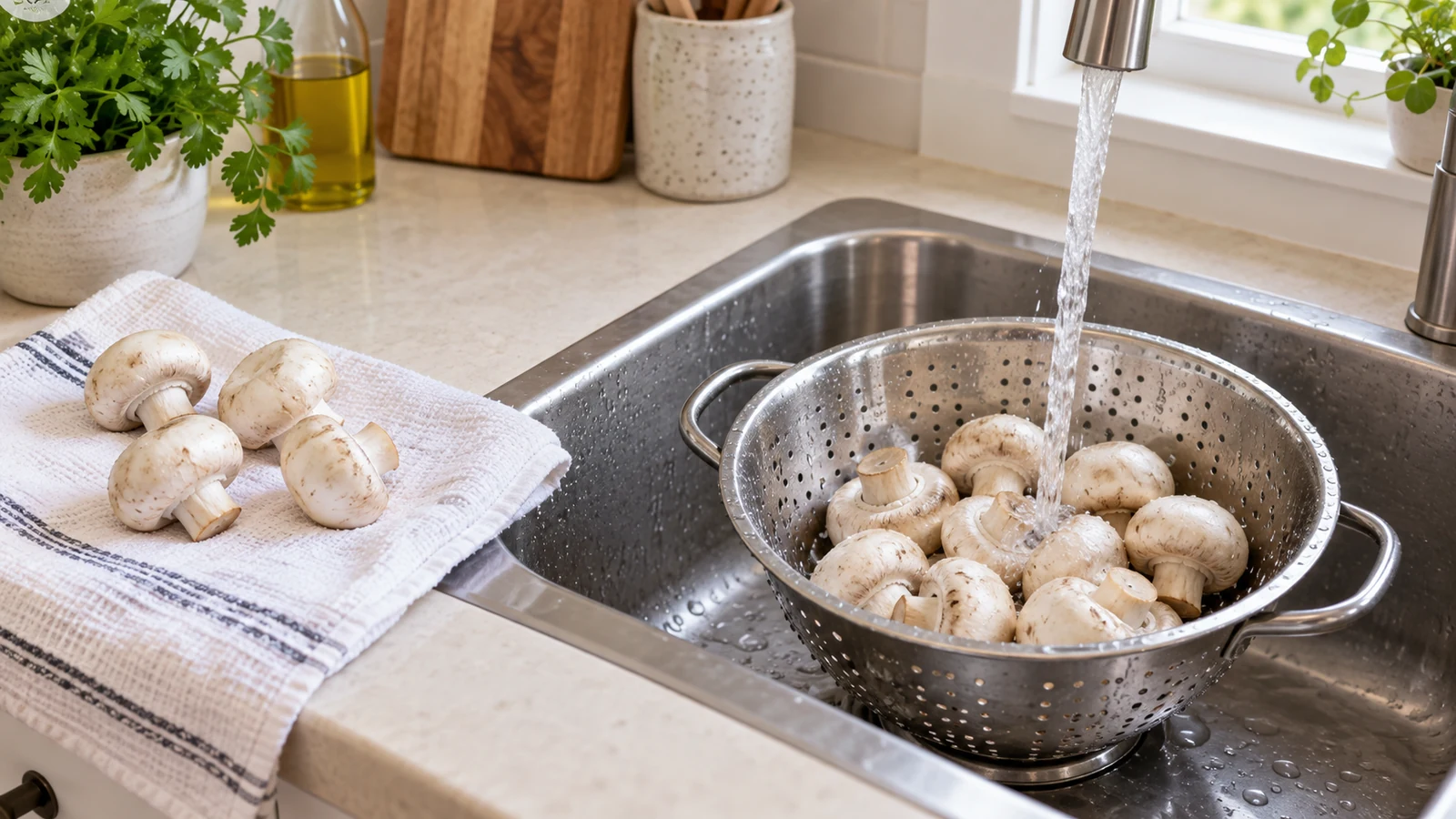
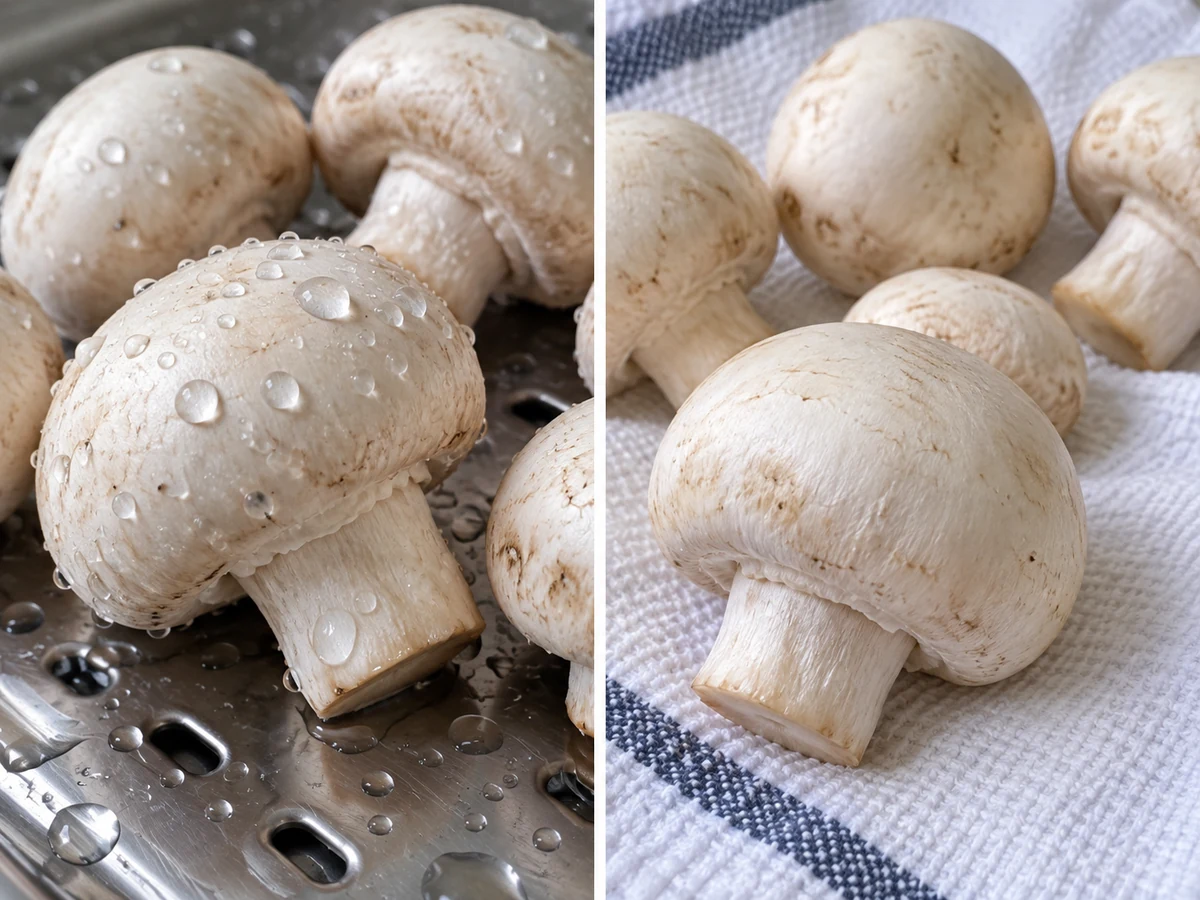
Rinse sound fresh mushrooms under cool running water, gently loosen any clinging debris, and pat them dry before a dry-pan recipe. Any pre-washed label changes the washing step, while hidden grit, spoilage and surface droplets each call for a different response.
Which cleaning method should you use?
Plain running water is a practical default for fresh mushrooms that need washing, followed by draining and gentle drying with a towel. Before the rinse, a damp cloth or soft brush can loosen clinging bits, especially where the cap meets the stem. Your aim is to remove dirt from the mushroom without removing the mushroom itself.
That means a speck of growing material has to come off, while sound skin, gills and tender stem flesh can usually stay. Scraping every surface until it looks evenly pale throws away food and may still miss the spots where grit hides.
Wiping, Brushing and Rinsing
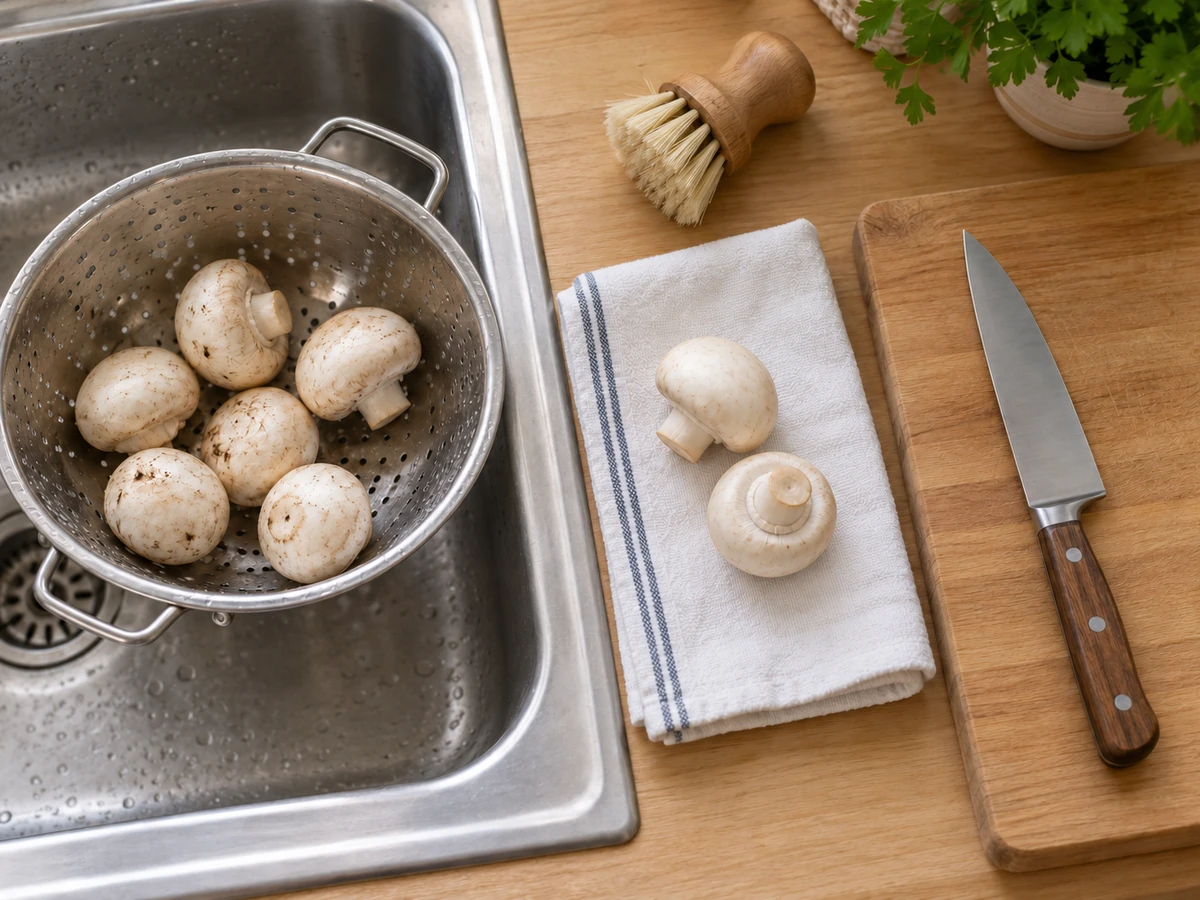
Each tool handles a slightly different job. With a damp towel, you get controlled contact on a smooth cap, so it suits a fleck you can reach that water alone has not shifted. Fold the towel to a clean part as you go, so you do not drag the same dirty patch across the next mushroom.
Soft brushes reach a shallow crease without the pressure of a fingernail. The bristles still need to be clean, and a stiff vegetable scrubber can tear delicate edges. Scouring the surface hard does nothing to make a mushroom better prepared.
Running water carries bits away as they loosen, so it works well for an ordinary batch with scattered debris. Your colander lets that water drain away and keeps it from pooling under the mushrooms.
Health Canada's mushroom guidance permits gentle wiping or brushing as well as rinsing, while FDA's general produce guidance recommends running water. The two fit together when you use a gentle tool to loosen debris and plain water to carry it away. Neither source makes a special mushroom brush or a bottle of produce cleaner a must for this kitchen task.
Condition and Labels Come Before the Water
Cleaning starts with sound food from a known edible supply. Mushrooms with visible mold, obvious decay or a slimy, broken-down surface do not belong in the cleaning batch. Small attached particles and tissue that is breaking down are different problems, even if both first catch your eye as an unwanted mark.
Someone has already cut pre-sliced mushrooms, but that alone says nothing about washing. Any pre-washed or ready-to-eat statement is a separate claim, and it has to actually appear on the package. FDA allows you to use produce carrying that claim without another wash. That label does not cancel the product's cooking directions or its need for refrigeration.
Another rinse also means another round of contact with hands, a sink and a colander. Clean equipment to receive the food does more for you than an automatic second wash.
Undersides, Stem Ends and Cluster Joints
Smooth caps can look finished while the underside or the stem joint still holds a particle. Turn each mushroom over to inspect another surface, and stop polishing the easiest side. How much tissue you remove depends on the condition of the food and the dish you plan, and no rule says every stem or dark underside has to go.
Closed Caps and Open Gills
White button mushrooms and cremini mushrooms are both cultivated forms of Agaricus bisporus, with rounded caps and usable stems. Their caps may hide the underside behind a veil or show the gills as they open. You do not need to pry an enclosed underside apart just to make every mushroom look like an open cap.
Loosen any debris near the visible edge gently, and trim material stuck to the cut stem end with the smallest useful cut. Taking a thin slice off a sound stem keeps food that cutting off the whole stem would throw away.
Portobello mushrooms are the mature open-cap form, with a much larger exposed underside. Their naturally dark gills are tissue, and washing should not try to turn them white as if they were a layer of dirt. Some recipes remove those gills to make room for a filling or to change the look. That choice belongs to the dish, so it is no required cleaning step for every open mushroom.
Peeling the cap follows the same logic. Your intact cap does not need its outer layer stripped just to finish a wash. Peeling also does nothing on its own for debris at the stem joint, which still needs direct attention.
Cluster Joints Need Access, Not Scrubbing
Oyster mushrooms, Pleurotus species, often arrive as overlapping fans joined at a shared base. That joint can hide debris that is hard to see while the cluster stays tightly packed. Splitting a large cluster into the portions your recipe needs exposes those meeting points.
Smaller pieces do not need harder washing. Splitting the cluster simply lets you reach the surfaces. Thin fan edges can tear when you push a towel or brush against them as if they were a firm button cap.
Crowded clusters also dry unevenly after rinsing. Spreading the usable portions on the towel opens up the places where water would otherwise sit between overlapping fans.
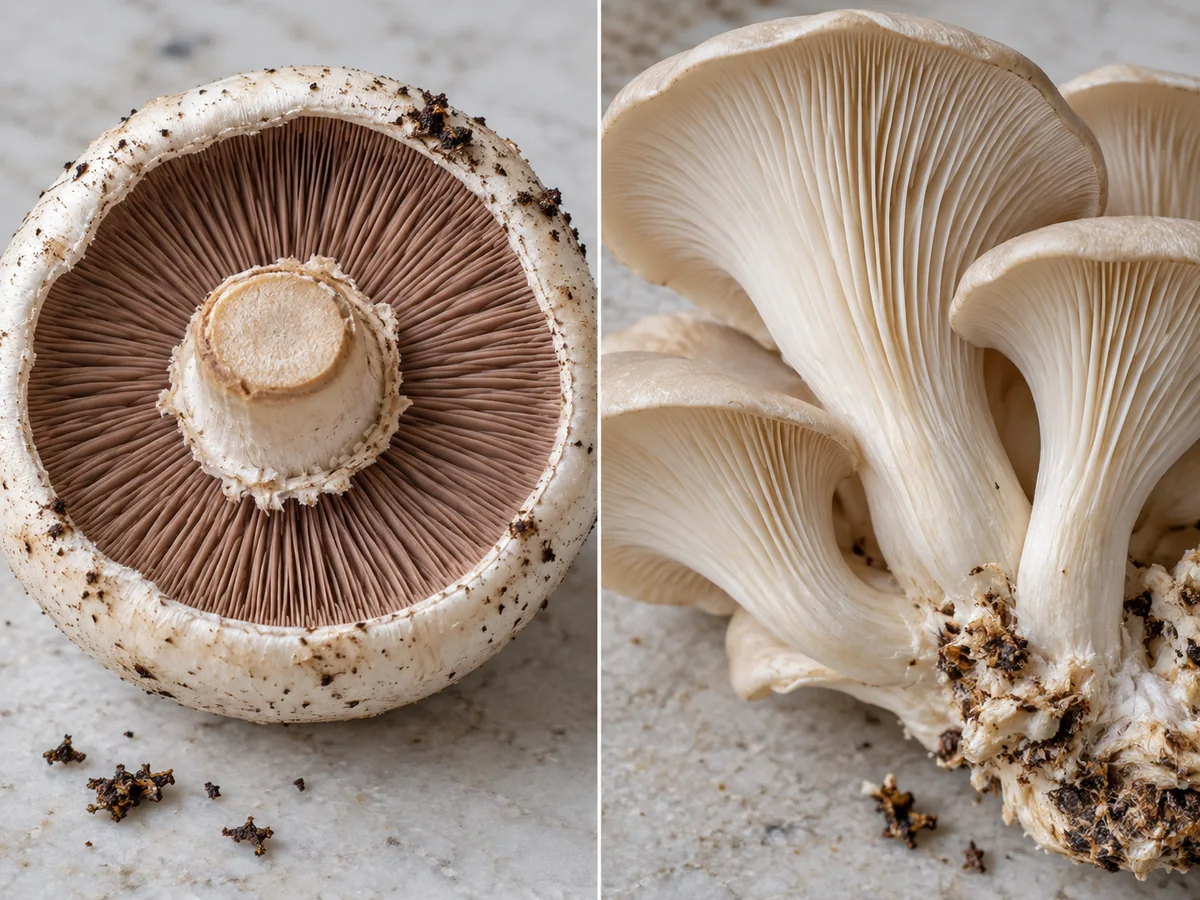
When a particle sits between folds, gentle access to that one spot solves it. Soaking for a long time to make up for it can leave you with wetter mushrooms and the same hard-to-reach joint.
Woody Stems Are About Texture
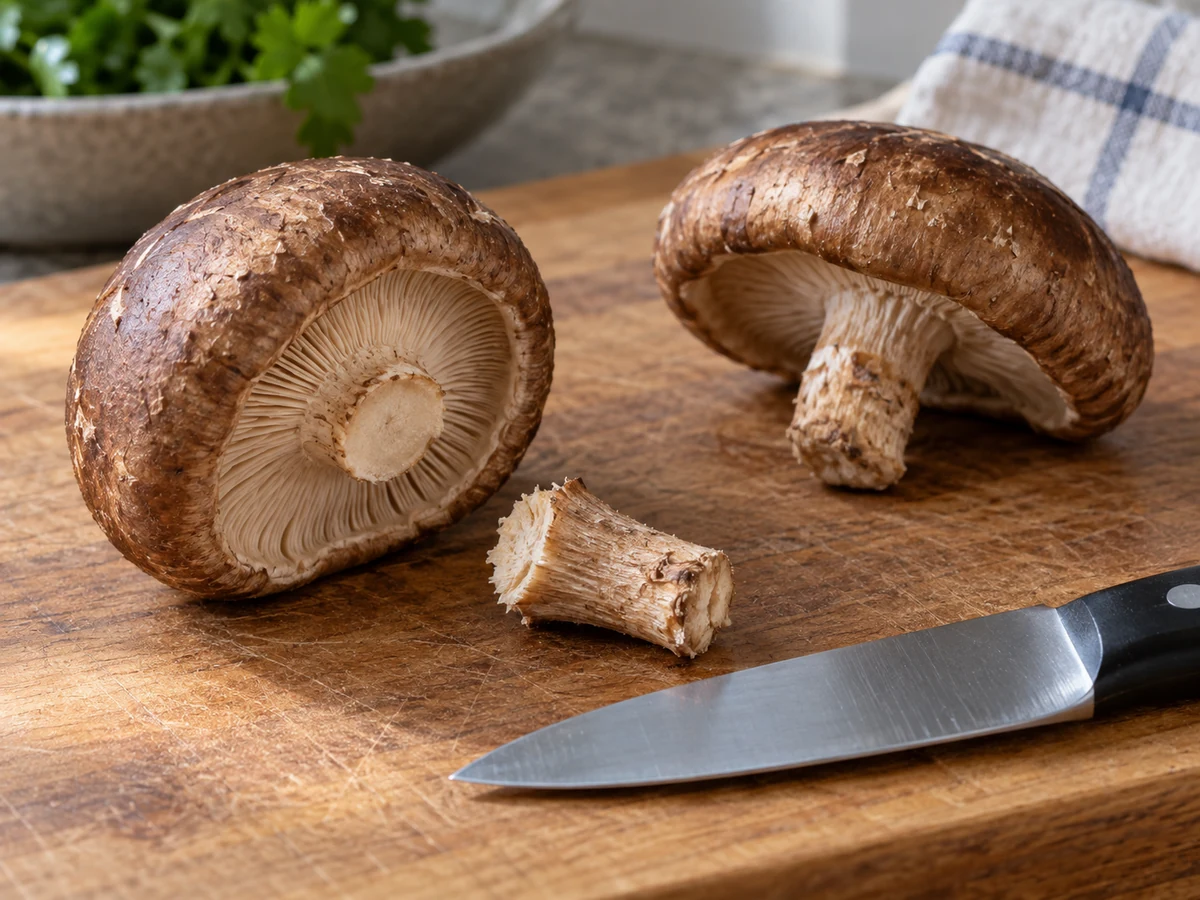
Shiitake, Lentinula edodes, have caps and stems that can behave differently in cooking. Their tough, fibrous stems may stay chewy after the caps have turned tender, and washing cannot fix that texture gap. The Mushroom Council treats trimming tough stems as cooking preparation and names shiitake stems for removal before use.
Cut a woody stem off near where it joins the cap, so you keep the cap whole and avoid cutting a broad chunk from its center. Any sound stems you keep for a recipe still need cleaning and cooking like the rest of the mushroom. They are not ready-to-eat scraps.
Once the dirt is gone, cooking shiitake is a separate question. Clean cap flesh still needs the preparation and cooking your dish requires.
| Surface or part | What cleaning addresses | What removal would change |
|---|---|---|
| Smooth cap skin | Attached flecks and loose particles | Peeling removes intact food and is not the same as washing. |
| Exposed gills | Visible debris between accessible surfaces | Scraping out natural gills changes a whole-cap recipe or filling space. |
| Cut stem end | Material attached to the end | A small trim removes the affected end without discarding all usable stem flesh. |
| Cluster junction | Debris concealed where portions meet | Separation exposes the junction and changes the size of the cooking pieces. |
| Tough woody stem | Particles on the stem surface | Culinary trimming prevents a fibrous piece from being mistaken for tender cap flesh. |
These points apply only to food whose identity you already know. Photos of gills or a clean-looking cluster cannot tell you whether a species is edible.
Washing Without Putting Dirt Back
You have finished washing when two things are true. The visible debris is gone, and the cleaned food has landed on clean equipment. Any dirty towel, board or utensil can undo the first result if you skip the second. Sorting the food and setting out the receiving surface before you wash keeps the order easy to follow, even when several ingredients share a small kitchen.
Smaller Loads Are Easier to Check
Heaped mushrooms in a colander hide the pieces underneath. Washing a manageable portion gives your fingers room to turn the caps, and the loosened bits drain away instead of collecting in a dense layer. No fixed number of mushrooms fits every colander. The real limit is whether you can move and inspect the pieces without squeezing them together. Two small loads are easier to handle than one that buries the pieces at the bottom.
Setting the colander in the sink does not mean letting the mushrooms rest against the sink basin. Move the cleaned portion onto its clean towel, and keep it off any surface that has caught the rinse water and debris.
Sliced Mushrooms Need Gentle Draining
Store-bought slices have more cut surfaces and smaller pieces that can catch or break as they move. With a fine enough colander, they need no long stay in a bowl of water. You do not need a heavy stream or a hard toss to finish the rinse either. Spread the slices on a towel and blot them without pressing them into a tight wet pile. Separate any pieces that fold or overlap, because the top can look dry while a droplet stays trapped underneath.
For whole mushrooms you are about to slice, FDA's sequence puts washing before cutting. That way the knife carries less material from the outer surface into the new cut faces. Packs that arrive sliced cannot go back to that earlier stage. Its label, its current condition, refrigeration and gentle handling are the choices still open to you.
Fixing Leftover Grit
If you can still see a particle after rinsing, go back to the spot where it sits. On a smooth cap, a clean corner of the damp towel may be enough. At a cluster joint, opening the portion slightly can expose the same particle better than running water over the outside again.
Water carries loose debris away, but it cannot replace light contact where material clings. Too much pressure can bruise a cap or tear an edge before the particle comes off. Check the towel as well as the mushrooms at the end, since a towel covered in particles is no longer a clean surface for the next portion.
Clean Handling and Its Limits
FDA does not recommend soap, detergent or commercial produce wash on produce. Soap belongs on hands and suitable equipment, where you rinse it away as part of cleaning them. Rinsing the mushrooms longer cannot make up for a board that has held raw meat.
The knife, colander and towel can bring in contamination after the cap looks clean, so the route from sink to pan counts as much as the water itself. Shared equipment needs proper cleaning between raw animal products and produce. Washing can reduce surface bacteria without removing all of them. So the absence of visible grit tells you the debris is gone, and it is no laboratory test result.
Warning
A rinse has limits
Washing does not rescue spoiled mushrooms or make unidentified wild mushrooms safe to eat. You still need a known edible species and its required preparation before cooking.
How dry should mushrooms be before cooking?
Surface water is the moisture a towel can remove from a freshly rinsed mushroom. The water inside the flesh stays part of the food and will react to heat during cooking. The matte look of a cap shows that the visible droplets are gone, and it does not measure the total water inside.
Drying Before a Dry-Pan Sauté
In an uncovered sauté, droplets that arrive with the mushrooms add to the liquid the pan has to boil off. Blotting lowers that starting load before the pieces begin releasing their own moisture. It does not prevent the wet middle stage of cooking.
When you sauté mushrooms, pan load, evaporation and contact all come into play after preparation is over. Perfectly blotted slices can still stay pale in a crowded, wet skillet, while rinsed slices can brown once the free liquid cooks away. Drying makes the next step easier, and it cannot guarantee the final color.
Water Exposure and Cooking Method Go Together
In her Serious Eats recipe, Leah Colins reports washing tests on several named cultivated mushroom varieties, paired with a method that steams them before browning. That method has a planned stage in which the released liquid has to evaporate later. Her results push back on the claim that any contact with water ruins browning.
They do not set one soaking time for every mushroom. They also do not mean a covered wet pan can stay covered through the browning stage. The result applies to the varieties and the cooking order that source actually describes.
For soup, a few droplets on the outside simply join the liquid, and no dry crust is at stake. The mushrooms still need cleaning, even though the drying decision changes.
Uncovered sauté
Drain and blot the exposed surfaces, then manage pan liquid during cooking.Blotting means less free water enters the pan, but the pieces still brown only as that water evaporates and the surfaces touch the metal.
Broth or soup
Drain away rinse water and inspect for remaining debris before adding to the recipe.The cooking liquid makes a few exterior droplets less important than grit removal.
Whole cap or delicate fan
Turn the pieces to release trapped water and pat without crushing the shape.Gentle patting keeps an intact cap or thin edge whole when that shape is part of the finished dish.
Broad caps can collect droplets underneath, so patting only the top leaves part of the job undone. With an oyster fan, you want gentle drying that keeps the edge intact, and pressing hard will flatten it. In the skillet, oyster mushrooms carry that shape decision forward, because their thin margins and broader portions do not behave like a thick quartered button mushroom.
Should you wash the whole pack at once?
Health Canada's guidance places washing close to use. That timing keeps extra surface water off food that is going straight back into the fridge. For a meal that uses half a pack, clean the portion you will cook and leave the rest unwashed and refrigerated in suitable packaging.
Storing the fresh mushrooms you do not use is its own task, covering the container, moisture and spoilage. Rinsing does not restart their original keeping time or make an old pack as good as a newly bought one.
When Cooking Is Delayed
Sometimes your cooking plan changes after the mushrooms are already clean. Thorough draining and blotting remove the free water you added, and clean handling removes another source of trouble. Refrigeration and the original package instructions still apply, especially to food you have already cut.
Towel-drying the surface does not earn a new shelf-life promise. The date and condition of the food before washing still count. So washing a large batch for convenience carries a different tradeoff from washing just what you need for tonight's pan.
If the unused portion is surplus and not tomorrow's ingredient, freezing mushrooms is a separate preparation route. That method has its own steaming or pan-cooking steps, and putting a freshly rinsed raw pile into the freezer skips them.
Blotting Versus Preservation Drying
Your clean towel removes droplets, and it does not turn fresh mushrooms into a shelf-stable dried product. Drying mushrooms for storage changes the food through a controlled process, with its own storage rules afterward. The word dry can describe both kitchen tasks, but they end in very different places. Caps that no longer look wet are still fresh mushrooms. They belong in the recipe or in the fridge, never in a cupboard as if you had dehydrated them.
Dried and Frozen Packs
Buying dried mushrooms means thinking about the species, whole pieces or fragments, and the intended use before any preparation starts. Rehydrating a dried product brings back usable texture through its own directions, and that is a different task from a quick fresh-produce rinse. Dried packs need the method meant for that product, and an improvised soak copied from fresh cleaning will not do.
This fresh-mushroom method does not set a rehydration time, a way to use every soaking liquid or a sterilizing treatment. Settle that before you decide what happens to any liquid from preparation.
Frozen mushrooms start from a different texture and processing state too. Some frozen products are meant to go straight into the pan from frozen, so the bag instructions set your next step. Thawing and rinsing every frozen pack by habit adds steps its recipe may not call for.
Fresh cleaning ends at a simpler point. You have sound, known food, loose debris removed, usable parts prepared and outside wetness suited to the dish. Cooking and preserving then carry on under their own methods.


