
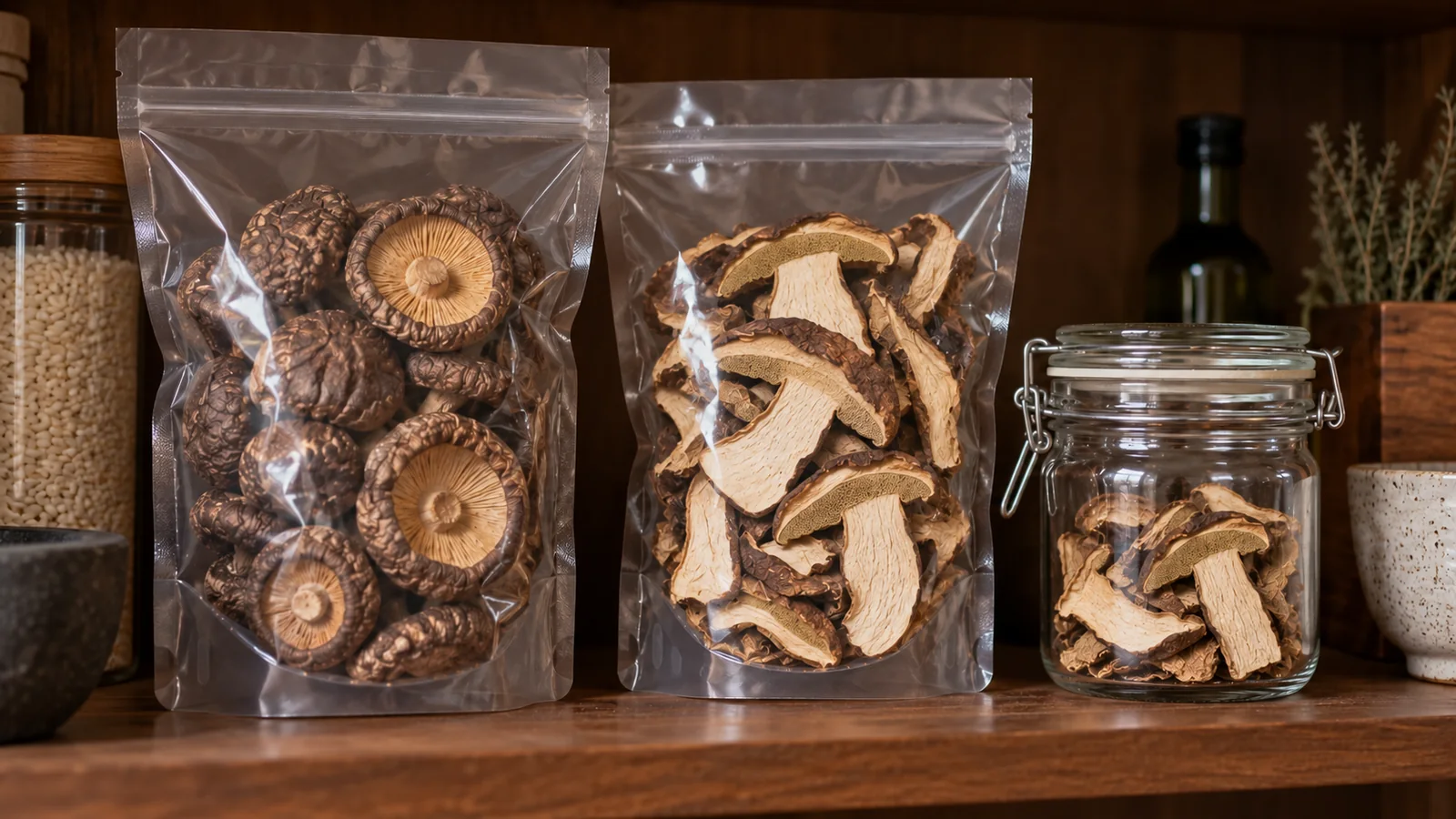
Buy dried mushrooms whose label names the mushrooms and whose form suits your dish, in dry, intact packaging. Whole caps, slices and powder do different jobs in the pot, and a strong smell or attractive color cannot tell you the product is safe.
What should a dried mushroom label tell you?
The ingredient name on a bag of dried mushrooms tells you more than the photograph of attractive mushrooms on its front. Sellers can call a single-species bag, a mixed mushroom bag and a seasoned mushroom powder dried mushrooms, and each one can still put quite different things in your pot.
Shiitake, Lentinula edodes, often comes as whole caps or slices. Porcini products may contain sliced caps and stems, while wood ear mushrooms supply a different kind of piece from either of those cap-and-stem mushrooms.
That distinction belongs on the label, because a dried fragment no longer shows the field features that would identify it. You cannot establish what the fragment is from a photo, a dark color or a strong smell.
Whole caps, slices and powder
The right form depends on what will still show in the finished dish. Whole caps keep a recognizable shape, so they suit a dish where the mushrooms stay on view. Slices save you cutting when the recipe needs smaller pieces anyway, and powder gives you finely divided mushroom without a separate bite. Broken pieces can be a sensible buy for stock, sauce or a filling you will chop. If the recipe grinds the mushrooms, paying more for large intact caps buys a presentation that disappears.
Shiitake stems vary, so the usable part of the bag depends on what you are cooking. The Mushroom Council describes them as ranging from tender to fibrous. You can pull tough stems out when a dish needs softer pieces and save them for stock.
| Form on the label | Useful cooking job | Purchase limitation |
|---|---|---|
| Whole shiitake caps | Recognizable pieces with a retained cap shape | Stem content and the time needed to soften the center affect use |
| Sliced mushrooms | Smaller visible pieces without cutting every whole cap | A broken slice is not automatically a quality defect |
| Named mushroom pieces or blend | Stock, chopped sauce or a mixed filling | Blend proportions may be unclear unless the label supplies them |
| Mushroom powder | Finely dispersed mushroom material in a sauce or seasoning | The ingredient list must distinguish mushroom powder from added salt or other ingredients |
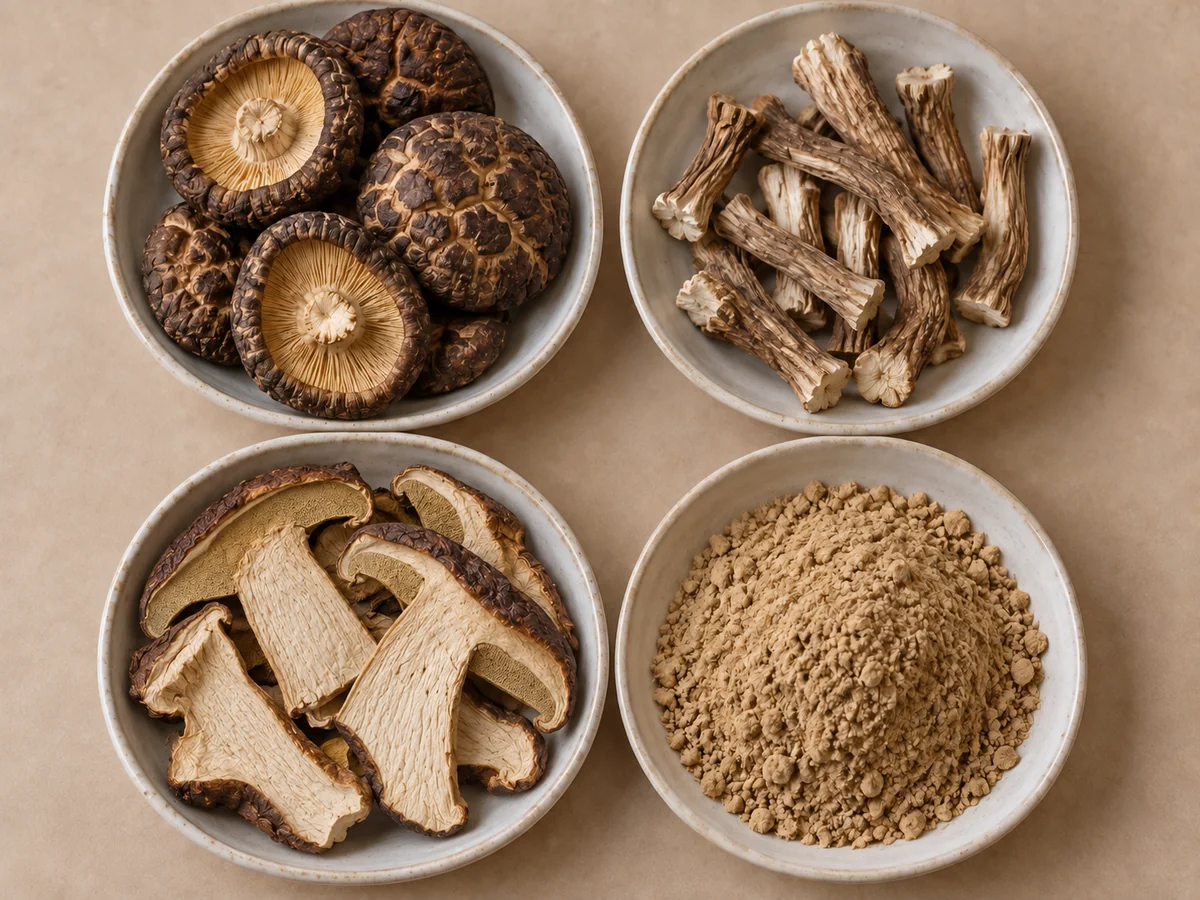
On a label, whole describes the shape of the pieces and does not promise that every part will be tender. Milling can hide even the original cut, so with a powder you lean harder on the ingredient declaration once you can no longer see any mushroom structure. Mixed bags can work well when their combined ingredients suit the dish. They become a weaker choice when your recipe depends on one particular mushroom and the label does not reveal how much of that species is in the bag.
Supplier, lot code and origin
The supplier or importer name, the lot code and working contact details give your purchase a route back to its source. If a recall comes out or you need to make a complaint, those details connect your bag to it. They cannot prove that every individual piece is the species on the label, or that it is free of contamination.
When you buy online, a photograph of the actual dried form and a readable ingredient declaration tell you more than a picture of fresh mushrooms in a forest. The forest picture may show the species in general while revealing little about what went into the bag. Country-of-origin wording and packing information each carry their own meaning. The packing address does not prove where anyone grew or collected the mushrooms when the product does not say so.
How can you tell if dried mushrooms have gone bad?
Properly dried mushrooms are dry and crisp or brittle, with no damp or sticky surface. Oregon State Extension uses crispness or brittleness as the endpoint in its mushroom-drying guidance, so that is the texture to expect when you open a bag.
Texture tells you about condition, and the exact color and firmness still vary with species and cut. Pale caps are not a universal grade standard, and a darker underside alone cannot show that a product is old or unsafe. Dryness, packaging, breakage and smell all describe the state of the mushrooms, while their identity still has to come from the label.
Moisture inside the package
Condensation inside a closed bag or jar means water has reached an ingredient the packaging should keep dry. The University of Georgia warns that foods which appeared thoroughly dry can spoil after taking up moisture during storage. The risk comes from water picked up after drying, so a bag that left the dehydrator in good shape can still go wrong on the shelf. Clumped powder, damp pieces or a failed closure call for an explanation from the seller before you accept them as ordinary dried-mushroom texture.
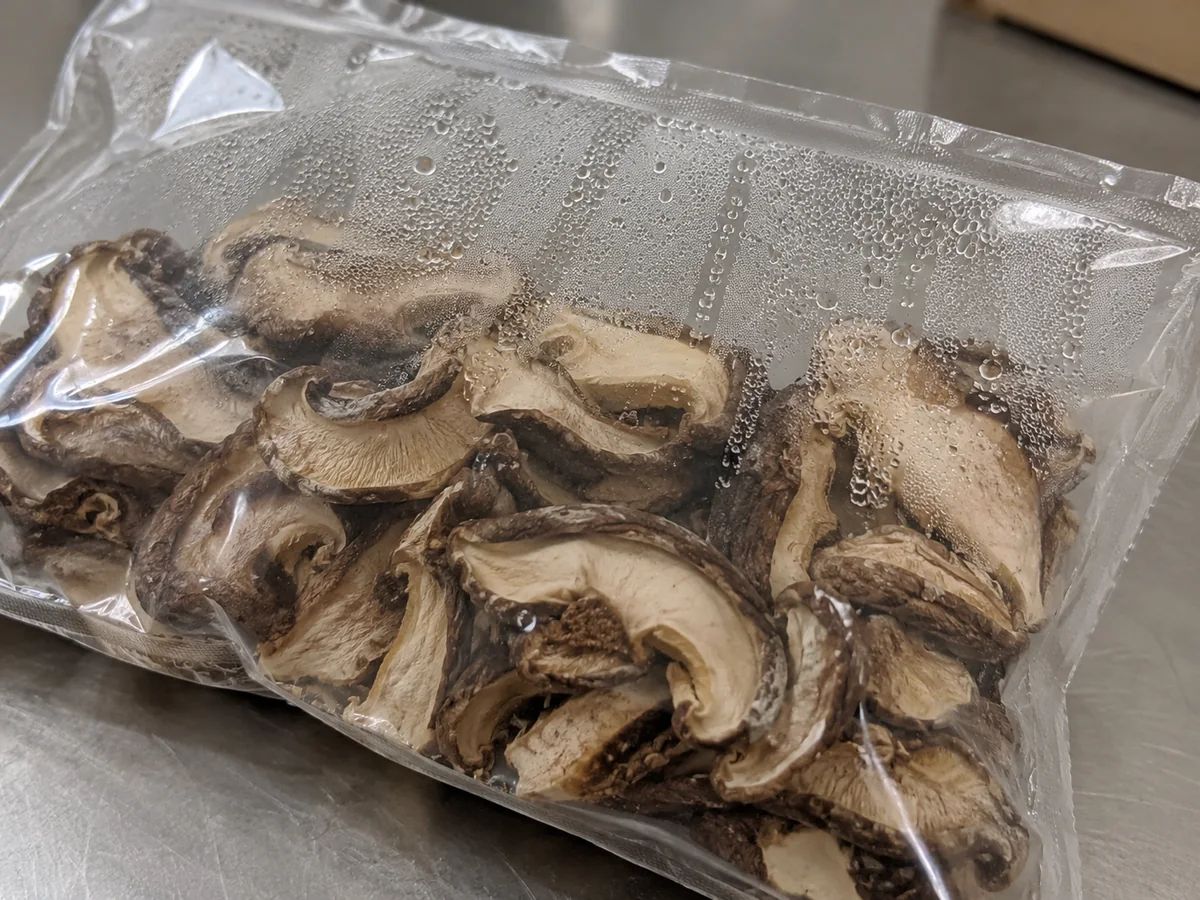
The packaging itself can let that water in. Punctures and unsealed edges can weaken the moisture barrier even when the outer print still looks new. Insects, webbing or obvious contamination make the whole package a poor purchase, and picking out a few attractive pieces does not rescue it.
Warning
Mold is a discard condition
Throw out any dried food that shows mold. Drying or cooking does not make poisonous mushrooms safe, and a pleasant aroma does not clear an unknown or recalled product.
Breakage and aroma
Some breakage is normal for a brittle ingredient in transport. It lowers the value of whole-cap presentation, but broken material stays useful when your dish needs chopped pieces anyway. Finding a large amount of powder in a bag sold as intact slices raises a different issue from buying a package sold as powder on purpose. The first may give you a form you did not intend to buy, while the second can be a suitable ingredient with an honest declaration.
Once the bag is open, its aroma gives you a fair sense of whether the product has the character you expect for cooking. Smell cannot reliably tell you how long the mushrooms sat in storage, rule out pathogens or identify an unfamiliar species. Before purchase you often cannot smell the contents at all, because sealed packaging keeps the aroma in. The buying decision therefore rests on the declaration, the visible condition, the seal and the supplier.
Quality and PriceBuying Mushrooms at a Farmers Market: Source, Weight, ValuePrice per usable gram
Price per bag is not price per usable portion when the bags differ in mass or form. Start with dry weight, which puts the price difference in plain numbers before you think about which parts the dish will keep.
Suppose a hypothetical 25 g bag costs $4 and a 50 g bag costs $7. Neither price comes from a current market comparison. The first works out at $16 per 100 g and the second at $14 per 100 g. In this example the larger bag has the lower dry-mass price. It is not automatically cheaper for your dish if it holds a form the recipe will reject, or more mushrooms than your household will use.
Stems and retained yield
Yield depends on the meal, and tough shiitake stems show how. In stock they may still have a job after you separate the caps. In a dish that needs tender visible pieces, the same stems can reduce the amount that reaches the plate. The yield to count is what is usable for this dish, and waste has no universal definition. If you use the stems in another meal, your yield differs from that of someone who throws them away.
Take an explicitly hypothetical 40 g pack that leaves 30 g of useful pieces. Its retained yield is 75% for that preparation, so each retained gram costs more than each packed gram, even though the label states the package weight correctly. Rehydrated weight brings in yet another denominator, because soaking adds water. Paying for dry mushrooms and then comparing them by their wet weight can hide differences in both retained solids and degree of hydration.
What a premium price should pay for
Paying more makes sense when the extra money buys something you actually need, such as an intact cap, a named species, a specified form or clearer source information. The word premium does not tell you which of those features, if any, the bag has. Grade terms need a definition that applies to that product and market, and one country's grading practice sets no universal standard for every dried mushroom species and seller. Clear ingredient declarations and an accurate picture of the packed form can explain a price gap. Fresh-mushroom photos leave that gap unexplained when the dried pieces themselves stay out of sight.
Package size also commits your household to a rate of use. Used in illustrative 5 g portions, a 50 g bag gives ten uses and a 25 g bag gives five. The 5 g figure is neither a required serving size nor a universal recipe dose. If you cook those meals only now and then, the smaller pack may be the better buy despite its higher price per gram. The comparison only becomes realistic once you connect the amount you buy to the meals that will use it.
Quality and PriceWhat Do Mushroom Grades Mean? USDA Quality, Size and PacksRehydration time and preparation
Buying dried mushrooms commits you to putting water back into them and then preparing them for the dish. Rehydration softens dry material, but it is a separate step from cooking, and you cannot assume it will bring back the original fresh texture. Thick whole caps and thin slices do not absorb water at the same rate. The center of the piece you are soaking and the product's own directions tell you more than one universal soaking time printed for every mushroom form.
If you are buying for a meal you need to cook right away, plan for that preparation. Dried mushrooms on the pantry shelf may still take more work than an already-cooked canned ingredient or a fresh mushroom ready for the pan.
Grit and soaking liquid
Grit or soil that got into the bag stays there after drying. If you lift the rehydrated pieces away from the settled particles, the particles stay out of the dish. Any soaking liquid you plan to cook with needs its own check for what it contains. Fine filtering can remove particles from that liquid, yet it does not sterilize it. When the ingredient is suspect, spoiled or covered by an applicable recall, passing the liquid through a filter gives it no safe second life as stock.
Use the soaking liquid only if its flavor suits the dish and it fits the product's instructions. Concentrated soaking liquid, such as the liquid left from dried porcini, can change a sauce or risotto. When you add it, it replaces part of the liquid you planned, so the recipe's total volume does not automatically go up.
Boiling water, recalls and powders
Dried food is not automatically ready to eat. In its 2020 advice on the dried wood ear outbreak, FDA recommended reconstituting non-recalled dried mushrooms with boiling water. The same advice explicitly excluded recalled products and told people to discard them and not treat them at home.
The FDA advice cuts against the idea that a dry product is sterile by nature. It does not prove that any brief hot soak makes every mushroom product safe, and it does not replace product-specific cooking requirements.
Mushroom powder raises the same question about intended use. If the seller supplies a powder for cooking, do not assume you can sprinkle it raw over a finished meal just because it is already dry and ground. How you prepare a particular mushroom still depends on the species and the product. The purchase makes sense only when you can cook it the way it needs and you do not mistake preservation for a universal safety treatment.
How should you store dried mushrooms after opening?
Once the package is open, dry storage depends on keeping moisture out. The University of Georgia recommends cool, dry, dark storage in clean containers that protect dried foods from moisture and insects. Its guidance also explains that repeated openings expose food to air and moisture and can lower quality. Opening a large bag again and again beside a steaming stove puts the contents in a different environment from a small sealed portion in a cool, dry cupboard. Mushrooms that arrive dry can still deteriorate later if the resealable strip stops closing properly or wet utensils go into the contents.
Splitting a large purchase
Splitting a large purchase into clean, dry, sealed containers lets the reserve stay closed while you work through a smaller portion. The benefit comes from protecting that reserve, and moving mushrooms into a jar does not give them a new expiry date. Clear containers make moisture inside easier to notice. Stored in a dark cupboard, they stay out of the light, so you can check the contents without displaying them on a sunny kitchen shelf.
Date and product information stay useful after the transfer. Keeping the lot details with the stored mushrooms lets you tell if a recall covers them. Pouring several bags together leaves you with an anonymous mixture.
Shelf life and printed dates
General dried-food guidance gives storage periods from four months to a year, and warmer storage shortens quality life. Those figures do not guarantee the shelf life of every commercial mushroom bag, or of an opened product kept under unknown conditions. The manufacturer's date and storage directions apply to that particular package and product. Read the date alongside the contents' condition and handling history. Torn seals, damp contents or mold can make the printed date irrelevant to your decision to use the food.
Smaller purchases suit you if you rarely cook with the ingredient. Larger packs make more sense when you use the form regularly and can keep the reserve dry and protected between meals.
Freezing and home drying are separate preservation questions, each with its own method and limitations. Buying dried mushrooms does not require either one, and you should not use either to rescue a product whose identity, recall status or spoiled condition remains unresolved.


