
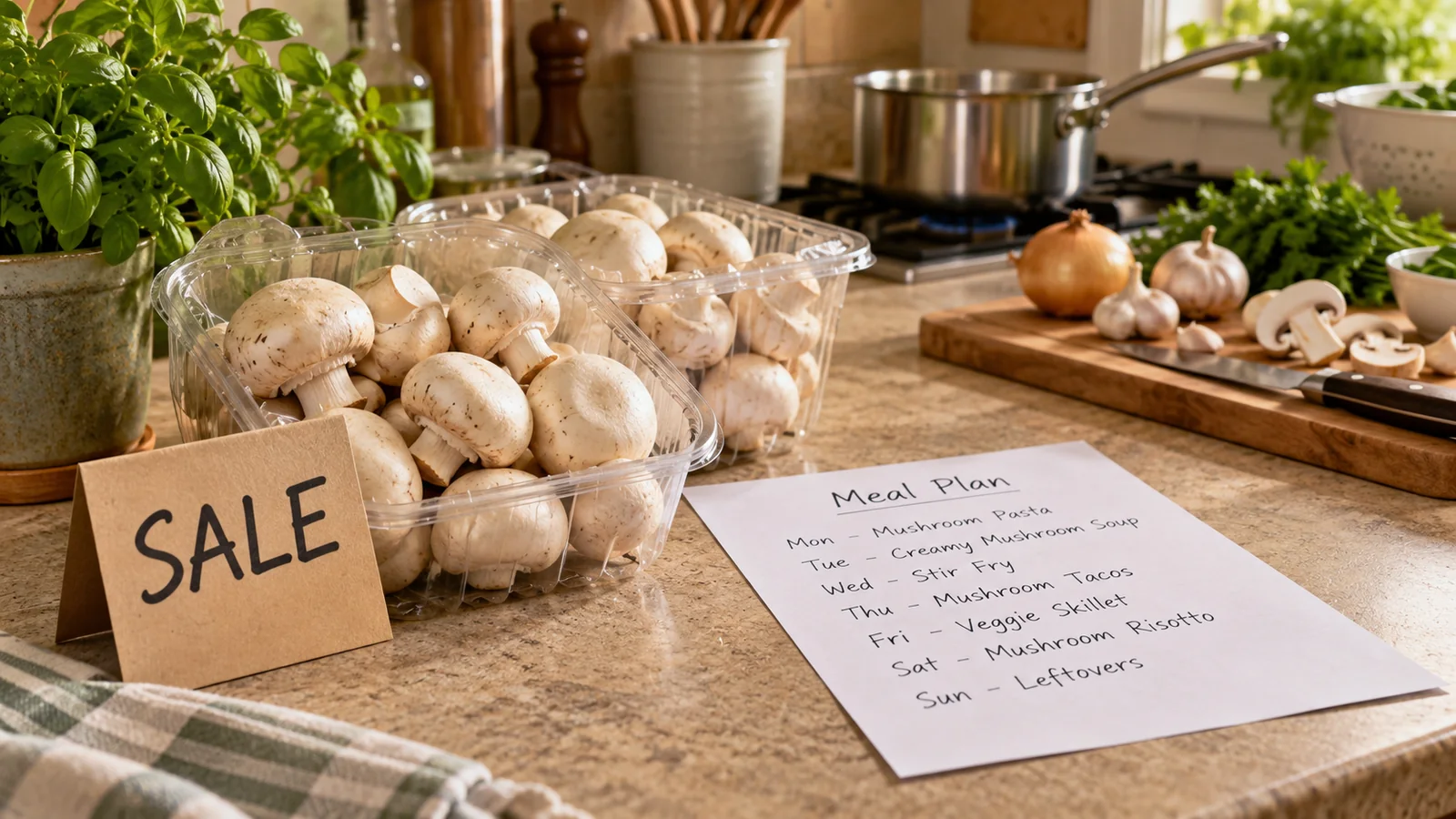
Cultivated mushrooms have no single cheapest month, so your best buying window is a good offer on the same product that you can actually use. Wild harvest seasons explain when stock is available, and bulk discounts save money only when your household uses enough of the extra amount.
Calendars can tell you when some wild mushrooms may appear, but you pay whatever a particular store offers. Getting a bargain means linking that offer to the same product, a comparable amount and a meal that will use it. For everyday cultivated mushrooms, your best buying window is usually a good local offer you can use. Picking a month from a general produce calendar does less for you, and waiting only pays when the later purchase lowers the real cost without upsetting the meal or creating waste.
Do Cultivated Mushroom Prices Move With the Season?
Farms grow white button mushrooms and cremini, and shops commonly sell them throughout the year. Mushroom farms do not wait for one outdoor harvest season before they can supply another crop. USDA's look at the mushroom industry notes that tight labor supplies have made it harder for farms to keep producing year-round. So a seasonal field-crop calendar gives an incomplete picture of the ordinary mushroom aisle.
Steady supply does not mean steady prices, though. Each store offer depends on more than whether a farm can grow mushrooms that month. The product, amount, packing, distribution and terms of sale can all change what you pay while cultivated supply carries on.
Note
No universal cheapest month
Year-round growing supports availability. It does not pick out the cheapest week at your store or prove that prices stay constant through the year.
Historical USDA producer figures show the difference, because they vary between marketing years. They give no monthly grocery timetable, but they are enough to show that continuous production and a fixed price are two separate claims. Sales on an everyday cultivated product may be useful whenever they appear. Their value depends on the price next to a comparable regular offer, and the date's likeness to another vegetable's harvest peak plays no part.
Holding back a recipe for a hoped-for seasonal bargain also costs something. If waiting means a separate shopping trip, a delivery fee or a pricier stand-in ingredient, a small cut on mushrooms may not lower the cost of the meal. Those are household sums, and they predict nothing about market prices. You can work them out from the real offers and your shopping plan, without assuming that a holiday, month-end or closing-time discount always comes.
Store routines call for the same restraint. Some retailers mark down products at set times, but you learn that by watching the retailer itself, and it makes no national rule about the best day to buy mushrooms.
When Are Wild Mushrooms Cheapest?
Wild mushrooms depend on conditions that differ from a controlled cultivated crop. Their fruiting windows can explain when fresh regional stock might be on sale, but availability and low prices remain separate questions. University of Illinois Extension gives a clear, bounded example for morels. Depending on the weather and location, the first Illinois morels may appear in late March to early April, and the season generally ends in May. The same page notes that morels are hard to cultivate, so you rarely find them in stores, and when you do they carry a hefty price.
That is evidence about a regional harvest window. It is no price record showing that April or May is the cheapest month for every buyer. Shops in another state may sell mushrooms from a different harvest region, and the sale date can reflect transport and distribution as well as local fruiting. So your local weather does not necessarily describe where the stock came from.
Morel season is therefore a starting point for a supply question: which region is supplying the seller now? Answering the price question would also need comparable offers for that product across the relevant dates.
Big harvests could create more supply, but that alone does not prove the lowest delivered retail price. The amount offered to the seller, the product's condition and the costs between harvest and purchase all stay part of the offer. The opposite mistake is assuming a scarce product must always be out of reach. Small amounts may fit a particular meal, while a large basket of cheap mushrooms may be more than your household can use.
Shopping at a farmers market stall can put the source and the current quantity within reach of a direct conversation. It still does not prove the stall is cheaper than a shop, especially when the products or weights differ.
Warning
Price does not establish identity
Wild mushrooms need a properly identified product and an accountable source. No seasonal label, bargain price or attractive look can show that an unfamiliar specimen is safe to eat.
Sound seasonal buying keeps these questions apart. Settle the food and its source first, then compare the actual offer, because a guessed bargain month answers neither step.
Matching a Price Figure to Your Purchase
Online mushroom prices often refer to different stages of sale. Growers' reported prices, terminal-market quotes and grocery pack prices are not interchangeable. USDA's August 2025 mushroom report gives a clear example. It reports an average of $1.64 per pound for the 2024-2025 marketing year, and it explains that the figure is the price producers receive at the point of first sale.
The report weights that average across the ways producers sell their crop, from packed sales by growers to bulk sales to brokers or repackers and some retail sales at roadside stands. So the figure is no promise that a supermarket should sell mushrooms at $1.64 per pound. Packaging, distribution, store costs and a different product mix can all sit between the first-sale average and the offer in front of you.
| Price observation | What it describes | What it can usefully tell a buyer |
|---|---|---|
| Producer first-sale average | Reported sales by growers over the stated period | Industry context within the report's definition, not a grocery target price |
| Terminal wholesale quotation | A specified wholesale product, pack and market | A comparable wholesale observation when the specifications match |
| Store shelf or advertised price | An offer for a particular consumer product | The purchase price after weight, eligibility and extra charges are checked |
| Personal purchase record | What you paid for a known product on a date | Whether the next equivalent offer is lower for your own shopping pattern |
The same report lists $1.56 for 2022-2023 and $1.65 for 2023-2024. Those figures show year-to-year changes within the reported measure. They reveal neither a cheapest month nor the current 2026 price at a shop. Averages also hide differences among single products and sellers, and a shift in the average can come from a change in the sales mix. That makes an average a poor stand-in for the mushrooms you actually buy.
White-button quotes are not automatically a yardstick for shiitake, dried porcini or a seasoned frozen blend. Even when a site lists all of them under mushrooms, the food and the unit still have to match.
Mushroom grades and size specs can change the comparison too. Packs chosen for even stuffing caps meet a different practical spec from sound mixed-size pieces bought for chopping. For a repeat purchase, the best guide is usually the same food in the same usable form at a store you can actually use. Wider market figures add context, but they cannot replace that comparison or remove shopping costs.
Keeping Your Own Price Record
Your price record can be small. It needs just enough detail to show whether the next offer buys the same thing for less, so it does not turn into a pile of unrelated package prices. The steady description covers the species or product name, whole or sliced form, net weight and any claim that changes the purchase. The date and the offer terms separate an ordinary price from a short promotion.
Pre-sliced mushrooms belong next to the same cut when you track that product's price. Comparing them with whole caps may still guide your choice of dinner ingredients, yet it mixes price timing with a convenience choice. Organic mushrooms bring a similar difference. Switching between certified and uncertified packs may be a fair budget choice, but it does not show that the same certified product got cheaper.
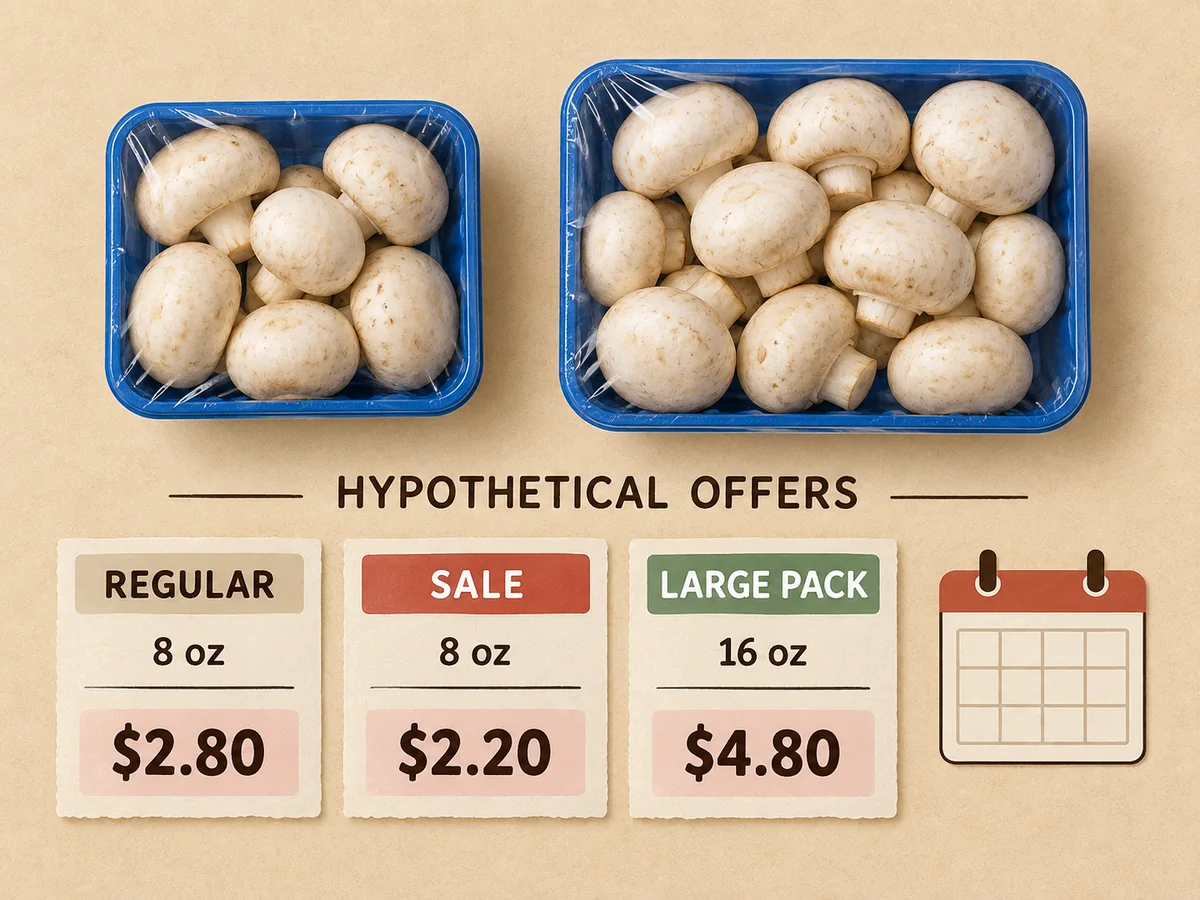
Suppose an 8-ounce pack usually costs $2.80 and later costs $2.20. For the same product and terms, that made-up sale saves $0.60 a pack, or about 21.4% of the regular price. A 16-ounce pack at $4.80 looks dearer at checkout than the $2.80 pack. Its price of $0.30 per ounce beats the small pack's regular $0.35, yet it loses to the small pack's sale price of $0.275.
These three made-up observations show why package size does not pick the winner. Two small packs on that sale would supply 16 ounces for $4.40, which is $0.40 less than the larger pack.
The result changes if the sale needs a coupon you cannot use or a membership you do not have. Promotional headlines do not show the real price until you apply their eligibility terms. Advertised "three for" prices also need reading. Some offers give the unit price on one pack, while others require all three, and the retailer's actual terms set what you pay at checkout.
Delivery fees can swamp a small saving when this purchase alone triggers them. Likewise, count a second trip that costs more than the discount, if your goal is lower total spending and not just a lower shelf price.
After several comparable observations, you have a personal reference price for a familiar product. That record can back a decision to buy a useful amount on a good offer, without claiming the same price exists elsewhere. It cannot guarantee what the store will charge next week. So use it to spot a worthwhile offer, and do not put off every ordinary purchase while waiting for a theoretical low. The meal, availability and total shopping cost stay part of the decision.
Does Buying in Bulk Pay?
Buying more lowers the unit price only when the terms actually do so. It lowers the cost of the food you eat only when your household uses enough of the extra amount. Take a second made-up offer: one 8-ounce pack costs $2.40, or three 8-ounce packs cost $6. The multibuy gives you 24 ounces at $0.25 per ounce, against $0.30 for the single pack.
The use threshold is 20 ounces, because $6 divided by $0.30 per ounce equals 20. Use less than that, and the money you spend per ounce eaten goes above the single-pack rate, even though the price per ounce bought was lower. This comparison simplifies things, since it assumes single packs are on hand when needed at the stated rate. Real meal sizes, whole-pack purchases and later prices can change the practical result.
If your household uses only 16 of the 24 ounces and throws out the rest, the $6 purchase costs $0.375 per ounce used. Two single packs would have supplied those 16 ounces for $4.80, so the bigger advertised bargain would have cost $1.20 more for the food eaten. If you use all 24 ounces, the three-pack offer saves $1.20 against three single packs at $2.40. The savings are real under those assumptions, and the extra meals are what let your household capture them.
Name those meals before you buy: perhaps one pack for dinner, one for another planned cooked dish and one prepared for later. "We will probably find something to do with it" leaves the saving hanging on a decision nobody has made. Storing fresh mushrooms protects a sound purchase, but storage cannot promise that an unplanned surplus will last until you need it. Your actual meal schedule counts for more than a generic shelf-life promise.
Spoiled mushrooms can wipe out the advantage, and they are no acceptable cost of buying cheap food. Rotten produce goes in the bin, and a discount does not change that. Cash at checkout is another limit. Spending $6 for a lower unit price may still be the wrong choice when your budget covers only the $2.40 pack you need tonight.
Sharing a bulk buy can work when the other household has a real use and gets its portion promptly, with proper handling. The saving then rests on a reliable arrangement, and buying extra in the hope that someone will take it does not count. So a multibuy is a conditional offer. The product, the minimum payment, the usable amount and your household plan all have to fit before the lower shelf unit price becomes a lower food cost.
Freezing a Bargain Takes Time and Space
Freezing mushrooms can stretch the use of a sound surplus, but it is part of the work of capturing the bargain. Buying extra creates a prep task and a storage commitment at the same time. The National Center for Home Food Preservation opens its mushroom guidance with sound mushrooms free from decay. Freezing a deteriorated purchase does not restore the quality it lacked when it went into the freezer.
Its prep steps include sorting by size, washing in cold water and trimming stem ends. Larger mushrooms get sliced or quartered, so the prep suits the pieces you are preserving. For the steam method, the stated times are 5 minutes for whole mushrooms, 3½ minutes for buttons or quarters, and 3 minutes for slices. Those are prep times for that method, and they are no evidence that any wild species becomes safe after those times.
The guidance also allows heating mushrooms in fat in a frying pan before freezing. Prompt cooling, draining where needed, packaging and sealing complete the prep. Leaving a fresh retail pack unopened is no substitute for following a preservation method.
Meals are already planned
Cook the needed quantity for the scheduled dishYou use the offer without adding an unplanned freezer task.
Sound surplus and available space
Prepare and freeze suitable meal-sized portionsThe saved quantity needs a method, containers and room to store it.
No time or storage capacity
Buy the smaller useful amountAvoid paying for food that has no workable use before deterioration.
Meal-sized portions make the later use concrete. You might pack a soup portion differently from the amount a sauce needs, but each one should match a dish your household expects to cook.
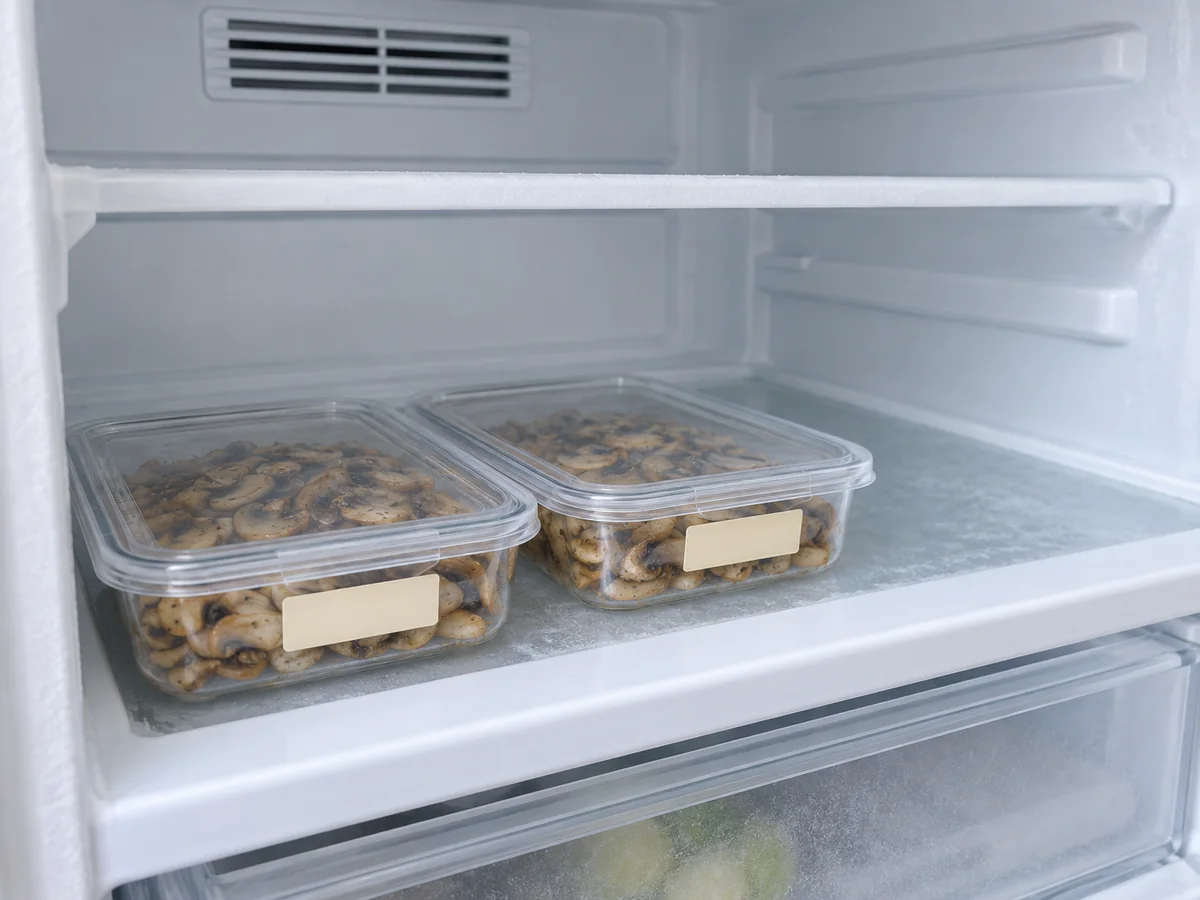
Packaging takes space as well as money. Freezers already full of planned food may make a bulk mushroom buy awkward, even when you have suitable containers. The prep time belongs in the decision too. If processing the surplus competes with an evening that already has no spare time, the lower unit price may create work your household cannot finish promptly.
Sauteing mushrooms before freezing adds a cooking step and ingredients. Those costs need not cancel the bargain, yet a savings claim should not quietly treat them as free when the comparison depends on them. Freezing also changes the product your future recipe gets. Frozen prepared portions suit many cooked dishes, yet they are not interchangeable with fresh whole caps chosen for a particular look.
FDA advises refrigerating perishable mushrooms at 40°F (4°C) or below while they wait for prep. The sale does not remove the need for proper storage between shopping and processing. The sensible sum is the saving on the amount you use, minus any extra costs that buying extra creates. Modest discounts can still pay when preserving fits your existing routine, while bigger ones can fail when the surplus has nowhere to go.
Switching Form Instead of Waiting for a Sale
Sometimes changing the form or amount of mushroom solves the budget problem more easily than waiting for fresh mushrooms to get cheaper. The right substitute depends on what the mushrooms do in the dish. Swapping fresh mushrooms for a frozen bag is one such choice. Prepared frozen products may suit a cooked soup or sauce, while a dish built around fresh whole caps may need a different purchase.
Compare the actual product and its added ingredients. Seasoned frozen mixtures are a different purchase from plain mushrooms, and their price covers more than the amount of mushroom. Dried mushrooms use another unit, because their water is gone. You cannot rank equal ounces of dried and fresh stock as if they were equal portions ready for the same recipe.
For a dish that needs mushroom flavor more than a plate of whole caps, a smaller recipe amount of dried stock may fit the budget. The cost is the amount that recipe uses, including any other mushrooms it needs, and no universal conversion between fresh and dried ounces stands in for it. Canned mushrooms may suit a cooked dish where their ready form is useful. The comparison needs the amount of food used after you account for packing liquid, and the label shows added salt or other ingredients.
Cheap cans are not automatically the cheapest way to supply every fresh-mushroom recipe. Texture, whole or cut pieces and whether you want the liquid in the dish can change how much of the purchase is useful.
Picture a made-up soup that uses $1.20 of dried mushrooms. It can cost less in mushroom ingredients than one that needs a $3.00 fresh pack. That example proves nothing about price per pound or texture. It shows why the recipe amount is the cost that counts for that meal.
The same reasoning supports buying a smaller fresh amount and using it where its texture counts most. No meal needs a large purchase just because mushrooms are on offer at a lower unit price. No universal ranking makes fresh, frozen, dried or canned mushrooms always win. The useful choice links the actual offer to the amount of food and the job the recipe needs.
For cultivated mushrooms, that approach is usually more reliable than a promised bargain month. For seasonal wild stock, the harvest window can explain availability, while the identified product, an accountable seller and the current offer still show whether the purchase is worth it.


