
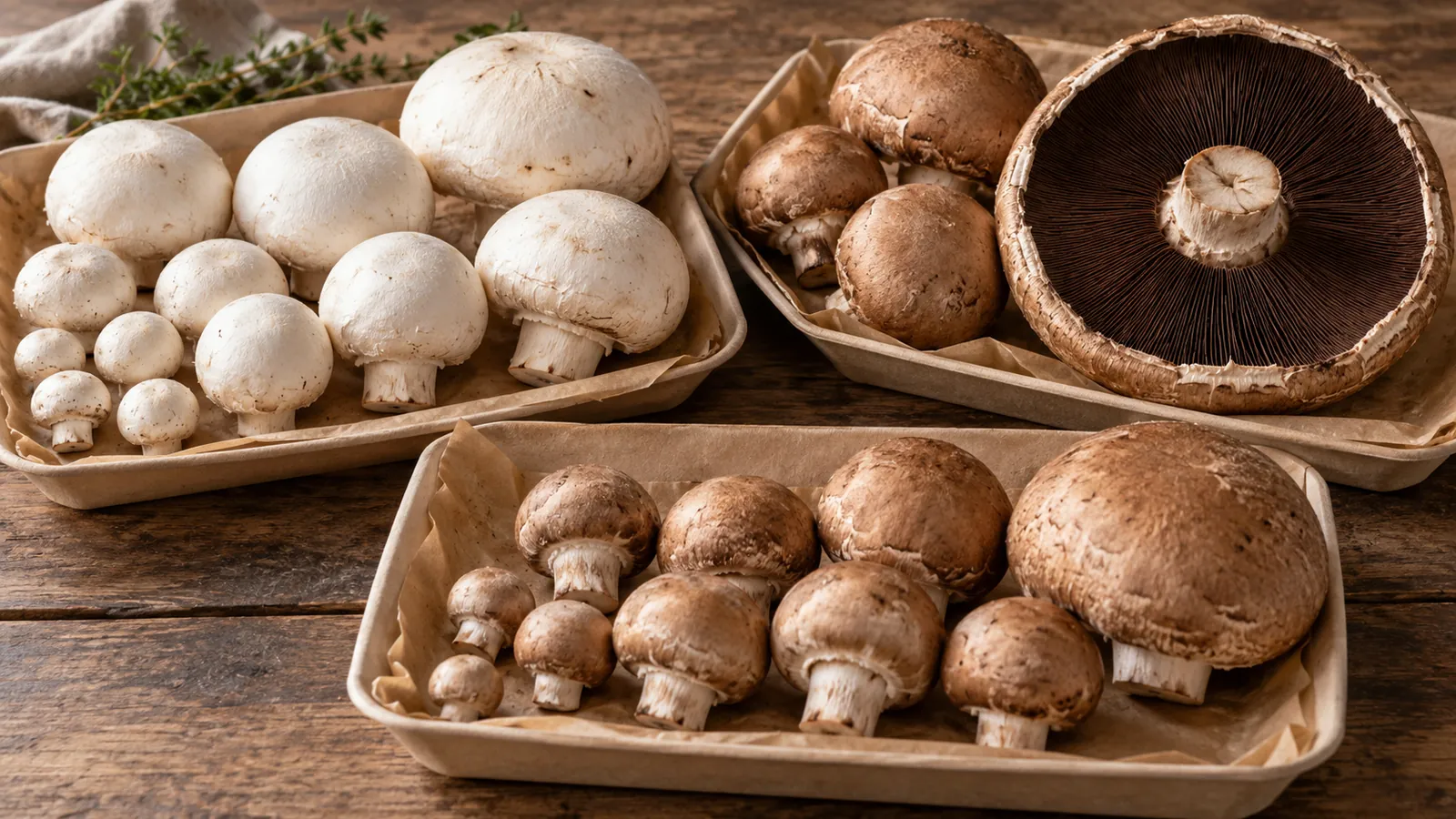
Official U.S. fresh mushroom grades describe quality, and cap size has its own separate specification. The current standards cover cultivated Agaricus mushrooms, so a seller's undefined Grade A label does not carry the same requirements.
What Do Mushroom Grades Mean?
Mushroom grades mean something only when the label names both the product and the grading system behind them. The current U.S. fresh standards judge quality in cultivated Agaricus bisporus. That species covers white buttons, brown buttons and Portabella mushrooms. The standards do not give every oyster, shiitake or wild mushroom sold in the United States an official fresh grade. Specialty sellers may use letters or size classes of their own, and only that seller's specification can tell you what they mean.
Official quality grades and cap-size specifications are separate things. Small mushrooms can meet a high quality grade, and large ones can fail on condition or defects. USDA's fresh mushroom standards, effective September 24, 2026, name U.S. No. 1 and U.S. No. 2 for fresh button mushrooms, plus a separate U.S. No. 1 Portabella grade. Older summaries that tie a default small-to-medium or large cutoff to each fresh grade do not describe this current framework.
Telling the Labels Apart
| Label or claim | What it describes | What it does not establish |
|---|---|---|
| U.S. No. 1 fresh buttons | A quality grade with requirements for firmness, maturity, shape, trimming and defects, subject to lot tolerances | A particular cap diameter, perfect individual pack or wild-specimen identity |
| U.S. No. 2 fresh buttons | The same baseline requirements with greater allowances for open veils and defects | Permission to accept rotten food at home or a fixed lower flavor score |
| U.S. No. 1 Portabella | A separate quality grade for open cultivated Agaricus mushrooms | A failure merely because the gills are exposed |
| Minimum or maximum cap diameter | A dimensional buying specification | Quality, freshness or flavor by itself |
| An undefined seller Grade A | A claim whose criteria the seller needs to explain | Automatic equivalence to an official fresh USDA grade |
| U.S. Grade A canned mushrooms | A grade within the separate canned-mushroom standard | A fresh button grade or a universal grade for dried mushrooms |
U.S. No. 1 fresh buttons must be mature, firm, fairly well shaped and well trimmed. The standard also protects against insect injury, disease, decay and damage. USDA's overview of mushroom grades gives U.S. No. 2 a greater tolerance for open veils and a larger share of defects. That lower grade does not mean a different species or make any promise about taste.
The Portabella grade covers a mushroom that growers sell open on purpose. Judging it by closed-button rules would mistake the stage a buyer wants for a defect in a different commercial form.
Grade A Needs Its Full Context
USDA uses U.S. Grade A in its canned-mushroom grades, which weigh color, character, defects and uniformity. That official canned grade does not carry over to a fresh or dried pack just because the same letter appears on its label. Grade A on a seller's dried shiitake may refer to size, whole caps or the supplier's own appearance rules. Without a named standard and a usable description, you cannot compare that letter with another seller's Grade A.
This distinction counts when you weigh canned mushrooms against fresh ones for a meal. The canned quality grade covers that processed product, while its softer texture and your recipe's needs remain a separate buying decision. Likewise, buying dried mushrooms means paying attention to the named species, whole versus broken pieces and the intended use. No letter grade can supply those details when the package leaves them out.
The fresh standard itself calls these voluntary U.S. grade standards, written as a common basis for buying and selling. The standards also state that meeting them does not excuse failures under applicable food laws. So a grade cannot replace the legal duties that govern the food's sale.
Fresh, Dried, Canned or FrozenShould You Buy Organic Mushrooms? What Certification CoversOpen Veils and Button Grades
In a button mushroom, the veil is the membrane between the cap edge and the stem that first covers the gills. As the mushroom develops, that covering can break and expose the gill surface. The 2026 standard counts an open veil as a defect when the broken covering and exposed gills noticeably spoil the look. So the grade comparison concerns one commercial button form, and visible gills on their own do not signal spoilage.
Maturity Is Not Another Word for a Closed Cap
USDA defines mature as showing normal growth for the type. Closed buttons and open Portabellas can each show proper growth for the form the buyer wants. The Portabella definition describes an open cap with fully exposed gills, no veil left and a slight downturn or cup at the edge. Buyers of that commercial form expect its open underside.
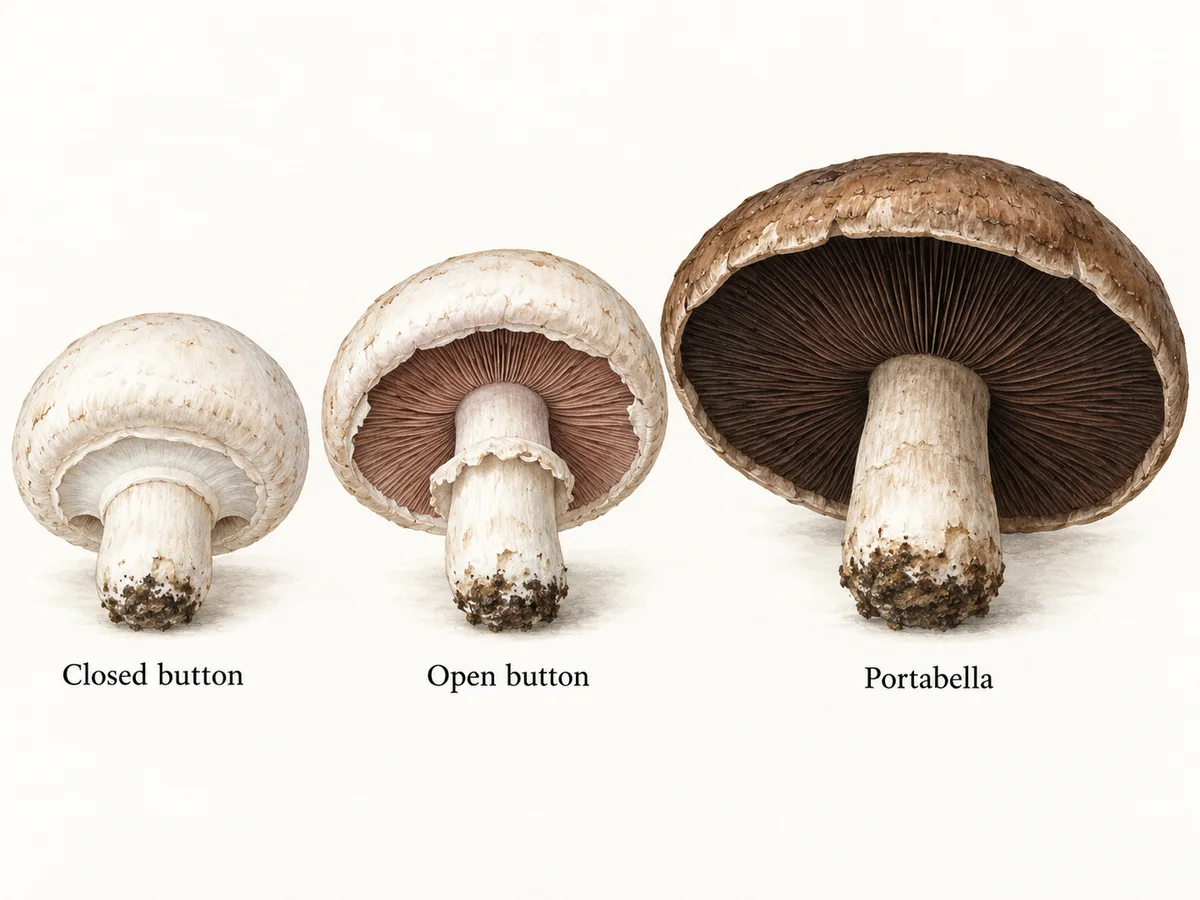
Buyers who want stuffing cups may prefer sound caps that hold their shape, while others want broad Portabella caps on purpose. The planned dish explains that preference better than any claim that open mushrooms are lower quality.
Note
Exposure is not a freshness verdict
Open button veils can affect a commercial grade, and an open Portabella is an intended product. Neither observation alone establishes the mushroom's storage history, current suitability for eating or the identity of a wild specimen.
White buttons, cremini and Portabella all sit in the cultivated Agaricus buying group, but their looks differ. Brown surface color is a normal trait of the product, while unwanted discoloration or damaged flesh needs judging against the type's expected condition. The gills also change appearance as Agaricus develops. Portabellas have dark undersides, so the look of a white outer cap is the wrong yardstick for them. Cutting out those gills for a recipe is a kitchen choice, and it cannot upgrade the official lot grade.
Firmness Answers a Different Question
The current standard defines firm as not yielding to moderate pressure, with a cap that is not shriveled, wilted or spongy. That gives quality language a clearer meaning than "fresh-looking" on a sign. It does not invite you to squeeze every mushroom in a store display. With permission, a look at the pack and a gentle check can separate sound structure from marked decline without damaging loose food.
Firmness and veil exposure vary on their own. Buttons with an opened veil may still have firm flesh, while a closed cap can turn wilted or spongy and fail another part of the requirements. So the underside is only one part of the buying decision. One photo of a closed cap cannot show the full grade, and an exposed underside cannot show that a wild mushroom is edible.
Cap Size Is Its Own Specification
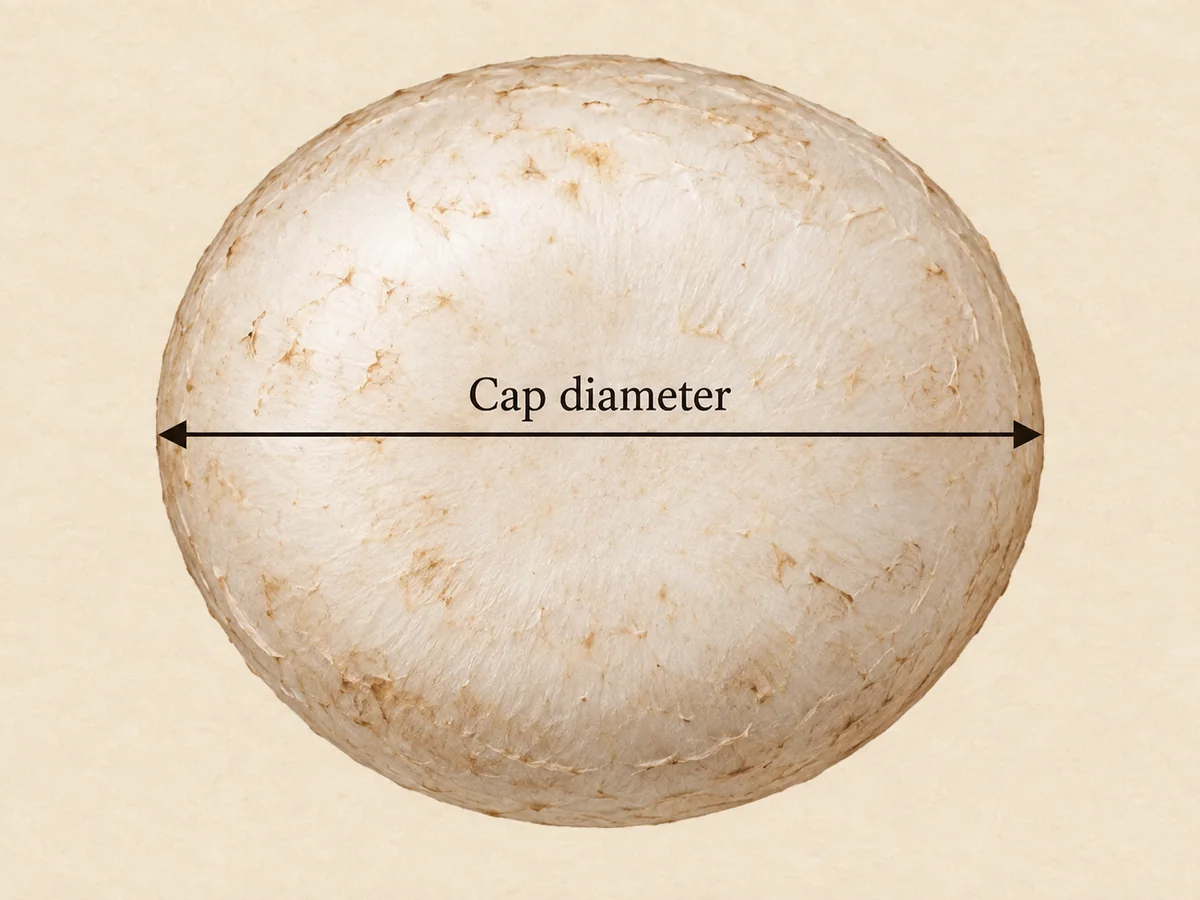
The current fresh standard lets a buyer specify a minimum diameter, a maximum diameter or both. It defines diameter as the greatest width across the cap, measured at right angles to the stem. For a normally placed mushroom, that is the cap's width, and not the distance from stem base to cap top. Irregular caps get measured across their widest span, never across a narrower line that makes them fit the advertised size.
A Number Beats "Large"
Large may be a seller's shorthand, but two suppliers can use it for different sizes. Orders that depend on size become clearer when they give a real cap-diameter range and the product form expected.
Take a made-up stuffing plan that needs eight sound caps of roughly the same usable size. One-pound packs can meet the weight and still hold too few caps, or too much variation, for that presentation. Sauces that chop the mushrooms finely, on the other hand, have little use for a narrow diameter range. Paying for even sizes in that meal buys a feature the knife will remove.
The dimensions that count can be narrower than overall width. Cap depth and structural soundness shape how a stuffing cup behaves, so diameter alone cannot promise that every mushroom holds the same amount of filling.
The Older Size Split Is Gone
The older fresh standard used a 1⅝-inch line between small-to-medium and large, as an earlier USDA notice on revising the standard records. The September 2026 standard moves size into a separate section that allows stated minimum and maximum diameters. That change makes the split between quality and size explicit. Current purchase specs can ask for both a grade and a size range, and neither term stands in for the other.
The standard also allows a by-weight off-size tolerance for a lot, so a stated diameter does not promise identical pieces in every package. Retail shoppers still need to look at whether the actual caps suit the planned dish. Pre-sliced mushrooms have already lost most of the whole-cap detail a size spec describes. For them, slice thickness, piece soundness and cooking method count for more than the diameter the whole cap once had.
Quality and PriceWhen Are Mushrooms Cheapest? Seasons, Sales and Bulk BuysLot Tolerances and Single Packs
Fresh grades allow for normal variation in commercial lots through set tolerances measured by weight. They are no defect-free guarantee for every mushroom, and they give no exact count of defective pieces allowed in a small retail pack. Where the lot gets assessed also counts. USDA lists different allowances at the shipping point and en route or at the destination, so a percentage quoted without that context is incomplete.
The Current Button Allowances
| Fresh button grade and assessment point | Open veils, by weight | Failures of the remaining grade requirements, by weight | Disease excluding spots, or decay, within that latter allowance |
|---|---|---|---|
| U.S. No. 1 at shipping point | 5% | 8% | No more than 1% |
| U.S. No. 1 en route or at destination | 10% | 12% | No more than 2% |
| U.S. No. 2 at shipping point | 10% | 12% | No more than 1% |
| U.S. No. 2 en route or at destination | 25% | 15% | No more than 2% |
These are the September 2026 button figures, and they are not the full rule set for every mushroom product. The detailed standard also limits permanent defects within the destination allowances, and it gives the Portabella grade its own defect tolerances. Open veils do not appear as a Portabella defect, because exposed gills belong to that form. Applying the button table to Portabella would give the wrong reading.
Why Weight Counts: A Worked Example
Picture a made-up 100-pound lot of U.S. No. 1 buttons assessed at the shipping point. Its open-veil allowance equals five pounds, and the separate allowance for failing the remaining requirements equals eight pounds. Disease or decay within that eight-pound group may not exceed one pound. That pound sits inside the eight-pound allowance and does not add on top of it.
This example does not mean a simple thirteen-pound pile of rejected food. Inspectors assess the categories and defects of real mushrooms under the standard. Nor can you convert the weights into a piece count without knowing what each mushroom weighs. Ten small mushrooms and ten large ones add different amounts to a by-weight sum. So counting blemished pieces through a lid cannot reproduce a professional lot assessment.
Small Packs Can Differ From the Lot Average
The standard sets limits for individual packages while requiring the whole lot average to stay within the grade tolerance. Packages over one pound, packages of one pound or less, and packages of four or fewer mushrooms each have their own rules. That structure explains why a small package can vary more than the headline lot percentage suggests. The package rule does not erase the lot rule, and the lot rule does not guarantee that every small package looks the same.
For size, the standard allows ten percent by weight outside a stated diameter in a lot. So when a recipe needs an exact number of matching caps, look at the actual package and do not lean on a lot-level size claim alone.
Warning
Commercial tolerances are not eating allowances
Disease-or-decay tolerances in an inspected lot give no permission to consume rotten mushrooms, and they set no share of spoilage to accept at home. FDA's household produce guidance says to throw out rotten produce.
These tolerances explain a commercial label and a purchase specification. As a home buyer, your useful question is still whether the food you received is sound and suits the planned dish.
Which Grade Suits Which Dish?
Uniform caps earn their price when a recipe uses the mushroom's whole shape. Stuffing cups or whole grilled caps may need similar sizes so the portions and cooking stay consistent. Chopped fillings, sauces and mixed sautes remove most of that visible sameness. Sound mushrooms with ordinary size variation can suit those dishes without the look of a pricey whole-cap pack.
So pay for a feature your cooking method actually uses, and skip the highest label for its own sake. No. 2 is not a measured flavor score, and No. 1 does not mean a mushroom will brown well in a crowded, wet pan.
Stuffed whole caps
Pay attention to intact structure and usable cap countShape and size remain visible in the finished serving, so weight alone may not provide enough suitable caps.
Whole Portabella cooking
Match cap dimensions and sound condition to the planned portionsThe intended open form fits this preparation, while the button open-veil rule does not.
Chopped sauces and fillings
Value sound useful flesh over cosmetic size matchingChopping removes the whole-cap presentation advantage but cannot repair deteriorated food.
Whole, Trimmed and Sliced Prices Use Different Bases
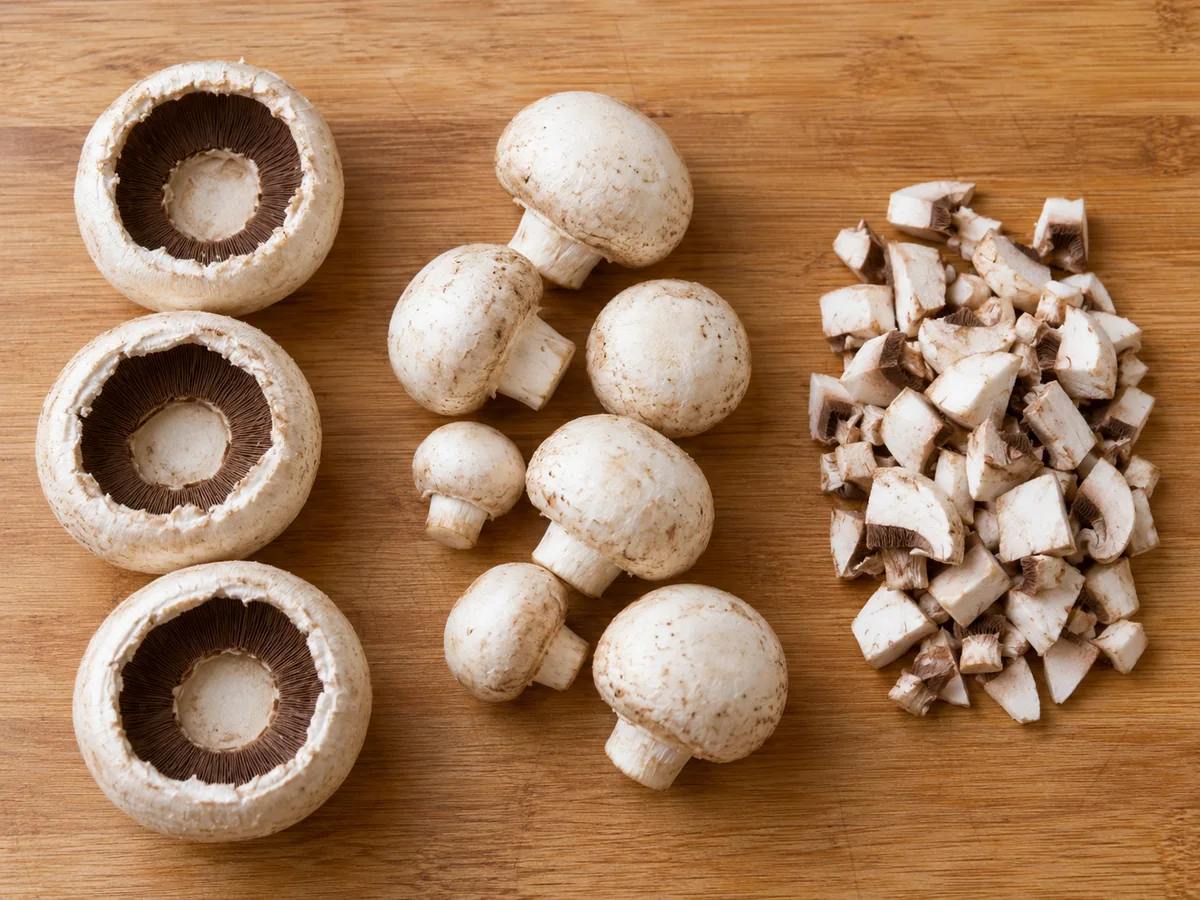
Untrimmed purchases can include parts a recipe will not use. USDA's well-trimmed definition covers the stem cut and rough butt. If you use the caps alone, you create extra trim loss beyond that commercial definition. Button and cremini stems may still work in a chopped dish, even when a stuffing recipe removes them from the cups. Tough stems or unwanted parts change the recipe's usable weight, yet they do not prove that every mushroom stem belongs in the bin.
Suppose a made-up dinner needs eight stuffing cups, and two one-pound packs each hold twelve mushrooms. One pack has ten sound caps that fit the planned portions. The other has only six suitable cups and six smaller caps. The first pack supplies the eight cups, while the second leaves the meal two cups short with the same total weight and mushroom count.
The smaller caps remain good food for another dish, but meeting a grade does not turn them into matched stuffing portions. This example rests on a made-up recipe need, and the USDA standard sets no such size threshold. Pre-sliced stock may save work when the meal calls for slices, yet it no longer offers whole caps for stuffing. Its convenience premium pays off only when the form fits the task and the cut pieces are still sound.
Cooking Loss Does Not Lower the Grade
Sauteing mushrooms releases water before steady browning, and the finished portion weighs less than the raw usable food. That water loss is part of cooking, separate from trimming stems or throwing out damaged pieces before the pan. Bigger caps also do not automatically cook up firmer. Slice thickness, crowding and cooking method change the outcome regardless of the commercial diameter spec.
Whether to buy frozen or fresh raises yet another question, about the form and texture your dish needs. Fresh quality grades cannot describe what freezing does, while a handy frozen portion may fit a cooked mixture without matching a fresh whole-cap look. Grilled Portabellas use broad caps as portions, so cap size and condition count directly. Even so, no grade label can give the exact cooking time for a given cap thickness or clear an unidentified wild mushroom for that method.
Does a Higher Grade Guarantee Good Mushrooms?
Grades describe how a product met a particular standard when someone assessed it. They do not fix its condition for the rest of its life. Handling and time can change the mushrooms after grading. So a pack with a familiar grade can still arrive with condition problems the label does not solve. Judge the actual purchase, and ask for a replacement or an explanation when the stock is bad. The grade is no reason to ignore decline.
Four Questions to Ask of a Grade Label
For a restaurant or institutional order, a written spec can separate grade, size range, pack weight and intended form. That gives the supplier a clearer requirement than asking for premium mushrooms and leaving the real criteria unstated. For a small household purchase, looking at the actual pack may count for more than a formal lot spec. The label gives context, but a count of suitable whole caps answers a stuffing question more directly.
Storage Is Still a Food-Handling Job
FDA produce guidance lists mushrooms among perishable produce that belongs in a clean refrigerator at 40°F or below, approximately 4°C. No grade replaces that temperature rule or shows whether anyone kept to it throughout handling. Storing fresh mushrooms also means paying attention to moisture in the packaging. Neither a higher grade nor a larger cap protects a damp purchase sealed into the wrong storage.
Cleaning mushrooms removes ordinary debris before cooking, but it cannot restore rotten stock. FDA's instruction to throw out rotten produce still applies, whatever commercial tolerance the label mentions. Freezing mushrooms can be a separate plan for good food you will not use fresh. It does not reset an uncertain handling history or turn a grade claim into a preservation guarantee.
Grade, organic status, cultivated source and species identity describe different things. No fresh USDA mushroom grade certifies a wild specimen as edible, and a private letter grade cannot fill in missing source or identity details.


