
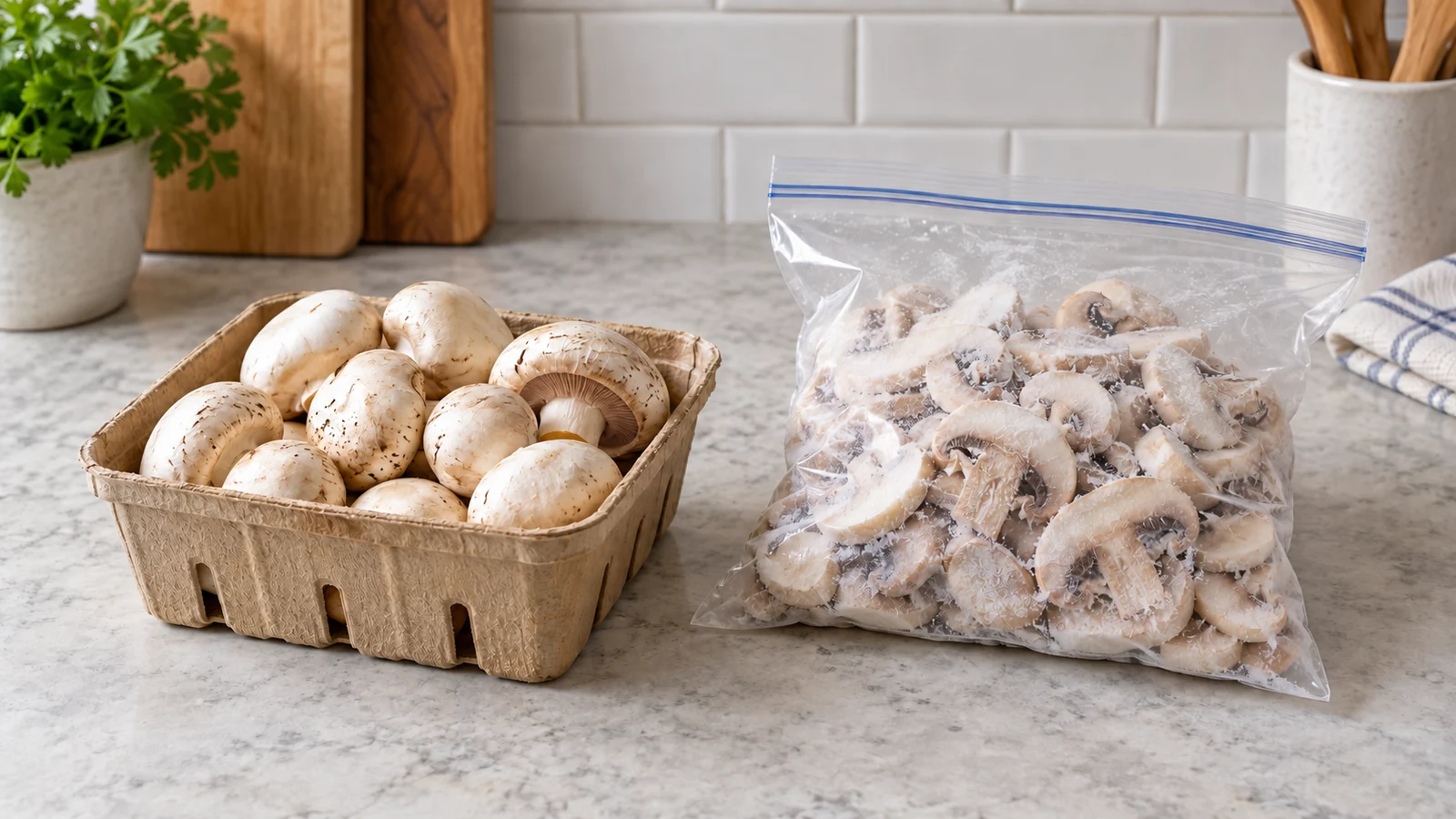
Frozen mushrooms often fit soups and sauces, while fresh mushrooms give you more control over a firm bite, whole caps and browning. The preparation printed on the frozen bag and the amount you will actually use can change which pack is better value.
Frozen mushrooms earn their place when you want pieces on hand for several cooked meals without finishing a fresh pack at once. They make a less predictable swap when the recipe depends on a firm whole cap, or on slices that brown before anything else goes into the pan. Any fair comparison starts with the same kind of mushroom in good condition. Fresh white buttons, Agaricus bisporus, and a frozen mix containing porcini, Boletus edulis, differ in species as well as storage form, so freezing alone cannot explain their price and flavor.
Which Dishes Suit Frozen Mushrooms?
Where the released liquid goes counts for more than whether the mushrooms started in the fresh aisle. Sauces can keep that liquid, while toppings need enough of it to boil off before the pieces go onto the finished dish. Freezing can change both mushroom texture and the amount of moisture that comes out after thawing.
How much texture survives depends on the processing, and no fixed loss applies to every bag. USDA's frozen mushroom specification notes that sauteing before freezing lets the mushroom keep its cell structure through freezing and thawing. Fresh, firm mushrooms give you more control over the starting texture. That control pays off in thick pieces you expect to bite through, or in whole caps that must hold their shape. Once you chop the mushroom into a simmered filling, the gap between the fresh and frozen bite may shrink to very little.
| Intended result | Where frozen mushrooms fit | Why fresh may be preferable |
|---|---|---|
| Soup, braise or mushroom sauce | Released liquid can join the cooking liquid | Fresh helps when a particular firm piece or whole cap is central to the dish |
| Browned slices served separately | A suitable product can work after surface moisture is managed | Fresh lets you choose slice thickness and control the wet stage from the beginning |
| Thin pizza or toast topping | Prepared mushrooms can work if excess liquid is dealt with before assembly | Fresh offers more control over both cut and moisture, though it still needs suitable preparation |
| Stuffed caps or substantial pieces on skewers | Only a bag containing the needed intact form is a possible substitute | Whole fresh mushrooms leave the shape and cutting decision to you |
Soups and Sauces Can Use the Liquid
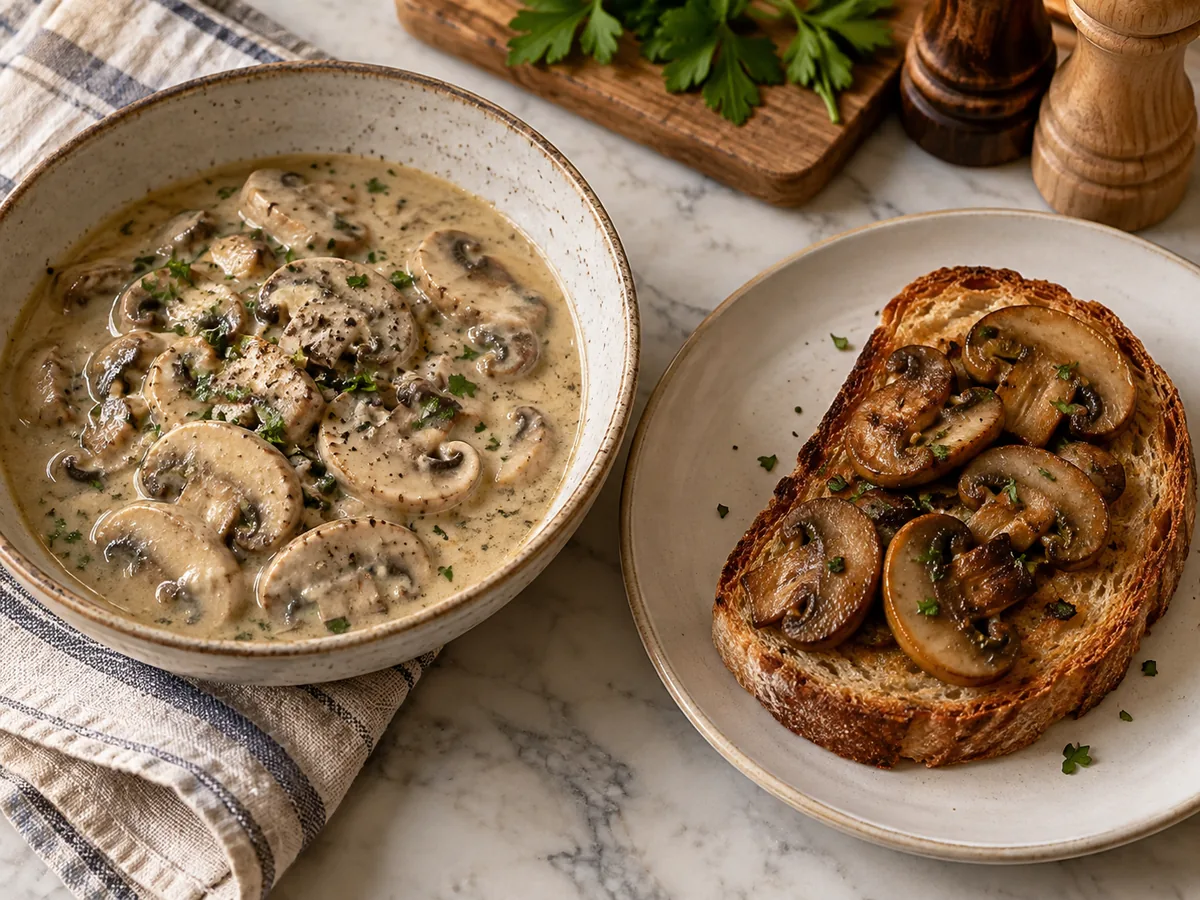
In a mushroom sauce, the released juices can become part of the liquid you reduce or thicken. Your cooking plan still has to allow for them, because a recipe with a fixed small amount of liquid can turn out thinner than intended. Plain frozen slices therefore make a useful reserve for a sauce you can adjust as it cooks. They offer less when the dish needs a set number of matching caps and the bag holds a mix of slices and fragments. This weighs the finished meal and makes no claim that frozen mushrooms match fresh ones.
Browning Needs Room for the Water
Wet pans spend heat on boiling off water before mushroom surfaces can take on the browned finish you want. Fresh mushrooms release water too, so buying fresh does not remove the need to manage pan load and cooking stages. Sauteing mushrooms is easier to plan when the pieces share a similar thickness and the pan has room for the batch. Large frozen loads add both cold mass and released liquid, which can stretch a short browning step past what the recipe assumes.
For a dry topping, cooking the mushrooms separately gives their liquid somewhere to go before the topping meets bread or pizza dough. Bags sold already roasted or sauteed may suit that job better than a minimally processed bag, depending on their directions and ingredients.
Quality and PriceBuying Mushrooms at a Farmers Market: Source, Weight, ValueIQF, Blanched and Roasted: What the Bag Holds
IQF means individually quick frozen. The term describes pieces frozen separately, which you can usually portion out, and it does not tell you whether anyone cooked them before freezing. USDA's commercial mushroom specification separates fresh IQF, blanched, fire-roasted, sauteed and sauteed-roasted forms. Those are different starting ingredients, even though all of them arrive frozen.
Raw, Blanched and Browned Pieces Have Different Jobs
Minimally processed mushrooms release flavor and moisture into a dish as they cook. Blanching heats the mushroom briefly and stops the enzymes linked to browning, yet it does not give the piece the surface of a roasted one. Roasted or sauteed products have already gone through a different heat treatment, so your recipe may need less of that work. Their labels still say whether they are ready to eat, need more cooking, or carry seasoning you have to account for. The frozen state alone answers none of those questions.
Home freezing mushrooms is a separate choice with its own method. Advice to steam or saute mushrooms before freezing them at home tells you nothing about how a commercial processor made a retail bag.
Read the Ingredient List Before You Compare
One real example is Picard's plain sliced button mushroom product, which lists mushrooms as its only ingredient. So a frozen product does not have to contain added oil or salt, and that bag is no recommendation for every shopper. Seasoned mushroom side dishes are a different purchase from plain pieces you will add to your own sauce. Oil, salt, herbs or a sauce change how much mushroom the pack holds and how much say you keep over the finished recipe.
Nutrition comparisons need the same care, with matching serving sizes and ingredients before a label difference means much. Blanket claims that fresh or frozen mushrooms are healthier would hide the product differences you actually need to compare.
Species and Cuts Can Outweigh the Storage Form
Mixed bags are not necessarily a cheaper version of the fresh mushroom beside them. Their declared species, the proportions when the label gives them, and the piece sizes tell you what ingredient you are buying. Porcini bring a different kitchen character from white buttons, while a bag of button slices gives a more direct match for a fresh button pack. Unspecified mushroom mixes leave you less sure which species will lead each portion.
Cuts can also take choices away. Slices cannot become whole stuffed caps, and small fragments cannot give you the large pieces that quartered fresh mushrooms do. Stems may work in a chopped dish, but the species and how tough those pieces are still count.
Canned mushrooms start from yet another state, with heat processing and packing liquid. Their shelf stability does not make them a fair yardstick for judging an IQF bag by package weight alone.
Quality and PriceWhat Do Mushroom Grades Mean? USDA Quality, Size and PacksIs Frozen Cheaper Than Fresh?
Price per pound or per kilogram makes the first comparison fair. It does not tell you whether your household will use the pack, whether it holds the cut your meal needs, or what cooked yield to expect. Suppose an 8-ounce fresh pack costs $2.50 and a 16-ounce frozen bag costs $4.00, both made-up prices. Multiplying the fresh pack's price by two gives $5.00 per pound, against $4.00 per pound for the frozen bag.
Comparing only $2.50 with $4.00 makes the smaller fresh pack look cheaper, even though it holds half as much food. The example also assumes similar mushrooms, with no sauce or other large ingredient changing what the bag holds.
Bought Weight and Used Weight Differ
If you use all eight ounces of the fresh pack, its cost stays at $5.00 per pound of purchased weight. If four ounces go unused and end up in the bin, the same $2.50 bought only four ounces you actually used, which works out to $10.00 per used pound. That second figure describes one household's outcome. It is no shelf price, and it does not predict that fresh mushrooms normally lose half their value.
Finishing a smaller fresh pack can beat buying a larger bargain you cannot use. Frozen portions ease that pressure when the rest of the bag stays properly frozen for another meal. The benefit disappears if the whole bag thaws during prep, or if the leftover pieces sit exposed until their quality drops.
Storing fresh mushrooms well protects the fresh option, but it cannot turn a perishable pack into an endless reserve. The best amount to buy follows the meals you expect to cook while the mushrooms are still good to use.
Cooking Loss Is Not Automatically Waste
Fresh and frozen mushrooms both get lighter as they cook. Water that boils off in the pan is different from mushrooms thrown out because they spoiled, and liquid kept in a soup still feeds that meal. No reliable universal percentage exists to subtract from every frozen bag before you work out its value. Plain fresh IQF products and prepared roasted ones may also start at different points in the cooking.
Price per cooked portion can work once you know the yield from your own product and method. Until then, matched package weight plus a realistic plan for using it is more honest than a made-up shrinkage allowance. This arithmetic leaves out the running cost of a freezer, cooking energy and your prep time. Those costs may count, but the unit-price label does not measure them.
Storing and Cooking a Frozen Bag
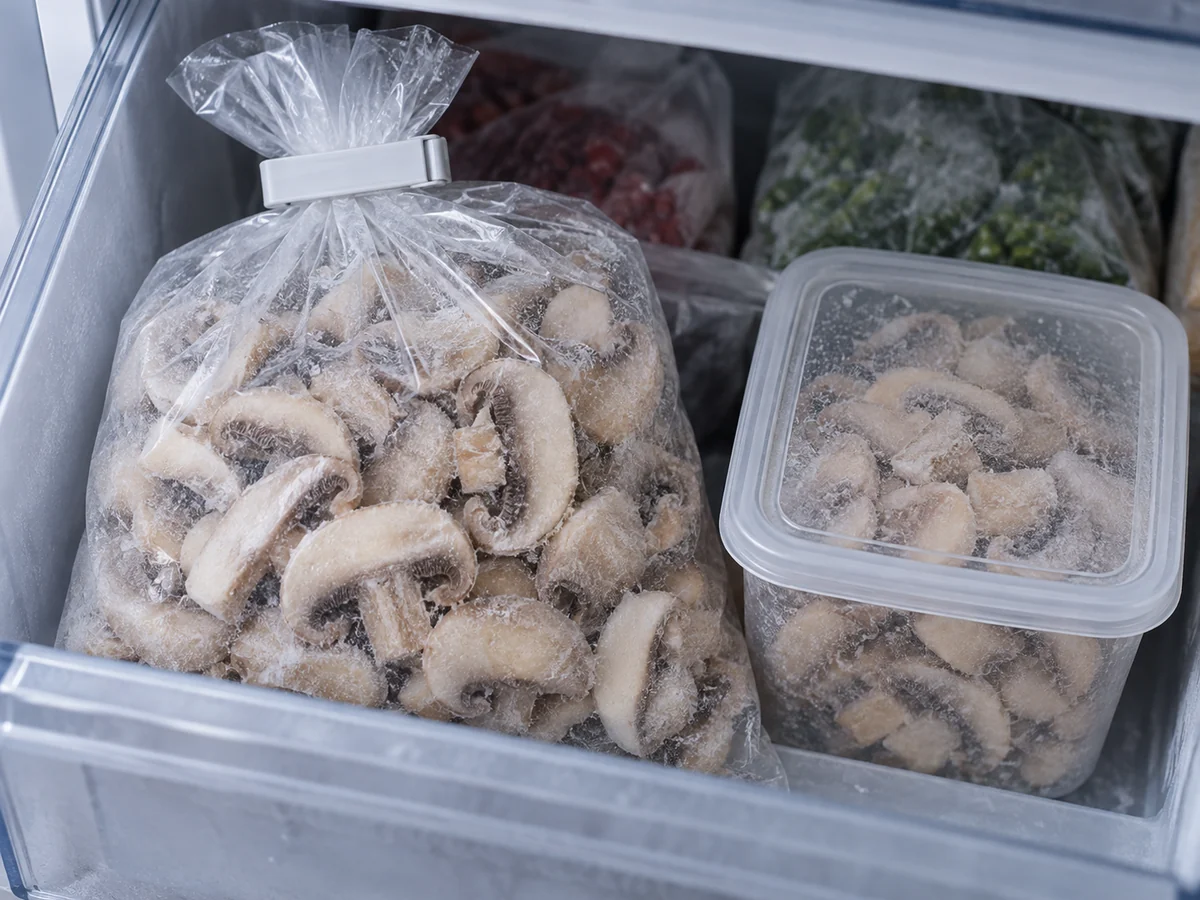
Frozen reserves need storage that keeps them cold and protects them from air. Taking out one portion and promptly closing the rest means the next meal starts with the product the package instructions describe. Picard's plain sliced product, for example, calls for storage at 0°F (-18°C) until the date on the package and forbids refreezing after thawing. Other products may say something different, so that instruction belongs to the named bag and not to every mushroom in the freezer aisle.
Freezer Quality and Food Safety Are Separate
Air exposure can dry frozen food and cause freezer burn, leaving unpleasantly dry or tough patches. The FDA treats freezer burn as a quality issue, and freezer burn by itself does not make the food unsafe. That point does not clear a damaged bag or food with an unknown thawing history. Freezing does not kill most bacteria; it only stops them from growing while the food stays frozen, so bacteria that survive can grow again once the mushrooms thaw.
Resealable bags make portioning easier, but they do not prove the product always stayed cold. Visible frost or clumping alone cannot rebuild the pack's full temperature history either.
Warning
Frozen does not mean ready to eat
Follow the cooking, storage and thawing directions on the actual package. Good looks cannot prove that mishandled mushrooms are safe.
The Package Sets the Cooking Method
Manufacturers may tell you to cook straight from frozen, or set another preparation for their particular product. Pan quantity, appliance and treatment all count, so a cooking time from one bag is no reliable shortcut for another. Picard's example lists six minutes in the pan for 450 grams and nine minutes for one kilogram. That gap shows you cannot keep the same short time for a larger amount without checking the product directions.
The bag is the right buy when its state, cut and cooking directions fit the meal you plan to make. If they do not, a fresh pack with the shape you need gives you more control, even at a higher unit price.


