
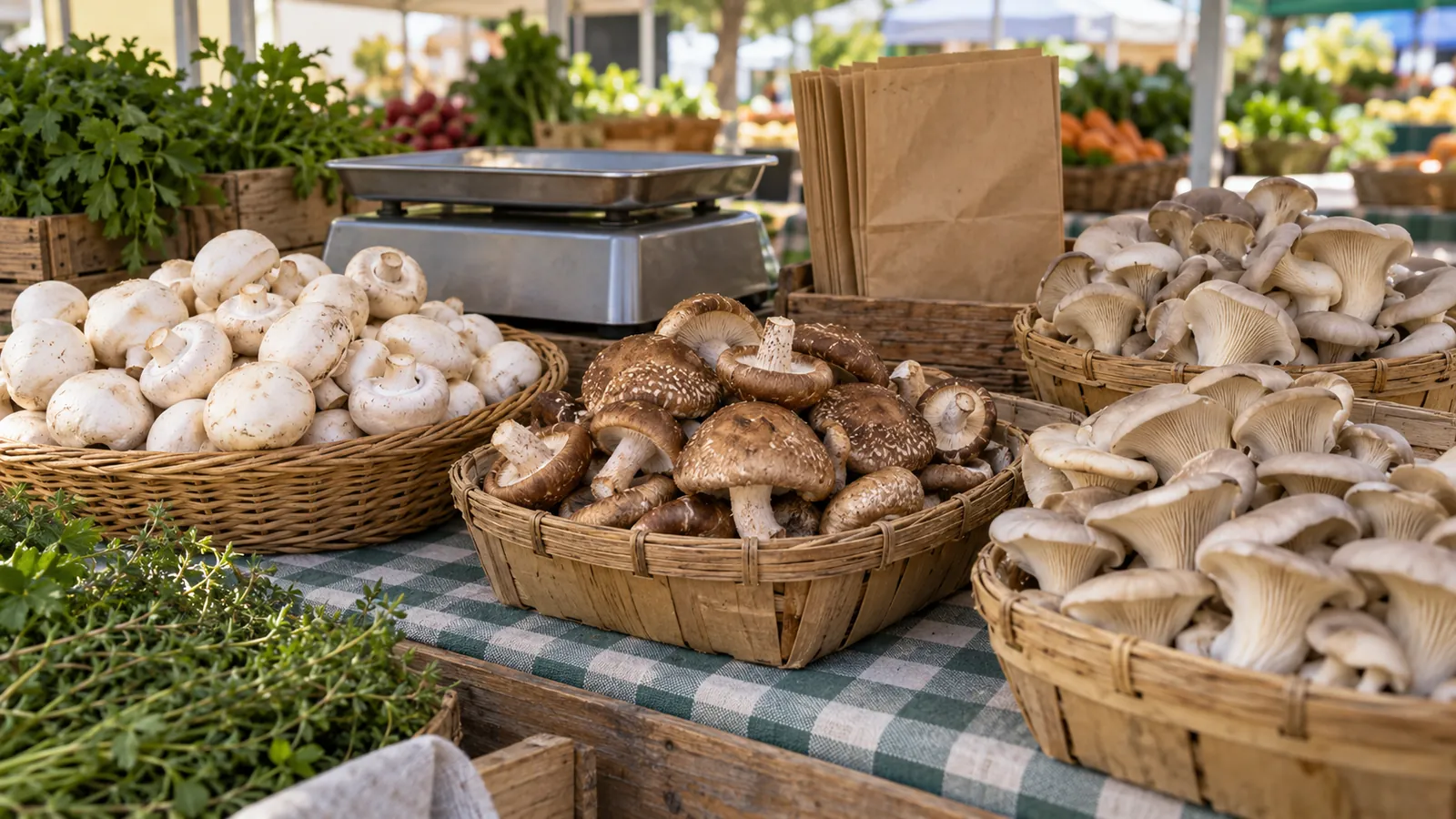
Cultivated mushrooms from a seller who can explain where they came from are the clearest starting point at a farmers market. Fresh condition, useful weight and a cool trip home tell you more than an attractive basket or a low displayed price.
What Should You Ask a Mushroom Seller?
Your first question at a mushroom stall is whether someone grew the stock or picked it in the wild. The answer changes the evidence you need, even when two baskets carry the same common name. Growers can describe the crop they raised, the growing material and when they harvested that batch. Resellers may offer stock that is just as good, yet their answer has to lead back to the producer and not stop with the person behind the table.
Cultivated provenance and fresh condition answer different questions. Provenance tells you where the food came from, and condition tells you about the particular mushrooms you will carry home.
Unfamiliar names do not automatically mean a wild collection. Shiitake, Lentinula edodes, and cultivated oyster mushrooms, commonly Pleurotus species, are specialty crops a grower may bring to market next to ordinary buttons. The word local, for its part, says nothing about how anyone produced the mushroom. Nearby resellers, cultivated crops and foraged collections can all wear that word, though their source records differ.
Questions That Get Useful Answers
The most useful conversation pins down the producer, the named product and the batch in front of you. The harvest date tells you more when the seller also explains how they held the stock between harvest and sale.
None of these questions asks a grower to reveal a private growing recipe. They ask for enough to tie the food on the table to an accountable source and a practical cooking plan. Mixed baskets need a separate name for each type, because one preparation may not suit them all. If the seller cannot name the contents or describe their source, a discount does not fix that gap.
Wild Mushrooms Need Stronger Evidence
Rules for selling wild mushrooms vary by place and by sales channel. Illinois Extension's guidance on selling mushrooms treats records of commercial spawn purchases as possible evidence of cultivated production. It also states that in that Illinois context, sellers shall not offer wild-picked mushrooms for sale or distribution.
Minnesota shows a different approach for supplying food establishments. Its approved-source system for wild mushrooms includes identification training on the species sold, plus documentation that the state agriculture department holds. That example does not set one national licensing rule for every market stall.
Your market manager or local food authority can tell you which rules apply to a given sale. Your vendor's general confidence, or a course that covered a different species, carries less weight than the actual source requirement and the records for this product.
Warning
A sales label is not identification
This buying advice does not identify a wild specimen or clear it to eat. When the source or identity remains uncertain, do not buy the mushrooms to eat on the strength of their appearance, a common-name sign or a seller's reassurance.
Cultivated stock with a clear source is the simplest choice when you cannot assess a wild-source claim. It cuts down the open questions, though cultivated mushrooms still need normal food handling.
How Do You Judge Freshness at a Stall?
Baskets can look tidy while the mushrooms in them have already gone soft or dried out. The Mushroom Council's selection guidance gives a useful baseline for cultivated retail stock. It describes firm, plump mushrooms with a fresh look and surfaces that feel dry yet do not look parched.
Read that baseline against the type of mushroom in the basket. Button caps are rigid, oyster caps bend and branching clusters have their own texture, so compare each one with sound stock of the same type. At a stall, the condition of the whole portion counts for more than the best cap at the front. With the seller's permission, a look at the lower mushrooms or the bottom of a container can show crushing, pooled moisture or damaged pieces the display hides.
Dry Is Different From Dried Out
Dry surfaces go along with plump caps and springy flesh. Shriveled edges, a collapsed body or a very spongy texture describe a different condition, even with no visible water on the surface. Stock in that state has lost cooking value, whatever the price on the basket.
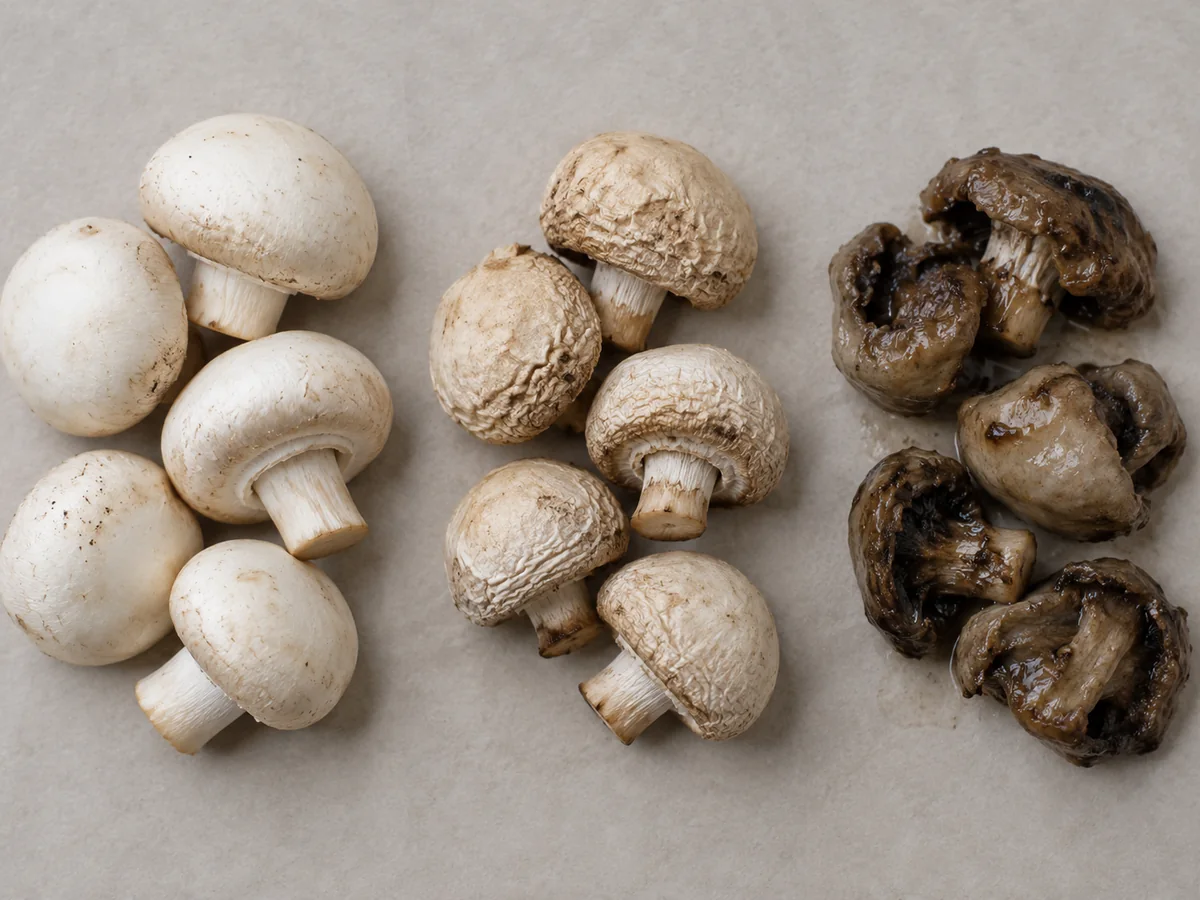
Water droplets need reading too, and they are no freshness badge. They may come from condensation or a wet display, and they do not show when anyone harvested the mushrooms or how long they sat warm.
Loose growing material on a cultivated mushroom is not decay. You can remove ordinary debris during cleaning, but a clean-looking cap does not prove the mushroom has the right identity or storage history. Small bruises on otherwise sound produce differ from widespread softening, visible rot or a wet, breaking-down surface. FDA guidance says to throw out rotten produce, so a visibly spoiled basket makes a poor bargain and a poor cook-it-tonight rescue.
Abnormal sour or rotting smells give you a reason to question the purchase. Their absence proves nothing about safety, and odor cannot clear a wild mushroom or reveal its temperature history.
Harvest Time Means Little Without Good Handling
"Harvested this morning" is useful, but it says nothing about time in a hot vehicle or an exposed display. Stock harvested earlier and held properly may reach the stall in better shape than a newer batch handled badly. Visible refrigeration, a shaded display and a clear answer about backup stock each tell you something different. Shade keeps direct sun off the display, but it does not show that anyone refrigerated the mushrooms.
No reliable stall-side sum turns a good look into a guaranteed number of days at home. Buying a sound portion for a definite meal is more dependable than expecting a harvest-date claim to promise a full week of storage.
Cleaning comes later, close to cooking. Washing a purchase right away to make it look ready can add a storage problem when the mushrooms then sit damp in their container.
Quality and PriceWhen Are Mushrooms Cheapest? Seasons, Sales and Bulk BuysBuying the Amount and Form Your Meal Needs
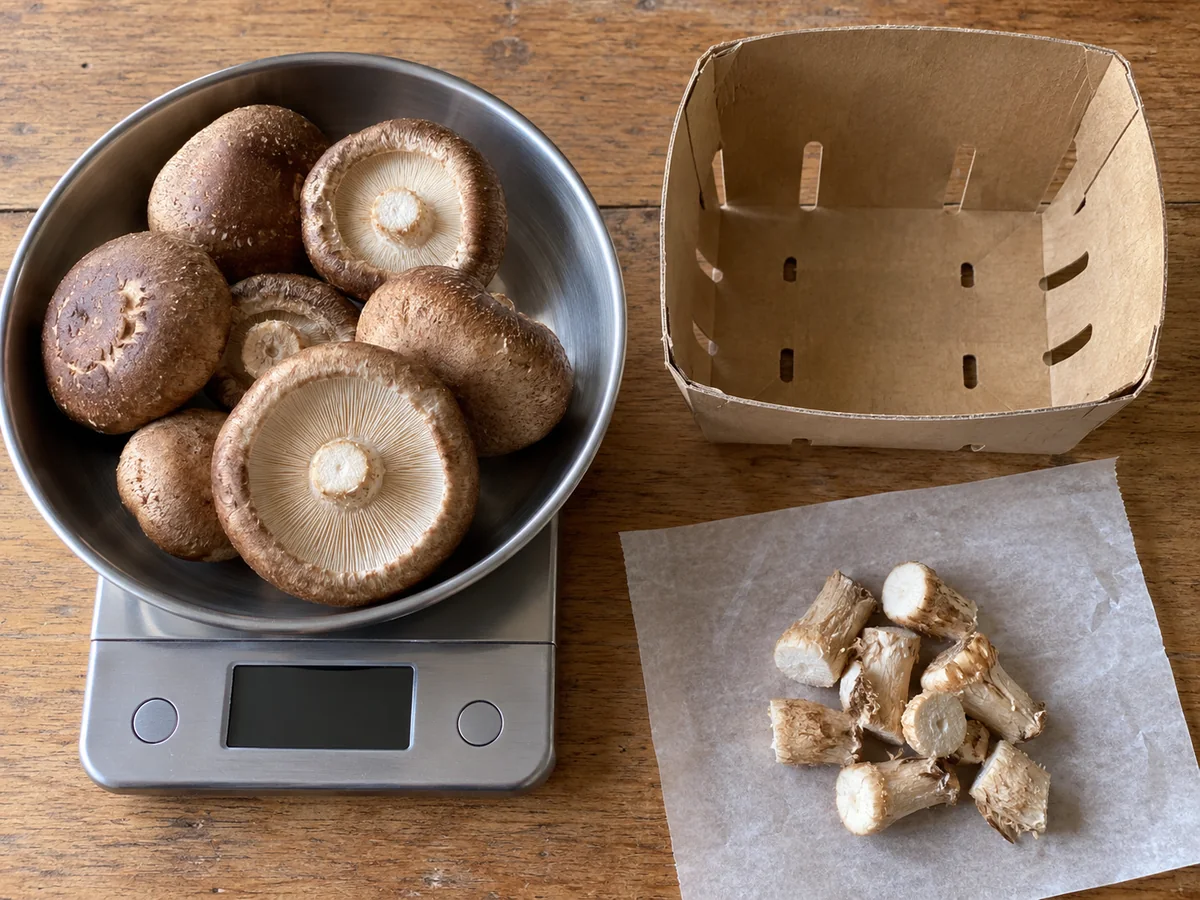
The best basket is the one whose usable form fits your meal. Whole, intact caps earn their place when the cap must hold stuffing or stay recognizable on the plate, while ordinary size differences may not matter in a chopped sauce. Shiitake stems can be much tougher than their caps, and oyster clusters may grow from a firm shared base.
Those differences change the useful weight and the prep work, though they do not make a whole cluster worse than a trimmed pack. Your cooking method can keep or remove the feature you are paying for. Large caps lose their good looks once you chop them, and a fragile cluster offers little if the recipe calls for even, thin slices.
Intact caps
Buy enough sound caps for the planned portionsStuffing and whole-cap presentation depend on shape and usable cap count as well as weight.
Slices or chopped pieces
Compare useful flesh and preparation timeUneven cap sizes can work when the recipe cuts them into a common form.
A mixed basket
Match each named type to its preparationSeveral types may need different trimming, so one pile is not automatically one cooking batch.
Weight, Servings and Shrinkage Are Separate
One pound of raw mushrooms does not cook down to one pound of browned mushrooms. Water leaves during cooking, and the cooked portion takes up less room than the loose raw basket. That cooking loss is different from stems or damaged pieces you cut away before the pan. Trimming changes how much usable raw food you bought, while evaporation changes what that usable food yields once cooked.
Recipes written for a raw weight give you the clearest buying target. If the recipe lists prepared caps, a stem-heavy purchase needs extra allowance for the parts that will not go into the dish. For a first purchase of an unfamiliar cultivated type, a smaller amount limits both waste and the prep you have to learn at once. Purdue's market overview of mushrooms also notes that a small amount of a pricier wild type can add to a meal, but a small portion does not fix an uncertain wild source.
Lion's mane, Hericium erinaceus, needs a different preparation from separate caps, because you slice or tear its body and do not count it as stuffing cups. Its cooking plan is a reason to buy a suitable portion. It does not mean every specialty mushroom belongs in the same mixed basket.
A Bigger Bargain Needs a Real Second Use
Two planned meals make a larger purchase easier to use than a vague plan to find recipes later. The second meal might take chopped pieces or a cooked portion, even when the first needs whole caps. Any big surplus also needs freezer space and a suitable way to prepare it. Freezing can keep a usable portion for later cooking, but it does not rescue stock that has gone downhill or keep every fresh texture unchanged.
Pre-sliced mushrooms can save real work when slicing is the slow part of the meal. At a loose stall, though, that convenience only counts if the cut pieces are still sound and the seller can say when they cut them.
Buying fewer mushrooms makes sense when the meal is small or the trip home is long. Paying a lower total bill for a usable amount can be better value than buying a discounted bulk basket you will not finish.
Quality and PriceWhat Do Mushroom Grades Mean? USDA Quality, Size and PacksWhat Is a Fair Price for Market Mushrooms?
No single fair price covers every market, species and package. Any useful comparison starts with the same product, the same net weight and similar condition, and then accounts for trimming and the form your dish needs. You cannot compare prices per basket, per ounce and per pound directly. The displayed number may look lower only because the basket holds less food, while the pound itself costs no less.
Net mushroom weight leaves out the container. When a stall uses a scale, the reading should allow for the basket or bag, so you do not pay for packaging as if it were mushroom flesh.
Convert Each Offer to a Price per Pound
The figures below exist only to show the arithmetic, and they do not estimate market prices. Sixteen ounces make one pound, so dividing the price by the ounces and multiplying by sixteen gives a comparable price per pound.
| Hypothetical offer | Calculation | Comparable raw-weight price |
|---|---|---|
| $6 for an 8-ounce basket | $6 divided by 8, multiplied by 16 | $12 per pound |
| $10 for a 12-ounce basket | $10 divided by 12, multiplied by 16 | About $13.33 per pound |
| $14 for one pound | The weight is already one pound | $14 per pound |
The $10 basket costs less in total than the $14 offer, but more per pound than the $6 basket. Which one makes sense still depends on how much your meal needs, since paying for unused food saves nothing.
Volume measures such as one pint do not stand for a set mushroom weight. Large caps, small buttons and loose clusters fill the same basket with different amounts of food and air. Sellers who give an exact net weight make your comparison simpler. If an offer stays priced only by container volume, you cannot judge it against another stall's price per pound without weighing the portion.
Usable Weight Can Flip the Bargain
Suppose a made-up $8 pound leaves 12 ounces of useful flesh after normal trimming. Its usable-weight cost is $8 divided by 0.75 pound, or about $10.67 per useful pound. Compare that with a second made-up $10 pound that needs no trimming and so costs $10 per useful pound. So the pricier raw pound is cheaper on that usable basis, though you have to judge the real trimming and not assume it.
This sum only covers sound mushrooms and the parts your dish uses. It does not justify buying rot in the hope that cutting enough away will turn a bad basket into a good one. Prep time also belongs in the decision. Trimmed packs may be worth it for a rushed meal, while a whole purchase may suit someone who has time for the caps and a use for the trimmings.
Paying More for a Particular Species
Purdue's overview notes that wild mushrooms tend to cost more than standard buttons, but that comparison is no current price list. Species, supply, growing effort and availability all shape the offers, and none of them proves the priciest option is best for your dish. Paying more for a particular texture or a whole-cap presentation can make sense in that meal. Finely chopped mixed sauces may lose too much of that difference to justify paying for very even, large caps.
Dried mushrooms sit on a different buying basis, because their water is already gone. Comparing a dried ounce with a fresh ounce as if both were the same ingredient weight hides how you will soak and use them. Choosing between frozen and fresh packs is also a question of cooking fit more than shelf price. Frozen products may suit a cooked mixture, while a meal that relies on fresh structure needs that structure when you buy.
Getting Mushrooms Home in Good Shape
Rough handling can undo a sound purchase before it reaches your kitchen. Heavier groceries can crush a loose bag at the bottom of a tote, even when the mushrooms left the stall in good condition. Rigid baskets or supported bags protect delicate edges better than an unsupported pile. Breathable packaging and physical support do separate jobs, so a paper bag alone will not stop crushing.
Cooling and Airflow Need Separate Fixes
The Mushroom Council names the original packaging or a porous paper bag as suitable storage. For loose market stock, the bag gives a different moisture setting from an airtight box, but it provides no cold. Coolers can protect a purchase on a warm or long trip if you keep the mushrooms away from meltwater and heavy items. Sealed cold packs kept apart from the food stop melting ice from soaking a paper bag.
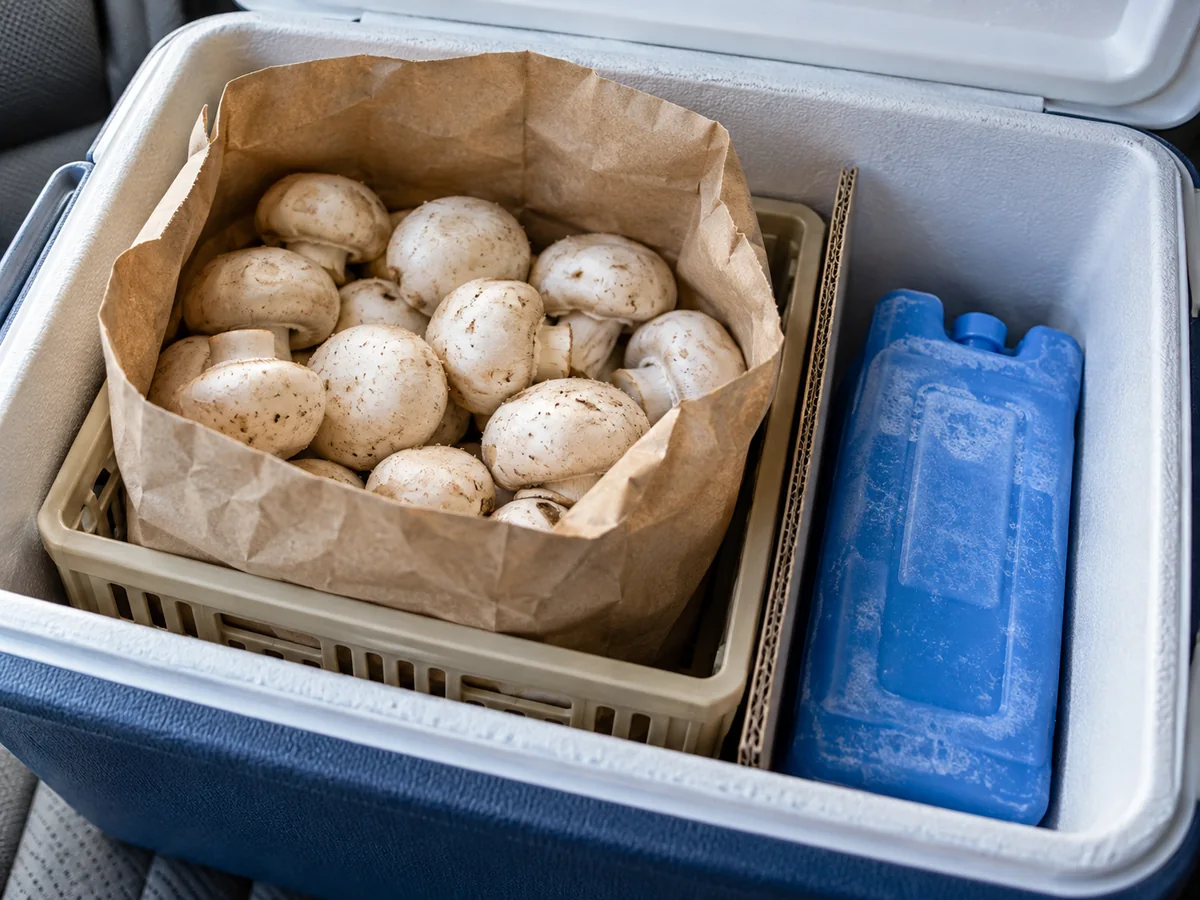
FDA produce guidance lists mushrooms among the perishable produce to store in a clean refrigerator at 40°F or below, approximately 4°C. Paper bags left in a warm car cannot meet that temperature just because they sit in shade. The same guidance gives no universal safe time for a stall display either. If the handling history or condition leaves a real concern, you cannot rebuild that history with a photo, a smell test or extra cooking.
Finish the Prep the Purchase Calls For
Fresh-mushroom storage works best when the packaging limits trapped moisture and the refrigerator holds the right temperature. When sauteing mushrooms, surface water and crowded pieces slow the pan's move from steaming to browning. Good buying condition gives you a head start, but the cooking method still sets the finished texture.
If the purchase cannot go into the planned meal, decide early on another meal or freezing while it is still good food. Waiting until the basket has gone downhill leaves nothing worth preserving. Keep the seller's details and the product name until you use the batch. They give you a contact point for a question about the purchase, but they do not prove identity, professional review or a guaranteed shelf life.


