
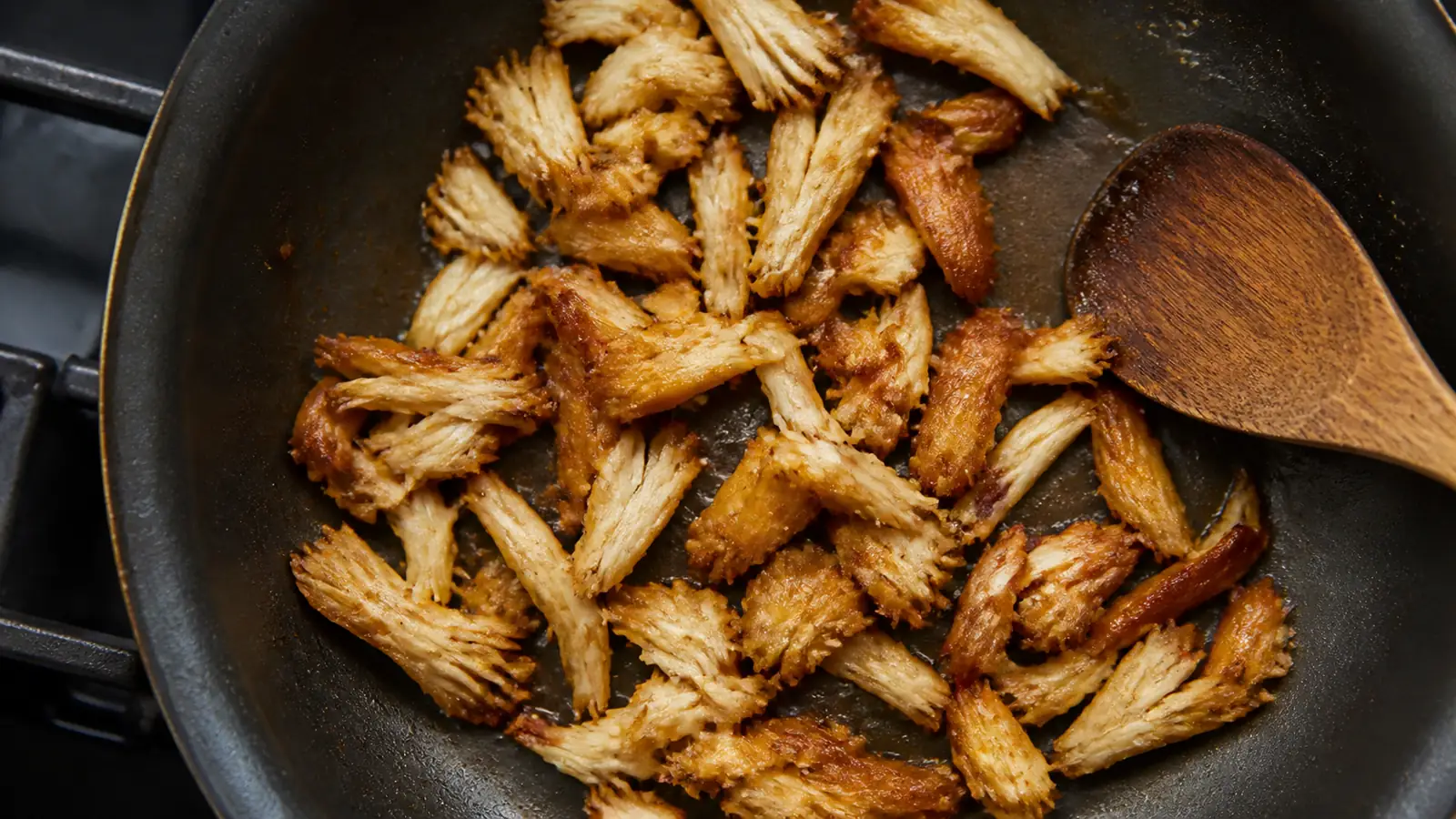
You can slice lion's mane into steaks or tear it into pieces for a different kind of meal. Browned steaks need contact with the pan. Mushroom cakes need cooked, cooled flakes with the excess water squeezed out before binding.
How Do You Clean Lion's Mane?
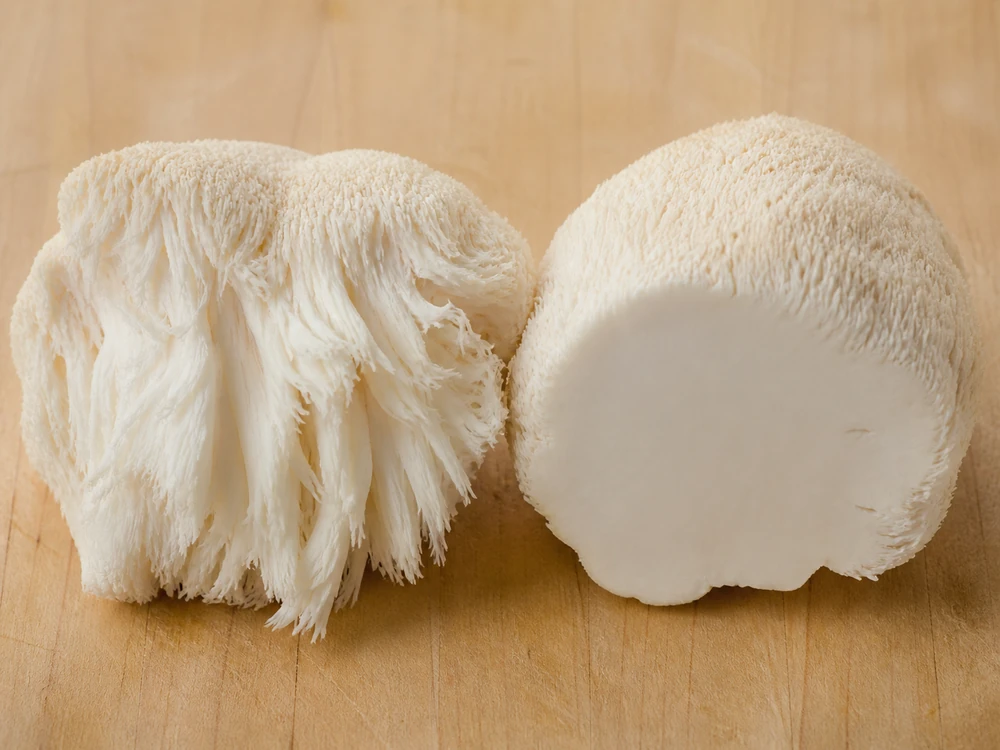
Fresh lion's mane, Hericium erinaceus, has a compact interior surrounded by hanging teeth. The methods here start with a sound mushroom sold for food, and not with a wild specimen whose identity is still uncertain. Firm fruitbodies give the knife something to hold together for steaks. If yours is already separating into small pieces, loose bites or cake filling may suit it better, but no change of recipe rescues spoiled produce.
Health Canada's mushroom guidance advises rejecting bruised or spoiled mushrooms. Throw out a mushroom that shows visible deterioration, and keep in mind that a clean-looking surface tells you nothing about how anyone handled the food. The attached base can carry growing material that has no place in the finished dish. Trim that material away and keep the clean flesh around it, without cutting off a large part of the mushroom just to make it look round.
For light debris, a soft brush or damp cloth may be enough. Where particles stay lodged among the teeth, a brief rinse under cool running water followed by gentle drying works. Health Canada allows rinsing and recommends waiting until use to wash mushrooms, so you can ignore any blanket rule against water. Pat the mushroom with a towel to lift off surface water without breaking it apart, and keep the cleaning gentle so the loose teeth stay on.
Warning
Identification comes before cooking
Never eat a wild mushroom unless a mushroom identification expert has confirmed it. Cooking does not make a poisonous mushroom safe, as Poison Control warns, and the cooking illustrations on this page cannot identify your specimen.
Slicing or Tearing Lion's Mane
Slicing works well for lion's mane. Cut a compact mushroom into slabs and you get a broad face that rests against the skillet, so the surface browns while the inside stays together. Tearing gives irregular pieces and exposes more separated flesh. That shape suits small pan-cooked bites, roasted chunks or a filling meant to look like flakes.
| Intended dish | Useful preparation | What happens next | Main tradeoff |
|---|---|---|---|
| A whole mushroom steak | Intact slabs with similar thickness | Brown both faces and cook the middle | A thicker slab needs more attention to its center |
| Loose browned bites | Torn pieces of broadly similar size | Pan-cook with space between pieces | Small teeth and fragments can brown sooner than the larger pieces |
| Mushroom cakes | Separate bite-sized pieces | Wilt, cool and squeeze before binding | The filling loses volume, and the binder changes the texture |
| Coated cutlets | Slabs or substantial intact pieces | Pre-sear, dredge and fry | The coating adds a second cooking stage |
The size of the fruitbody limits the cut. You do not need to force a small clump that cannot hold a broad slice into a steak, and the pieces left after slicing a larger clump can go to a different dish. Mushroom Direct's sliced method uses slabs roughly half an inch to one inch thick. Treat that as a starting range for a fresh compact mushroom, since no range promises that every piece cooks in the same number of minutes.
The thicker end keeps a more substantial interior. Thinner pieces have less center to cook through, though their outer teeth still need protection from too much heat.
Raw size makes a poor serving measure. Lion's mane holds water that leaves during cooking, and squeezing cake filling removes more of it than browning a slab does. No supported rule says every batch finishes at one-third of its starting weight. For a measured recipe, trust its stated raw quantity over counting fist-sized clumps or guessing at a reduction.
How Do You Cook a Lion's Mane Steak?
Your steak needs a browned contact face and a cooked interior. The fine outer teeth can color before the middle has finished, especially when a thick slab meets fierce heat. Alan Bergo's steak method starts with cooking oil in the skillet, browns the mushrooms, and uses a weight after turning them. That directly contradicts the idea that lion's mane must spend time in a fat-free pan before any oil goes in.
Starting dry can reduce moisture in loose pieces, but a steak does not need it. Pan space and evaporating water count for more than whether oil is in the pan.
Prepare the cooking surface
Heat a heavy skillet over medium-high heat and add cooking oil. Set the dried slabs in one layer with room around them.
Develop the first face
Let the lower face brown before turning. If liquid pools around the mushrooms, allow it to evaporate or move some pieces into a second batch.
Turn and improve contact
Brown the second face, using a stable cooking press or gentle spatula pressure where a slab does not sit flat. Lower the heat if its fine edges darken before the middle softens.
Finish the interior and seasoning
Continue until the center cooks through, then finish with the chosen seasoning, butter or sauce. The slab's thickness and the pan's heat determine the time.
Pressing does two things at once. It brings uneven flesh against the pan, and it compacts the mushroom. Both effects suit a dense steak, but repeated hard flattening can remove the thickness you meant to keep.
Whatever weight you use must sit securely on the pieces, because a rocking stack of improvised objects makes the surface harder to see and the pan harder to control. Small torn bites may gain little from pressing at all. Their exposed sides can brown separately, and a heavy weight can crush the fragile fragments into the gaps between larger pieces.
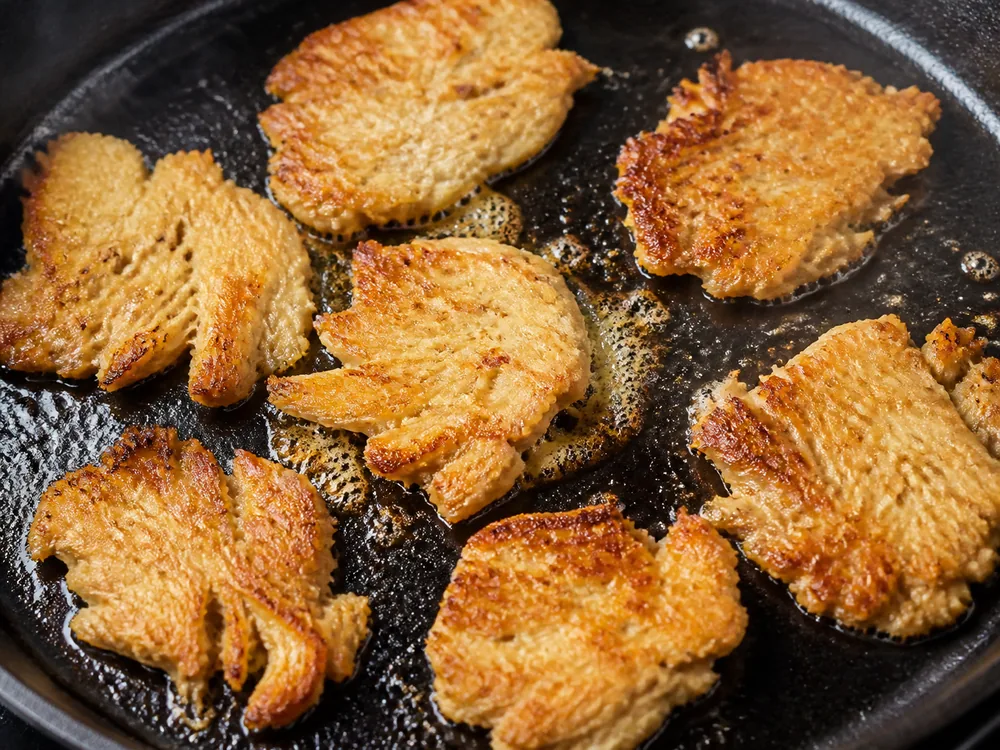
Browning on the outside is a surface cue, and it does not prove any particular internal temperature. Very thick slabs can be golden outside while the center stays firm, so a fixed two-minute finish is unreliable. Butter works as a finishing flavor once the surface has developed. You can add it earlier, but then its browning needs watching while the mushroom still cooks.
Seasoning belongs to the method too. Bergo seasons the flour in his coated steak, so you do not have to hold all the salt for the final seconds. Using a modest amount leaves room for salted butter or a seasoned sauce later, and lemon and herbs add brightness after browning without putting much liquid in the skillet.
Draining Flakes for Mushroom Cakes
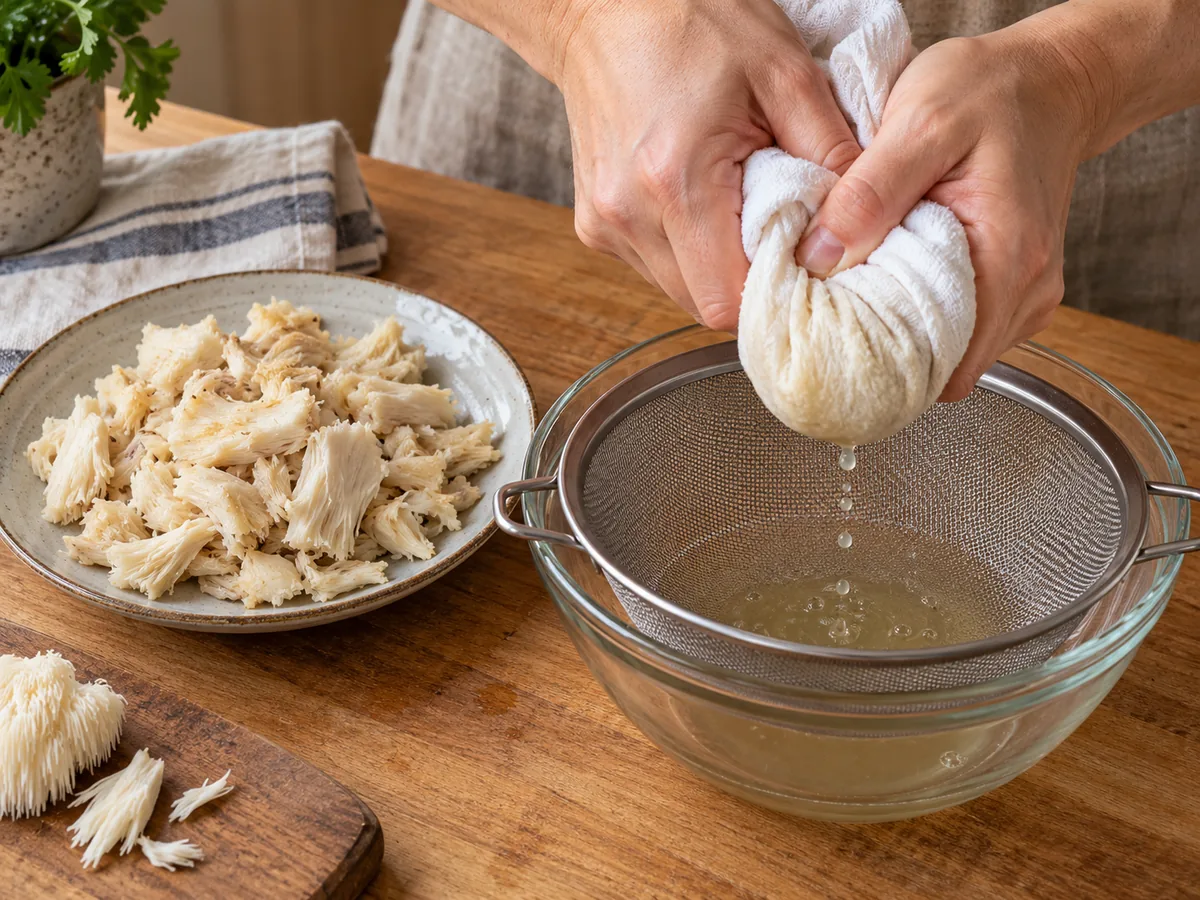
Mushroom cakes need separate pieces that hold together in a formed patty, and each piece can skip the steak's crust before mixing. Bergo's lion's mane cake method begins with a little water and salt in a covered pan. The pieces wilt and release juice, then cool before you squeeze out the excess water. That moist start suits the next task, making a manageable filling, and a dry pan would confuse the cake's needs with the steak's browning stage.
Cool the pieces before squeezing. Hot mushroom juice can burn, and you can handle a cooled filling without rushing it from the skillet into the cake mixture. After draining, the pieces should still look like flakes. Grinding everything into a fine paste removes much of the reason for choosing lion's mane in the first place.
Breadcrumbs and an egg binder hold the pieces together. Too much dry binder makes a cake feel more like bread than mushroom, so adding handfuls of crumbs is a poor first answer to filling that still holds free liquid. Resting the mixture lets the breadcrumbs absorb moisture already in it. Bergo's recipe allows at least 15 minutes for that, which changes how easily you can form the mixture without adding more crumbs.
Egg size counts as well. Recipes written for a large egg do not automatically work with a much larger one, and the extra liquid can upset a mixture that was otherwise balanced. Formed cakes stay delicate until the egg sets. Turn one before the lower crust develops and it may break, while a thick cake can brown outside before the center cooks.
Warning
Egg-bound cakes need a cooked center
FDA egg safety guidance puts dishes containing eggs at 160°F internally. Use a food thermometer in the center of the cake, and cook a small test portion to check seasoning instead of tasting an uncooked egg mixture.
The mushroom weight, egg size, breadcrumb quantity and patty size in a cake recipe work together. Change one of them and you change how the filling holds together and how long the center takes to cook. The crab-style name refers to the separated texture and the chosen seasonings, and it promises neither a crab taste nor the same nutrition.
TechniquesHow to Cook Black Truffle: Slicing, Carriers and Late HeatCutlets, Roasted Chunks and Sauced Meals
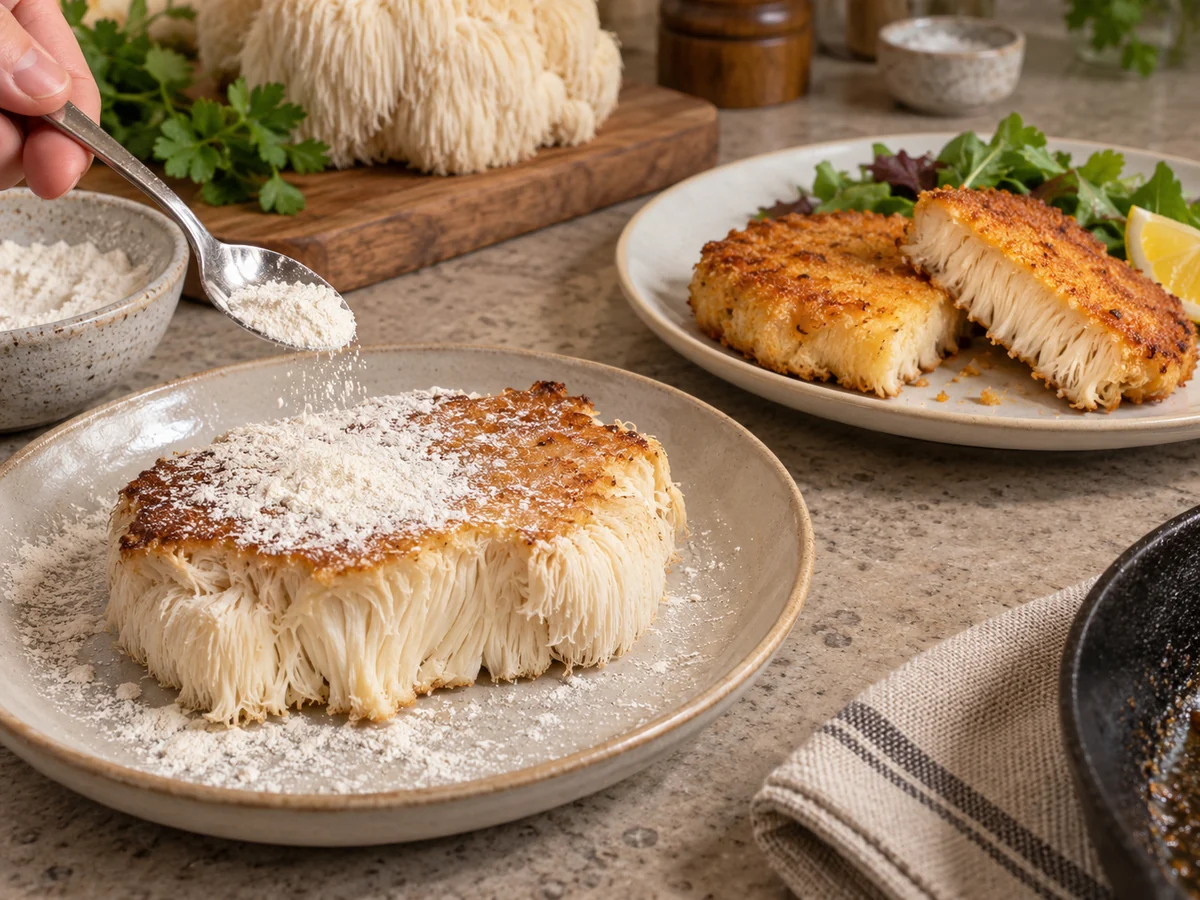
Intact slabs also suit a cutlet with a thin flour coating. What you need to decide is whether the mushroom loses its water before or after the coating goes on. Smallhold's piccata method sears the lion's mane first, so released moisture evaporates and the faces brown. The cooked pieces then go through the flour and into the pan again, which keeps the wet stage apart from the coated crust.
Keep the coating light so the mushroom stays recognizable beneath it. Loose flour in the skillet can darken on its own and make the actual cutlet surface harder to judge. Sauce changes the crust once the two meet, and in a piccata-style meal the lemon and caper sauce softens some of the surface crispness while the mushroom's structure still holds.
Roasting works well when several pieces need to cook together and the oven gives you more room than a skillet. On a sheet pan each chunk gets its own contact area, so the batch avoids one crowded pan. Mushroom Direct's roasting example uses 425°F, or 220°C, with oil-seasoned chunks in one layer. Its 20 to 25 minutes and halfway turn describe that recipe, and they make no universal timer for pieces of any size.
Torn mushrooms piled on a tray cook under different conditions from that spaced batch. More exposed surface lets moisture escape, while crowded crevices can stay damp even as the outer teeth color.
Soup aims for a moist texture on purpose. Browned lion's mane pieces can add a more distinct surface flavor before they go into the broth, but no crisp crust stays crisp after simmering. Small pieces spread through mushroom soup more easily than a broad steak, and the broth and other ingredients shape that dish.
In mushroom risotto, you can fold cooked pieces into the rice and keep a few browned pieces for the top. That way one portion absorbs sauce while the other keeps a distinct surface until serving.
Butter, lemon, parsley and chives suit a mild preparation. Stronger seasoning is a flavor choice and no technical error, provided the mushroom has cooked for the meal you want. Seafood-style plates need no promise of identical flavor either. The fleshy bite and separate flakes are what the cook works with, while herbs, acidity and sauce shape much of the final impression.
Reading a Cooking Problem From the Pan
Poor texture has more than one cause. Wet pans, scorched surfaces and cakes that fall apart point to different stages of preparation, and each needs a different change.
| Observation | Plausible explanation | Useful adjustment | What the adjustment cannot prove |
|---|---|---|---|
| Liquid gathers around pale pieces | Moisture is leaving faster than it evaporates in the available space | Split the batch and let the exposed liquid cook off | A wet pan does not mean the mushroom was unsafe to rinse |
| Teeth turn dark while a thick center stays firm | Surface heat is outrunning the interior cook | Reduce heat and allow the middle more time | Dark edges do not verify doneness |
| A pressed steak feels flatter and drier than intended | Compression and continued cooking have gone beyond the desired texture | Use gentler pressure or retain a thicker piece next time | There is no guaranteed crab-like bite from pressing |
| Cakes spread or break before turning | Filling may be too wet, binder may be unbalanced, or the lower crust may not be set | Drain filling before mixing and follow the recipe's binder and resting method | More breadcrumbs do not fix every cause |
Cooking one small piece can separate a center problem from a surface problem. If the outside is already dark and the middle is still firm, more heat makes the mismatch worse. The sound of frying can change as free water leaves the pan, but sound alone is no doneness test. The browning where the mushroom meets the pan and the state of the center still need to agree with the dish you are making.
For cakes, notice when the mixture fails. Filling that leaks liquid before you shape it has a different problem from a patty that holds cold but breaks when turned too early. Crumb-heavy mixtures can hide the mushroom texture even when they hold together well. Good binding and a good lion's mane bite are separate goals, so drain and rest the filling before you reach for more binder.
Seasoning cannot reverse a burnt edge or an overly compacted slab. It can lift a bland but properly cooked piece, though, so a flat flavor does not automatically mean the pan technique failed.
Storing Fresh and Cooked Lion's Mane
Cook fresh lion's mane while its condition is good, and leave the cleaning until you need it. Health Canada's general fresh-mushroom guidance puts loose mushrooms in a refrigerated paper bag and keeps prepackaged mushrooms in their original suitable packaging. That advice for fresh mushrooms says nothing about leaving a cooked batch exposed. Cooked food goes through a cooling stage first, then cold storage that also needs protection from cross-contamination.
Health Canada's leftovers advice is to eat refrigerated leftovers within two to three days or freeze them. It also advises discarding cooked food that has stayed at room temperature for more than two hours. Large hot piles cool differently from a shallow layer, so portioning the batch lets you chill it promptly without leaving it on the counter while the steam clears.
The loose lid during cooling lets heat escape, and it does nothing to protect the browned crust for days. Once the food is cold, storing it cleanly comes before keeping the exact surface it had when it left the skillet.
For freezing, Health Canada's mushroom guidance specifies steaming or sauteing first. You can set cooked portions aside for a later meal, though a thawed piece may suit a sauce or filling better than the original crisp presentation. Larger batches need the full sequence. The first cook, prompt cooling, packaging and later reheating are separate steps, so putting raw clumps in the freezer does not follow that guidance.
Health Canada says leftovers need reheating to 165°F, or 74°C. Warming the surface falls short when a thick slab or cake still has a cool center. Reheating a cake does not bring back its first crust either, so a portion you cooked safely and stored correctly may still need a different serving plan from a freshly fried piece.
Smell and appearance cannot reliably tell you whether leftovers are safe. Pressing, browning or fresh herbs will not make a batch acceptable once it has gone outside the handling limits.


