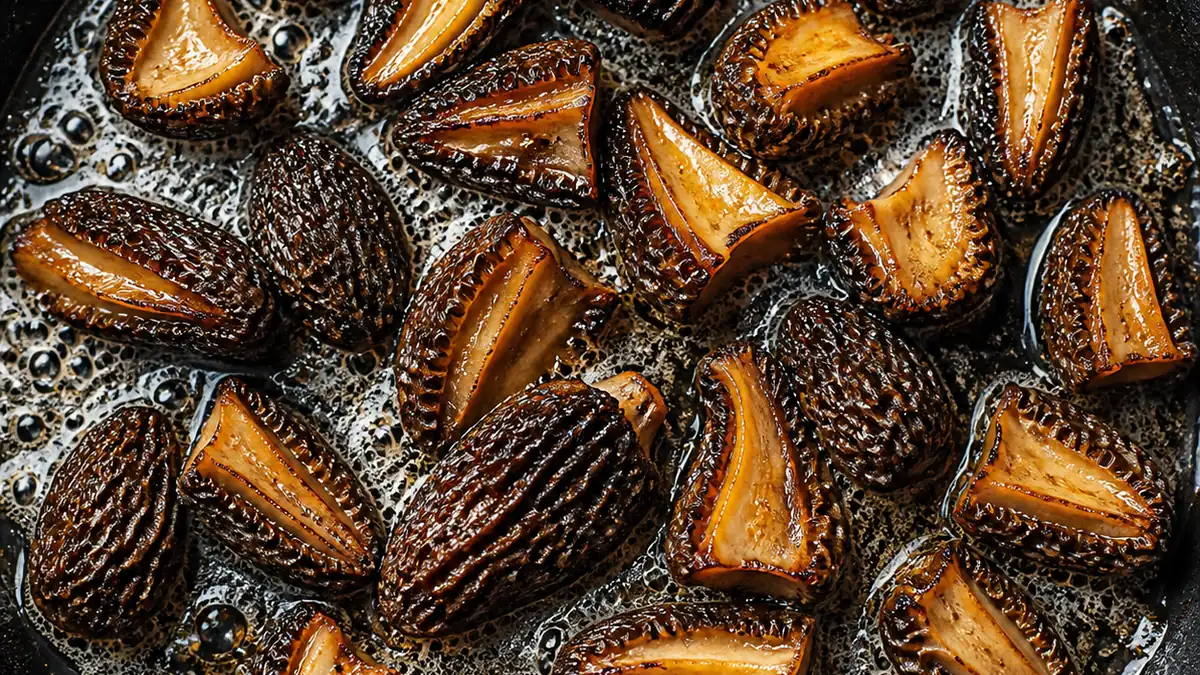
A black morel is a thin ribbed wall around a hollow chamber, and that decides everything. Halve them lengthwise so the cavity opens, rinse briefly in salted water to drop the grit and float out the insects, dry them properly, and cook them in butter for ten to fifteen minutes until the ribs brown and the flesh stops springing back.
Cut a black morel in half and the mushroom turns out to be mostly nothing: a ribbed shell around an empty chamber that runs from the tip of the cap to the base of the stem.
That single fact decides everything below.
The hollow is the whole story
Every ordinary mushroom habit assumes solid flesh. None of them survives contact with a morel.
Only the first of those four is a warning, since the other three are advantages that most cooks never reach because they never open one up.

The hollow structure affects cleaning, cutting, and how quickly heat reaches the flesh.
The species record on our black morel profile has the botanical side, while what matters at the board is that the wall is a few millimetres thick and the rest is air.
That hollow is also the field test. A true morel is empty inside and a false one is not, which our page on false morel lookalikes works through properly.
Halving them therefore does two jobs at once, cleaning the mushroom and confirming what you picked in the same movement, which is a good argument for never cooking one whole unless you are certain of it.
Cooking MushroomsHow to Cook Cauliflower Mushroom Without Trapping GritNever eat them undercooked
A lot of people learn this the hard way, at a dinner they had been looking forward to.
Warning
Raw and undercooked true morels cause gastric upset in a substantial number of people, even when the identification is correct. Ten to fifteen minutes of real heat settles it, and there is no version of this mushroom worth eating rare.
There is no hedging in that warning, and cooked properly they are fine for most people. The trouble comes from a quick sear that leaves the flesh barely warmed through, which is exactly what a thin-walled mushroom invites you to do.
Our page on eating morels raw covers who reacts and how, and the short version is that the reaction is common enough to plan around and mild enough not to fear.
Alcohol shows up in a lot of the reports, and whether it causes the reaction or merely accompanies the meal is not settled, so a cautious first morel dinner is one without wine in it.
None of this is the false morel problem, a genuinely dangerous and completely separate thing explained on our page about false morel poisoning, which has nothing to do with cooking time.
Halve them, always
Lengthwise, from the tip of the cap straight down through the stem. Not into rings, and not into anything else.
Those four facts all point at the same instruction, and the third of them is the one people refuse to believe until they have seen it.
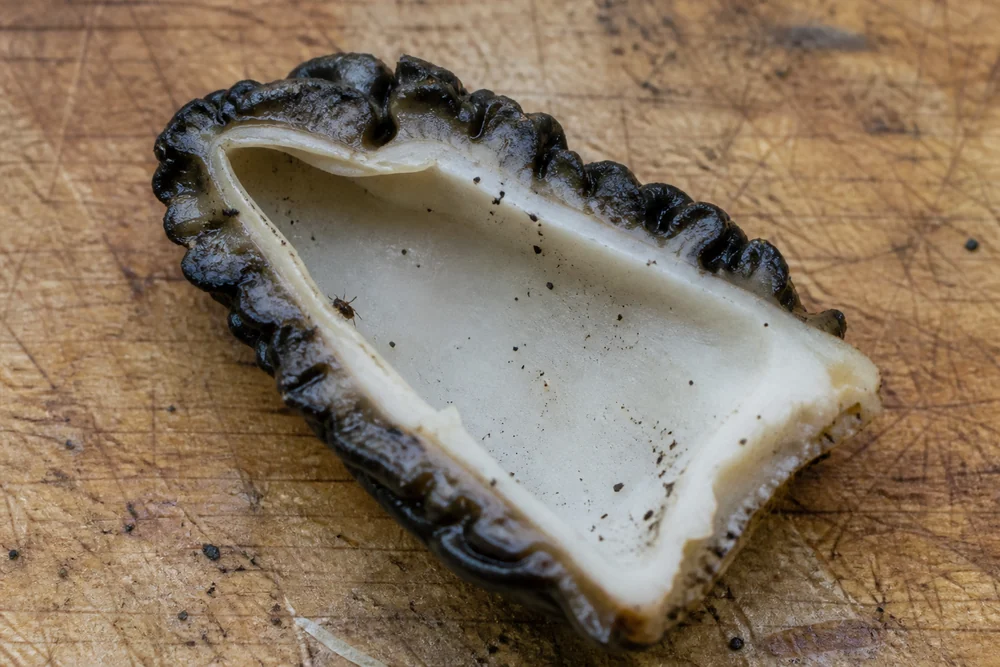
Slicing is the habit that ruins morels, and it is a habit worth naming because it comes from every other mushroom you have ever cooked. Rings look good and they seal the problem inside.
What you find in there is not a sign of a bad mushroom. Morels grow on the ground in spring, insects live in them, and a clean one is the exception rather than the rule.
Three things fall out of a halved morel that would have stayed inside a sliced one:
- Soil from the ground it grew on, held in the ribs and the chamber.
- Insects, which live in morels as a matter of course rather than as a fault.
- Water from the rinse, which is why halved morels dry and whole ones do not.
Size decides how much of this matters. A thumbnail morel holds almost nothing and a fist-sized one can hold a spoonful of soil, so the rule scales with what is actually in the basket.
Very small morels can go in whole if you are confident about the source, but anything larger than a thumb should be opened and there is no cooking advantage to leaving it closed.
Cleaning without waterlogging
Whether to soak morels is the longest-running argument in the subject. The cavity settles it.
| Method | What happens | Verdict |
|---|---|---|
| No wash at all | Grit and insects stay in | Only for tiny, obviously clean ones |
| Brief salted rinse, halved | Grit falls out, insects float up | Yes, this is the method |
| Long soak in water | Wall absorbs, flavor leaches out | No |
| Dry brushing | Cannot reach inside the cavity | Not sufficient on its own |
The never-soak rule was written for solid mushrooms that absorb water like a sponge, whereas a halved morel is a thin curved wall that drains rather than filling.
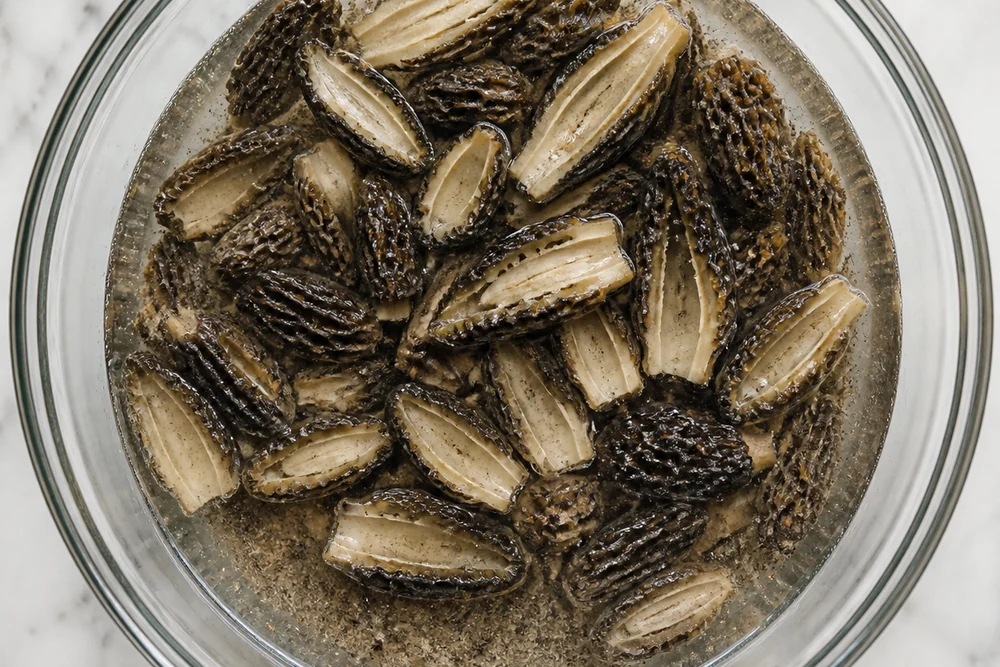
Salted water does two things at once. The grit falls out of the open cavity, and anything living in there comes out rather than staying put.
Brief means under a minute, which is the part people stretch, and twenty minutes in water gives you a limp morel with the flavor in the sink, as our guide to cleaning mushrooms explains at length.
Drying afterwards is not optional. Spread the halves cut side down on a towel for ten minutes, because a wet morel steams in the pan and the ribbed surface never browns.
Cooking MushroomsHow to Cook Black Truffle Without Losing Its AromaHow to cook them
Butter in a hot pan, then more time than something this thin looks like it needs.
Two of those steps are the ones people compress. Drying gets skipped because the morels look dry, and the timing gets cut short because the mushroom looks done long before it is.
Heat behaves differently here than it does with a solid mushroom. Because the wall is thin and open on one side, the pan is effectively cooking both faces at once, which is why the timing is about safety rather than about getting heat to the middle.
The ribbed surface is a gift for browning. All that texture means far more contact with the pan than a smooth cap has, and the flavor that develops on it is most of what people remember.
Three signals say a morel is done, and none of them is the clock alone:
- The ribbed surface has gone dark rather than merely warm.
- The flesh no longer springs back when pressed.
- The butter has stopped spitting, because the water has gone.
Size sorting is worth two minutes before the pan. A basket usually holds halves from thumb-sized to palm-sized, and cooking them together means the small ones are leather by the time the large ones are safe.
Cream is the natural next step rather than an indulgence. A splash at the end, reduced for a minute, picks up everything stuck to the pan and turns a handful of morels into a sauce for four people.
What the hollow is good for
Here is the one thing no other common mushroom lets you do.
A whole morel is a container with a small opening, which means it can be stuffed. This is not a restaurant flourish, it is simply the obvious use of the shape once you notice it.

That technique comes with four constraints, worth knowing before you commit half a basket to it:
- Only large, intact, obviously clean specimens are candidates.
- They have to be cleaned whole, so a brief rinse and a good shake rather than a soak.
- The filling must be cooked already, since the mushroom needs less time than most fillings do.
- Cook them on their side in a pan or a low oven, not standing upright.
- Expect to lose one or two while filling them, which is why this is a technique for a good year.
Nothing in that list is a rule about flavor, incidentally. They are all consequences of a mushroom that is thin, quick to cook and shaped like a bag.
Bread, cheese, cooked shallot and herbs is the traditional filling because none of it needs cooking, whereas a raw meat filling will still be raw when the morel is past its best.
The cooking time does not change. A stuffed morel still wants ten to fifteen minutes, and the filling should be warm rather than being cooked in there.
Cooking MushroomsHow to Cook Black Trumpets: They Are a Seasoning, Not a VegetableWhat they taste like
Deep, nutty and genuinely meaty, since morels are one of very few mushrooms that taste of something other than mushroom.
Tip
Cream, butter and eggs are the classic partners because they carry the flavor without competing. Anything acidic or strongly spiced buries a morel completely, which is an expensive way to make a curry.
Nothing about that flavor survives a heavy hand. A morel in a tomato sauce is an expensive way to make tomato sauce, and the same goes for anything with chilli or vinegar in it.
Black morels are stronger than yellow ones, with a smokiness the yellow ones do not have. If you have cooked yellow morels and found them subtle, the black ones are not that.
Fresh and dried also taste noticeably different, in a way that suits different dishes.
The flavor also survives drying better than almost any other mushroom. That is unusual enough to be worth planning around, and it is why dried morels command a price that dried oysters never will.
Anyone eating them regularly rather than once a spring will find the figures on our black morel nutrition record. As a cooking matter they behave like a thin-walled, low-water mushroom that browns hard and dries well.
Black and yellow morels are not interchangeable
Recipes say morel and mean whichever one the writer had in front of them. The two are different enough in a pan to be worth separating.
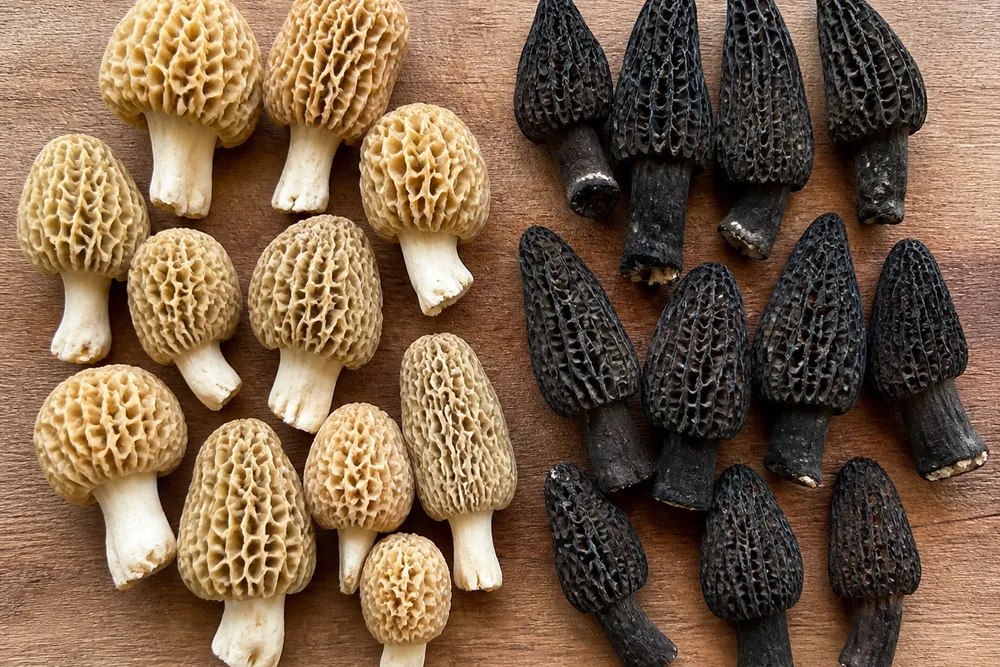
Black morels are darker, more conical and thinner-walled, with a smokier and more assertive flavor.
Yellow morels are rounder, paler, thicker-walled and noticeably milder than that.
Wall thickness is the practical difference between them. A yellow morel has more flesh to heat through and takes the upper end of the timing on this page, while a black one is done at the lower end and dries out past it.
Season separates them as well, since black morels generally appear earlier in spring than yellow ones.
A basket picked in a single week is usually one or the other rather than both.
Our record for the true morels covers the genus and the identification side. In the kitchen, treat the color as a timing instruction rather than as a label.
Neither is better and they suit different jobs. A yellow morel holds its own in cream where a black one can get lost in it, and a black one carries a dish that a yellow one would need help with.
Fresh, dried and buying
Fresh morels should be firm, dry and springy. Tip the basket and they should rattle.
The fridge life is the number that surprises people, since it is shorter than almost anything else sold at the same price.
Sound carries information here that sight does not, and a soft morel is already going.
They go slimy rather than drying out, so store them in a paper bag or an open container, never sealed in plastic.

Dried morels are the honest alternative rather than a poor relation, which is not true of many species. Because the mushroom was hollow to begin with, it rehydrates far more completely than a solid mushroom does, and the texture comes back close to fresh.
There is one practical catch with the dried form, which is that rehydrated morels are already soft and brown less readily than fresh ones.
Rehydrating them is also where the last of the flavor gets thrown away, so soak them twenty to thirty minutes in hot water and keep the liquid. It collects the last of the grit as well, so pour it off gently and leave the bottom centimetre behind.
Quantity is the last practical question and the answer is less than people expect. Morels are rich and a handful goes a long way, so a hundred grams of fresh halves is enough for four people once there is cream or butter in the pan with them.
Price is worth mentioning because it shapes how people cook them, since morels are among the most expensive mushrooms sold anywhere and that pushes cooks toward elaborate treatments when butter and restraint would do.
Slicing is what turns a good basket into a gritty dinner. A knife does rings to a mushroom by default, every ring keeps its share of the soil, and the cook decides morels are overrated when the problem was one cut.
If you have had a good season, our page on drying mushrooms at home covers the method, and this is a species where it is genuinely worth the trouble. For the fresh ones you are keeping, storing black morels has the detail on containers and timing.
Sources & References
- Morchella species, the true morels (Fungi Atlas) Species reference used for the hollow fruiting body running unbroken from cap to stem base, the ribbed pitted surface, and the spring fruiting habit on disturbed ground and dead elm.
- Morels (Forager Chef) Cook and forager reference used for the lengthwise halving method, the brief salted rinse for grit and insects, the ten to fifteen minute cooking time, and the rehydration behavior of dried morels.
- Mushroom Poisoning Case Registry (North American Mycological Association) Case reference used for the pattern of gastric upset following raw or undercooked true morels, the frequency with which alcohol appears in those reports, and the separation of this from gyromitrin poisoning by false morels.