
Slice before anything else
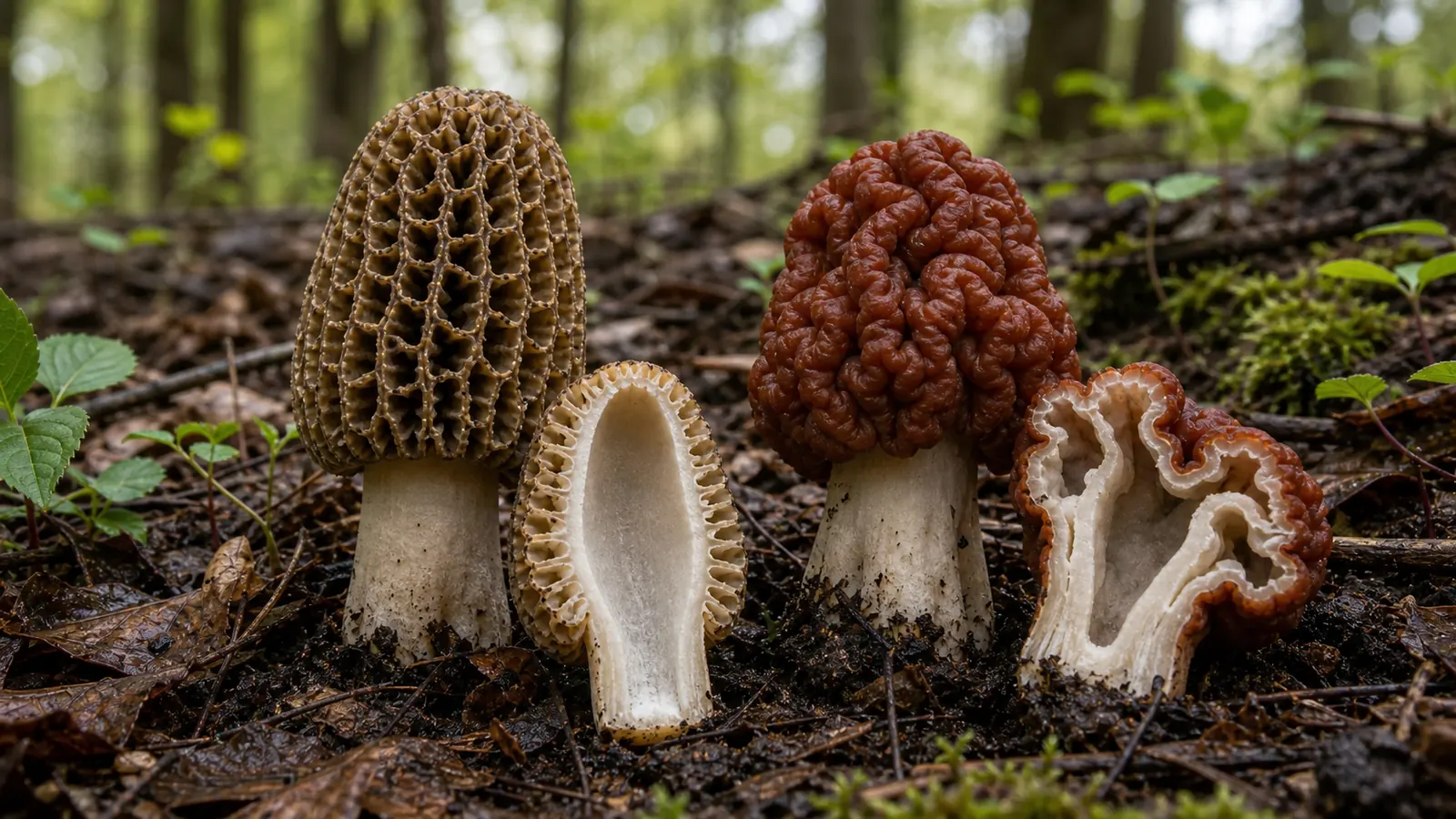
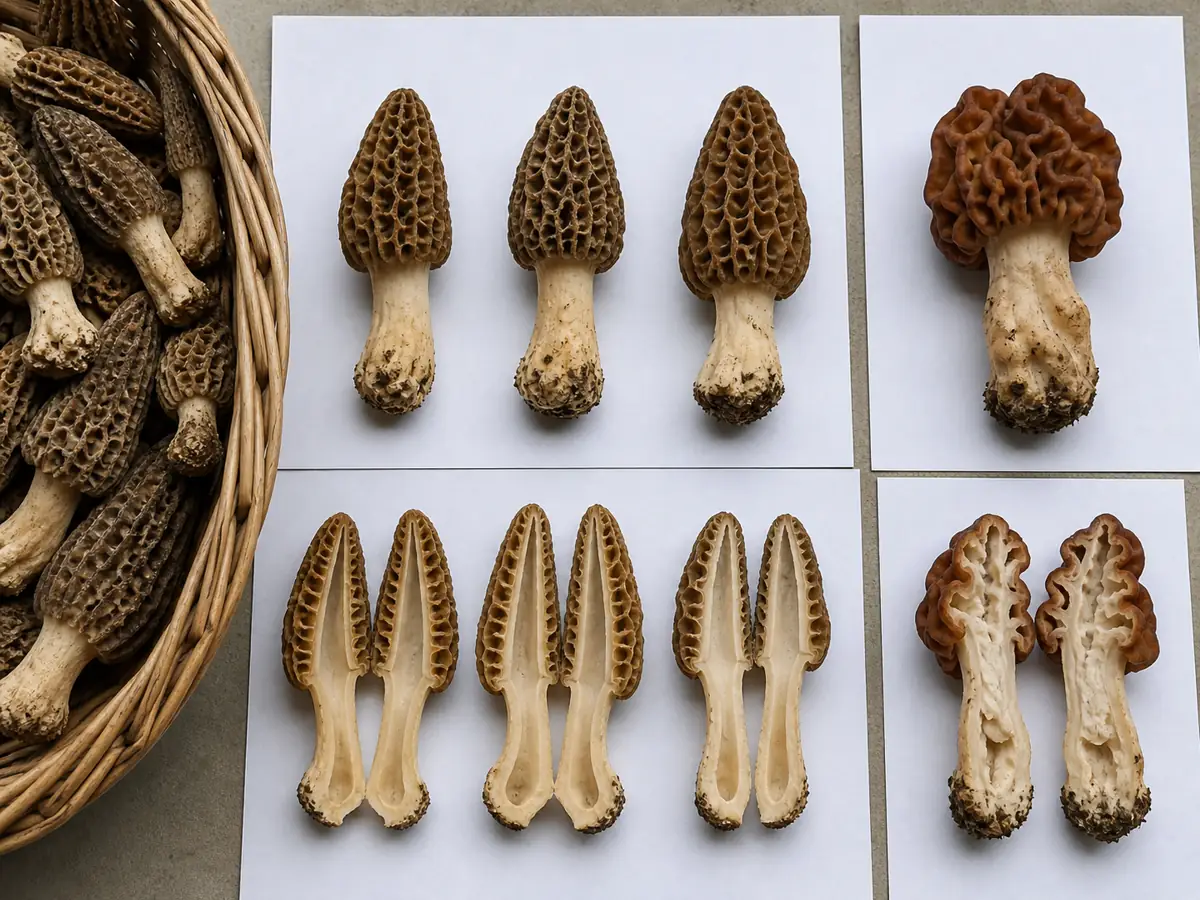
Cut the mushroom lengthwise from cap tip through stem base before cleaning, soaking, or cooking. A true morel forms one continuous hollow chamber, while a false morel often contains folds, cottony tissue, or irregular chambers.
Do not use cap wrinkles as the final answer. Both mushrooms can look spring-like from above, especially when they are old, wet, or partly hidden in leaf litter.
| Check | True morel | False morel |
|---|---|---|
| Interior | One hollow chamber | Chambered, cottony, folded, or irregular |
| Cap surface | Pits and ridges like honeycomb | Wrinkled, lobed, brain-like folds |
| Cap attachment | Attached to the stem | Often attached unevenly or hanging |
| Main risk | Unsafe raw or undercooked | Poisonous risk, often gyromitrin-related |
| Food decision | Cook thoroughly after full ID | Do not eat |
Why does the lengthwise cut need to be complete?
Slice from the very tip through the base in one clean line. The cut should expose the cap and stem as one continuous space, not separate pockets.
A partial cut can miss the problem because trimming only the stem base leaves the cap interior unseen.
Bad interiors are not close calls
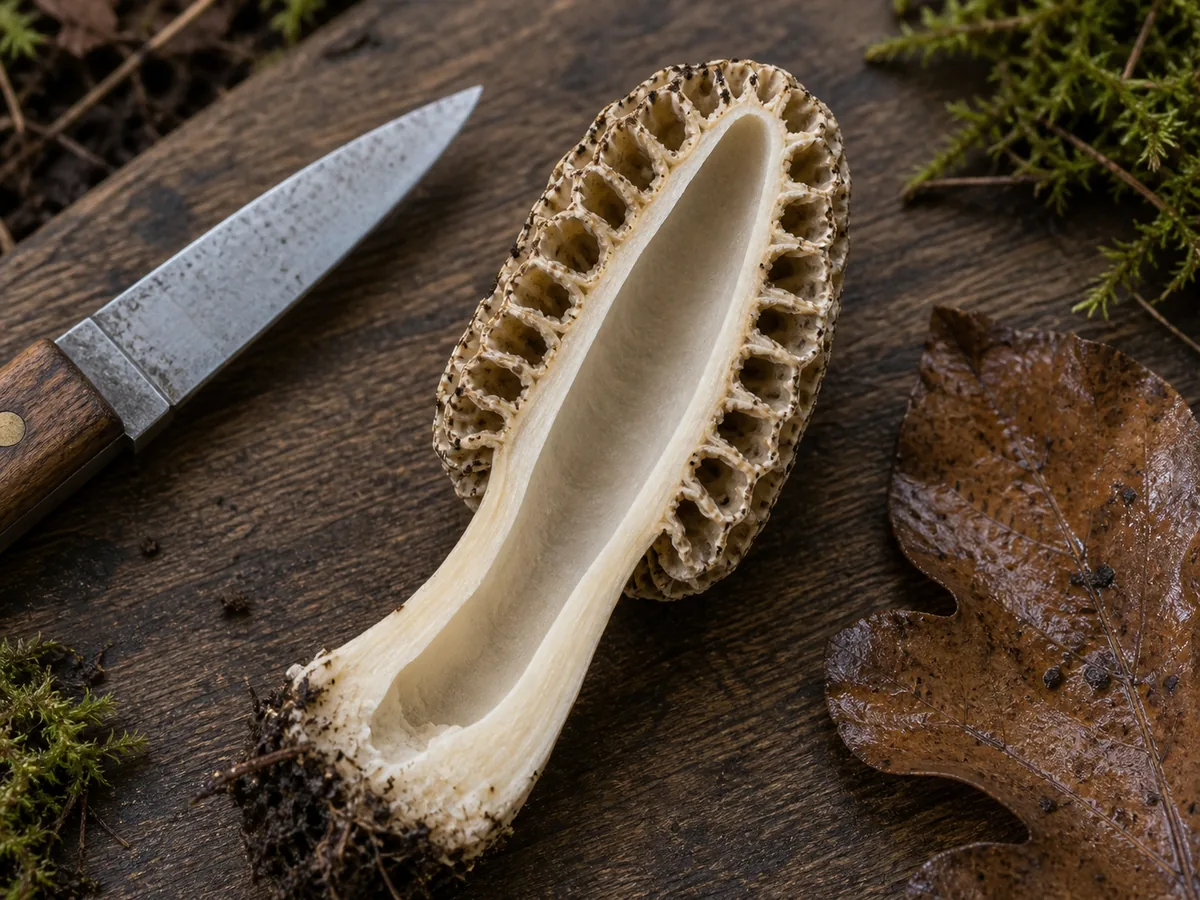
False morels often contain folded, cottony, or chambered tissue rather than one open space from cap to base.
That difference matters more than the outside color. A reddish cap is suspicious, but the inside gives the safer answer.
Cap shape starts suspicion
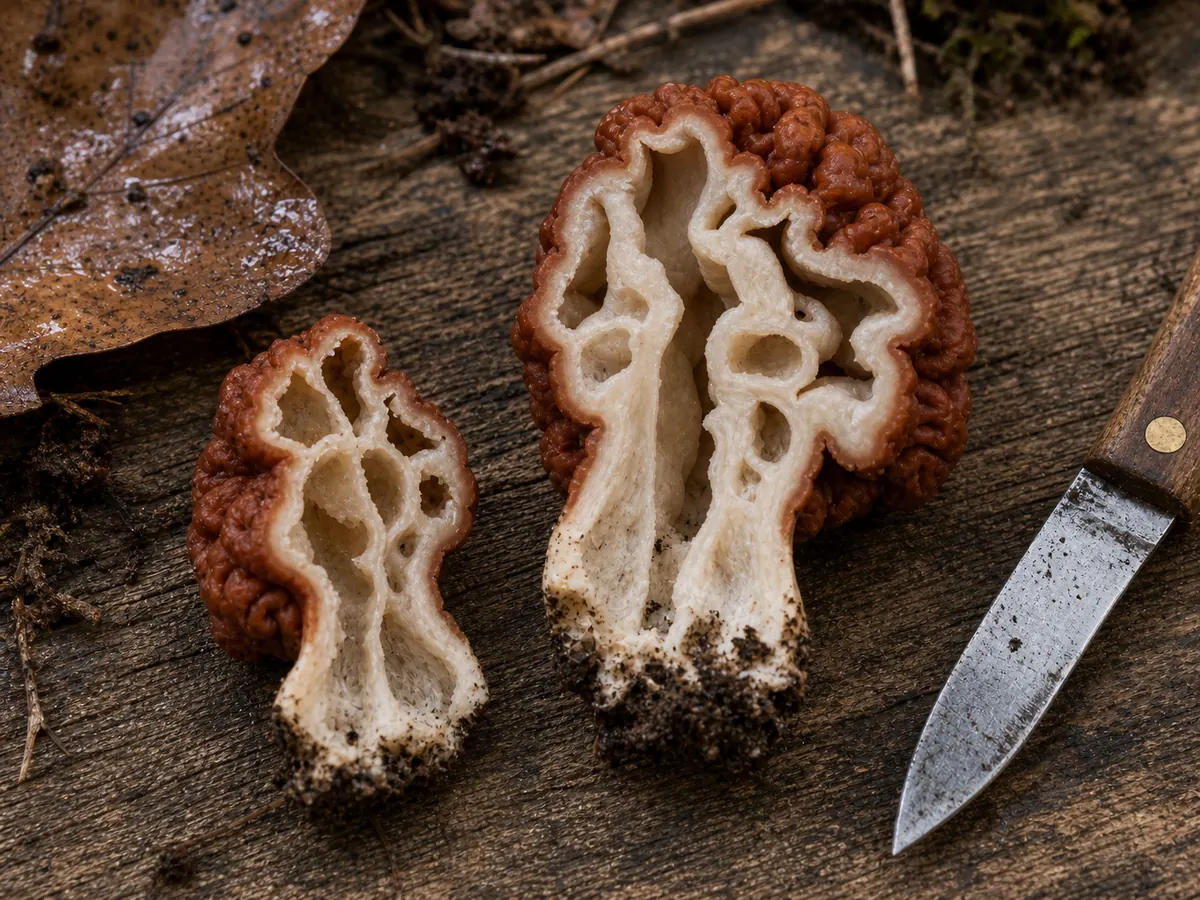
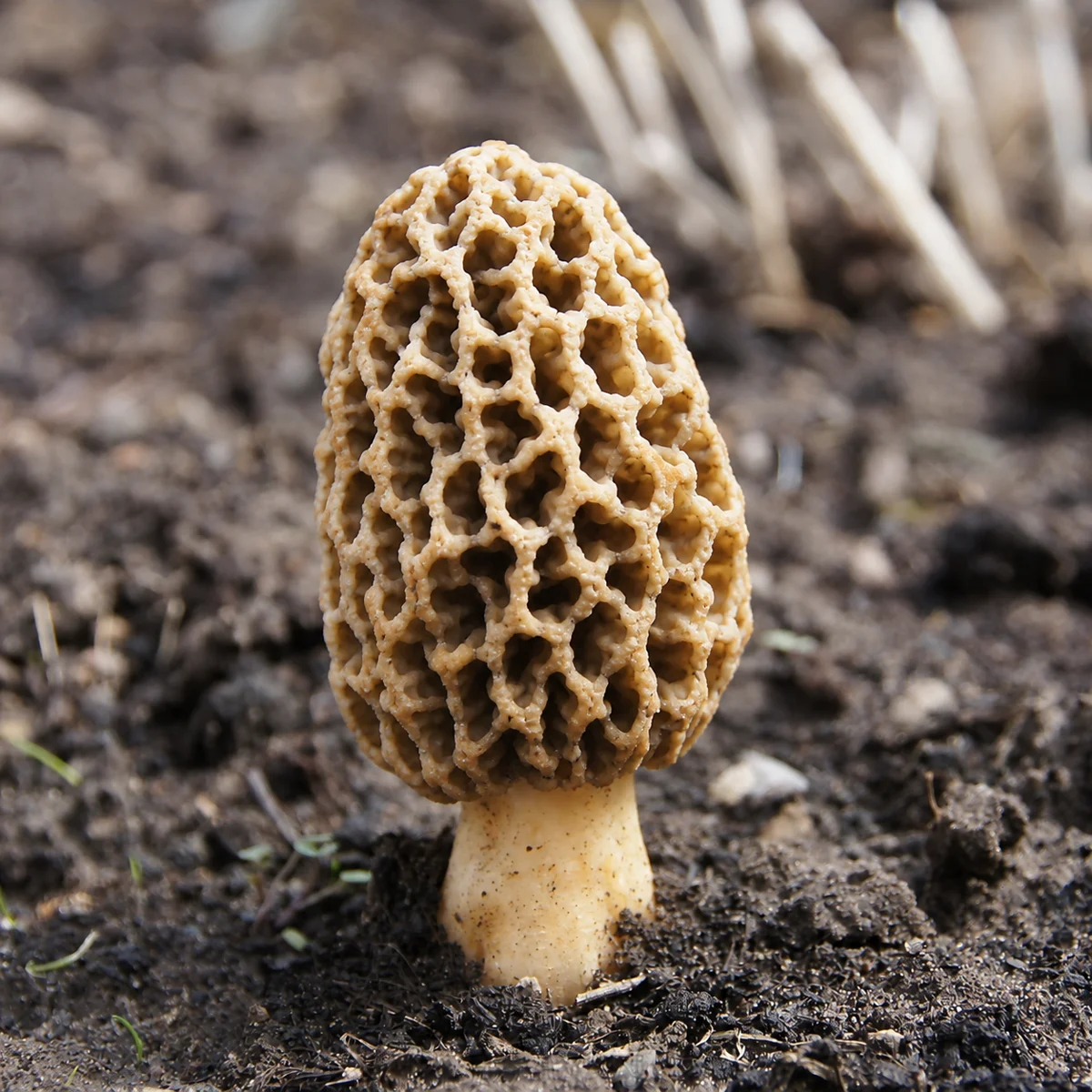
True morels have regular pits and ridges that form a honeycomb surface, although the interior still carries more weight than the cap pattern.
False morels can look wrinkled, lobed, saddle-shaped, or brain-like. Some are reddish brown, but color varies enough that it should not carry the decision.
Look at how the cap meets the stem. A true morel usually looks built as one piece, while many false-morel suspects look more irregular, folded, or loosely attached.
Cap attachment supports the identification, but only the lengthwise cut reveals whether the mushroom has one open chamber or hidden tissue.
Cooking is not the same question
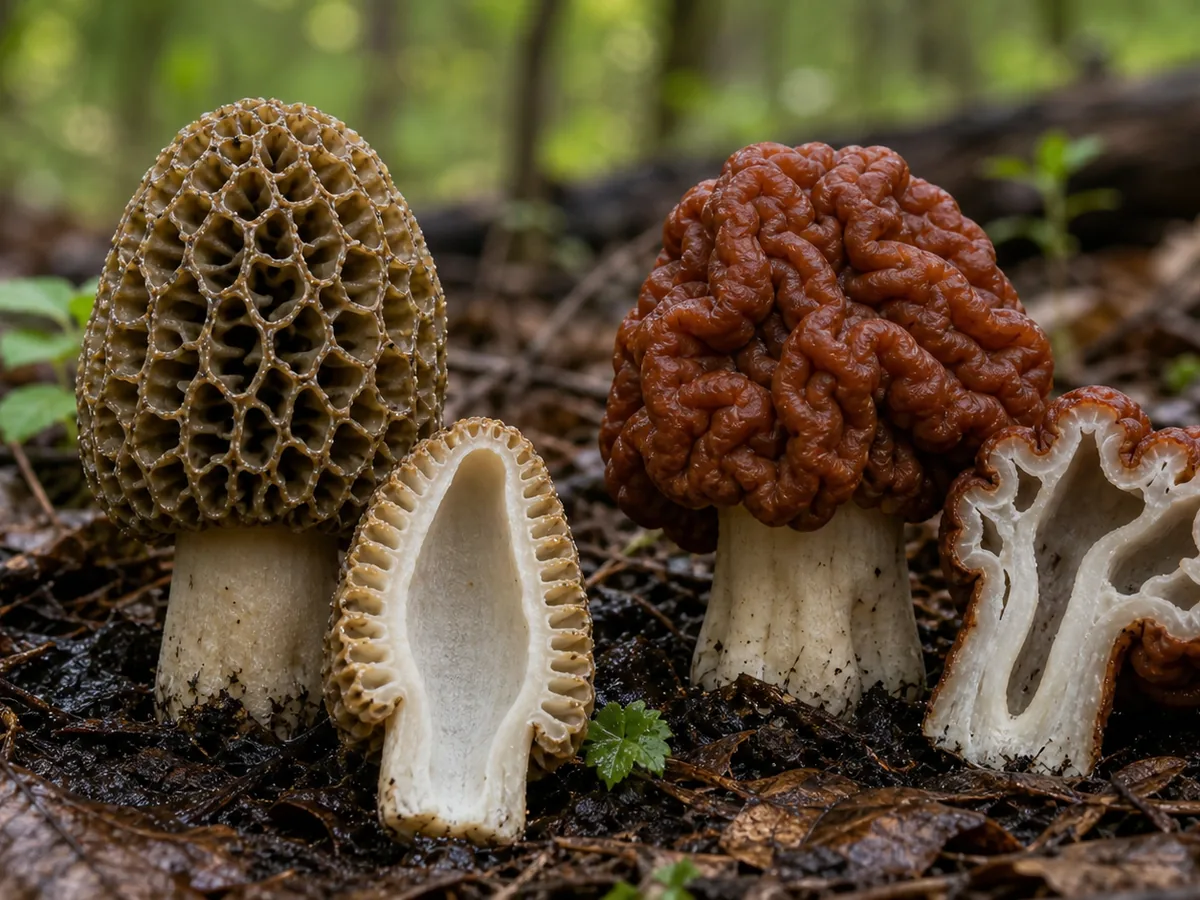
Cooking true morels thoroughly is required. Raw or undercooked morels can make people sick, so a correct ID still needs enough heat.
Cooking cannot turn a false morel into safe food because gyromitrin risk and uneven toxin levels make home processing unreliable.
Warning
If the mushroom is not one clean hollow chamber, do not eat it. Put it aside as a false-morel suspect and keep it out of mixed dishes.
Timing and habitat only narrow the search
Spring timing helps you know what to study, not what to eat.
True morels and false morels can appear in the same broad season, so timing cannot replace the cut.
Habitat also narrows the search without proving safety. Burn sites, hardwood edges, disturbed soil, and conifer woods can all produce confusing spring mushrooms depending on region.
The best use of habitat is note-taking. If the specimen came from a conifer edge, a burn, a landscaped bed, or a hardwood slope, write that down before the mushroom is cleaned.
Habitat details help a local expert, but they cannot overrule a chambered or cottony interior.
Mixed batches need specimen-level checks
Check every mushroom separately. One true morel in the basket does not bless the rest of the batch.
Mixed fragments are a problem because the safety check depends on a whole mushroom. If caps and stems are already separated, discard the uncertain pieces.
- Keep spring mushrooms separate by specimen.
- Cut each one from tip to base.
- Remove old, buggy, or waterlogged mushrooms.
- Save photos before cleaning.
- Cook only the mushrooms that pass every check.
This is also why buying loose wild morels from an unknown person is hard to evaluate. A pile of trimmed caps may be convenient, but it removes the full-body evidence a beginner needs.
Inspect the whole batch without losing evidence
Keep every spring mushroom whole until its outside and inside are documented because detached caps remove the stem base, cap attachment, and continuous cut that separate a true morel from a dangerous suspect.
Number the paper bags or specimen groups before cutting. Use the same number on the habitat photo, whole-mushroom photo, and lengthwise cut photo so an expert can trace each interior back to the correct patch.
Choose one mature, undamaged specimen from each visible group for the first cut. If caps differ in color, shape, size, attachment, or texture, treat them as separate groups even when they grew within a few feet of one another.
Cut from the cap tip through the bottom of the stem in one pass because a short slice through only the cap or base can hide folds elsewhere.
Set any mushroom with cottony tissue, extra chambers, loose lobes, or an incomplete base apart from the food candidates. The false morel profile helps name those warning patterns, but the specimen remains rejected when the exact species is unresolved.
Do not return cut suspects to the edible bag. Separate paper and clear labels keep fragments from becoming anonymous after the field marks have been checked.
At home, lay each numbered group on its own sheet of paper and repeat the cut on another specimen before cleaning. Two matching interiors confirm that the group was sorted consistently, while one different interior means the entire group needs another identification pass.
Keep rejected specimens available for photographs or expert review, but separate them in a dedicated container away from food storage, kitchen trimmings, and pet-accessible compost, label each bag REJECTED with the date and patch number, and prevent later review from returning anonymous pieces to food.
Local traditions do not remove risk
Regional traditions around false morels do not change the identification or toxicology problem for an unknown specimen.
The safer choice is clear. A false morel suspect stays out of the pan, and a morel substitute can replace the spring flavor without gambling on a bad ID.
Do not treat a neighbor's confidence as identification evidence because a long local habit cannot reveal the inside of the mushroom in your hand.
Gyromitrin changes the stakes
False morel risk is often tied to gyromitrin, which can convert into a toxic compound in the body. Amounts vary by species, specimen, region, and handling, which is exactly why casual cooking advice is a poor safety plan.
False morel poisoning can cause nausea, vomiting, diarrhea, dizziness, headache, weakness, seizures, or liver injury. The delay varies, so symptoms after a spring mushroom meal need prompt professional advice.
CompareOyster Mushroom vs Shiitake: Which One Fits the Dish?Drying and boiling are not beginner fixes
Do not use drying, boiling, or parboiling as a home safety plan because these methods do not make an uncertain specimen suitable for food.
They also create a second problem. Once a false morel is processed, the original identification evidence is weaker, and a mixed dish becomes harder for an expert to evaluate if someone gets sick.
Ventilation is another reason not to experiment. Some false-morel preparation traditions involve fumes and repeated water changes, which are not beginner kitchen controls.
The safe public answer is keeping a false morel suspect out of food, regardless of local preparation traditions.
Notes that preserve evidence
Write down the tree mix, soil, slope, date, and whether the mushroom was alone or in a patch. Those details will not prove dinner, but they help an expert understand the find.
Photograph the mushroom before cutting it, then photograph the cut surface. A cleaned pile of spring mushrooms on a plate has already lost the evidence that matters.
When a friend shares mushrooms, ask for the same habitat and whole-specimen photos because a bag of trimmed caps has lost critical evidence.
Can a partly hollow mushroom still be a false morel?
"Almost hollow" fails the true-morel check because the specimen should show one continuous open chamber from cap tip through stem base.
Borderline interiors happen when mushrooms are old, damaged, or poorly cut. Keep uncertain specimens out of food. A plausible name is not enough to make them safe.
When a specimen is torn, cut another whole mushroom from the same patch instead of reconstructing the interior from fragments.
Do not average the batch. Three clean hollow morels do not fix one chambered specimen, and one suspicious cap should not be chopped into the same bowl.
How does age blur the morel comparison?
Old spring mushrooms become difficult because morels can darken, soften, split, or collect insects as they age. False morels can also collapse, making their folds look less obvious.
That is why the interior check stays important even when the cap looks familiar. A tired true morel is still hollow, while a false morel does not become one clean chamber with age.
Condition affects food quality as well as identification because a waterlogged or decaying true morel still belongs outside the pan.
When the specimen is old enough that the cut surface tears instead of showing a clean chamber, do not force the call. Keep it for study or discard it.
Skipping an uncertain morel costs one meal, while cooking a false morel suspect creates a medical risk that no recipe can justify.
That tradeoff is easy to accept before the pan is hot, especially with guests.
Cooking starts after identification
The comparison ends before the pan comes out. A true morel should be hollow from cap to base, then it still needs thorough cooking.
Once the ID is settled, clean the mushrooms and cook morels thoroughly before tasting them. If the cut shows folds, cottony chambers, or a separate cap attachment, do not try to save the meal.
A morel substitute is safer when the mushroom itself is uncertain. No recipe step can turn a false-morel suspect into dinner.
Apply the same whole-specimen habit to dangerous lookalikes in other mushroom groups.
Sources behind the stop rule
This page follows the hollow-interior split used by MushroomExpert.com, Poison Control's morel safety guidance, and CDC reporting on morel-related illness. These sources separate true-morel cooking risk from false-morel identification risk.
Local experts still matter because spring fungi are variable. Use this page as a stop rule, not as permission to eat an uncertain mushroom.
The safest answer can be simple because a true morel has one hollow chamber and an uncertain specimen does not become food.
When in doubt, throw it out. Never consume a wild mushroom unless you are 100% certain of its identity. Foraging safety rules keep the full specimen, habitat, and dangerous alternatives in the decision before any wild mushroom becomes food.