Which mushroom does this profile cover?
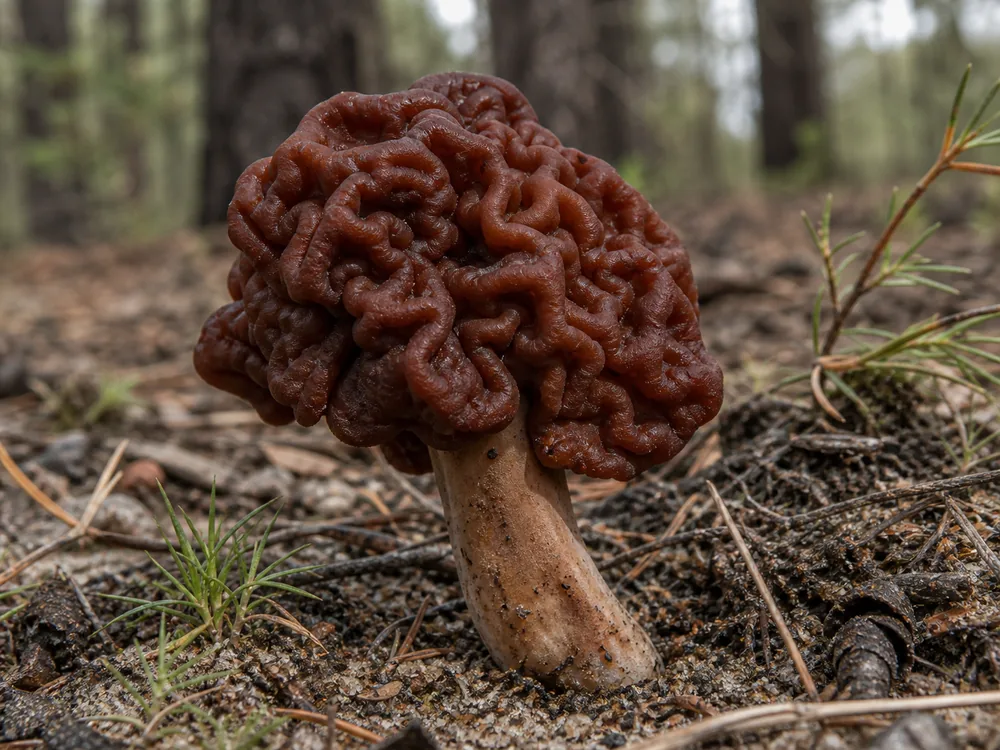
The name false morel covers several mushrooms, but this profile is specifically about Gyromitra esculenta. Its field pattern is a deeply convoluted reddish-brown cap on a pale stem, usually emerging from sandy ground in conifer country during spring.
That scope matters because toxin chemistry and identification uncertainty cannot be transferred automatically from one Gyromitra-like mushroom to another. Treat the common name as a warning category, not a species diagnosis.

A whole specimen gives more information than a detached cap. Photograph the cap, complete stem, point of attachment, substrate, and nearby trees before cutting it.
None of those characters alone confirms G. esculenta. Older field reports and poison-center records may identify only Gyromitra species, and modern work continues to resolve species boundaries within the family.
What does a cut prove, and what does it not prove?
Irregularly lobed and deeply convoluted, often reddish brown to chestnut, with a brain-like surface rather than orderly pits and ridges.
No gills. The exposed fertile surface covers the folds of the cap.
Pale, usually shorter and less massive than the cap, and often irregular or compressed rather than evenly cylindrical.
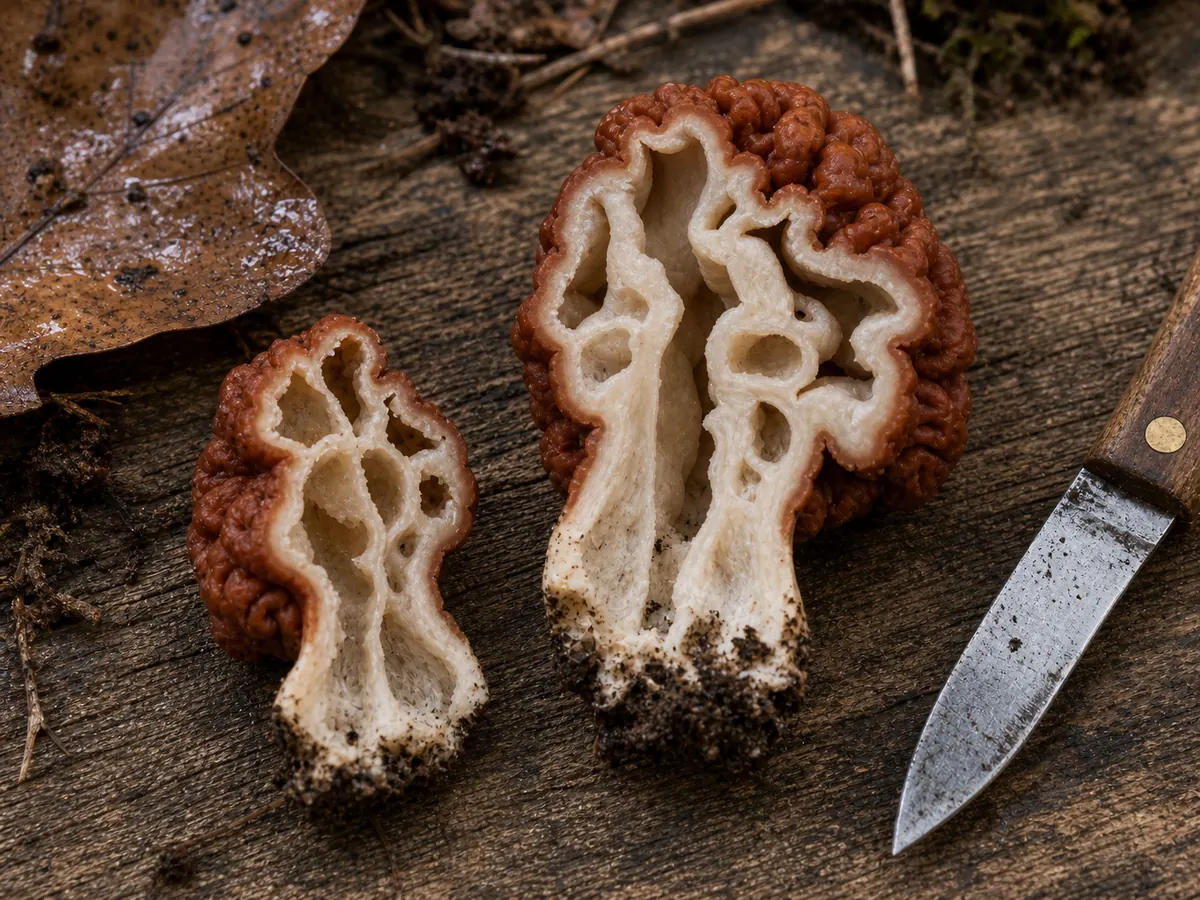
Brittle flesh with an interior divided by folds and chambers. Odor is not a safety character.
A lengthwise cut answers a narrow but important question. If the cap and stem do not form one clean hollow cavity, the specimen fails the true-morel pattern and stays out of the basket.
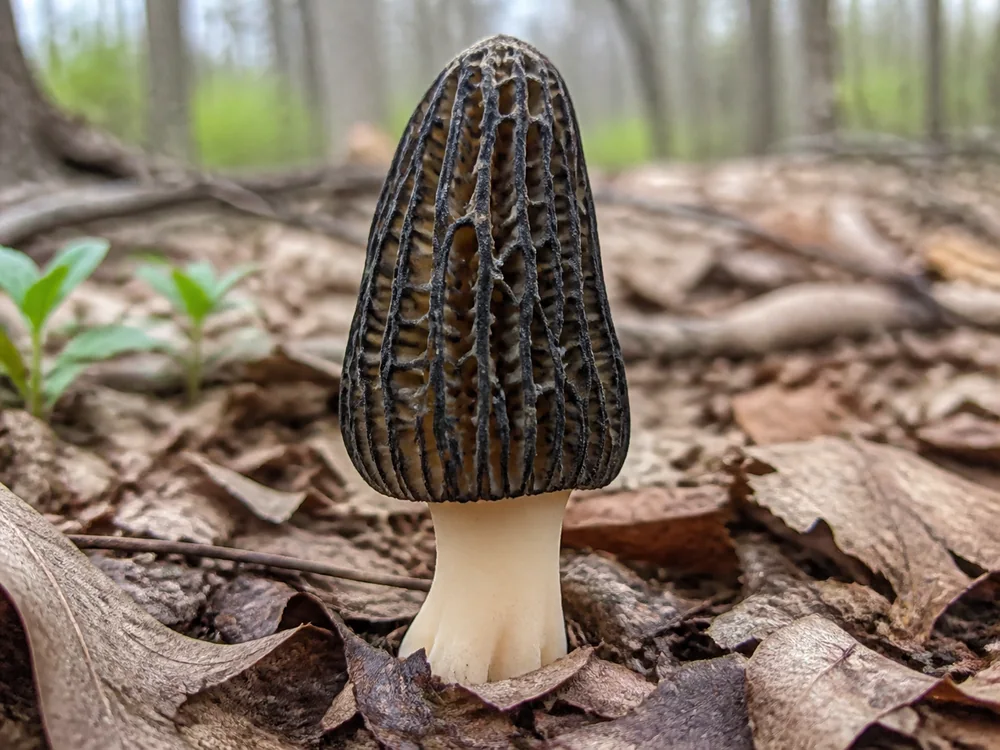
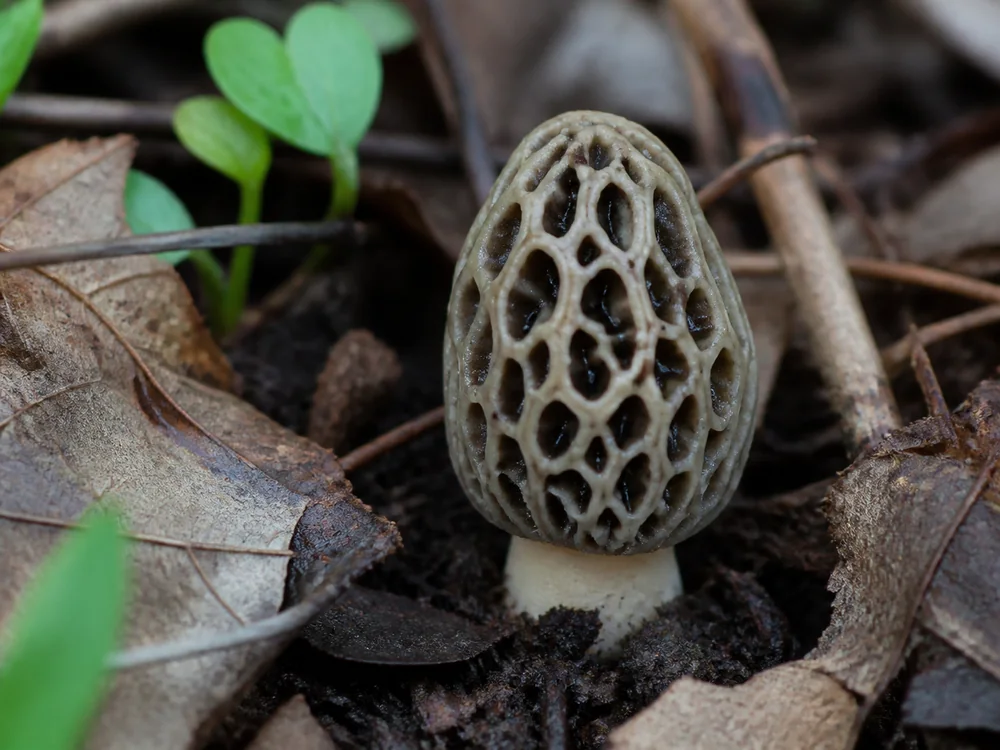
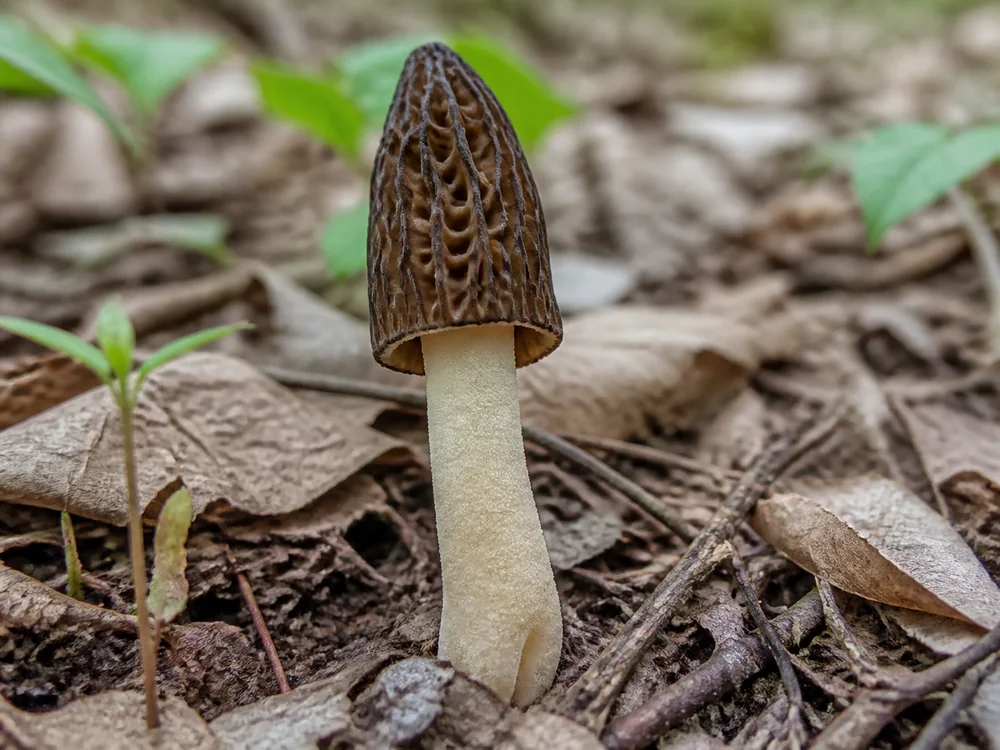
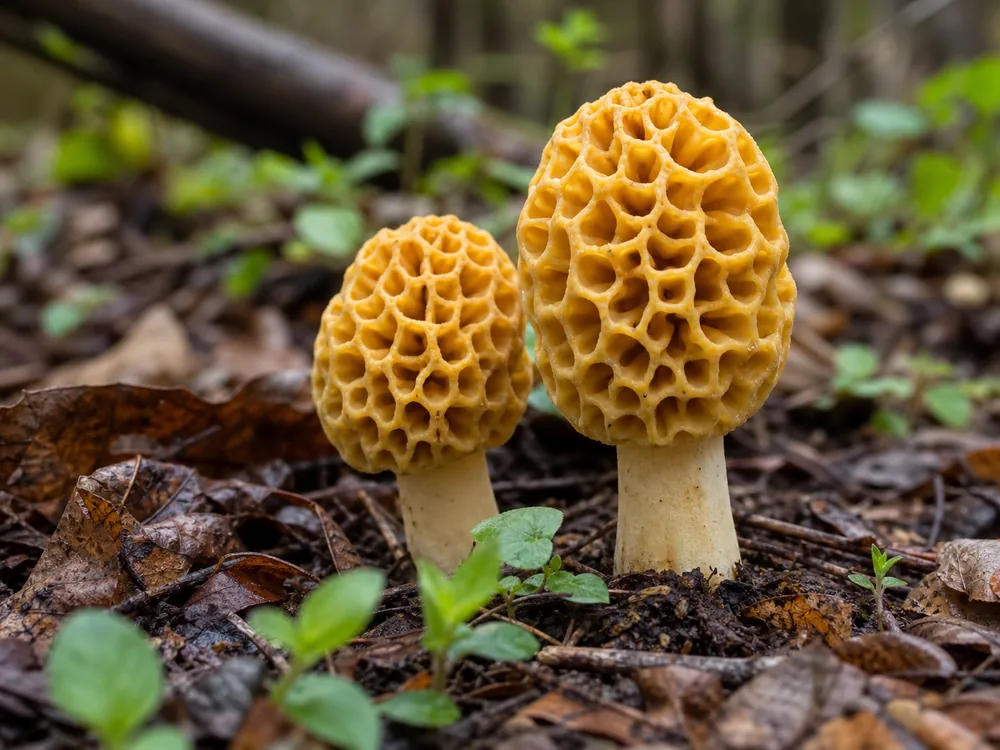
The outside supplies a different set of evidence. G. esculenta usually has broad, rounded convolutions that resemble a folded brain, while a true morel has a more regular network of pits and ridges.
| Evidence | Gyromitra esculenta pattern | True morel pattern | What it can establish |
|---|---|---|---|
| Cap surface | Irregular brain-like lobes, commonly reddish brown | Distinct pits separated by ridges | Raises or lowers suspicion, but color and texture alone do not settle identity |
| Full cut | Folded or chambered interior | One continuous hollow cavity through cap and stem | A chambered cut rejects true morel |
| Stem and cap | Pale stem under a broad convoluted cap | Pitted cap attached to a hollow stem, with attachment varying by species | Keeps the comparison tied to the whole specimen |
| Food decision | Reject and preserve evidence | Requires complete species confirmation before any food decision | Prevents a cut test from becoming permission to eat |
This comparison protects against one dangerous mix-up. It does not distinguish G. esculenta from every related Discinaceae species, so a record intended for science or public reporting may need microscopy, location data, and molecular work.
Do not taste a questionable specimen or use odor as a shortcut. Drying, damage, and age can distort the cap and interior, which makes an intact field photograph more useful than a loose pile of pieces.
If someone may have eaten this mushroom, act now. Call Poison Control at 1-800-222-1222 (US) or emergency services before symptoms appear, and save a piece of the mushroom for identification.
How does the whole mushroom differ from a true morel?
False morels can be confused with true morels, so examine the whole specimen. Cap surface, cap-to-stem structure, and a full-length cut answer different parts of the identification question.
The hollow test has a strict limit. It can reject a false morel from a true-morel basket, but it cannot assign every chambered spring fungus to Gyromitra esculenta.
A true morel has an orderly pitted cap and one continuous hollow cavity through cap and stem. Gyromitra esculenta has broad brain-like folds and an internally folded or chambered fruiting body.
Half-free morels and Verpa-like mushrooms create additional attachment questions, so cap attachment should be read with the full cut and local species knowledge. A single photograph or color match is insufficient.
If any specimen fails the true-morel pattern, keep it out of food and separate from the rest of the collection. Cooking does not repair an unresolved identification, and U.S. guidance does not clear false morels after cooking.
Where does Gyromitra esculenta fruit?
Gyromitra esculenta is a spring-fruiting fungus associated with northern and montane settings. Field accounts emphasize sandy soil in conifer woods, along roads, in clearings, and on other disturbed ground.
Those conditions help document a collection, but they cannot confirm a meal. True morels and other spring cup fungi can occur in overlapping country, while a familiar patch can produce more than one species.
Keep an uncertain specimen separate and record the tree community, substrate, date, and broad location. That evidence becomes especially important where North American collections resemble European G. esculenta but cannot be assigned confidently from a photograph.
A field record should preserve the entire base. Pulling or cutting away the lower stem removes proportion and attachment clues before an identifier can examine them.
Why do U.S. and Finnish guidance look different?
Do not attempt to detoxify false morels at home. In the United States, the FDA states that false morels should not be consumed cooked or uncooked because heat may reduce some gyromitrin while toxin can remain.
Finland has a distinct regulated food tradition for G. esculenta. A 2025 Finnish Food Authority assessment reported that its recommended double-boiling process left about 18 percent of the original gyromitrin on average, so that national handling rule is not evidence of complete toxin removal and should not be exported as universal clearance.
The uncertainty cuts in one direction for a food decision. Variation among specimens, incomplete species records, and residual toxin mean there is no defensible safe dose or home preparation that this page can provide.
If someone may have eaten the mushroom, do not wait for a predicted symptom window.
- Call Poison Control in the United States at 1-800-222-1222, use its online tool, or contact the appropriate poison service where the exposure occurred.
- Seek emergency help immediately for collapse, trouble breathing, seizure, or severe confusion.
- Keep an uncooked specimen, scraps, packaging, and clear photographs available for the poison specialist.
- Do not induce vomiting or attempt a home antidote unless a medical professional directs it.
Clinical reports describe gastrointestinal, liver, and neurologic effects, but no fixed onset or recovery clock applies to every exposure. The absence of early symptoms does not clear the meal.
How should you preserve a specimen after an exposure?
Cultivation does not help someone manage this poisonous species or a suspected exposure. The useful handling task is preserving evidence when it appears in a yard, garden, or collected batch.
Photograph the mushroom in place, then isolate the complete specimen in a paper container. Keep children and animals away from it, and record whether any part may have been eaten before contacting the relevant poison service.
Are medicinal or long-term health claims established?
No established medicinal use changes the poisoning boundary for Gyromitra esculenta. Concentrating or drying unidentified material for tea, powder, or tincture also removes field characters that a poison specialist may need.
Claims about long-term neurologic effects remain an active research area and should not be used to diagnose an individual exposure. Acute symptoms and a known or suspected ingestion belong with a poison service and clinician.
Why is nutrition not the deciding question?
Nutrition figures do not make a poisonous mushroom suitable for food. The relevant consumer conclusion is that nutrient content cannot offset an unpredictable poisoning risk.
For a mixed collection, leave every uncertain piece uncooked until a qualified identifier has reviewed the intact evidence. A chambered specimen fails the true-morel check, and chopping the batch only makes the remaining mushrooms harder to assess.
Taxonomy & Naming
Gyromitra esculenta belongs to Discinaceae in the order Pezizales. A 2023 multigene revision retained Gyromitra in a narrower sense for cerebriform species and confirmed G. esculenta with European reference material.
The family revision also showed why gross shape has limits. Several Discinaceae lineages can be lobed, saddle-shaped, or cup-like, and accurate species work may require morphology plus sequence data.
North American poison records often concern Gyromitra species or the G. esculenta group rather than a sequence-confirmed G. esculenta. Use the accepted species name with its geographic and identification limits.
False morel poisoning questions
Are false morels really deadly?
Why do some people eat false morels?
What is the fastest field check?
Can false morels grow beside true morels?
Can you make false morels safe by boiling them?
When and where do false morels grow?
Sources & References
- MushroomExpert Gyromitra esculenta cap shape, spring habitat, conifer association, and northern or montane distribution.
- Simon et al., Clinical Toxicology Narrative review of human Morchella and Gyromitra ingestion reports, clinical patterns, outcomes, and evidence limitations through 2024.
- FDA False morels should not be consumed cooked or uncooked, gyromitrin risk, and possible severe outcomes.
- Finnish Food Authority Finland-specific regulation and the 2025 finding that recommended double boiling left about 18 percent of original gyromitrin on average.
- Vohra et al., Toxicon Michigan poison-center series showing clinical scope and the limits created by species-level uncertainty in reported Gyromitra exposures.
- Wang et al., Microbiology Spectrum Multigene revision of Discinaceae, narrow Gyromitra concept, and the taxonomic position of Gyromitra esculenta.
- Poison Control Official U.S. poison-service access for suspected mushroom exposure.