Which half-free morel occurs in eastern North America?
Morchella punctipes is the half-free morel of eastern North America. A western half-free collection can belong to a different species, so the regional boundary matters before a name is assigned.
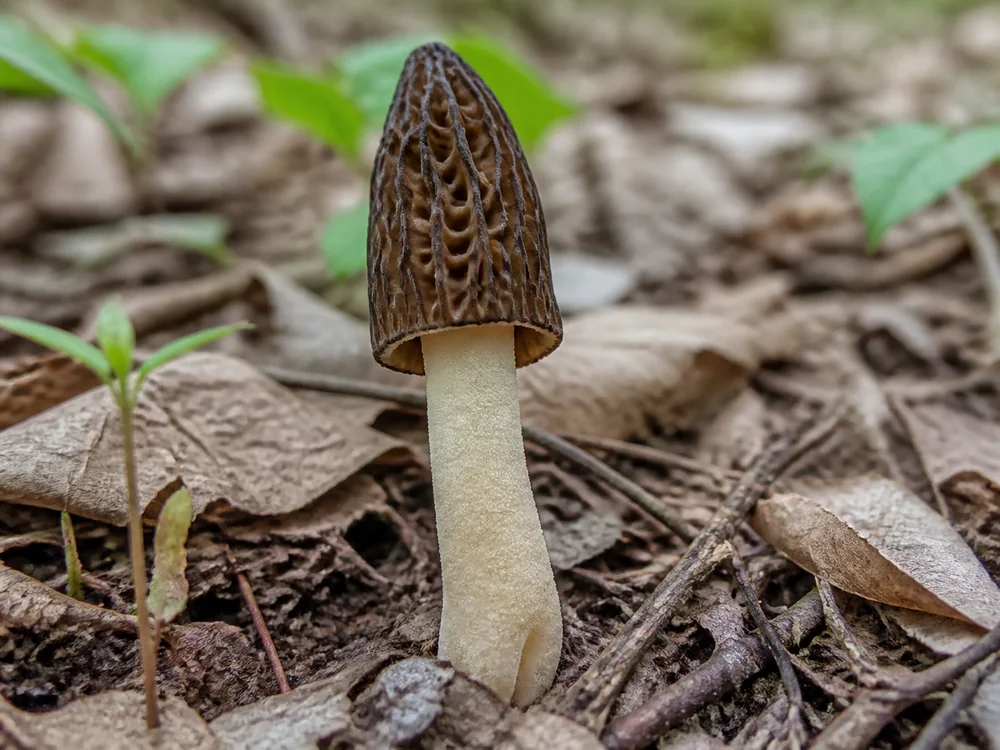
The fruitbody looks top-heavy in reverse. Its pitted cap is commonly about 2 to 4.5 cm tall, while the pale stem can reach roughly 15 cm and may show fine granules that darken with age.
Attachment explains the common name. The inner cap surface joins the stem partway down, leaving only the lower margin loose rather than allowing the whole cap to hang from the apex.
That geometry separates three observations that are easy to blur in a photograph: a genuinely pitted cap, a partway attachment, and one continuous hollow cavity. All three need to be visible before a food decision is made.
Where exactly does the cap join the stem?
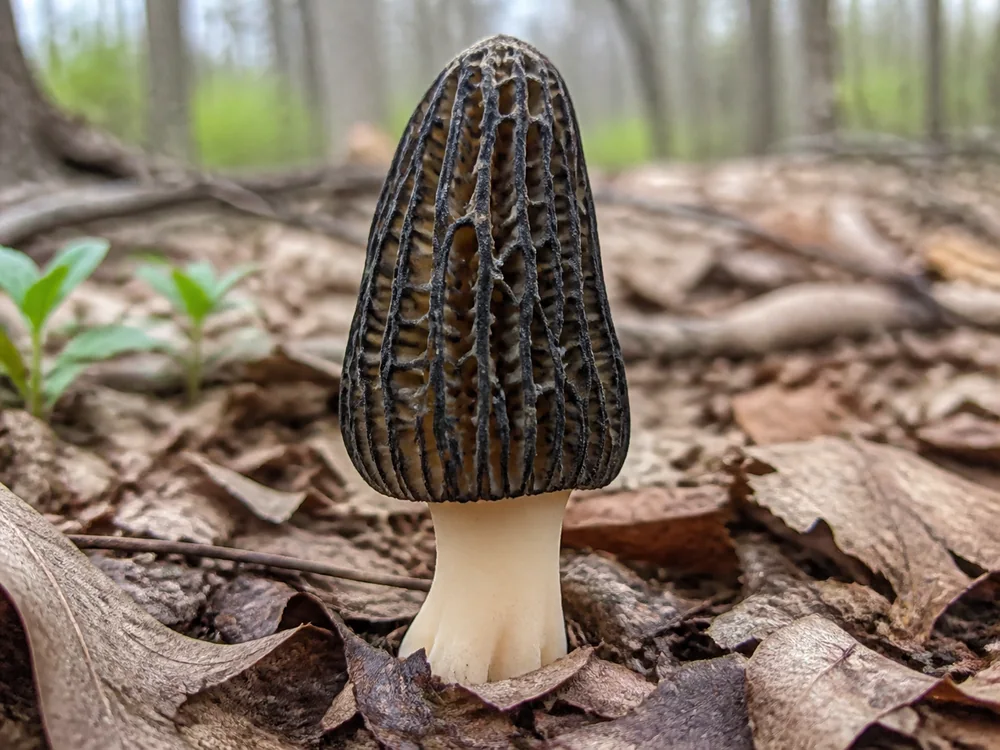
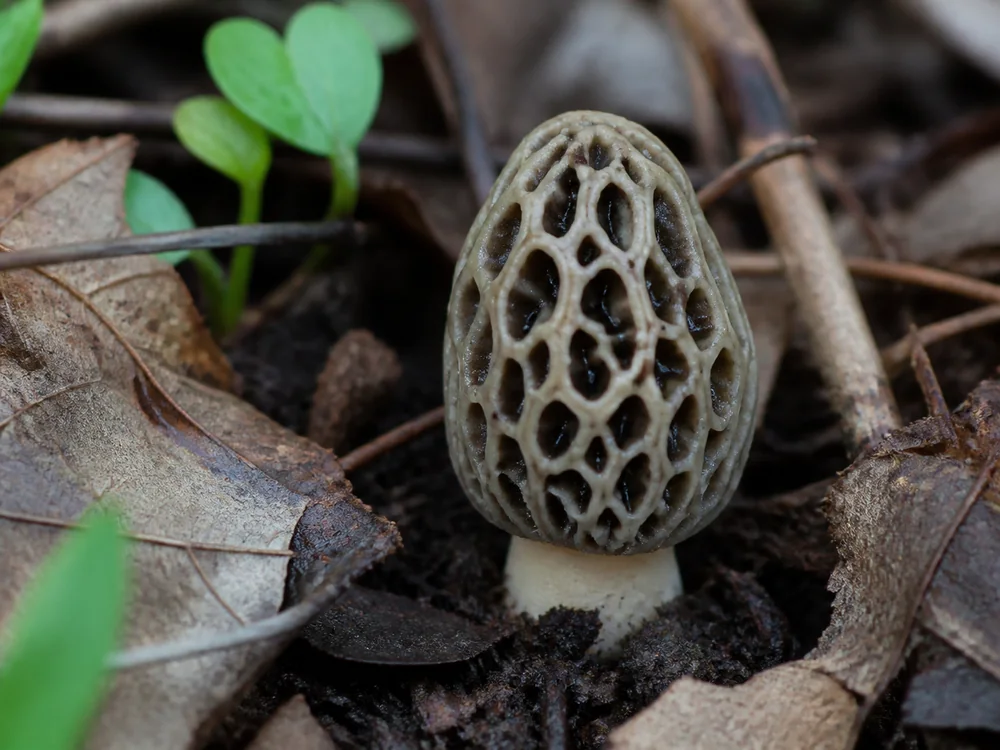
Small and conical, 2 to 4.5 cm tall and wide, pitted with the pits arranged mainly vertically. Ridges start pale brownish over whitish pits and darken to dark brown or black over yellowish brown pits. The cap is attached about halfway down the stem, so its lower half hangs free.
No gills. The pitted surface of the cap carries the spores.
Whitish and fragile, 1.5 to 15 cm high and 1 to 4.5 cm wide, usually mealy with whitish granules, hollow and often far longer than the cap.
Thin and brittle, hollow through cap and stem, mild earthy smell.
Begin underneath the cap because the loose edge is the feature most likely to be misread. The join should form a visible ring partway down the stem, with a short free margin below it.

Use that attachment as the first decision, then verify the rest in a fixed sequence. A loose edge alone does not identify the mushroom.

A damaged cap can hide the attachment, so an incomplete mushroom cannot pass this sequence. The false morel comparison helps with folded or chambered specimens, but it does not substitute for seeing this fruitbody's complete join and interior.
What separates a half-free morel from Verpa?
A half-free morel really does have a loose lower cap margin. The decisive question is where the inner cap surface joins the stem, followed by what the complete interior contains.
A Verpa is attached only at the stem apex. Its cap hangs like a thimble, and the stem contains cottony material instead of forming the half-free morel's clean continuous cavity.
Morchella punctipes joins partway down the stem, leaving only the lower cap margin free. Inspect the attachment before cutting, because the cut can destroy the very geometry you need to see.
NAMA records Verpa among ascomycetes that can cause gastrointestinal upset, especially when raw or inadequately cooked. Uncertain collections stay out of food rather than being assigned safety from a common name.
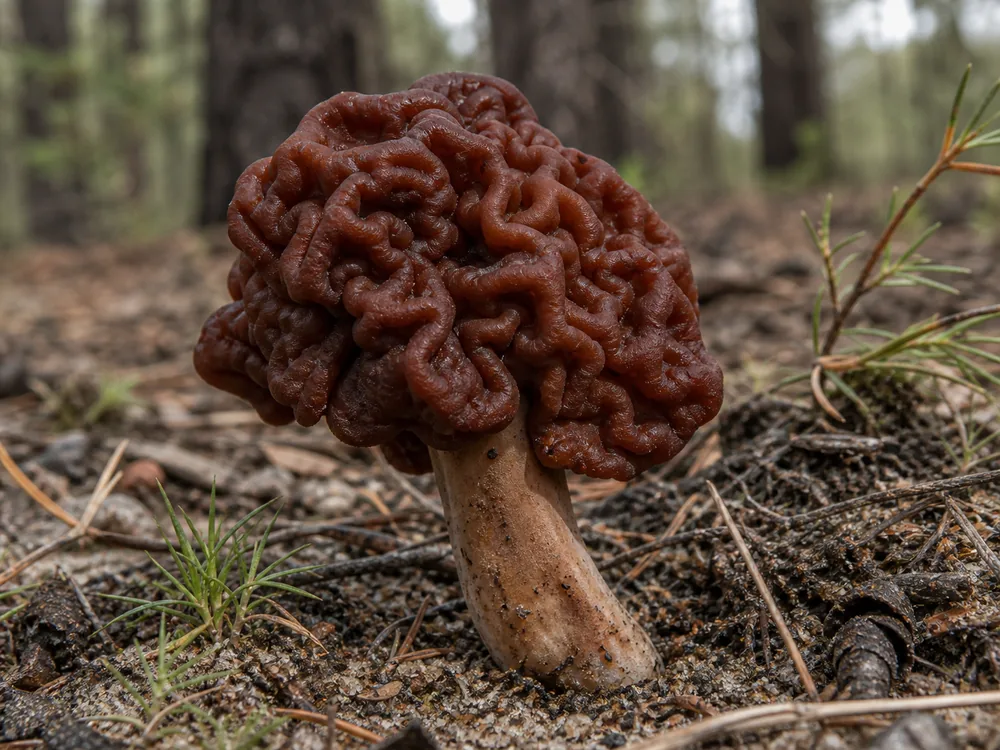
A false morel presents another pattern, with a broadly folded or brain-like cap and an irregular stuffed or chambered interior.
How do the thin cap and long stem change preparation?
Half-free morels have thin caps and long hollow stems, so a basket contains less dense mushroom tissue than the same volume of larger yellow morels. That proportion changes handling but does not relax the safety standard.
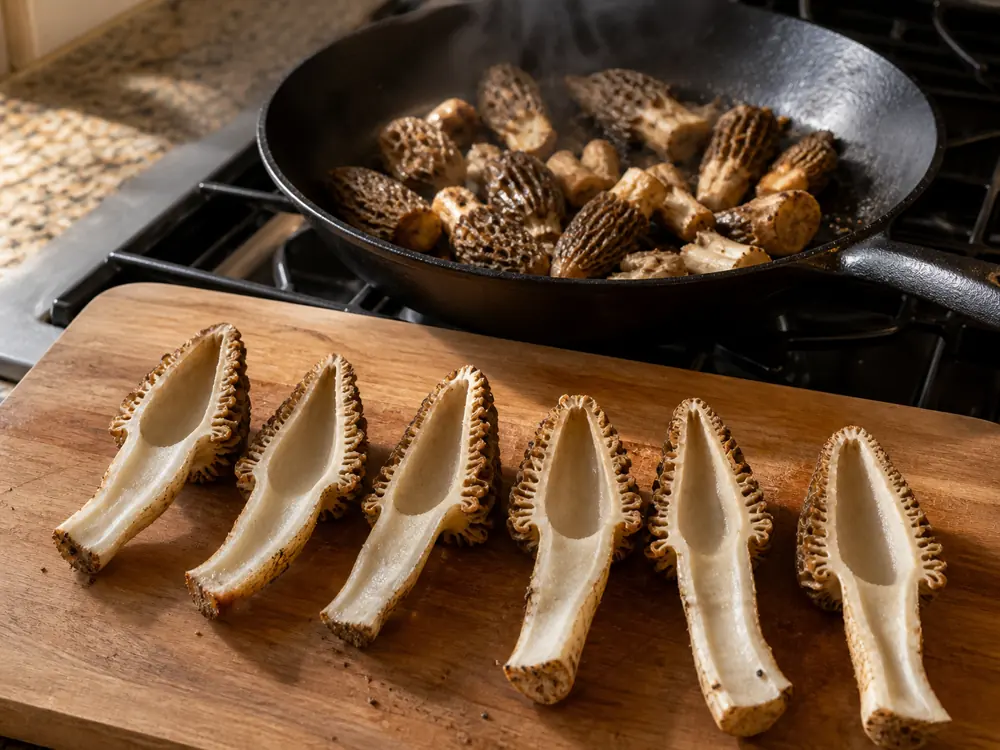
The CDC investigation of a 2023 morel outbreak found a stronger association between illness and raw exposure than exposure to mushrooms reported as at least partially cooked. Thorough cooking is required for every piece, and quick surface browning does not prove the interior heated through.
Photograph firstPreserve the attachment evidence before cutting the fruitbody open
Cook in one layerLet released water evaporate while every piece heats through
Mix uncertain fragmentsA loose cap or broken stem cannot pass the attachment and cavity checks
Serve a large first portionIndividual reactions can occur even after correct identification and cooking
Retain field photographs and one uncooked reference specimen until the meal is finished. If illness follows, preserve the sample and contact Poison Control or emergency services rather than attempting a home diagnosis.
The mushroom poisoning symptoms page explains what details to report. Timing, preparation, amount eaten, and a usable specimen record can all assist the response.
Why does geography change the species name?
Published North American treatments place Morchella punctipes east of the Rocky Mountains in spring hardwood forests. That boundary excludes the western half-free species from this page even when a photograph shows a similar cap attachment.

Eastern records include ash, tulip poplar, and elm associations. Moist rich leaf litter in river bottoms, creek benches, and sheltered lower slopes is a useful search filter, but the nearby tree and setting remain supporting evidence.
- Record the state or province because geography affects which half-free species name is plausible.
- Photograph nearby trees from bark, buds, leaves, and fallen material rather than guessing from one feature.
- Keep the entire stem base and cap attachment intact for examination.
- Separate every collection until the junction and complete hollow interior have been checked.
Spring sequence varies with latitude, elevation, soil temperature, and weather. Calendar position can guide a return visit, but it cannot establish Morchella punctipes.
Note
Saturated bottomland is easily damaged underfoot. Use durable access lines, respect property rules, and avoid soft banks whether or not mushrooms are present.
Is there a verified method for growing Morchella punctipes?
There is no verified practical home protocol in the cited sources for fruiting Morchella punctipes. General morel kits or spore slurries do not establish that the material is this eastern species, and a label cannot replace a documented strain and method.
Commercial success with other Morchella lineages cannot be transferred automatically to a half-free morel. Species identity, culture conditions, substrate, and environmental controls would all need evidence specific enough to reproduce the result.
Documenting an existing wild site is different from cultivating it. Record geography, tree association, soil setting, and fruiting dates, but do not present mesh bags, cutting versus pulling, or patch disturbance claims as proven propagation methods.
Do half-free morels have medicinal use?
Morels have a long culinary history and have been examined in the laboratory for polysaccharide and antioxidant content, but the half-free has attracted little specific research.
No reliable clinical evidence supports treating or preventing any human condition with morels of any species, and they should be regarded as food.
The health point that does matter is the cooking rule, because raw or undercooked morels cause gastrointestinal illness even when correctly identified.
What do cooked half-free morels provide?
Morels are low in calories and largely water, with modest protein and fiber, and the half-free is thinner fleshed than most, so a given volume carries less food than it appears to.
Fungi exposed to sunlight convert ergosterol into vitamin D2, so morels can contribute vitamin D depending on the conditions they grew in.
They also supply small amounts of iron, copper, manganese, phosphorus and several B vitamins, though normal portions keep those contributions minor.
Published values for wild mushrooms vary considerably with growing conditions, maturity and handling, so any figure should be read as an approximation.
None of this alters the preparation requirement, since morels of every kind must be cooked through before they are eaten.
Taxonomy & Naming
Morchella punctipes is the eastern North American half-free morel recognized in the 2012 multilocus revision of Morchella in Canada and the United States. The treatment retained the older species name for an eastern phylogenetic lineage rather than applying the European Morchella semilibera broadly.
Western North America has other half-free lineages, including Morchella populiphila. A field record from outside the eastern range therefore needs regional taxonomic evidence before it is labeled M. punctipes.
Verpa bohemica sits outside Morchella despite common names such as early morel or thimble morel. Its cap joins only at the apex and its stem contains cottony material, so the taxonomic boundary is visible through attachment and interior anatomy rather than cap color alone.
Half-free morel questions
How do I tell a half-free morel from a Verpa?
What makes a morel half-free?
Are half-free morels safe to eat?
What is a gooseneck or peckerhead morel?
Does finding half-free morels mean anything about the season?
When do half-free morels appear?
Sources & References
- MushroomExpert Cap and stem dimensions, halfway cap attachment, vertical pit arrangement, mealy granular stem, spore print color, season, hardwood habitat, and eastern distribution.
- MushroomExpert Verpa cap attached only at the stem apex and the cottony pith that fills its stem.
- North American Mycological Association Verpa and inadequately cooked morels among ascomycetes associated with gastrointestinal upset.
- CDC Morbidity and Mortality Weekly Report The 2023 Montana outbreak, dose-response evidence, stronger association with raw exposure, and the recommendation to cook morels thoroughly.
- Kuo et al., Mycologia 104(5) Multilocus revision retaining Morchella punctipes for the eastern North American half-free lineage and separating other North American morels.