
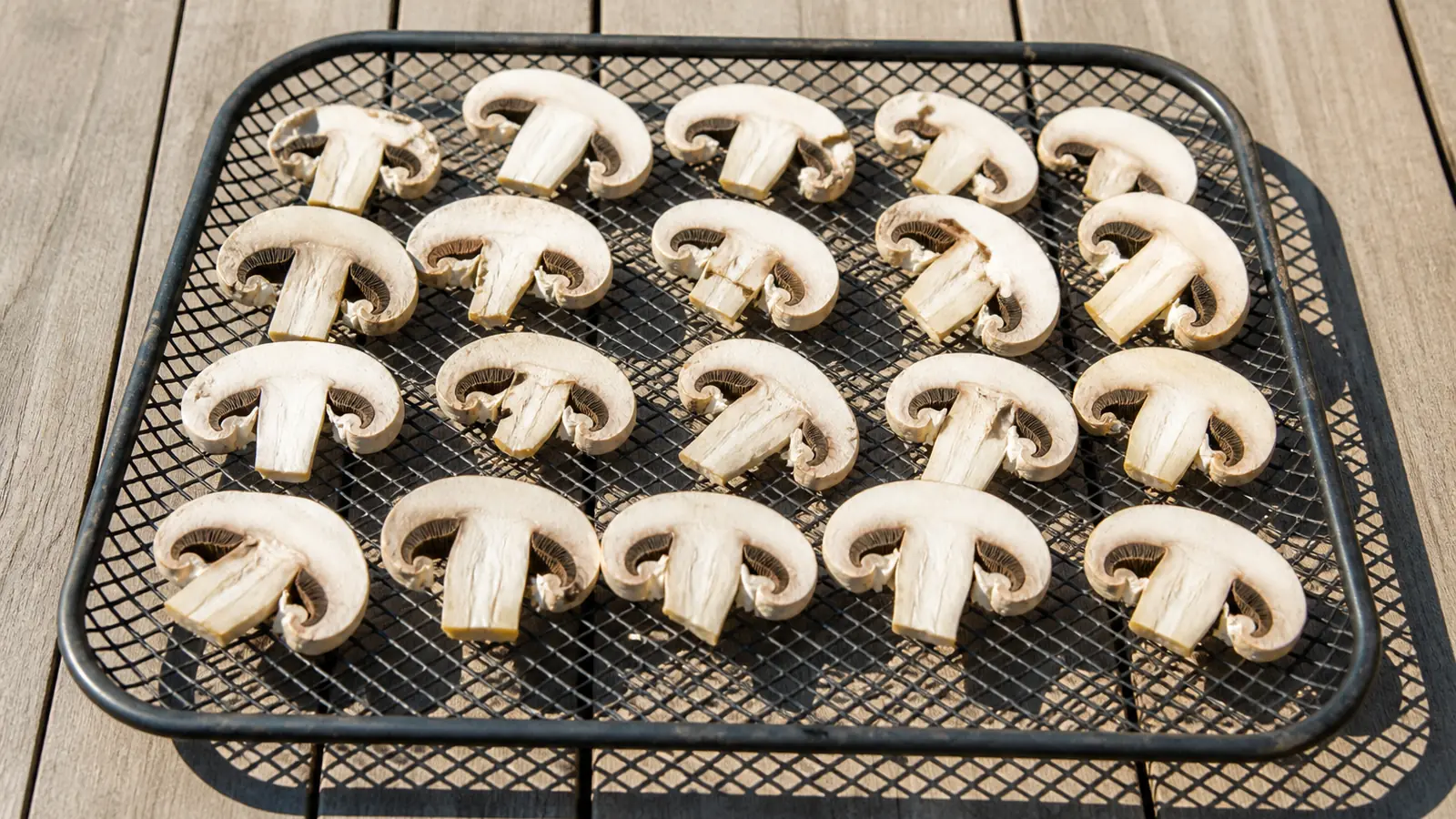
Mushrooms are the only produce-aisle food that makes vitamin D, and commercial ones are grown in darkness so they carry almost none. Sunlight can increase mushroom vitamin D, but a change in the food does not guarantee the same change in a blood test. Compare the exposure conditions, serving units, and human trial results before relying on mushrooms to meet a vitamin D need.
Mushrooms make vitamin D under ultraviolet light, and the ones in the shop were grown in the dark.
That single fact separates a true claim about the food from a much shakier claim about the person eating it, and most coverage runs the two together.
Why the ones you buy have almost none
Mushrooms are the only thing in the produce aisle that can make vitamin D at all. That part of the headline is correct and worth keeping.
The catch is in how the vitamin gets made.
The punnet below holds plenty of ergosterol and has never met any ultraviolet light.

The mushroom has the raw material and no light.
Nothing about the growing method is a mistake, since darkness suits the crop, but it does mean the vitamin D headline arrives at the shop unfulfilled. Some producers now run harvested mushrooms under ultraviolet lamps and label them as such.
- A pack claiming a vitamin D figure has almost certainly been treated
- A pack with no such claim almost certainly has not
- The two sit side by side in the same chiller and look identical
- Treated mushrooms cost more, which is the only other clue on the shelf
What ultraviolet actually does
The conversion is a single photochemical step, which is why it is quick and why it stops at the surface.

Five details govern everything that follows.
- The molecule
- Ergosterol, spread through the mushroom and concentrated toward the gills
- The wavelength
- Ultraviolet B, the same band that makes vitamin D in skin
- The timescale
- Minutes rather than hours
- The limit
- Only surfaces the light reaches convert, so exposed area governs the yield
- Living or not
- Irrelevant, which is why a sliced mushroom works as well as a whole one
Exposed area is the part that turns into practical instructions. A whole mushroom presents its cap to the light and hides everything else, while a sliced one presents several times as much.
The gilled underside is the surface that matters most, because it holds both the highest ergosterol concentration and by far the largest area.
Putting them in the sun yourself
This works, and it has been measured rather than merely recommended.
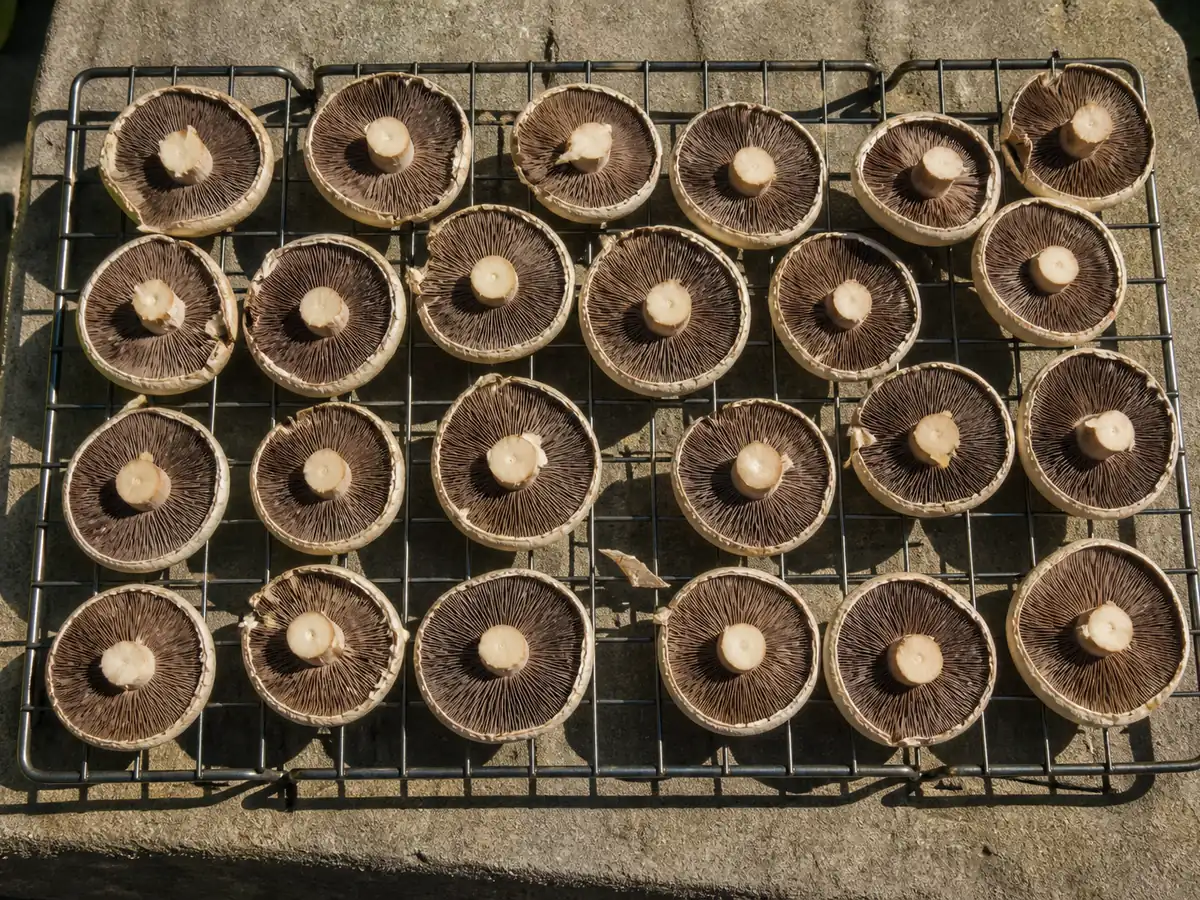
The numbers behind that arrangement are worth quoting exactly.
Those figures are a best case rather than a typical afternoon. Midday, midsummer sun is the strongest ultraviolet most people ever stand in, and the same tray in October at a northern latitude is a different experiment.

The window point catches people out most often, because a sunny windowsill feels like the obvious place and ordinary glass removes most of the wavelength that does the work.
- Slice them first, since exposed area is what converts
- Lay them gill side up in one layer, not heaped
- Use direct outdoor sun near the middle of the day
- Expect much less outside high summer, and much less at high latitudes
If you are going to leave them out anyway, drying them at the same time is the obvious move, and drying mushrooms has its own conditions worth getting right.
For anything you are not drying, the sun session ends and normal rules resume, so storing fresh mushrooms picks up from there.
Does eating them change your blood level?
Here the ground gets less firm, and the honest answer has two halves that do not fully agree. The food side is settled, because ultraviolet light puts real, measurable vitamin D2 into a mushroom, and eating that mushroom puts real, measurable vitamin D2 into blood.
Neither of those results is wrong, and reading only one of them produces a confident answer that the evidence does not support.
Warning
A non-significant pooled result is not proof that mushrooms do nothing. It means six trials did not agree well enough to settle the question, and anyone treating a diagnosed deficiency should be working from blood tests and their own clinician rather than from any food page.
Why D2 is not simply D3
There is a mechanism behind that disagreement, and it is worth knowing because it explains why two honest sources can differ.
Mushrooms make vitamin D2, while sunlight on skin and animal foods make vitamin D3, and several reviews find D3 the more effective of the two at raising total vitamin D status. The more interesting finding is what happens to the two together.
Note
In half of the trials covered by the 2023 review, the vitamin D3 fraction in blood fell while the D2 fraction rose. That is why a mushroom can add vitamin D to a meal without a person's total moving as much as the food figure suggests.
The question is genuinely open rather than closed against mushrooms. A separate trial not included in that review found mushroom D2 as effective as both D2 and D3 supplements at the same daily dose.
It is worth naming who is arguing which side. The 2024 review making the strongest case for mushrooms as a public vitamin D solution was funded by a horticulture industry body, and most of its authors were employed by a food consultancy, which is disclosed in the paper and does not by itself make the case wrong.
Which species, and how much
Species matters less than exposure, but it is not irrelevant, and the units matter more than either.

Four species cover almost everything a reader will meet.
| Mushroom | Notes |
|---|---|
| White button, cremini, portabella | The same species at three ages, and the one most of the measurements used |
| Oyster | Measured under lamps and responds strongly |
| Enoki | The strongest responder in one lamp study, on a dried weight basis |
| Shiitake | Traditionally sun dried, which is the oldest version of this whole idea |
Most of the published human work used button mushrooms, so cremini and button sit closest to the evidence rather than furthest from it.
That same lamp work covered the oyster mushroom, which converts readily. Its thin flesh and very large gill area are mostly exposed surface, which is what the lamps reward.
Warning
Lamp studies often report micrograms per 100 grams of dried weight, and dried mushroom is a small fraction of its fresh weight. Comparing a dried figure with a fresh one overstates the food several times over, and headline numbers in the thousands are almost always dried weight.
Sun drying has been doing this quietly for centuries. Dried shiitake caps prepared in sunlight rather than a dehydrator picks up vitamin D2 as a side effect of the drying.
Where this sits against other sources
Mushrooms are a real contributor and a poor sole strategy, and both halves of that deserve saying plainly.
| Source | What it gives you | The catch |
|---|---|---|
| Summer sun on skin | Vitamin D3, in quantities food rarely matches | Season, latitude, skin, and the risks of deliberate exposure |
| Supplements and fortified food | A known dose, stated on the label | Requires knowing what dose you need |
| UV-treated mushrooms, labeled | A meaningful amount of D2, stated on the pack | Sold in fewer shops, and easy to confuse with untreated ones |
| Untreated mushrooms | Almost nothing | Still a food worth eating, just not for this |
| Home sun exposure | Large gains, measured under good conditions | Highly variable, and no way to know what you actually got |
The variability is the honest limit, because a supplement tells you what you took and a tray on a balcony does not.
- Mushrooms suit topping up a reasonable diet
- They do not suit correcting a shortfall someone has been diagnosed with
- Untreated mushrooms contribute nothing measurable to this
- Nothing on this page replaces a blood test or a clinician
Anyone who reads this and concludes they would rather take something measurable is drawing a sensible conclusion, and choosing a supplement is a different problem with its own pitfalls.
One boundary is worth marking before finishing. This is a nutrient question rather than a therapeutic one, and the claims attached to medicinal fungi are a separate subject with a separate evidence base.
Sources & References
- Bioavailability of vitamin D2 from UV-B-irradiated button mushrooms in healthy adults deficient in serum 25-hydroxyvitamin D: a randomized controlled trial, European Journal of Clinical Nutrition 2011 The 26 adults with serum 25-hydroxyvitamin D at or below 50 nanomoles per liter, the five week design, and the rise of 3.9 nanomoles per liter per week in the mushroom group against 4.7 in the supplement group
- Effect of Ultraviolet Light-Exposed Mushrooms on Vitamin D Status: reanalysis of biobanked sera plus a systematic review and meta-analysis, The Journal of Nutrition 2023 The pooled analysis of six randomized trials finding total 25-hydroxyvitamin D not significantly increased, a weighted mean difference of 8.6 nanomoles per liter, a probability value of 0.12, very high heterogeneity, and the fall in the vitamin D3 fraction in half the trials
- Mushrooms: a food-based solution to vitamin D deficiency to include in dietary guidelines, Frontiers in Nutrition 2024 The measured sunlight figures of 17.5 micrograms per 100 grams after 15 minutes and 32.5 micrograms after 60 minutes, and the trial outside the 2023 review in which mushroom D2 matched D2 and D3 supplements. This review was funded by a horticulture industry body and most of its authors were employed by a food consultancy.
- Effect of Ultraviolet Irradiation on Vitamin D in Commonly Consumed Mushrooms in Thailand, Foods 2023 That eight species were tested under ultraviolet B lamps rather than sunlight, that enoki responded most strongly, and that the results are reported on a dried weight basis. Dried-weight values cannot be read as fresh-weight values