
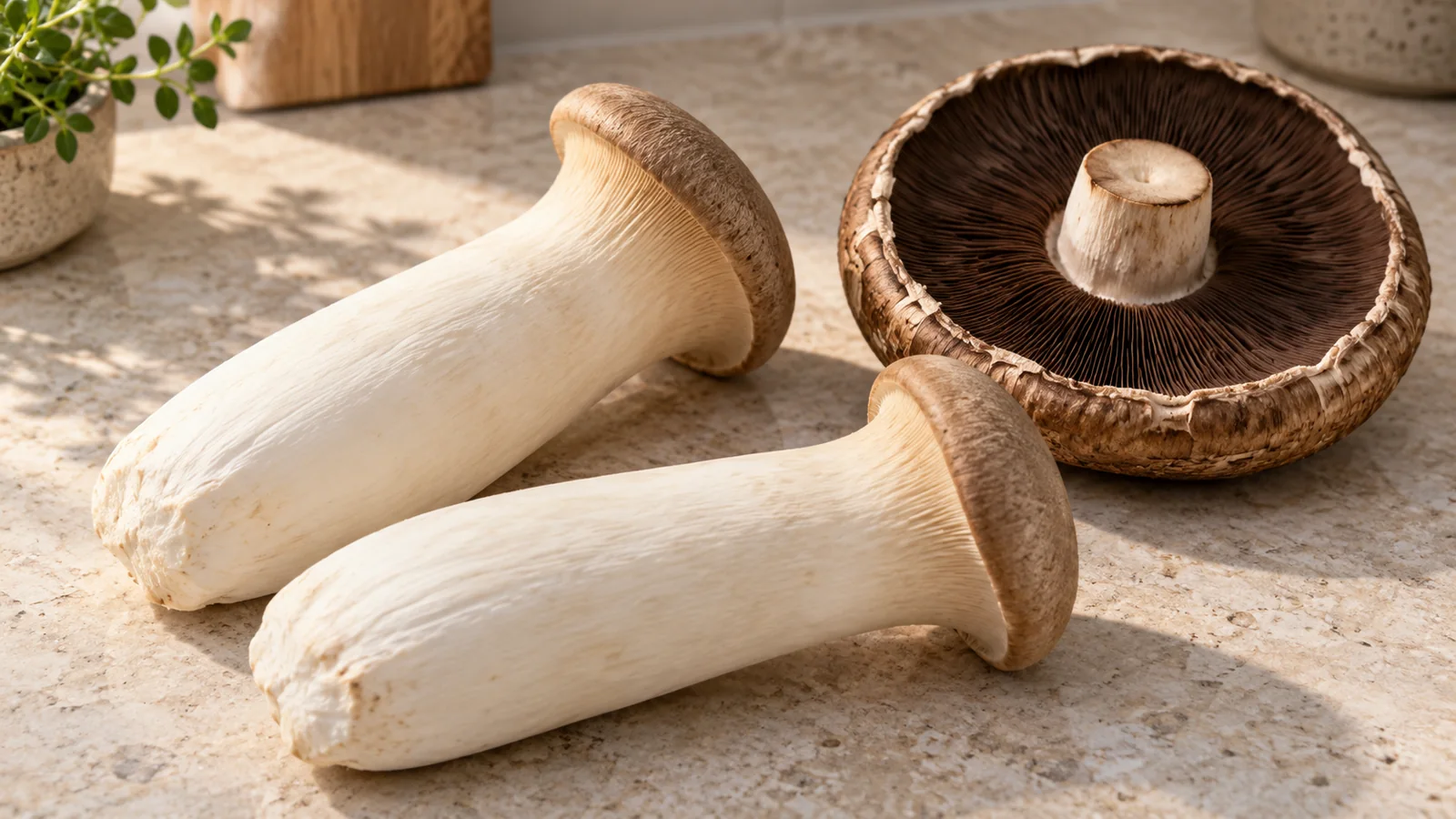
King oyster gives you thick stem rounds and lengthwise planks, while portobello gives you one broad whole-cap portion. Both can become the center of a mushroom main dish, yet swapping one for the other may change the shape the recipe depends on. In a rice bowl of cut mushroom pieces, matching prepared weight is a reasonable start, but scallop-style rounds or a single cap spanning a burger bun need a structure that only one of them has.
Note
Illustrated ingredient comparison
All images here are AI-generated illustrations of cultivated food and kitchen arrangements. They do not document a product, a measured absorption trial or our own recipe testing.
Thick Stem or Broad Cap
King oyster and portobello are different mushrooms. King oyster is Pleurotus eryngii, also sold as king trumpet or eryngii, and cultivation research uses king oyster mushroom and Pleurotus eryngii together. Portobello is the mature brown market form of Agaricus bisporus, and the University of Massachusetts calls it a large mature cremini, which places it in a different cultivated group.
The part you plan to cook tells the two kitchen jobs apart. Cultivated king oyster usually has a large pale stem under a fairly small cap, and that stem is usable flesh, so trimming it off by habit would throw away the part behind many of the mushroom's typical preparations. Great British Chefs describes the stem as firm but suitable for cooking, including rounds and lengthwise slices, and the cap stays usable even when it is not the biggest piece on the plate.
Portobello reverses the emphasis, because its broad cap supplies the wide piece and its short stalk cannot usually give the large cylindrical rounds that a thick king oyster stem can. Two mushrooms that both get called meaty can therefore lead to different purchases. The adjective describes how they eat, while the stem or cap sets which shape you can physically cut.
Ordinary oyster mushrooms add another naming trap. Their familiar fan-shaped clusters are not just a smaller package of the thick-stemmed king oyster, so a recipe built on stem rounds needs king oyster itself. Once you have that stem in hand, cooking king oyster takes its preparation further.
CompareCremini vs Portobello: How Age Shapes Flavor and UseCutting King Oyster Into Rounds or Planks
Cut crosswise for rounds and lengthwise for planks. Both shapes come from the same king oyster, but their faces meet the pan and the plate differently. Each round has two broad circular ends and a curved side, while a lengthwise plank has one long face and can keep part of the cap as a recognizable end of the whole mushroom.
Great British Chefs gives both cuts for king oyster and compares fried stem rounds to scallops or abalone for taste and texture. That comparison refers to how a stem round eats, and it makes no claim that fungal tissue turns into seafood.
| Cut and ingredient | Shape created | Useful dish job | Limit of a portobello substitution |
|---|---|---|---|
| King oyster stem cut across | Thick circular pieces | Individual browned rounds arranged on a plate | Cap strips do not reproduce the cylinder |
| King oyster cut lengthwise | Long flat faces, sometimes with cap attached | Seared planks or slices for a sandwich | A curved cap slice has a different outline |
| King oyster shredded along the stem | Separate strands | A pulled-style filling with sauce | Portobello slices make ribbons rather than the same stem strands |
| Portobello kept whole | One broad cap | A burger portion or a filled cap | Several stem planks need assembly to cover the same space |
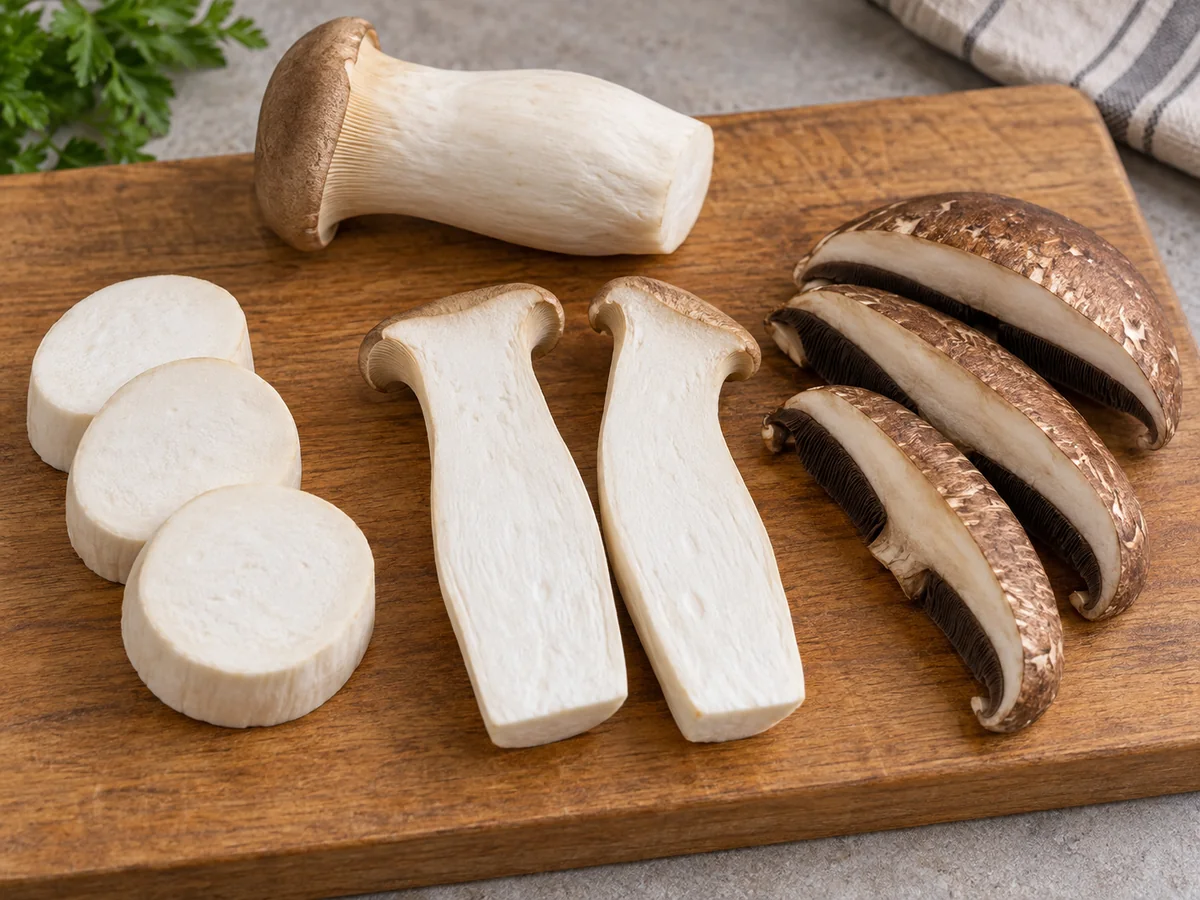
Thickness is a separate decision from direction. Very thick rounds look short and carry a substantial center, while lengthwise slices can be long without being equally thick. When you adapt an existing recipe, start from its stated thickness and method, because changing the ingredient and doubling the cut thickness at the same time leaves the original timing much less useful.
Shallow scoring adds exposed surface to a broad cut face. Scoring is different from slicing the piece into fragments, so keep the diagonal pattern shallow when the dish needs the plank to stay whole. The pattern cannot support an exact, universal absorption claim either. Visibly, the scoring cuts into the surface and exposes more edges to seasoning and heat.
Shape also shows the limit of meat substitutes. Either mushroom can fill the space of a steak-style slice or a scallop-style round without matching the original food's nutritional contribution or every part of its texture.
Searing the Face and Cooking the Center
Golden color tells you what happened where the mushroom touched the pan, and it says nothing about the thickest part of the center. That gap shows up most with stem rounds and thick lengthwise halves. In the Great British Chefs method, the cook sears the cut face first, then turns and bastes the mushroom until it cooks through, and the starting time varies with mushroom size, so no single time fits every stem.
At home, the piece's thickness, the cooking surface and the rest of the method still count. When a thinner slice in a different pan reaches the same color, that color tells you nothing certain about whether your large half has finished cooking.
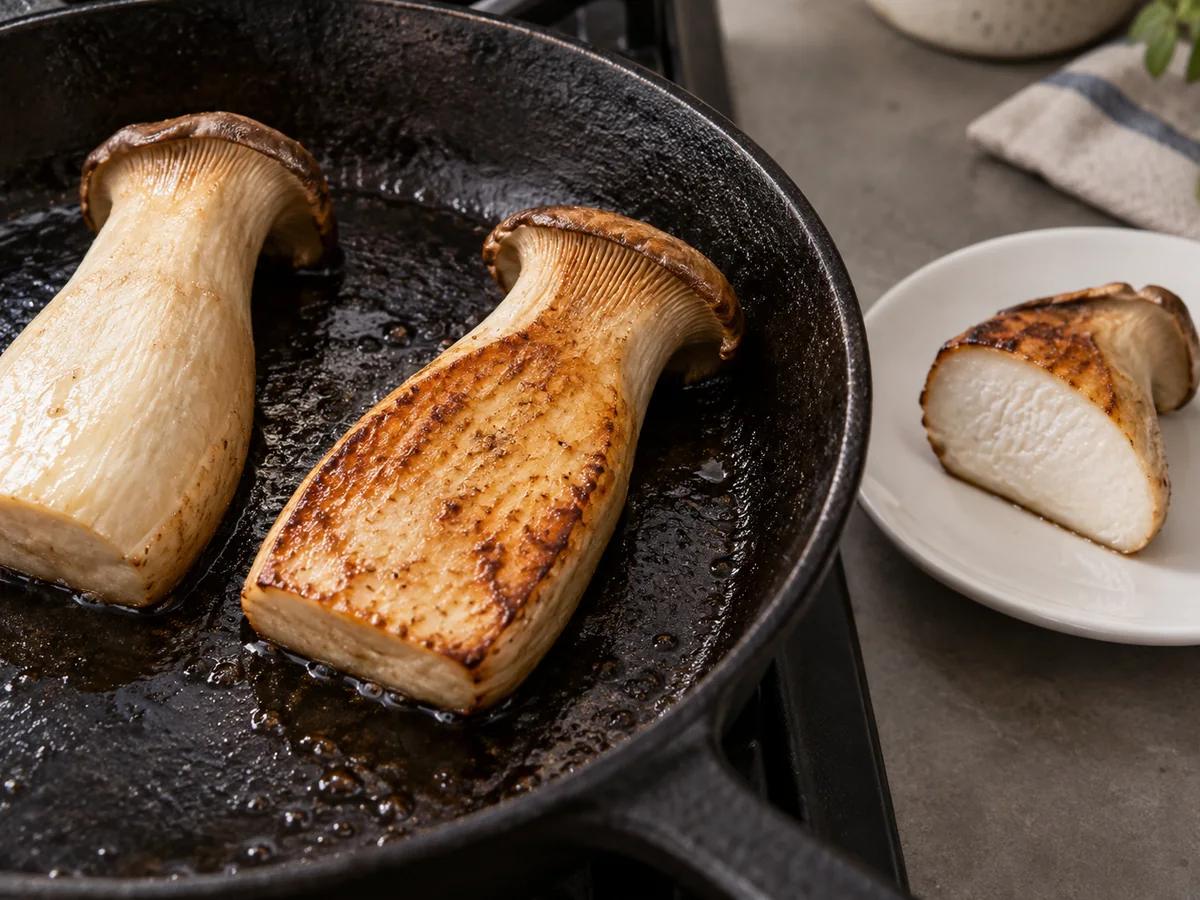
Pale centers do not by themselves mean a failed sear, since the inner tissue never touches the pan the way the face does. Judge the face by its color and the center by the recipe's own cooking stage.
Portobello changes the contact problem. Whole caps curve and may sit differently from a flat stem slice, while sliced cap pieces expose different edges and take up more separate spots in the pan. Matching raw weight alone cannot remove those differences.
Sautéing mushrooms has its own water-release and contact stages, and grilling mushrooms changes the picture again because the food rests on grates and loses one continuous pan surface. Your pan's own limits still apply when a method calls for substantial heat, and a source's burner setting gives you no license to push a nonstick pan past its permitted use.
CompareOyster Mushroom vs Shiitake: Which One Fits the Dish?Which Takes a Marinade Better?
None of the sources used here offers a matched absorption measurement that names a winner between king oyster and portobello. Firm flesh alone cannot tell you how much seasoning reaches a mushroom or how fast it gets there. Great British Chefs scores its cut king oyster face to season it, which supports scoring as a preparation option. It does not measure whether an equally cut portobello would take up more or less.
Picture a hypothetical cook comparing a whole king oyster with scored portobello strips. Thickness, exposed area, scoring and time in the liquid would all differ, so stronger flavor in one sample would not isolate the species. Your marinade decision therefore starts with the preparation you are using. Thin coatings before cooking and later glazes deliver flavor in different ways, even when both use the same sauce ingredients.
Note
Keep flavor and browning tasks distinct
Wet coating adds liquid to the pan. Draining excess surface liquid before searing and adding a finishing glaze later manage those separate stages, and neither shows that one species absorbs marinade better.
The pan gives you visible feedback. Pooled liquid has to evaporate before the same face can take a dry sear, and a thick coating may hide the mushroom's own surface color. Glaze also changes the dish whatever the species, so its saltiness, sweetness and concentration belong in the final seasoning decision. Matching mushroom weight does not mean either one can take any amount of sauce.
CompareChanterelle vs Jack O'Lantern: Tell Them Apart SafelySwapping by the Ingredient's Job
The easiest swaps keep the ingredient's role and accept a different shape, and the hardest try to rebuild a structural feature the replacement does not have. In a bowl or pasta dish, the mushroom's contribution may simply be a chosen amount of cooked pieces. On a plate of arranged rounds, the shape is part of what the recipe promises.
| Original recipe job | Substitution that can work | Change that remains |
|---|---|---|
| King oyster rounds arranged individually | Portobello strips can supply mushroom pieces with the same sauce | The scallop-style round presentation is lost |
| Cut mushrooms in a rice bowl | Begin with equal prepared fresh weight and adapt the cut | Different pieces need their own contact and cooking checks |
| One portobello cap in a bun | Overlapping king oyster planks can fill the sandwich | Several pieces replace one continuous portion |
| Shredded king oyster filling | Sliced portobello can make a sauced ribbon filling | Cap ribbons do not reproduce stem-derived strands |
In an illustrative rice-bowl swap, 250 grams of prepared portobello can replace 250 grams of prepared king oyster. That keeps the starting mushroom mass comparable, though the piece count and the final cooked yield can still differ. Shortening wide cap strips makes them easier to pick up with rice, and their cooking still has to allow for moisture release and the pan surface, so a thick-round timer does not carry over unchanged.
Round-focused dishes call for a more honest adaptation. Portobello stems generally do not supply the same thick cylinder, and cutting circles from the cap would waste usable pieces while giving a different thickness and structure. Seasoned cap strips can still make a sensible dinner, as long as you accept the changed presentation.
The burger reverses the problem. Portobello supplies one broad cap, while king oyster planks cover a bun only by overlapping several pieces.
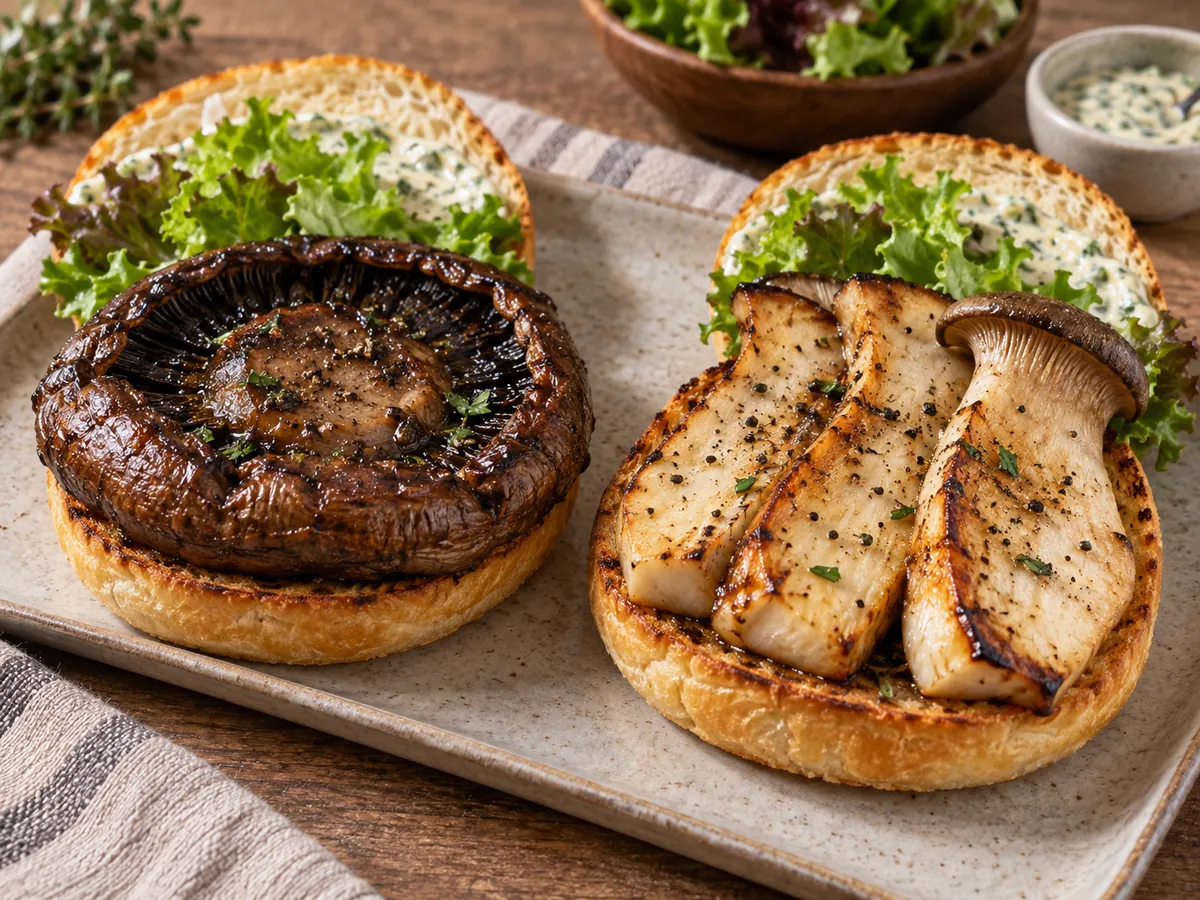
Several sliding pieces can change how the sandwich holds together when you lift it, and a sauce or topping that suits a single cap may need spreading differently across them. Building a mushroom burger therefore raises an ingredient question and an assembly question. Portobello substitutes and other mushroom substitutions are most useful when they say which of those jobs they keep.
Chopping either mushroom into a filling does not waste it. Whether its distinctive shape is worth keeping depends on the meal you wanted, the price you paid and what else you can do with the rest.
Which Is Easier to Find, and What Does It Cost?
Availability comes down to the actual shop or seller. Searching for king trumpet and eryngii alongside king oyster widens the search, but no name guarantees that a nearby store stocks it today. Portobello can be the practical buy when the king oyster you wanted is missing, provided the recipe accepts its different form. Finding king oyster, on the other hand, does not oblige you to make stem rounds when dinner only needs sliced mushrooms.
Usable parts change the price calculation. Thick king oyster stems are food, while a cap-only portobello recipe may leave a stem for another dish or take it out of the measured portion. Suppose, purely as an example, that 300 grams of king oyster costs $6 and 400 grams of portobello costs $5. The raw prices are then $2 and $1.25 per 100 grams.
If the portobello recipe keeps only 350 grams after trimming, its price for that retained portion is $5 ÷ 350 × 100, or about $1.43 per 100 grams. Portobello still wins by usable weight in this example, but the gap is smaller than the untrimmed comparison suggested. We invented these prices and trimming amounts, so they do not report typical market differences.
Price answers a spending question, and shape answers a recipe question. Cheaper caps do not become round stem slices because their unit price is lower, and a pricier stem may be unnecessary when the meal only needs chopped mushroom volume. Buying online adds delivery and cold-handling questions that a shelf price leaves out.
Larger orders also leave you with leftovers to use. Caps and sound trimmings can go into another mushroom dish, but a planned second use saves money only if the food gets eaten while still suitable.
Which Has More Bite?
The sources describe king oyster as firm and meaty and portobello as a substantial mushroom suited to whole-cap cooking. Those descriptions explain why both turn up in meat-style dishes, but they give no controlled, universal ranking of chewiness or flavor intensity. Cut thickness, cooking and sauce all change the eating result. Thin king oyster slices and thick stem rounds will not bite the same just because the species matches, and a heavily seasoned portobello strip puts flavor in a different setting from a lightly seasoned whole cap.
Meaty texture does not make either mushroom nutritionally equal to meat. Replacing the shape of an animal-food portion does not show that the mushroom supplies the same protein, energy or other nutrients. Comparing mushroom nutrition needs matched foods, amounts and preparation data, and nothing about cap size, stem density or a picture of a burger supplies that.
Freshness needs an actual basis too. Thick stems do not guarantee storage life, and the dark underside of a mature portobello is normal anatomy that tells you nothing about shelf life.
Warning
Reject deterioration
The FDA advises discarding rotten produce. Neither a marinade nor a browned exterior is a reason to keep a mushroom that has deteriorated, and these culinary descriptions cannot clear a wild specimen for eating.
The FDA specifically includes mushrooms among foods to refrigerate at 40°F or below, and fresh mushroom storage covers the next handling steps once the package reaches home. Before cutting, wash and dry the food with clean hands and tools, unless the label says prewashed, which is the exception the FDA describes. Cleaning mushrooms gives the fuller method, and nothing in this kitchen comparison works as an identification guide.


