
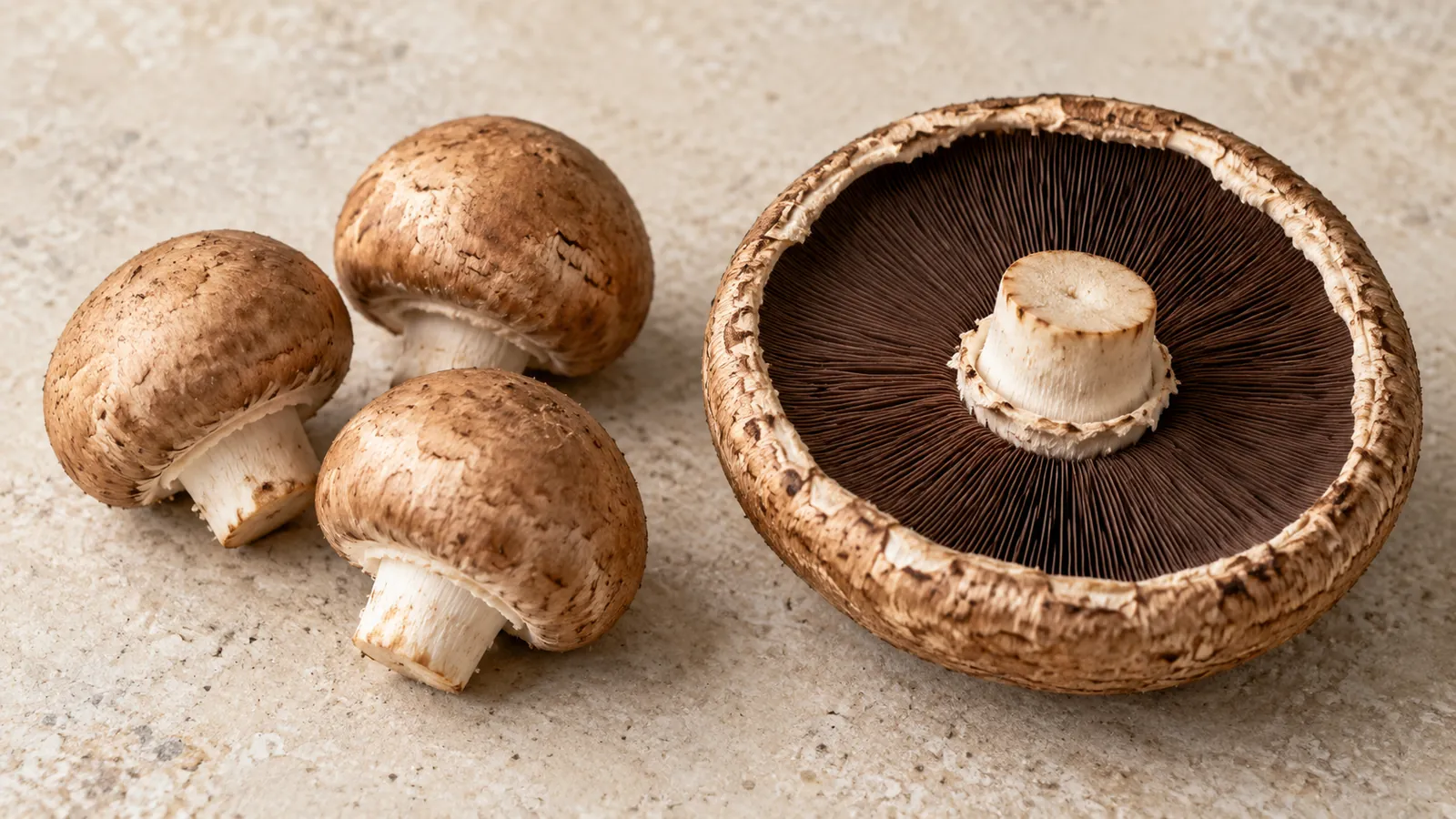
Cremini and portobello are young and mature market forms of the same brown mushroom, Agaricus bisporus. Cremini fit sliced or chopped dishes with little adjustment, while only portobello gives you the broad cap that a whole mushroom burger or a large stuffed portion needs. When you swap one for the other, go by usable weight and the size of the finished pieces, since several small caps cannot hold a filling the way one large cap does.
Note
About the illustrations
The images on this page are AI-generated culinary illustrations. They show anatomy, cutting and how the food might look, and none of them shows a named product or a controlled cooking test.
Is Portobello Just a Grown-Up Cremini?
Portobello is the same brown mushroom as cremini, left on the growing bed longer. Growers pick cremini while the caps are still fairly small and closed, and they let portobello keep growing until the cap spreads and its underside opens. The University of Massachusetts describes portobello as a large, mature cremini, which explains why packages of the smaller brown form may say baby bella, baby portobello or cremini.
You will also see the spelling crimini in American shops and recipes. None of these labels tells you the harvest day, the cap diameter or the moisture percentage, so two packages with the same name can hold different sizes without breaking the basic relationship between the forms.
The change from cremini to portobello happens while the mushroom is still growing, and your refrigerator cannot repeat it. Once harvested, the mushroom in your package has stopped growing as a crop, so leaving cremini on the shelf will not give you portobello. Storage can dry the caps out or let them deteriorate, but it never turns an old package into the fresh, mature caps a grower meant to sell. When your recipe calls for a large open cap, buy that cap at the store and skip any plan to let small mushrooms age into it.
White button mushrooms belong to the same species, which complicates the simple story. Penn State traces white strains to selected tissue cultures, so the three retail forms do not form a single line in which every white button turns brown, becomes cremini and then grows into portobello. In the kitchen, you only need to see whether the package holds small closed caps or broad open ones.
CompareKing Oyster vs Portobello: Choose the Stem or the Whole CapOpen Gills Change Prep and Color
Young cremini already have gills under the cap. While the mushroom is young, a thin partial veil can cover them, and as the cap expands the veil breaks and exposes the darker underside of a mature portobello. Opening the cap reveals gills that were there all along; it does not create new ones.
| Feature in a purchased mushroom | Smaller cremini | Mature portobello | Kitchen consequence |
|---|---|---|---|
| Underside | Often covered by an intact or partly intact veil | Dark gills normally exposed | Open gills are expected mature anatomy |
| Cap shape | Rounded, compact pieces | Broad cap with a larger surface | Whole-cap recipes require the larger structure |
| Gill trimming | Usually little reason to scrape small caps | Optional when appearance or filling space matters | Removal is a culinary choice, not a safety treatment |
| Cut pieces | Small slices or quarters | Wider strips or wedges unless chopped further | Thickness and width need separate attention |
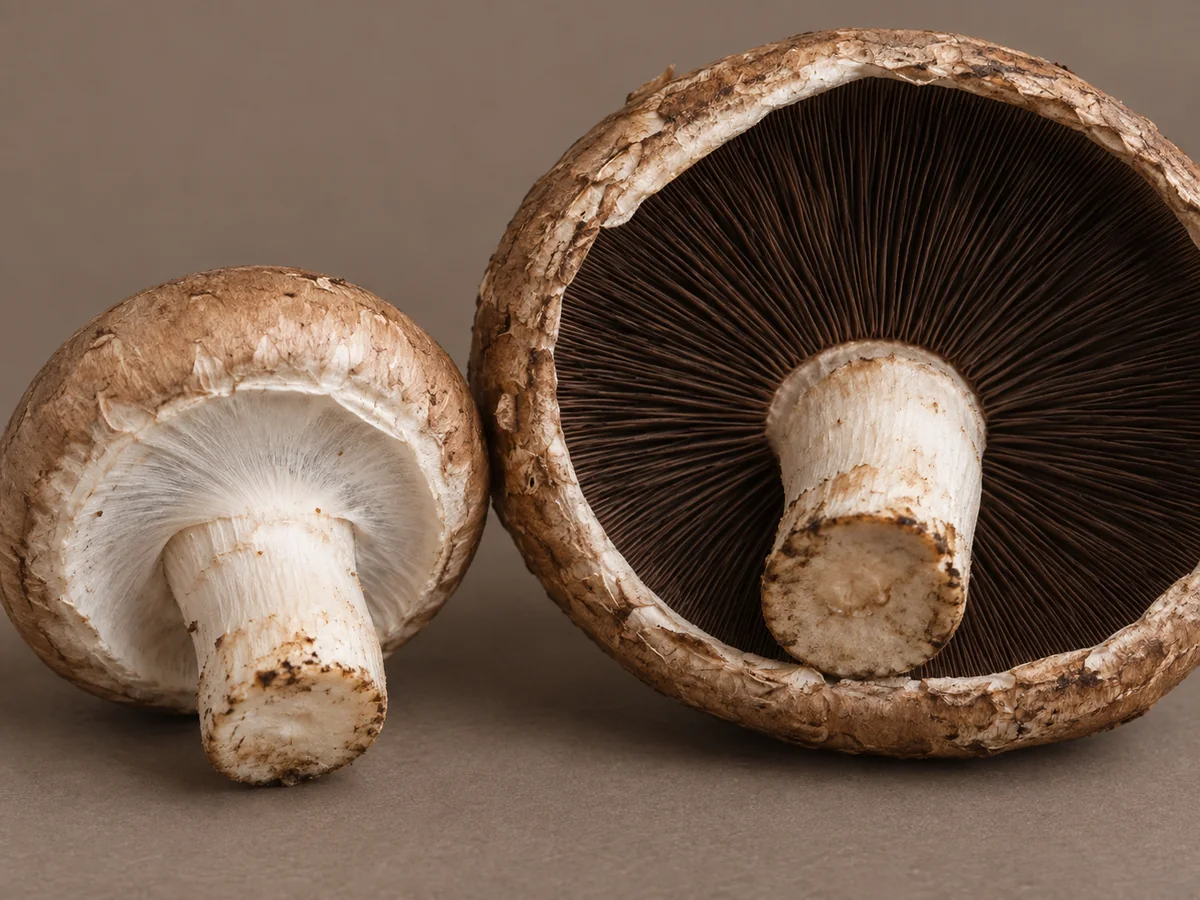
Portobello gills are part of the edible cultivated mushroom, and the Mushroom Council treats gill removal as optional. Keeping them suits a dark gravy or a dish where the underside stays visible, while scraping them out may suit a pale sauce or a filled cap where you want a cleaner-looking cavity. Scraping also takes away usable material, so weigh a trimmed recipe by what you keep once the gills and stem are gone, because the package weight overstates it.
Scraping out the gills does not make a spoiled or unidentified mushroom safe. Dark mature gills and rotten tissue are two different observations, and neither the table nor its illustration can identify a wild specimen for eating. Cleaning mushrooms deals with debris and handling before you cut, which is a separate job from scraping away edible tissue for looks.
Can You Swap Cremini and Portobello by Weight?
For chopped or sliced dishes, start with equal usable fresh weight. That is a practical recipe adjustment, and it makes no promise that the cooked yield or taste will match exactly. Suppose a sauce calls for 250 grams of prepared cremini. If you weigh out 250 grams of portobello after removing any stem or gill, the raw mushroom contribution stays comparable.
Weighing 250 grams of untrimmed caps and then discarding part of them gives the sauce less mushroom. Adding two enormous caps because the recipe mentions two mushrooms can push the amount the other way, and a kitchen scale shows you both errors.
Cut size is the next adjustment. Small cremini slices and strips cut across a large portobello can share the same thickness yet differ greatly in width and length. In a spoonable sauce, cutting the broad strips shorter keeps each bite close to the original, while on a plate of mushroom strips that larger footprint may be exactly what you wanted to keep.
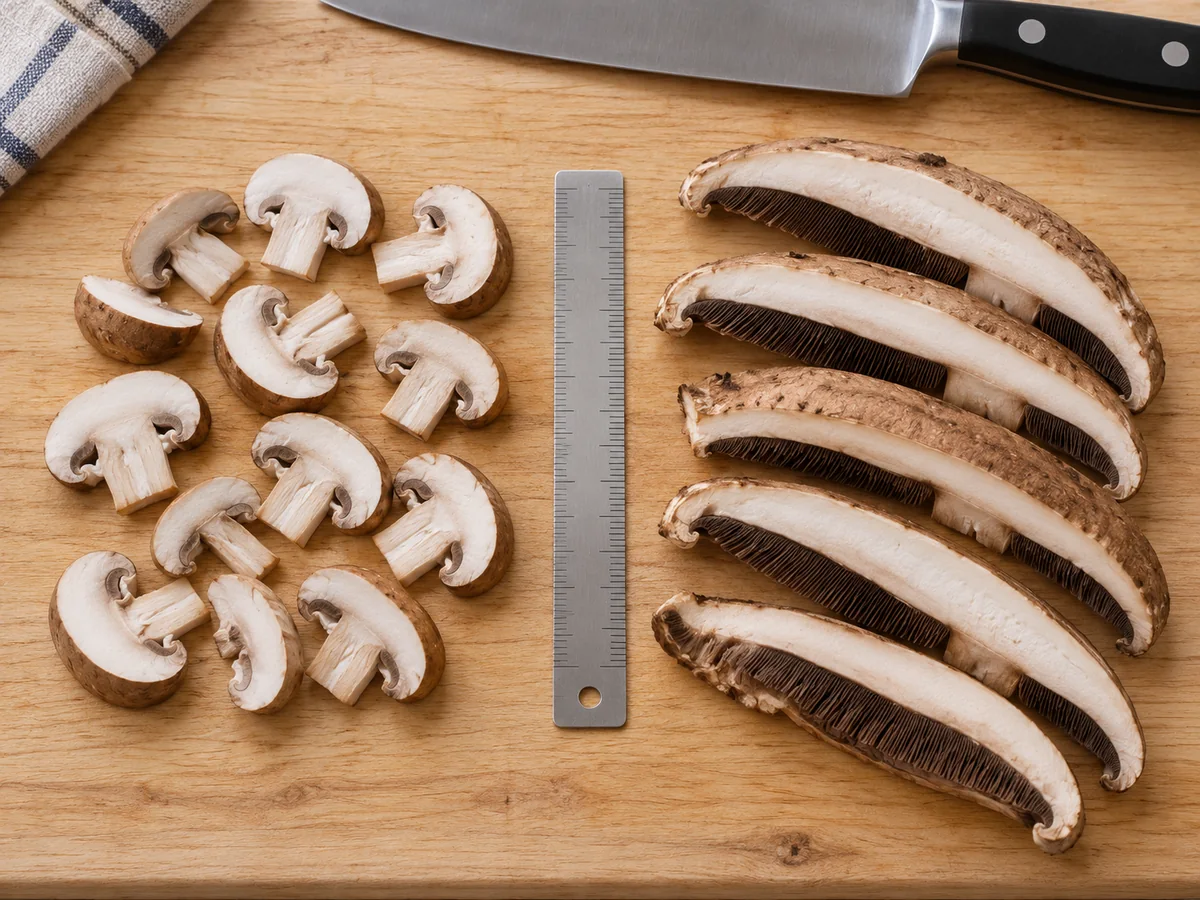
Cup measures add another variable because pieces leave gaps between them. Large loose wedges and compact chopped cremini need not pack the same way, even when both reach the top of the cup. When the recipe gives only cups, follow its cut description, so a chopped measure gets similarly chopped pieces.
Pre-sliced mushrooms save cutting time, but the packer has already fixed their thickness, so they suit you only when that cut fits the recipe. For a small-piece dish, a cremini substitute may be easier to adapt than a large intact cap.
CompareOyster Mushroom vs Shiitake: Which One Fits the Dish?Why Do Both Release Water in the Pan?
Both forms can release a lot of liquid as they cook, and that liquid can come from the mushrooms themselves as well as from water left on the surface after cleaning. Crowding adds to it, because many pieces in one skillet share a small area through which their liquid can evaporate. So a wet start does not show that the package holds the wrong mushroom, and it does not prove a fixed moisture difference between cremini and portobello.
During browning, watch the pan more than the package label. The Mushroom Council's traditional sauté method spreads the mushrooms in a single layer and lets them sit in contact with the pan before you turn them. Cutting broad portobello strips smaller lets you spread them more evenly, but squeezing extra pieces into the same space cancels that gain.
Serious Eats takes a deliberately wet route, steaming mushrooms before searing and then cooking uncovered so the liquid evaporates before the final browning. That method starts differently, yet it still clears the water before it asks for a browned surface. Liquid pooled under a lid never gives the same surface result as dry contact with the pan.
Note
Match the cooking stage
Expect a puddle during a steam-first method. When browning is the immediate goal, the liquid has to evaporate and the mushroom faces need contact with the pan; adding fat alone does not remove the water.
Before you blame the ingredient for a disappointing swap or a watery pan of cooked cremini, look at what the pan is doing. Keep cooking a chopped sauce mixture until its liquid reduces, and give a batch meant for crisp browned edges more pan space or a second round. Large portobello pieces can also bend or bridge over parts of the pan, so their shape can limit contact even when their weight matches the cremini they replace.
When you sauté mushrooms, moisture release comes first and browning follows once that liquid has gone. If your skillet is too small for the batch, roasting on a tray gives the pieces more useful space.
How Close the Swap Gets Depends on the Dish
The closest swaps happen in dishes that break the mushroom down anyway. Chopped sauces, mixed fillings and sliced pasta dishes leave more room for adjustment than a recipe built around one intact cap. The University of Massachusetts suggests roasted portobello for a vegetarian burger, where one broad cap can fill the bun. Cremini can still make a mushroom sandwich, but the slices need their own arrangement or binding, because they cannot act as one continuous piece.
| Recipe job | Portobello replacing cremini | Cremini replacing portobello |
|---|---|---|
| Small pieces in a sauce | Match prepared weight, then shorten broad strips or chop them | Match prepared weight and the requested cut |
| Pieces on skewers | Use substantial wedges that suit the skewer and cook evenly | Several small mushrooms can make a different skewer layout |
| A stuffed mushroom portion | A large cap makes fewer, larger portions | Several caps divide the filling into smaller portions |
| A whole-cap burger | A broad intact cap can span the bun | Loose slices need assembly; they do not supply one continuous cap |
Go back to the hypothetical 250-gram sauce swap. The mushroom amount stays fixed and only the cutting changes, so the sauce's other ingredients do not need to increase just because the portobello pieces started as larger mushrooms. Timing still counts, though. Stirring a watery mushroom mixture into a finished sauce can loosen it, while reducing that liquid first keeps the consistency under your control.
Pizza raises a related assembly problem. Broad raw cap strips bring a different bite and footprint from thin cremini pieces, and a wet topping changes the finished pizza even when its raw weight was correct. Cooking the mushrooms separately first lets you manage the liquid and spread the pieces before assembly. That step adapts the ingredient to its job, and it does not mean either form always needs one fixed cooking time.
Stuffing changes the portion arithmetic as well. Two large caps and eight small caps might take the same filling, but the amount on each cap and the number of portions are separate decisions. On the grill, a large cap and small loose pieces meet the grate differently, which turns grilling mushrooms into a handling question. Small mushrooms become manageable in a basket or on a skewer, while keeping the broad cap whole preserves the shape you bought portobello for.
CompareChanterelle vs Jack O'Lantern: Tell Them Apart SafelyFlavor and Sauce Color Are Separate Choices
The University of Massachusetts describes open-cap mushrooms as more robust in flavor than closed-cap forms. Treat that as a general kitchen description, because it gives no guaranteed flavor score to every package, and condition, preparation and the rest of the dish all change how clearly the mushroom comes through. Heavily browned mushrooms in a dark gravy sit in a different setting from lightly cooked pieces in cream. Garlic, wine or other ingredients in the sauce can also make a small difference between the market forms harder to notice.
Dark gill material changes how a sauce looks without measuring flavor. Cream sauce with mature gill fragments may turn browner, yet its color says nothing about how much savory taste a diner will notice. For a visibly pale dish, smaller closed caps or trimmed portobello flesh make a practical start, while keeping the mature gills suits a dark mushroom gravy and saves that material from the bin.
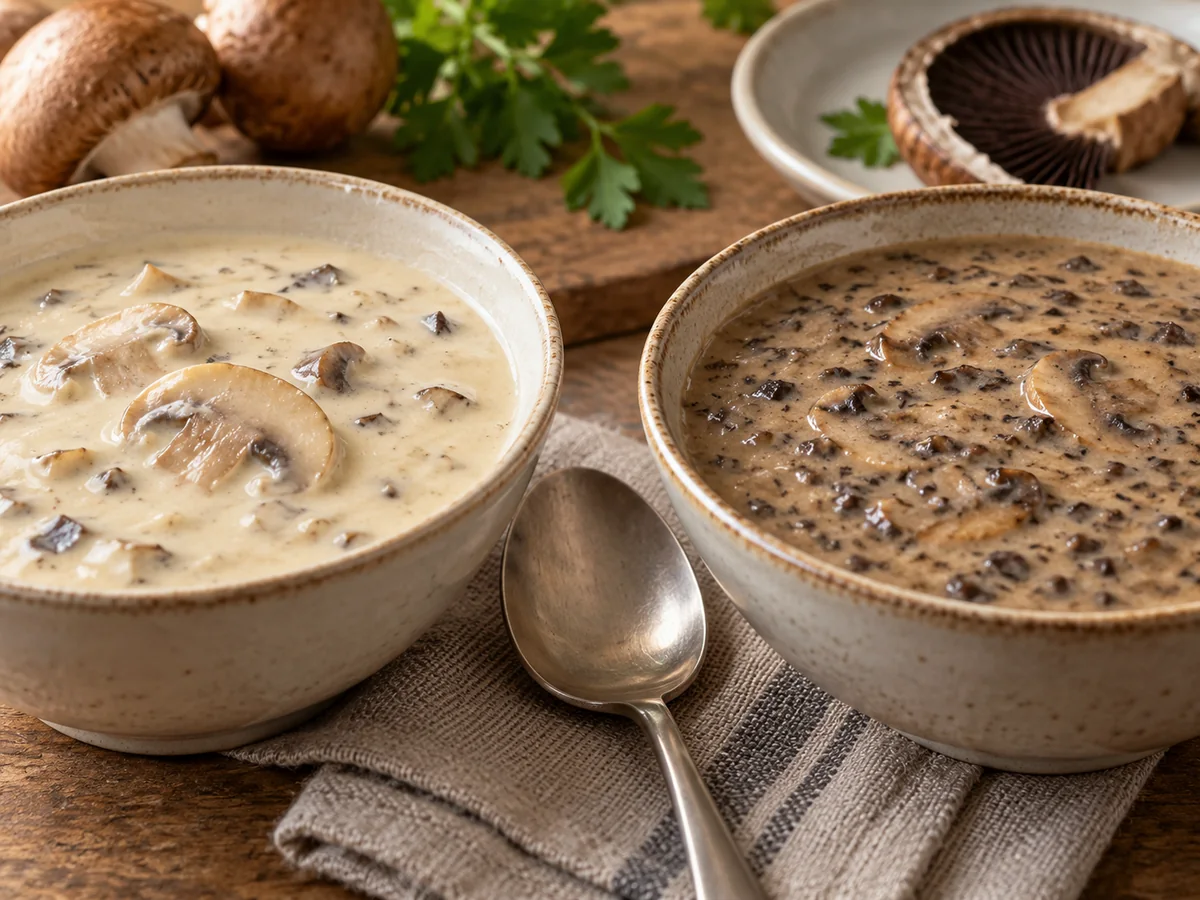
Trimming has its limit, since it cannot make a browned mushroom mixture white again, and the cooking process and other sauce ingredients still shape the final color. Umami describes one part of savory taste, so the word cannot crown a universal winner. Neither a darker underside nor a stronger mushroom aroma proves that one market form is healthier.
Comparing Price by Usable Weight
Price comparison starts with how much mushroom the package holds. Stores may sell large caps by count and cremini by weight, and those two descriptions do not measure the ingredient you have for dinner in the same way. Take two invented offers, 8 ounces of cremini for $3 and 12 ounces of portobello for $4. Before trimming, the cremini costs 37.5 cents per ounce and the portobello about 33.3 cents per ounce, so the larger package costs more at checkout but less for each raw ounce.
Now suppose, purely as an illustration, that the recipe discards 20 percent of the portobello package; that figure is not a typical loss rate measured across mushrooms. The retained amount is then 12 × 0.8, or 9.6 ounces, and the cost rises to about 41.7 cents per retained ounce, which reverses the usable-price comparison. Keeping suitable stems and gills would change the calculation again.
About 8 ounces is 227 grams and 12 ounces is 340 grams, so either unit system supports the same comparison as long as you convert before setting an ounce-based price against a gram-based weight. Temporary offers follow their own patterns in mushroom sale prices, while the shelf label supplies today's numbers.
The cheaper usable ounce is worth buying only when it is fresh and fits the meal you plan. Bargain caps that cannot hold the planned filling fail the recipe, and a larger package that leaves more fresh mushrooms than you can use is a different spending decision from a smaller one you finish in one meal. Buying mushrooms therefore means checking weight, condition and how much the dish needs, since package size alone cannot tell you the value.
Storing and Handling Both as Perishable Food
The FDA lists mushrooms among perishable produce that belongs in a refrigerator at 40°F or below. Mature portobello caps need that cold handling too, because a tougher-looking shape does not make them shelf stable. The Mushroom Council's buying guidance separates a dry, plump surface from mushrooms that have dried out, so the driest-looking cap in the bin is not automatically the freshest.
Clean hands and tools before preparation cut down on transfers from other foods. The FDA recommends running-water washing and drying, except for products labeled prewashed or ready-to-eat. Soap and household detergent do not belong on the food.
Throw out rotten produce, because scraping, marinating or cooking it will not rescue it. Dark mature gills alone are normal anatomy and no sign of rot, yet that anatomy does not excuse deterioration elsewhere in the mushroom. Fresh mushroom storage covers packaging and moisture after shopping, and when you buy more than the next meal needs, freezing mushrooms is a separate preservation task with its own preparation steps.
Everything on this page applies to labeled cultivated food. Any unfamiliar mushroom gathered outdoors needs expert identification before a substitution question even arises.


