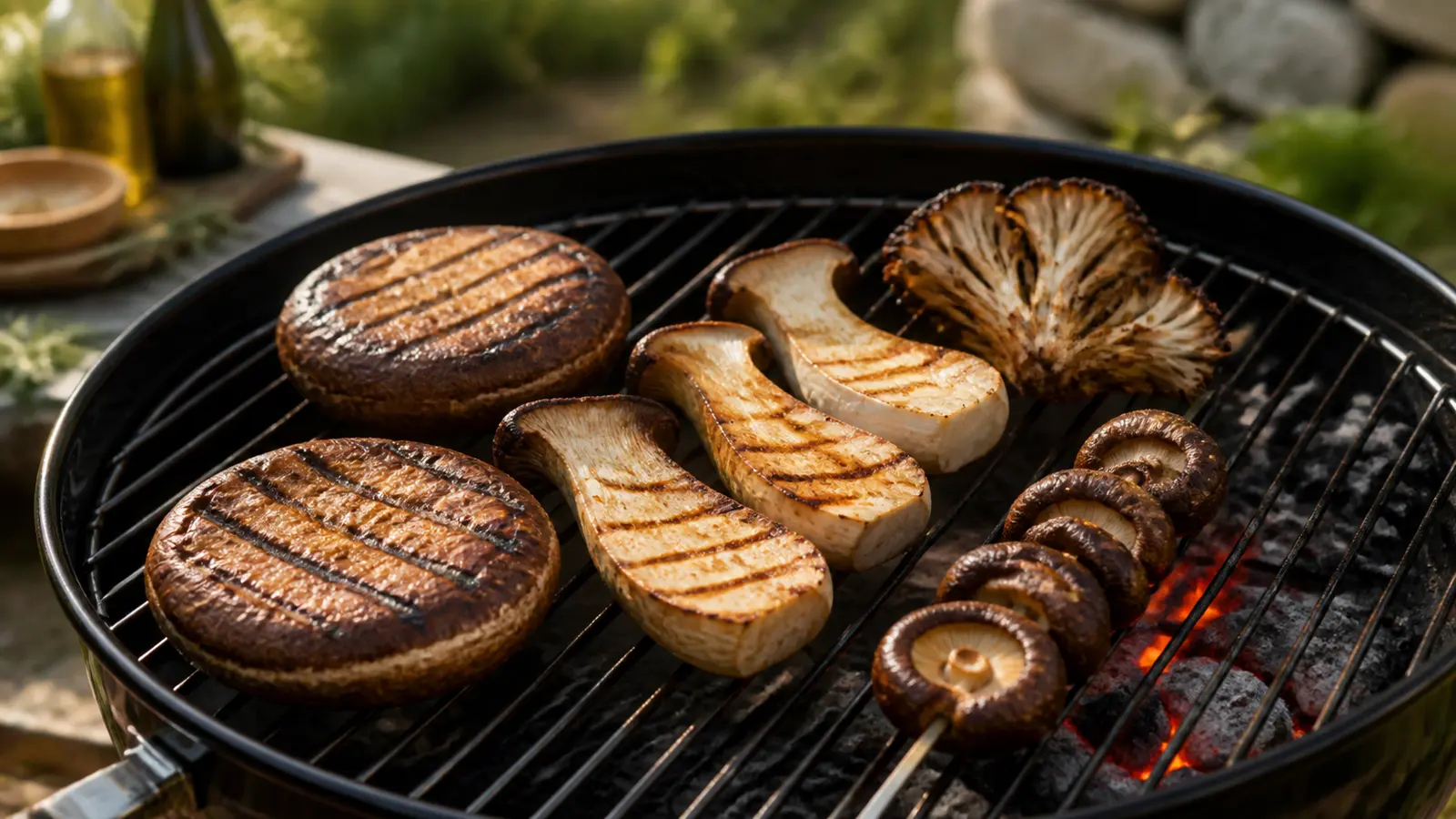
Portobello is the best overall mushroom for direct grilling. King oyster makes broad slabs, maitake gives crisp clusters, shiitake works on skewers, and oyster mushrooms need a basket or plancha.
Portobello is the best mushroom for grilling when you want one dependable choice for bare grates because a whole cap stays above the fire and browns before its thick center turns dry.
King oyster makes the strongest steak-like slab, maitake gives crisp cluster edges, shiitake belongs on skewers, and oyster mushrooms need a basket, so the useful ranking starts with how each piece will stay over the heat.
Choose Bare Grates, Skewers, or a Basket
The grate tests size and attachment before flavor. A piece that slips between the bars or spins on one skewer cannot brown evenly, however good the mushroom tastes.
Portobello caps and broad king oyster slabs can sit directly on clean grates because their wide contact faces lift cleanly with a sturdy turner.
Maitake can use bare grates only when every wedge keeps its dense base attached, while loose fronds need a basket to keep shrinking edges out of the fire.
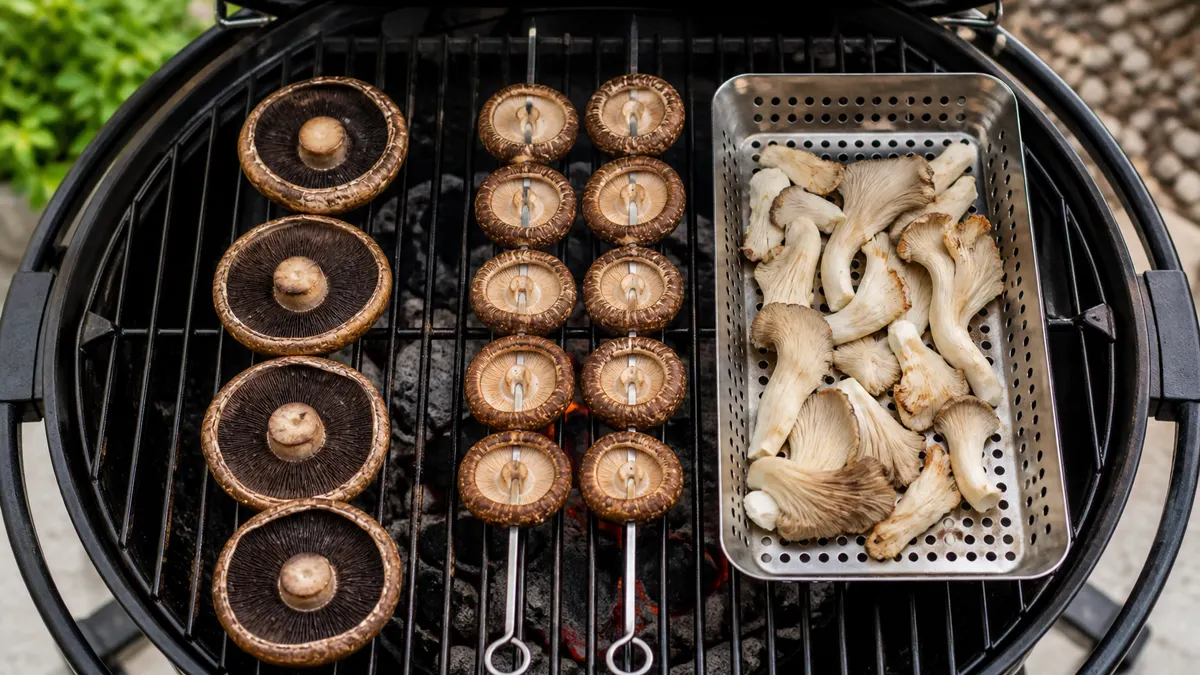
Shiitake caps work best when two parallel skewers keep the gill side stable instead of letting each cap rotate around one center skewer.
Oyster mushrooms are the basket candidate. A perforated basket or plancha preserves the folds while still letting steam escape, which is why a solid foil packet gives a softer result.
Match the basket holes to the smallest cooked piece because a raw cap that barely spans a gap may fall through after water loss contracts it.
Use cultivated mushrooms from a reputable seller unless a qualified local expert has identified the wild specimen with certainty, since grilling creates char and smoke without neutralizing mushroom toxins.
Warning
Keep the mushroom platter and tongs away from raw meat juices. Put cooked mushrooms on a clean plate rather than returning them to the tray used beside uncooked meat.
The three grill setups below show where each structure belongs.
5 Best Mushrooms for Grilling, Ranked by Grate Survival
This ranking rewards a mushroom that stays intact long enough to develop color. It also accounts for how much oil the surface needs and whether the center can finish before an exposed edge burns.
1. Portobello: Best Overall
Portobello wins because its broad mature cap takes clear marks while remaining substantial enough for a sandwich, plated main, or sliced side.
Use 4 large caps for four servings, removing the woody stems and debris while keeping each rim whole enough to protect the center during turning.
Start with roughly one part oil to 12 to 16 parts mushroom by weight. This relationship gives the outer surface a thin film without filling the dark gills with liquid.
Place the cap smooth-side down first for distinct marks, then turn it gill-side down and tip away gathered liquid before moving the mushroom to the cooler zone.
A wet, deeply scored cap is a poor grill candidate because every cut releases more moisture and weakens the structure. Shallow seasoning is enough when the whole cap must act like one piece.
2. King Oyster: Best for Steak-Like Slabs
King oyster stems are dense and uniform enough to cut lengthwise into 12 to 18 mm slabs with two flat contact faces and a juicy center.
Use 450 to 500 g for four side portions with about one part oil to 16 parts mushroom by weight, brushing the film across both faces instead of pouring it into score marks.
Score a shallow crosshatch only when the slab is thick enough to remain one piece. The cuts improve seasoning contact, but deep diamonds create small corners that dry before the core yields.
Begin on the hot zone for color, then give any slab that darkens before bending under tongs less flame and more covered finishing time instead of another glaze layer.
King oyster is the better pick than portobello when you want clean slices after grilling. The dense stem cuts across the grain without spilling cap liquid onto the plate.
3. Maitake: Best for Crisp Cluster Edges
Maitake gives the grill two textures at once as thin fronds crisp around a moist, chewy attached junction.
Use 340 to 450 g for four servings, cutting four compact wedges through the base and starting with one part oil to about 18 parts mushroom by weight so thin edges receive coverage without saturation.
Press the flat cut side against the grate first. Once that base browns and releases, turn the wedge onto a frilled side and move it away from the strongest flame.
Loose maitake tips show that the cut missed the base and belong in the basket rather than between the bars.
The tradeoff is timing within one piece. The darkest tips may be ready while the junction still resists, so a two-zone grill is more useful here than a rigid minutes-per-side rule.
4. Shiitake: Best on Skewers
Shiitake caps deliver concentrated mushroom flavor in a small package, but their diameter makes direct placement unreliable. Remove the tough stems and secure the caps with two parallel skewers so they turn as one flat row.
Use 340 g caps for four servings with one part oil to 14 to 16 parts mushroom by weight, coating the exposed gills without leaving drops that can flare below the skewer.
Pack the caps close enough to support one another but leave a narrow gap for hot air. A compressed stack steams at the touching edges, while widely separated caps make the skewer awkward to turn.
Shiitake need less time than thick portobello, so pull the skewer when its centers feel tender and edges have browned instead of waiting for every cap to match the darkest one.
Save the removed stems for stock rather than forcing them onto the skewer. Grilling can dry their surface, but it does not turn a fibrous stem into a tender bite.
5. Oyster Mushroom: Best in a Basket or on a Plancha
Oyster mushrooms develop smoky edges, but their thin irregular folds tear easily and expose many points to direct heat.
Use 340 to 450 g for four side portions, keeping small clusters attached and starting near one part oil to 18 parts mushroom by weight to protect the rims without pooling beneath them.
Spread the mushrooms in one basket layer with the denser bases toward the hotter side. Shake or turn the pieces when the undersides color, then pull thin caps before the bases if the cluster separates.
A plancha gives more direct browning than a crowded basket because released water can travel away from each fold. A foil packet traps that water and produces a tender steamed mushroom with little grill character.
Choose oyster mushrooms when delicate folds matter more than pronounced grate marks. They are the least suitable candidate for unattended direct grilling, but one of the quickest when the right surface contains them.
The prepared lineup shows why one universal grill cut would fail.

Oil the Surface Without Soaking the Mushroom
Mushrooms need a continuous oil film because their exposed surfaces dry quickly over radiant heat. They do not benefit from a deep reservoir that must drip, flare, or steam away before browning begins.
Measure oil against the prepared mushroom weight and brush every contact face, using roughly one part oil to 12 to 18 parts mushroom by weight across these candidates.
Portobello sits at the higher-oil end because one broad cap and its gills expose a large area. Maitake and oyster sit at the lower end because liquid collects between their many thin folds.
- Broad cap
- Brush both faces, then inspect the gills for pooled liquid
- Dense slab
- Coat the flat faces and keep crosshatch cuts shallow
- Frilled cluster
- Toss lightly, then brush any dry junction
- Skewered cap
- Coat before threading so every gill face remains reachable
Acid can sharpen a portobello marinade when added shortly before grilling and drained before the cap reaches the grate, while a long soak works against browning.
Sugar needs even stricter timing. Honey, maple syrup, and sweet bottled sauces can blacken while a king oyster center is still firm, so apply them during the cooler finishing stage.
Salt draws surface moisture, which is manageable when the grill is hot and the load is uncrowded. If seasoned mushrooms wait in a bowl, blot or drain the released liquid instead of pouring it onto the grate.
Wet minced garlic and herbs can also block contact. Use a fine coating during the first sear, then add fragile aromatics after turning or in a warm finishing dressing.
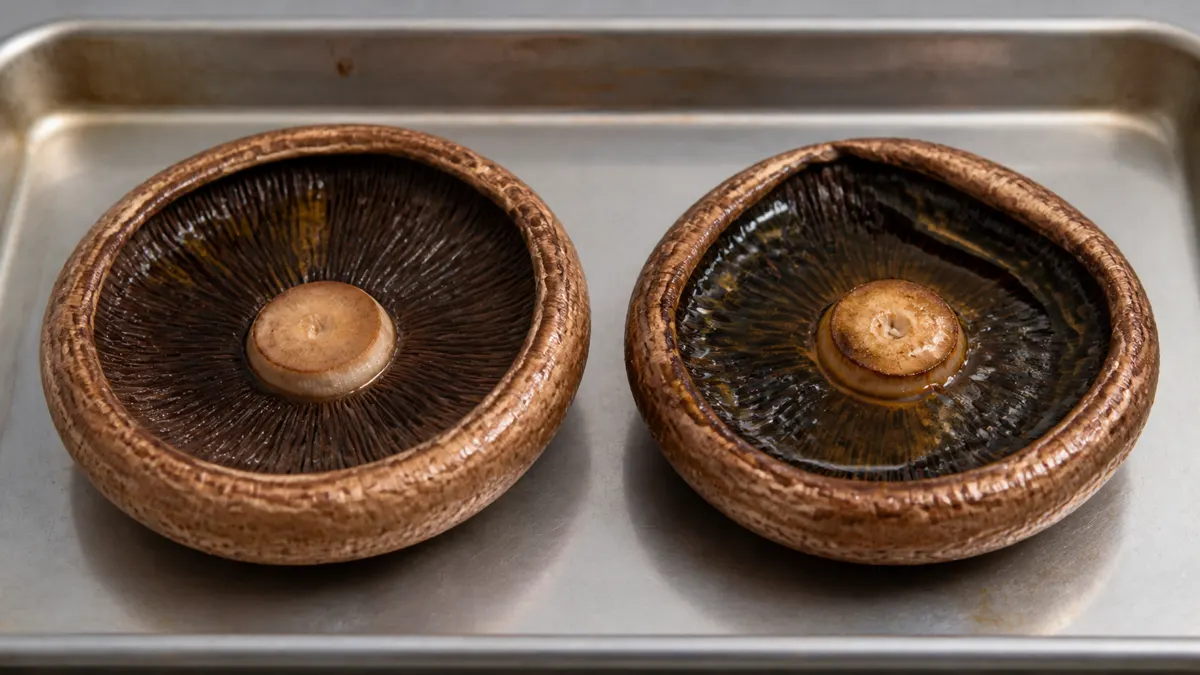
The side-by-side caps make a sheen without running liquid the visible difference between coating and soaking.
Build Two Heat Zones and Turn by Release
A single fierce zone asks the exterior and center to finish at the same speed. Two zones let the hot side establish color and the cooler side finish thick flesh without burning it.
Preheat and clean the grate before oil-coated mushrooms arrive because residue causes random sticking and hides the new food's actual browning.
Place portobello and king oyster on the hot zone with open space around each piece. Maitake wedges can start there on their cut base, while baskets and skewers should sit where their handles remain easy to control.
Do not force the first turn because a properly heated, oiled mushroom releases more cleanly after browning, while early tugging tears the surface before the crust forms.
| Grill piece | Start over | Move or turn when | Finish over |
|---|---|---|---|
| Whole portobello | Medium-high direct heat | Smooth face releases and shows brown marks | Cooler zone until the center is tender |
| King oyster slab | Hot direct heat | Flat face browns without a dry rim | Cooler zone for thick centers |
| Maitake wedge | Hot zone on cut base | Base releases and outer tips darken | Lower heat on a frilled side |
| Shiitake skewer | Medium direct heat | Cap centers soften and edges color | Brief cooler hold only if needed |
| Oyster basket | Medium-high heat | Lower folds brown and basket stops steaming hard | Off heat as soon as thin caps are tender |
Close the lid briefly for portobello or thick king oyster when the outside is ahead of the center. Leave it open when maitake tips or oyster folds are already dark, because trapped heat continues cooking every exposed edge.
A flare is a movement signal. Shift the mushroom to the cooler side and let the flame fall rather than leaving sugary marinade or dripping oil directly above it.
The grill image shows why the finishing area must exist before the first piece begins to brown.

Read Doneness in the Center, Not the Stripes
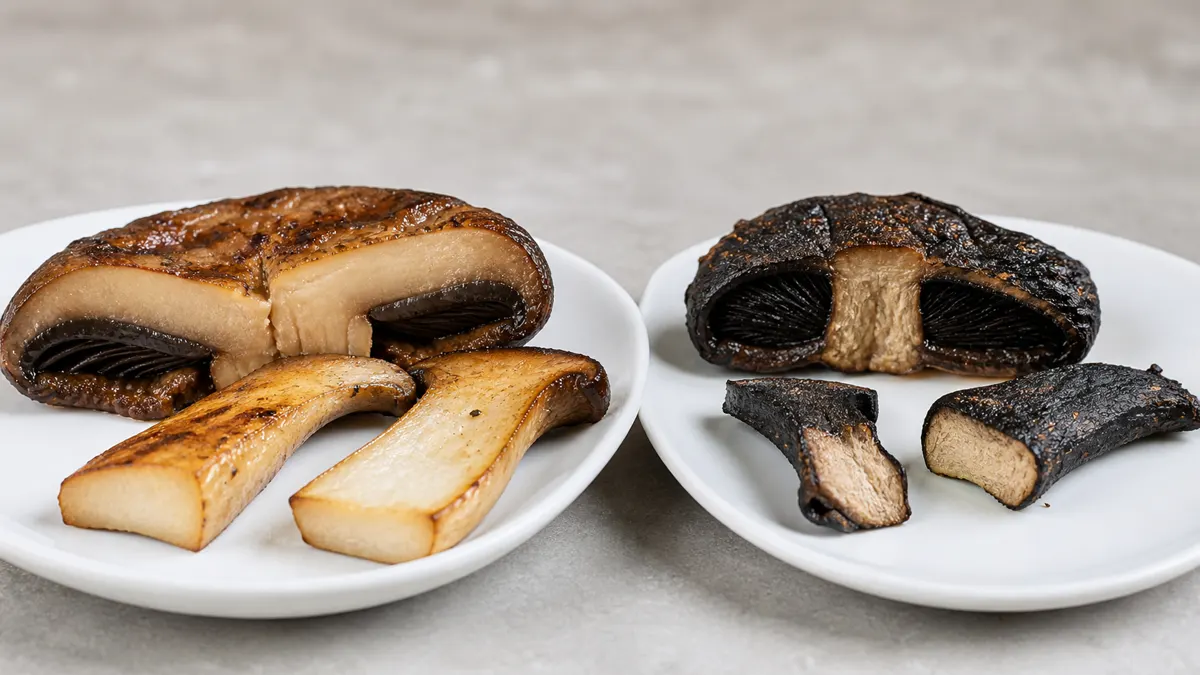
Dark stripes prove contact, not doneness. A thick mushroom can carry sharp marks while the center is still stiff, and a thin frill can dry out before it develops a tidy pattern.
Press portobello near the center until it yields without collapsing and any cap liquid looks hot and integrated rather than like a cool raw pool.
King oyster slabs should bend slightly and show a moist, opaque interior when one test piece is cut. A chalky firm center needs a cooler finish, while a shrunken fibrous center has stayed over heat too long.
Maitake is done when the base is tender enough to bite and the frond edges are crisp rather than black and papery. Remove each wedge independently because cluster density varies.
Shiitake centers should feel tender and the rims should remain flexible. Oyster folds need the earliest removal once their edges color, since their small remaining moisture reserve disappears quickly.
The cut comparison below separates real center doneness from decorative grill marks.
Move finished mushrooms to a clean platter and season while their surfaces are hot. Thin maitake and oyster edges lose their crispness during a long covered hold, so serve them before dense caps that tolerate a short rest.
Note
If the outdoor temperature is above 32 C, refrigerate perishable leftovers within one hour. Under cooler conditions, do not leave them out longer than two hours.
The right mushroom should leave the grill with the structure that earned its place in the ranking. Portobello remains a whole cap, king oyster keeps a juicy slab, maitake holds its wedge, shiitake stays on the skewer, and oyster retains tender folds.