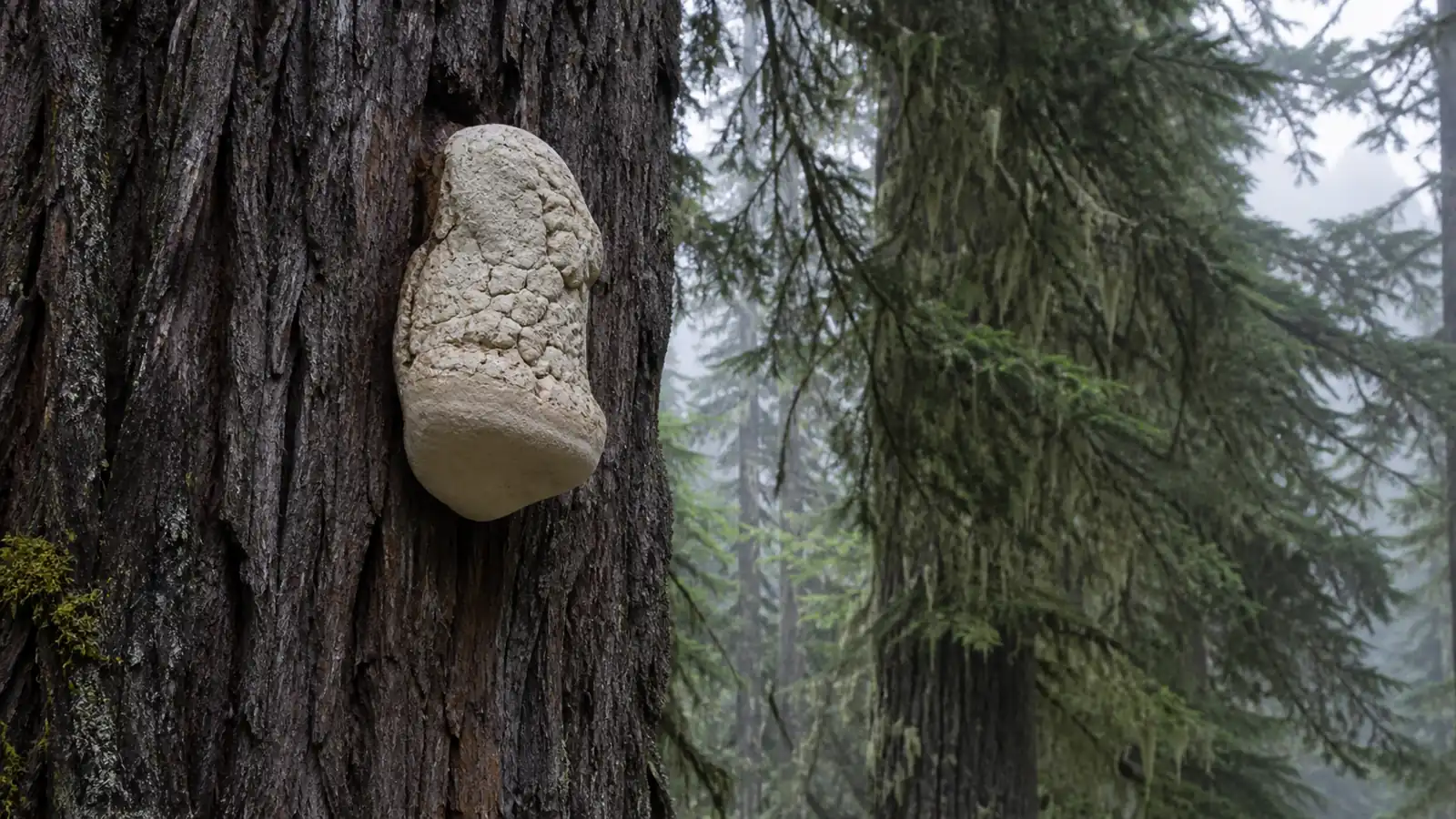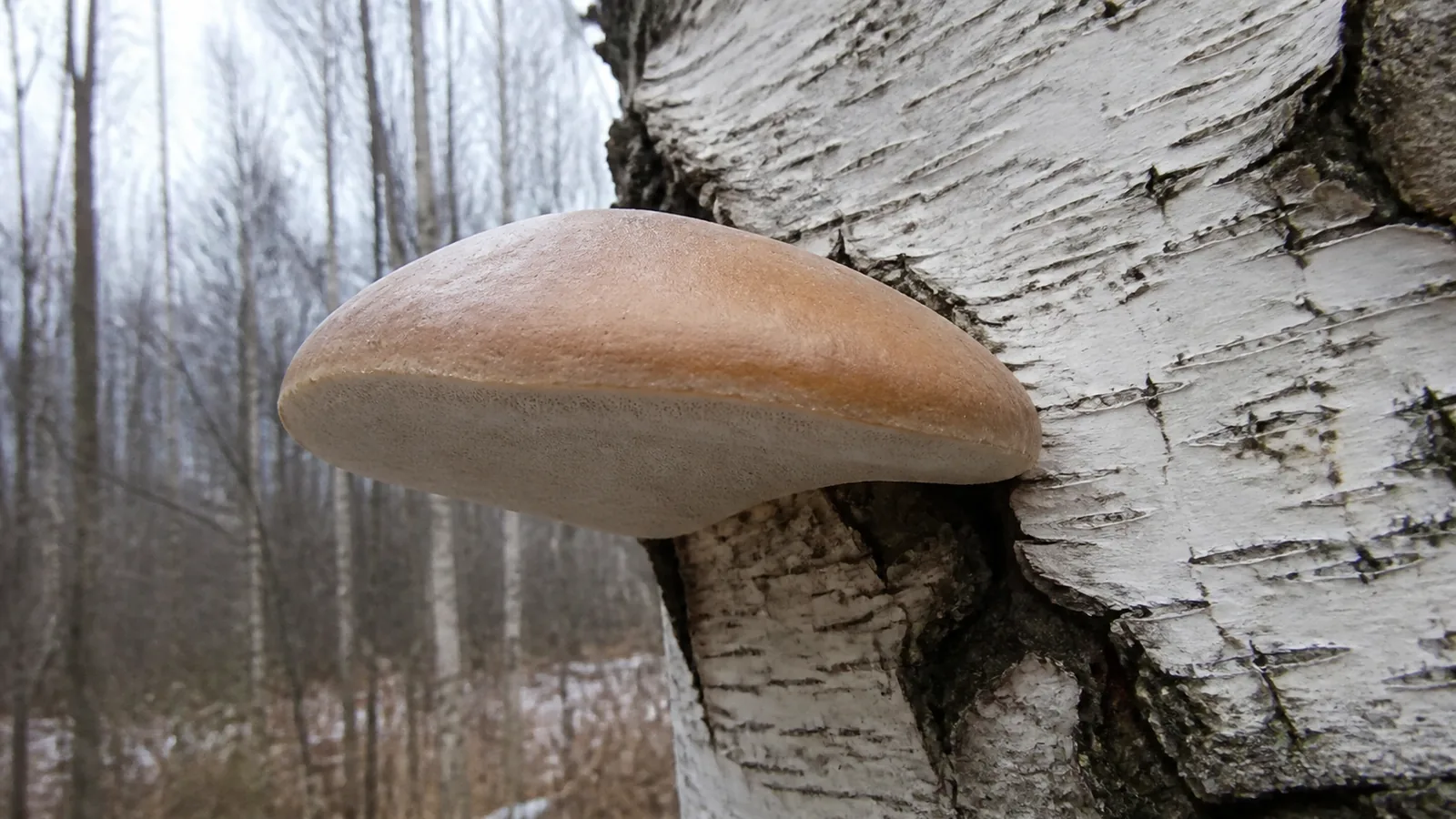
What does a maitake actually look like?
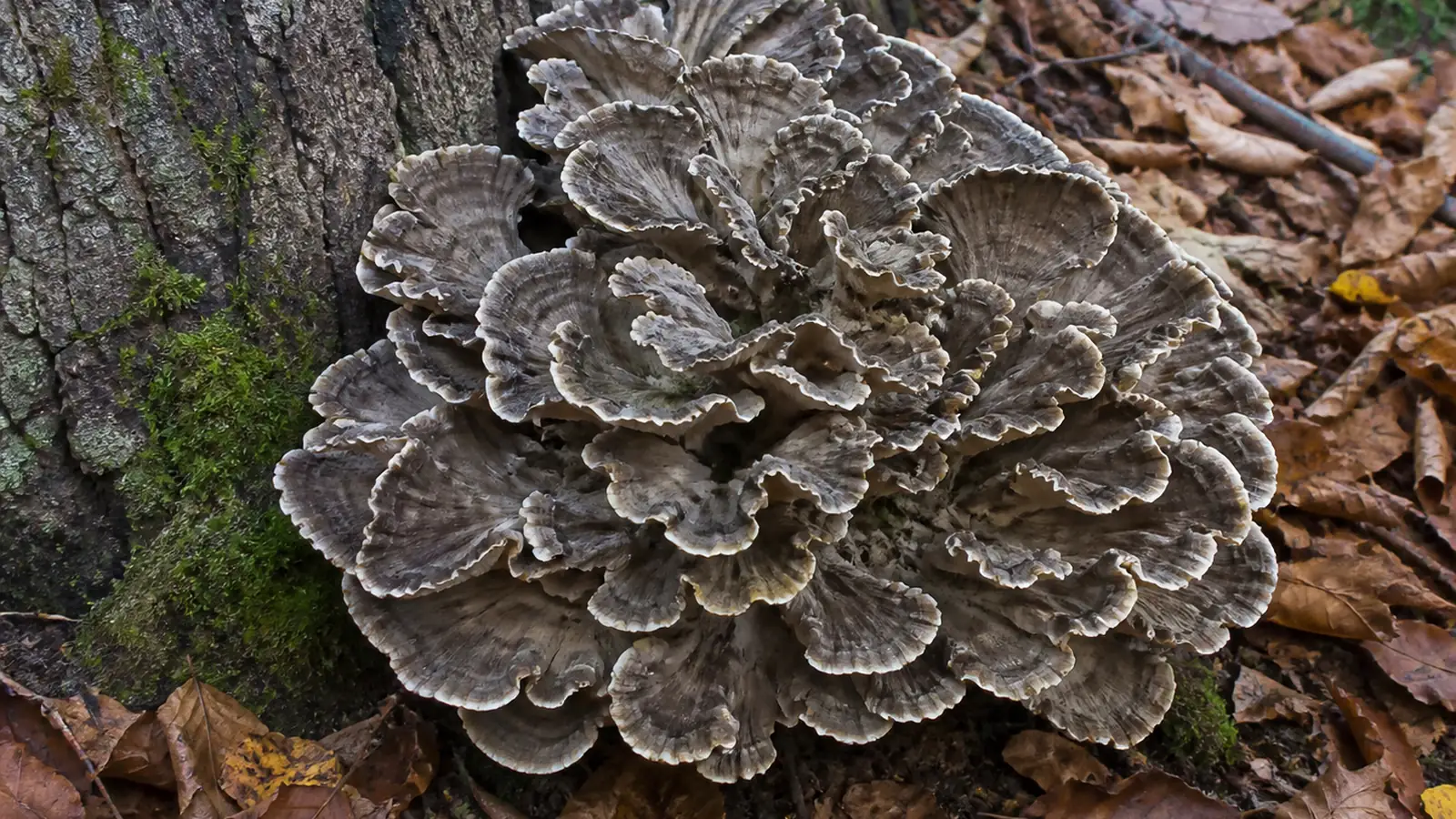
Maitake grows as a dense rosette of many small fronds rather than as a single cap, all of them rising from one branching white stem. A good cluster looks more like a ruffled hen sitting at the foot of a tree than like a mushroom, which is where the English name comes from.
The size is the first surprise. A single cluster can pass 50 cm across and weigh several kilograms.
Individual fronds are small, spoon- to fan-shaped and two to seven centimeters across, gray-brown with vague concentric zones.
The impression of bulk comes from how many of them share one stem rather than from any one of them being large.
Underneath, a pore surface runs down onto the stems themselves rather than stopping where the frond ends, and it does not change color when handled.
Position is part of the description rather than a separate fact. This mushroom belongs at the base of a trunk or over its roots, and never high up on the wood.
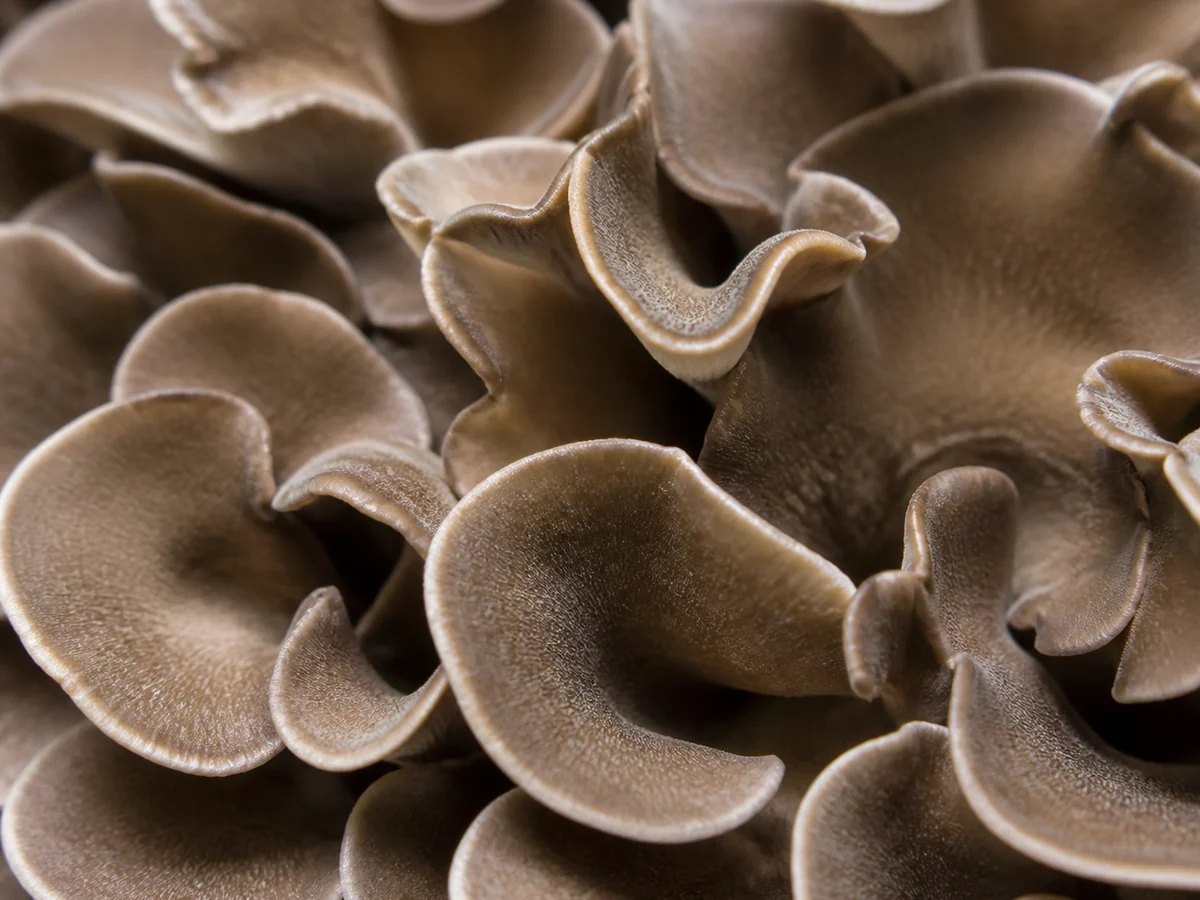
The whole rosette is one mushroom. Every frond traces back through the branching stem to a single point of attachment, which is worth checking, because it separates maitake from things that merely grow in a crowd.
How do you know it is maitake?
A dense rosette of many small overlapping fronds rather than one cap, each frond spoon- to fan-shaped, 2 to 7 cm across, dark to pale gray-brown with vague concentric zones, finely velvety, with wavy margins. A whole cluster can exceed 50 cm and several kilograms.
No gills. The underside is a pore surface running down onto the branching stems, lavender gray when young, then white, yellowing with age, and it does not bruise.
A branching white stem system rising from a single base, dividing repeatedly so that every frond is attached to the same stalk.
White, firm and slightly fibrous, with a pleasant earthy smell and no bitterness in young material.
Position does much of the work here. This is a mushroom of tree bases, and a bracket high on a trunk is something else regardless of color.

Five checks settle it, and none of them needs equipment.
The pore surface deserves a second look because it settles the most common confusion.
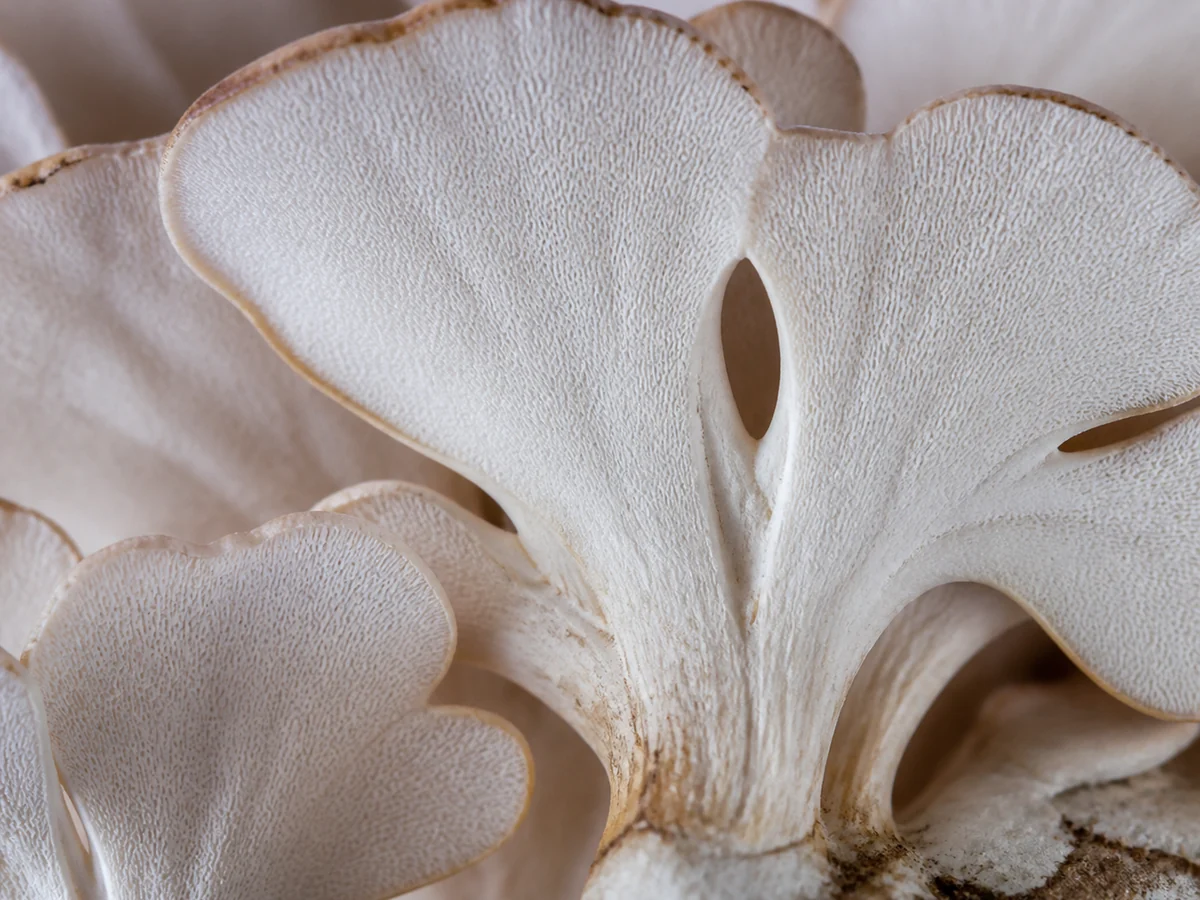
Press the pore surface and wait. Maitake does not change color, and the nearest lookalike turns black. The harder problem is seeing one at all, and no checklist helps with that.
Gray-brown fronds against gray bark and brown autumn leaf litter is close to camouflage, and people walk past clusters at arm's length every season. The color is the least visible thing about it.
What carries is the shape and the shadow. A maitake breaks the vertical line of a trunk with something rounded and horizontal, and in low autumn light the layered fronds throw a texture of small shadows that nothing else at a tree base produces.
So the productive habit is to look at oak bases specifically rather than to scan the forest floor generally.
Walk the trunks, look at the ground within a meter of each one, and move on.
It also rewards a second pass from a different angle. A cluster invisible against the light is often obvious with the light behind you, which is why the same tree can seem empty and then not.
What safety details matter for Maitake?
The usual precautions still apply. Take young firm material, cook it thoroughly, and eat a small portion the first time in case you personally do not tolerate it.
Avoid clusters growing beside roads or on treated ground. A fungus digesting the base of a tree takes up what is in that soil.
If symptoms follow a meal of any wild mushroom, note what was eaten and when it started, because onset timing is the single most useful thing a clinician can be told.
What else grows at the foot of an oak?
Every serious confusion with maitake is with another large polypore at the base of a hardwood, and none of them is dangerous.
That is worth saying plainly, because it changes what is at stake. A mistake here costs you a tougher or blander dinner, not a hospital visit.
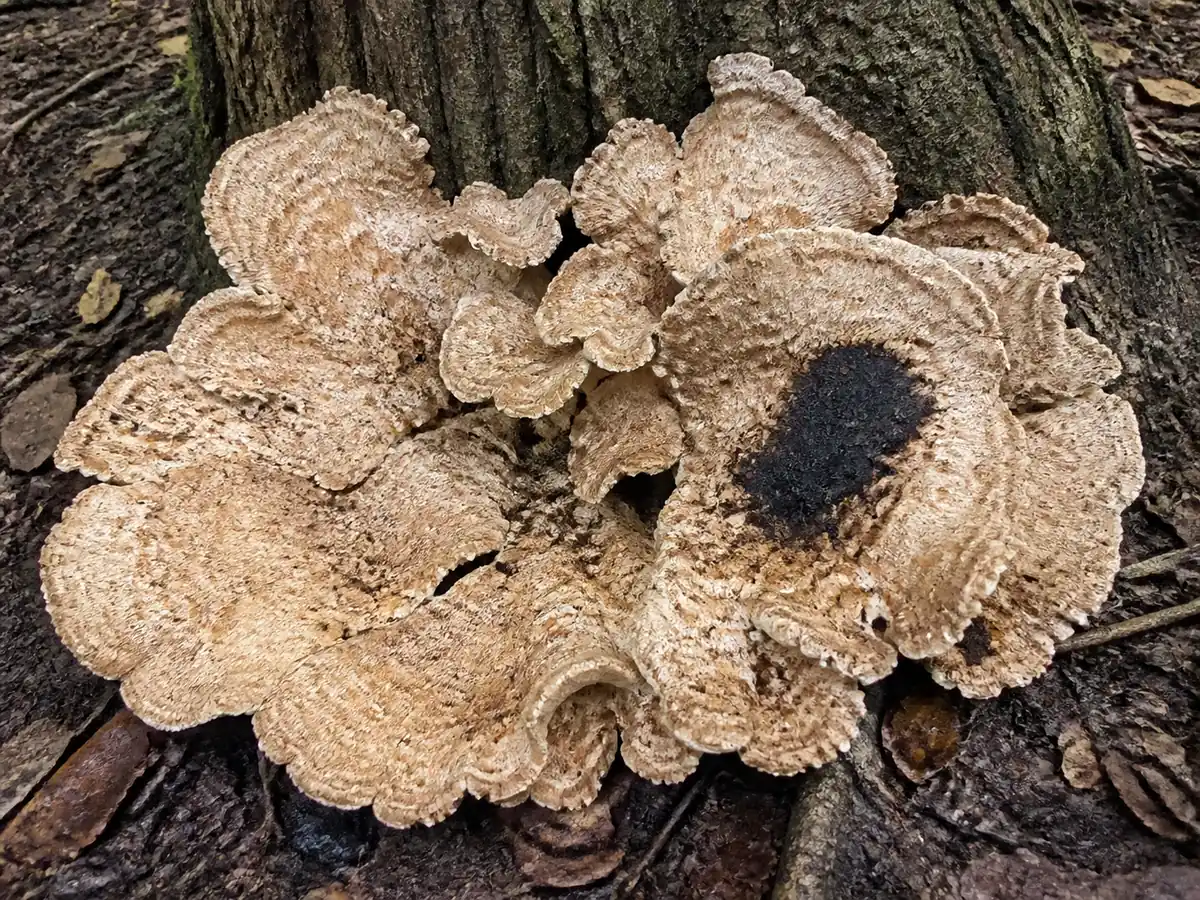
Side by side the two separate on one response.
MaitakeGray-brown fronds, one to three pores per millimeter, no bruising
Black-staining polyporeLarger individual caps, smaller pores, and a pore surface that bruises black
The black-staining polypore is the one people actually meet. It is edible when young and turns tough and sour quickly, so the point of telling them apart is quality rather than safety.
Berkeley's polypore is the other big one. It has much larger pores, a pale whitish to tan upper surface, and it does not bruise black either, so the pore size is what separates it.
One more looks closer than it is. Umbrella polypore forms more clearly defined individual caps, each with its own visible stem, rather than the crowded fronds of a maitake rosette.
The risk with maitake is age and quantity rather than misidentification.
Warning
Older clusters go tough and can upset a stomach even when correctly identified. Take firm young material with clean pale margins, leave anything soft, sour-smelling or insect-riddled, and cook it thoroughly. As with any wild mushroom eaten for the first time, keep the portion small and eat nothing else new with it.
A second caution is about the tree rather than the mushroom.
A large maitake at the foot of an oak means the root and butt wood is being digested, so a tree that fruits heavily for several seasons may be losing the structure that holds it up.
That matters if the tree stands over a path, a road, or a building. It is one of the few cases where telling a landowner beats keeping the spot quiet.
Why does it come back to the same tree?
Maitake is a weak parasite on living oaks. Trace the fruiting body to its attachment point before deciding which tree it is associated with.
It enters the root and butt wood of a standing tree and causes a white rot there, digesting lignin as well as cellulose. The tree carries on leafing out above ground while the base is being consumed.
Because the fungus lives in the tree rather than in a passing log, it fruits from the same spot repeatedly.
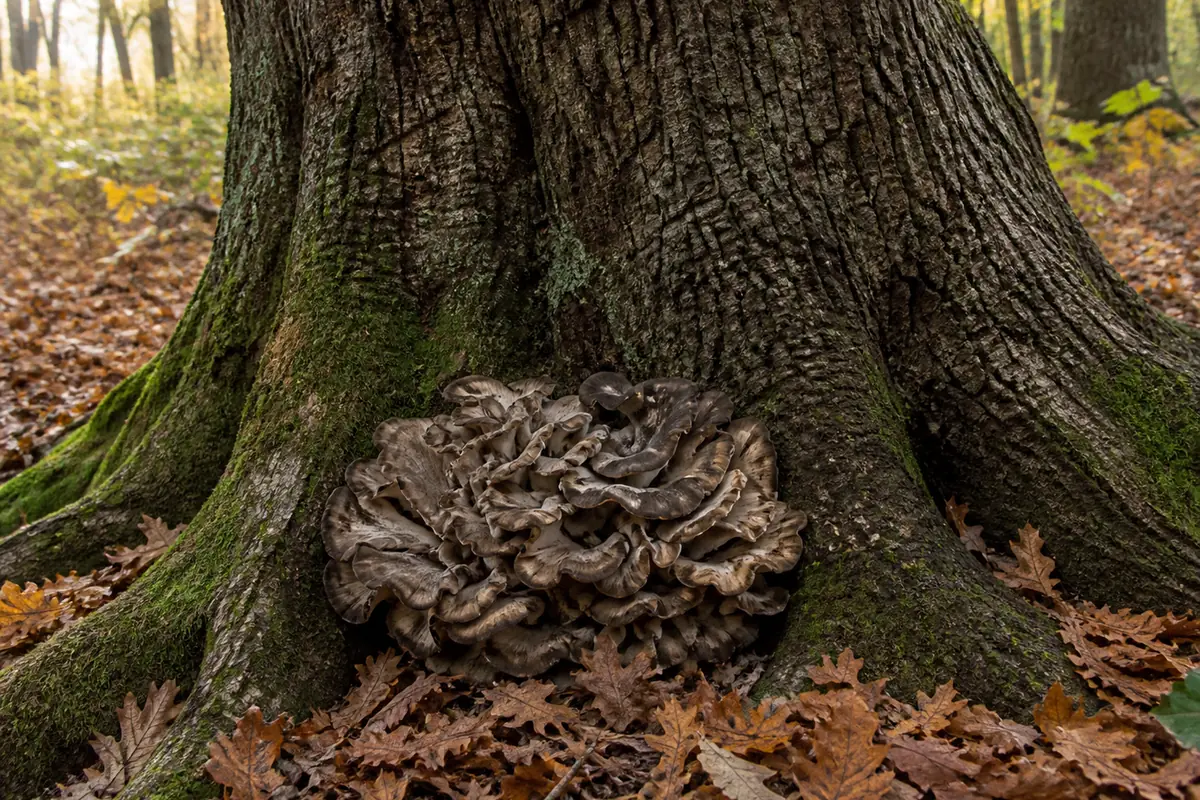
A cluster high on a trunk is something else, whatever it looks like from a distance.
That is why a maitake tree is treated as an asset rather than a find. A productive oak can be walked every autumn for a decade, and the location is more valuable than any single cluster taken from it.
That asset is worth recording properly rather than remembering. A photograph of the trunk from a fixed spot, the date, and a rough position relative to something permanent will still be useful in five years when the undergrowth has changed completely.
How you harvest affects what you get back. Cutting the rosette off cleanly above the base leaves the attachment and the wood undisturbed, while pulling a cluster out takes soil, bark and often part of next year's growing point with it.
It is also why the mushroom is scarce in the west.
It is widely distributed east of the Rocky Mountains and rare beyond them, so a western forager looking for it at oak bases is usually looking for something else.
How do you cook maitake well?
Maitake is among the best of the wild polypores in a kitchen. It rewards dry heat far more than moisture, which is the opposite of how most people treat a big soft mushroom.
Tear the rosette apart along its natural divisions rather than cutting across it. The fronds separate cleanly at the stem branches, and torn edges brown better than knife edges.

Four steps, and the order of the last two matters.
1
Tear the cluster into pieces along the stem branches, keeping some stem on each
2
Check for grit at the base, where soil collects, and trim the attachment point away
3
Roast or pan-fry hot in fat until the thin edges crisp and the stems firm up
4
Season at the end, because salt early draws out water and steams the pieces
The flavor is deeper and more savory than most cultivated mushrooms, with a faint pepperiness in the stems. Cultivated maitake is milder than a wild cluster from an oak.
Grit is the failure this species actually produces in a kitchen. Soil and bark collect where the branching stems meet, and a cluster that looks clean on top can carry sand deep in the base.
Trim the attachment point away rather than trying to wash it out. Water gets into the layered fronds easily and leaves easily, so a soaked cluster steams instead of roasting and the grit usually stays where it was.
It also dries well, which matters when a single find is more than a household can eat fresh.
The texture after rehydration is closer to the original than most species manage.
That makes maitake unusual among the large finds. Chicken of the woods is best cooked and frozen because it dries badly, while a maitake can go straight to a dehydrator and still be worth eating in February.
What did the maitake trial actually measure?
Maitake carries a large supplement literature, and the human trial most often cited for it did not measure whether it works.
That distinction gets lost constantly. A trial reporting that a substance was tolerated is often quoted as though it reported that the substance helped.
Note
Nothing here supports taking maitake to treat anything, and anyone in cancer treatment should raise any supplement with their oncology team before starting it.
As a food it needs no such defense. It is a good mushroom on its own terms.
Can you grow maitake at home?
Maitake is cultivated commercially and is one of the harder species for a home grower.
It wants supplemented hardwood sawdust, a long colonization, and a cold period before it will fruit, and blocks that look perfect often sit for months without forming a rosette.
The cultivated product is also noticeably milder than a wild cluster, which is unusual. For most species the difference runs the other way or not at all.
If you want maitake reliably, finding an oak is a better strategy than buying a block.
Is maitake worth eating for nutrition?
Maitake is a mushroom, which means it is mostly water, and the figures worth knowing are about what it replaces rather than what it supplies.
It is filling out of proportion to its calories, and it carries the savory character that lets it stand in for meat in a dish without pretending to match it nutritionally.
The beta-glucan content that the supplement literature is built on is real, and it is also present in every other mushroom on this site. Nothing about eating maitake as food delivers a supplement dose.
Why do sources disagree about the family?
The genus name is settled and the family is not.
Grifola frondosa is placed in Grifolaceae by some authorities and in Meripilaceae by others, which is why two reputable sources can list this mushroom under different families without either being careless.
The common names are more confusing than the science. Hen of the woods and maitake are the same mushroom, while chicken of the woods is an entirely different fungus with a different color, a different shape and a different set of cautions.
Sheep's head and ram's head both circulate as well, and ram's head is sometimes attached to a different species altogether, so a Latin name is worth asking for whenever money changes hands.
Maitake identification and cooking questions
What is maitake?
How do you tell maitake from its lookalikes?
Where does maitake grow?
Does maitake come back to the same tree?
When is maitake season?
How should you cook maitake?
Sources & References
- Grifola frondosa, MushroomExpert.Com The Grifolaceae placement, the gray-brown zoned fronds with wavy margins, the pore surface that does not bruise, one to three angular pores per millimeter, the weakly parasitic relationship with living oaks causing a white butt rot, fruiting at tree bases, distribution east of the Rocky Mountains, and the separation from the black-staining and umbrella polypores
- A phase I/II trial of a polysaccharide extract from Grifola frondosa in breast cancer patients: immunological effects, Journal of Cancer Research and Clinical Oncology 2009 The 34 postmenopausal patients free of disease after initial treatment, five dose cohorts from 0.1 to 5 mg per kilogram twice daily for three weeks, safety and tolerability as the primary endpoints, the absence of dose-limiting toxicity, and the two grade I withdrawals