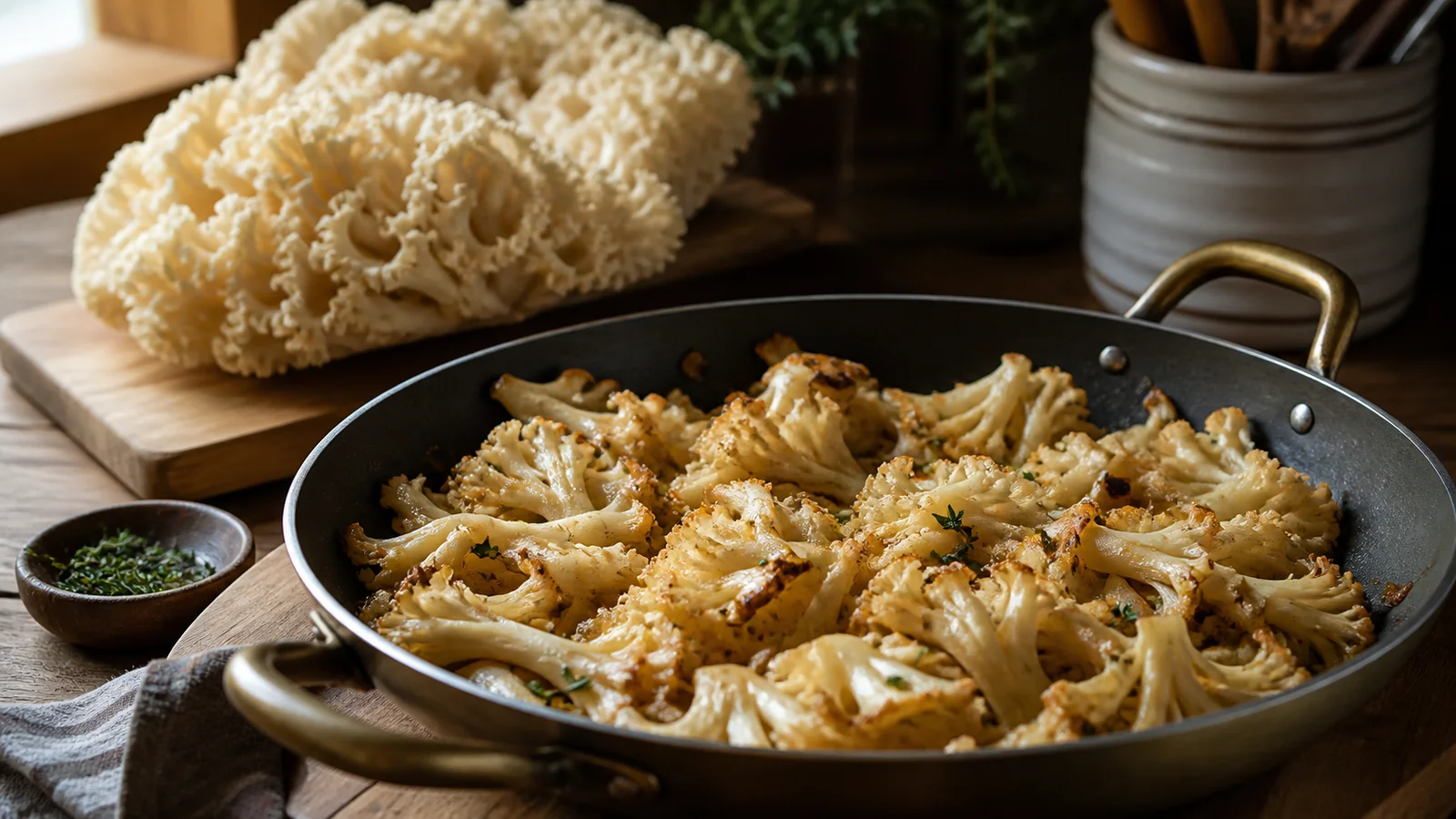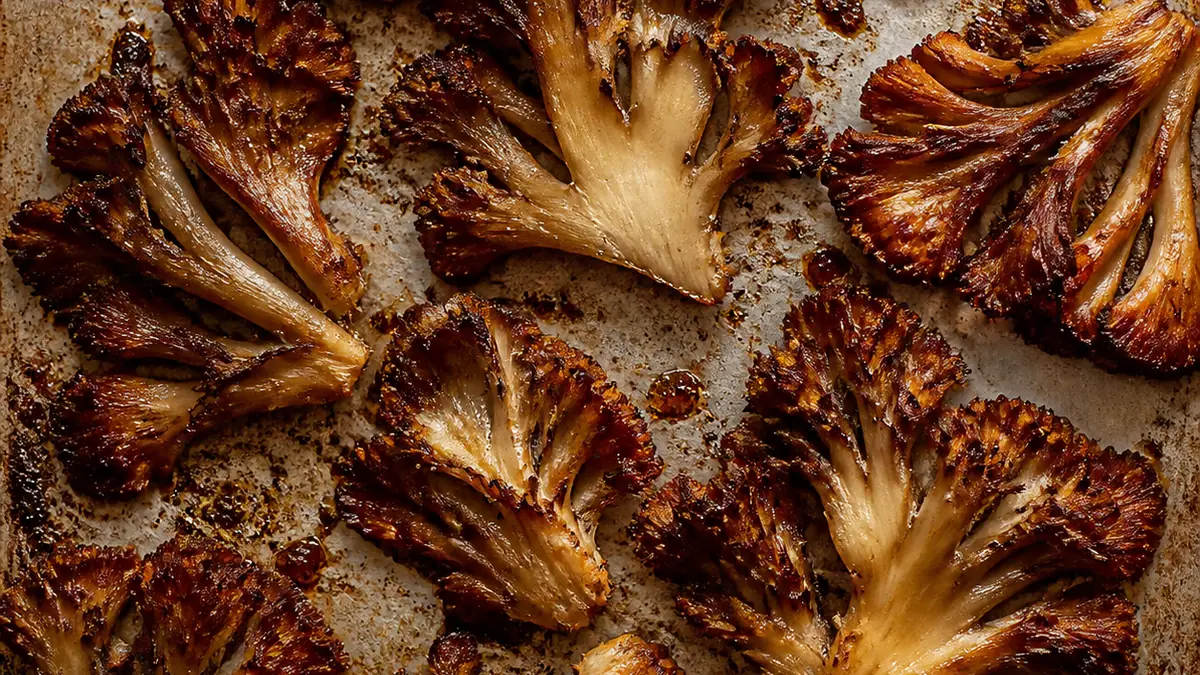
Maitake is a rosette of thin fronds carrying far more surface area than a sliced mushroom of the same weight, so a crowded pan floods and a hot tray crisps. Tear it along the frond lines rather than slicing, cut off the dense core, and roast in a single layer at 425F for twenty to twenty-five minutes.
You put a beautiful maitake in a skillet and ten minutes later you were looking at a gray, wet, faintly sad pan.
That is the standard first attempt, because the mushroom is shaped unlike anything else in the shop and a skillet is the wrong tool for that shape.
It is mostly surface
A maitake is not caps and stems but a rosette of thin overlapping fronds, and almost all of it is edge.
Key takeaway
Thin fronds and a dense base need different handling. A maitake carries several times the surface area of a sliced mushroom of the same weight, which makes it release water fast and brown fast, in that order.
Fast in both directions is the part to sit with. The same property that ruins a crowded pan in four minutes is the one that gives you brittle edges in twenty.

Surface area is what makes it good and what makes it fail, because given space and dry heat those edges turn genuinely crisp while a crowded pan has them dumping their water all at once and boiling the whole thing.
It helps to compare it against a mushroom you already know. A sliced cremini is two flat faces and a rim, whereas a single maitake frond is a wavy sheet whose edge runs the entire way around it and then folds back on itself.
That is the difference the oven exploits.
You can read the species record on our maitake profile for the identification side, which is a separate question from the kitchen one. The shape is the part that matters here.
Nothing about the mushroom is difficult once the shape is understood. Give the surface somewhere to go and it behaves, and every failure below is a version of not doing that.
Cooking MushroomsHow to Cook Cauliflower Mushroom Without Trapping GritWhy a pan is the wrong tool
A skillet holds a small fraction of what a maitake cluster needs.
Torn into pieces, a medium cluster covers two baking trays. Pushed into a twelve-inch pan the same mushroom sits three or four layers deep, and only the bottom layer ever touches metal.
Only the last line is worth aiming at, and only the first is unrecoverable. The two in between are both fixable while the pan is still on the heat.
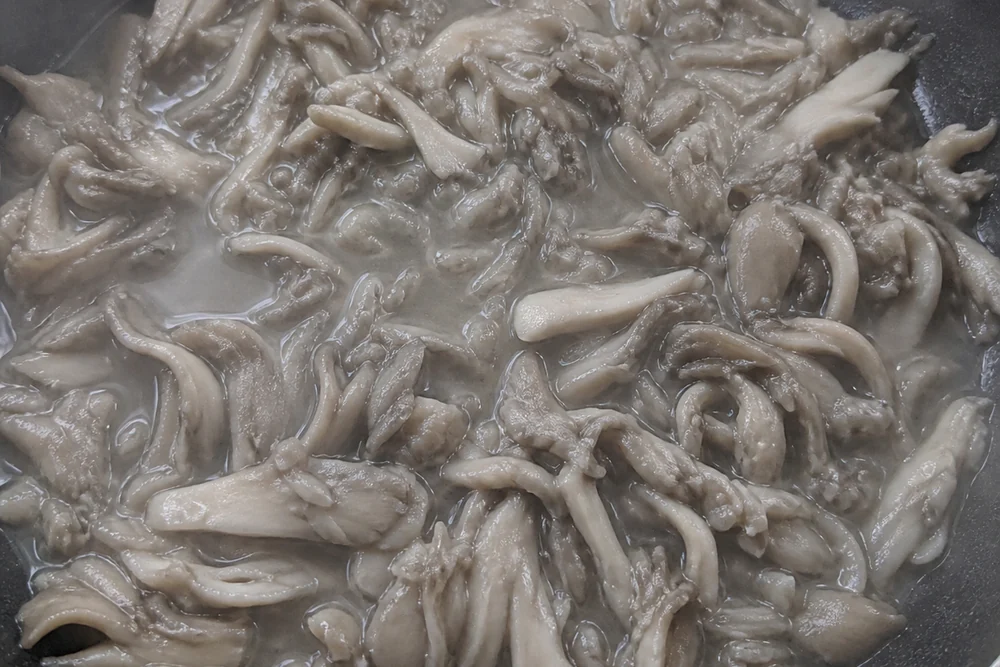
The mechanism is not mysterious. Water leaves the mushroom, pools, drops the pan to a hundred degrees, and holds it there until the liquid is gone, by which point the mushroom has already given up its structure.
The obvious response is to leave it on longer, and that response makes things worse rather than better.
Once the fronds have collapsed there is no crisp edge left to develop, and what you have is a gray braise you did not intend to make. The failure is structural rather than a matter of time, which is why people who add another five minutes only make it worse.
Both of the conditions behind that failure come down to space rather than technique:
- Too many pieces in the pan, so the released water cannot evaporate as fast as it arrives.
- A pan that was not hot enough to start with, so it never recovers once the water lands.
Neither condition announces itself while you are cooking.
Either one on its own is survivable. Together they leave the mushrooms steaming in a gray, wet pan.
Tearing, not slicing
Your hands find the seams better than a blade does. Maitake comes apart along the lines where the fronds meet.
| Torn by hand | Sliced with a knife | |
|---|---|---|
| Follows the frond lines | Yes | No, it cuts across them |
| Ruffled edge retained | Yes, on every piece | Mostly lost |
| Surface for crisping | High | Flat faces only |
| Pieces hold together | Yes | They fall apart in the pan |
Only the third row really decides anything. Edge is what crisps, and a knife removes most of it before the mushroom ever reaches heat.

Tear from the base upward and the cluster comes apart into flat sheets that keep the ruffled outer margin everyone remembers eating.
A knife gives you flat slabs with two smooth faces and no edge. They cook, but they cook like any other mushroom, and the whole reason for buying a maitake is gone.
There is a second instinct to override at this stage, and it is the tap. Do not wash it.
That is worth saying plainly, because the instinct with a ruffled mushroom is to rinse it under the tap and the instinct is wrong.
Our guide to cleaning mushrooms makes the general case, and it applies here more than almost anywhere because the fronds hold water in every fold.
Brush a cultivated cluster and shake a wild one hard, upside down, before it comes near the kitchen. Water trapped between fronds will not leave in the oven, and it steams the piece from the inside.
They also want cooking rather than tasting raw, which our page on eating maitake raw covers properly, and raw maitake is in any case tough and hard to digest with nothing to gain from it.
Cooking MushroomsHow to Cook Black Morels: Halve Them, Never Slice ThemThe core is not food
Every maitake grows out of a dense pale core where the fronds converge. That part stays tough no matter what you do to it.
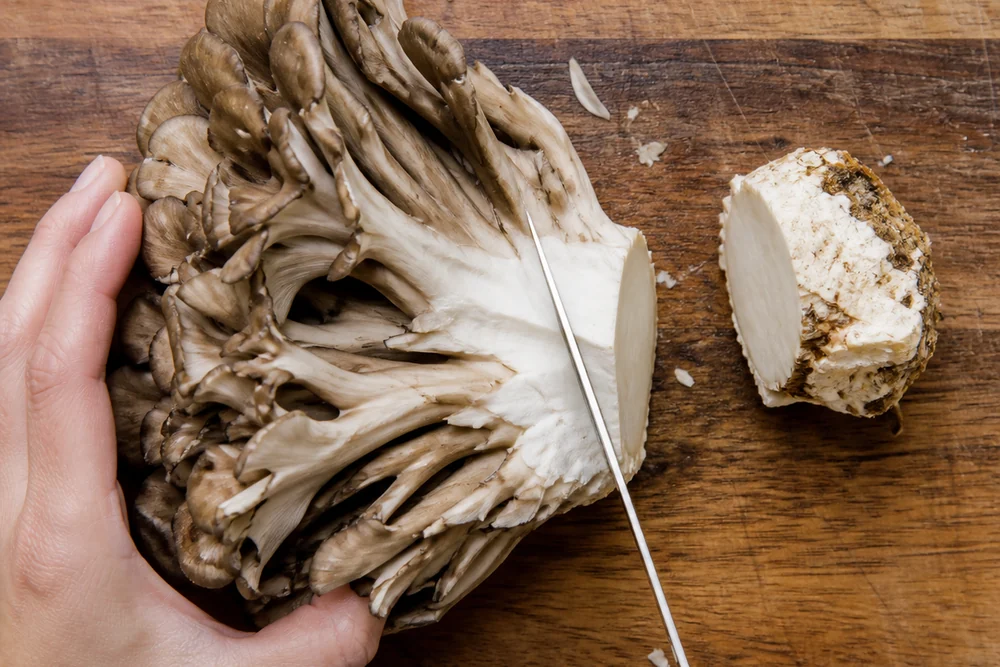
The line is easy enough to find by feel, because the flesh changes from something you can tear to something you cannot within about a centimetre.
This is the opposite of the blue oyster case, where the thick base is the best part of the cluster, and the general question of which bases earn their place is worked through on our page about maitake stems with this species firmly at the discard end.
There is one exception worth knowing about, and it is the youngest part of the core.
Where the fronds are still separating, an inch or so above the woody base, the flesh is dense but tender and worth keeping. Below that line nothing improves with cooking.
Do not throw it away, though, because simmered for an hour with an onion it gives a dark, savory stock better than most of what you would buy.
Dry heat, and plenty of room
Roasting is the reliable method.
Use a hot oven with a single layer on enough tray that no two pieces touch, and nothing else about it is complicated.
The oven wins here for a reason that has nothing to do with temperature. An oven is simply a much larger surface than a pan, and surface is the constraint this mushroom puts on you.
Those five steps are the whole method, and the last one is the only judgement call in it.
The hot tray is the small detail that makes the difference. Pieces laid on cold metal spend their first minutes releasing water into a cool surface, which is the tray version of a crowded pan.
None of this rules the stovetop out, but a pan only works under conditions the oven does not impose.
- Use the widest pan in the house and cook in two or three batches.
- Keep the pieces flat and do not stack them.
- Press them down with a spatula so more surface touches metal.
- Add the fat only after the released water has cooked off.
- Expect it to take longer than the recipe you are reading says.
Grilling works too, if the pieces are large enough not to fall through. A wire basket solves the problem for smaller ones.
The smoke suits the flavor better than it suits most mushrooms, and the ruffled edges catch it in a way a flat cap cannot.
One method is worth ruling out entirely, and it is the one people reach for when the pan starts to look dry.
What never works is a lidded pan. The lid returns every bit of water the mushroom just gave up, and a covered maitake is a braised maitake whatever the recipe calls it.
Between those two extremes sits the air fryer, which gets the principle right and the capacity wrong.
The circulating heat is the right idea and the basket is usually too small, so it works for a portion and not for a cluster. Shake it once partway through and treat the capacity limit as real rather than optimistic.
Whatever the method, the finish is the same: the edges should be dark and audibly brittle, and the thicker part of each sheet should still have some give.
Cooking MushroomsHow to Cook Black Truffle Without Losing Its AromaWhat it tastes like
Savory and faintly peppery, stronger than any oyster mushroom. It is one of the few cultivated mushrooms with a flavor of its own rather than a general mushroom flavor.
Tip
Season after roasting, not before. Salt on the tray draws water to the surface during the first minutes, which is exactly when you want the surface dry.
The crisped edges are the reason people talk about it.
They go brittle and almost meaty, and the contrast against the softer center of each sheet is the whole appeal of the dish. A uniformly soft maitake has lost the thing that makes it worth its price.
There is a reason it turns up so often as a substitute for meat on a menu, since the peppery savory note plus a crisp edge covers most of what a diner wants from a fried piece of something and no oyster mushroom gets close to that on its own.
It holds its own against soy, miso, butter and black pepper without disappearing. Cream is the one thing to avoid, for the same reason it is wrong on shimeji, which is that a wet sauce undoes the texture you just spent twenty minutes building.
Salt is the seasoning that needs the most care with maitake. The crisp edges take it well and the meaty centres take almost none, so salting the tray evenly leaves half the piece over-seasoned and the other half flat.
Anyone eating it regularly rather than occasionally will find the numbers on our maitake nutrition record, though as a cooking matter it simply behaves like a high-surface, moderate-water mushroom, which is exactly what the method assumes.
Wild ones and shop ones
They are the same mushroom and they cook the same way. Two practical differences are worth knowing about before a foraged cluster reaches your kitchen.
The first is grit, because wild hen of the woods fruits at the base of oaks in autumn and a cluster that has spent a week in leaf litter carries soil and small insects packed between the fronds.
The third row is the one foragers argue about, and the honest answer is that a week-old cluster is still worth taking home if you are willing to trim it hard.

Shaking it out is genuinely the whole job. A cluster held upside down and rapped firmly against a gloved hand loses almost everything that was hiding between the fronds.
The second is age, since wild clusters keep growing and the parts nearest the core toughen first, so on an older find you trim generously and keep only the outer few centimetres of each frond.
- Shake it hard, upside down, before it gets to the kitchen.
- Trim more than feels reasonable on anything past its first few days.
- Expect a big one to fill your oven twice over.
Anyone who would rather have a reliable supply than a lucky autumn can read growing maitake at home, which is slower than oyster mushrooms but not difficult. And when the shop has none at all, our page on maitake substitutes works through what comes closest for which dish.
Buying and keeping it
Feel the frond edges rather than looking at the color, since fresh maitake is dry and firm at the margin with some spring left in the whole cluster.
Weight is a useful second check. A cluster that feels light for its size has already lost water, which is not a problem for roasting but does mean it will not sit in the fridge for long.
Curling, darkening frond edges mean the cluster has been sitting. That is a reason to use it today rather than a reason to leave it, because maitake dries out rather than turning slimy.
A dried-out cluster still roasts perfectly well.
It is one of the more forgiving mushrooms at the end of its life, which is not something you can say about an oyster. Less water inside simply means less water to drive off, and the edges crisp sooner than they would have on day one.
One preparation suits a tired cluster better than a fresh one. Roasted hard and then blitzed to a coarse powder, dried-out maitake makes a seasoning with more character than most bought mushroom powders, and the fronds that had gone leathery grind best.
Buying a whole cluster beats buying pre-cut trays wherever the choice exists, since a cut tray has already lost to handling the frond edges the whole method is aimed at producing.
Pan size, not technique, is where a first attempt usually comes apart. The skillet that handles everything else gets filled, and the gray wet result at the top of this page follows from a vessel that was never big enough rather than from anything the cook did.
Our page on storing maitake covers freezing and drying in detail. The short version is that it freezes far better cooked than raw, which follows from everything above about water.
Sources & References
- Grifola frondosa, hen of the woods (Fungi Atlas) Species reference used for the rosette fruiting body structure of overlapping fronds arising from a common core, and for the autumn fruiting habit at the base of oaks.
- Specialty Mushroom Production: Grifola (Penn State Extension) Extension reference used for sawdust block cultivation, year-round availability of cultivated clusters, and the difference in grit and age between cultivated and wild material.
- Hen of the Woods (Forager Chef) Cook and forager reference used for the tearing method along frond lines, the toughening of frond bases in older wild clusters, and the use of the trimmed core for stock.