A black trumpet is a hollow funnel with a wall about as thick as paper, so it collapses to a fraction of its volume and contributes aroma rather than texture. Split each one to clean it, cook it in butter for three or four minutes, and let cream, egg or starch carry the flavor.
A bowl of black trumpets weighs almost nothing and costs a great deal, and the first time you cook them the bowl turns into about two spoonfuls.
That is not a mistake you made, it is what the mushroom is, and once you stop treating it as a vegetable everything about it makes sense.
It is a seasoning, not a vegetable
There is no cap here, no gills, and barely any flesh. What you are holding is closer to a shell than to a mushroom.
Split one open and the whole thing lies flat, like a scrap of dark leather, and while our black trumpet profile has the botanical account, the kitchen version is that you are holding a wrapper rather than an ingredient with a middle.
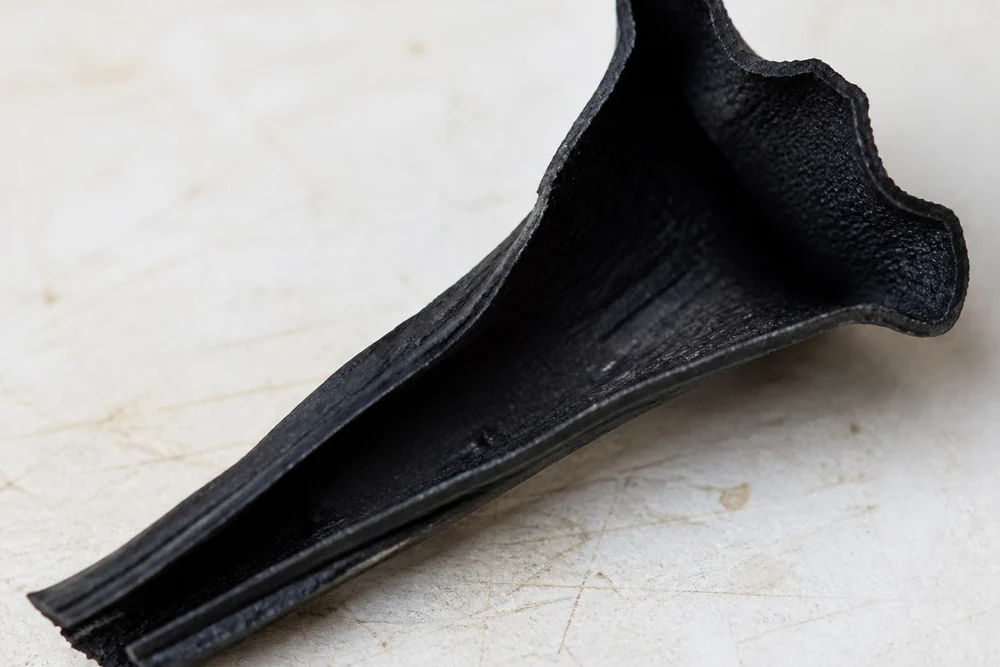
That single fact rules a great deal out, since you cannot sear a mushroom with no surface to crust and you cannot build the body of a dish out of something that will not be there in ten minutes.
Held up to a window a trumpet is faintly translucent at the rim, which explains why a pan full of them can look substantial and produce nothing.
What you can do is move its aroma into something that will stay. Fat, cream, egg and starch all hold it, which is why every good black trumpet dish is really a dish of something else that tastes of black trumpet.
The comparison worth making is the golden chanterelle, which shares the genus and almost nothing else, since a chanterelle has flesh you can sear and a trumpet has an aroma you can lend.
Cooking MushroomsHow to Cook Cauliflower Mushroom Without Trapping GritHow little you actually get
Weigh the bowl before and after, once. You will never plan a trumpet dish carelessly again.
| Fresh | After cooking | |
|---|---|---|
| Volume | A large mixing bowl | Two or three spoonfuls |
| Weight | 100 g | Roughly 15 to 20 g |
| Role in the dish | Looks like the main ingredient | Behaves like a spice |
| What a recipe weight assumes | Flesh | There is none |
The volume figure, not the weight, is what catches people. A bag that looked like enough for a family arrives on the plate as a scattering, and the disappointment lands after the money has already been spent.
The numbers surprise people because most mushrooms lose water and keep their shape, whereas a trumpet loses water and then collapses since the shape was only ever a thin wall holding air.
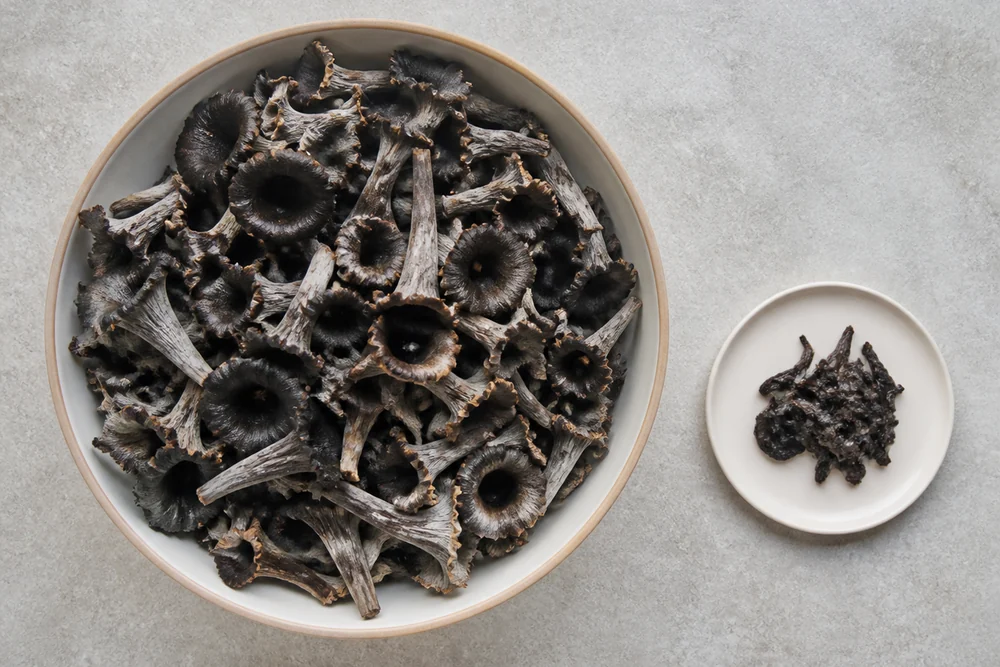
None of that makes them poor value. A hundred grams flavors a dish for four generously, which is a better return per gram than almost anything else in a woodland basket.
How much do you need, then, for a given dish? Three rules cover almost every case:
- A hundred grams of fresh trumpets seasons a dish for four generously.
- Ten grams of dried does the same job and takes up no room.
- A teaspoon of the powder seasons a butter, a dough or a piece of fish.
The practical rule is to buy or pick for flavor rather than for volume. If a recipe calls for three hundred grams of mushroom and you are using trumpets, use a hundred grams of trumpets and something else for the body.
Cleaning an open funnel
The funnel is open at the top and it has been standing in a wood all autumn.
None of those numbers is the hard part. The hard part is that there is almost nothing to hold while you do any of it.
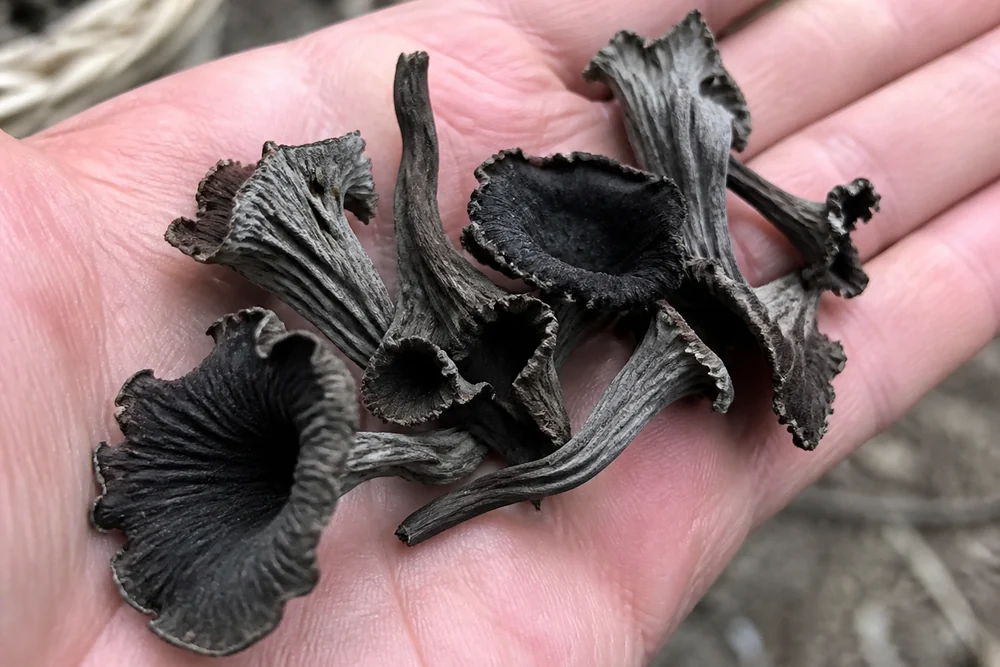
Pine needles, grit and the occasional small creature end up inside, and none of it comes out while the funnel is closed. Splitting each one from rim to base sounds tedious and takes about two minutes for a full handful.
Do it over a bowl rather than a board, because what comes out is fine grit that will end up back on the mushrooms if they are lying in it.
Once they are open, most of what was inside simply falls out. A dry brush or a shake finishes the job on all but the worst of them.
Water is the last resort rather than the first, and our guide to cleaning mushrooms makes the general case, while a trumpet is thin enough to survive a ten-second rinse but not a soak.
Drying them afterwards matters more here than with a solid mushroom, because a wet trumpet in a pan releases its water and its color at once and you get a gray puddle instead of a sauce.
The color bleeds
They will darken whatever they are cooked in, and there is no way around that.
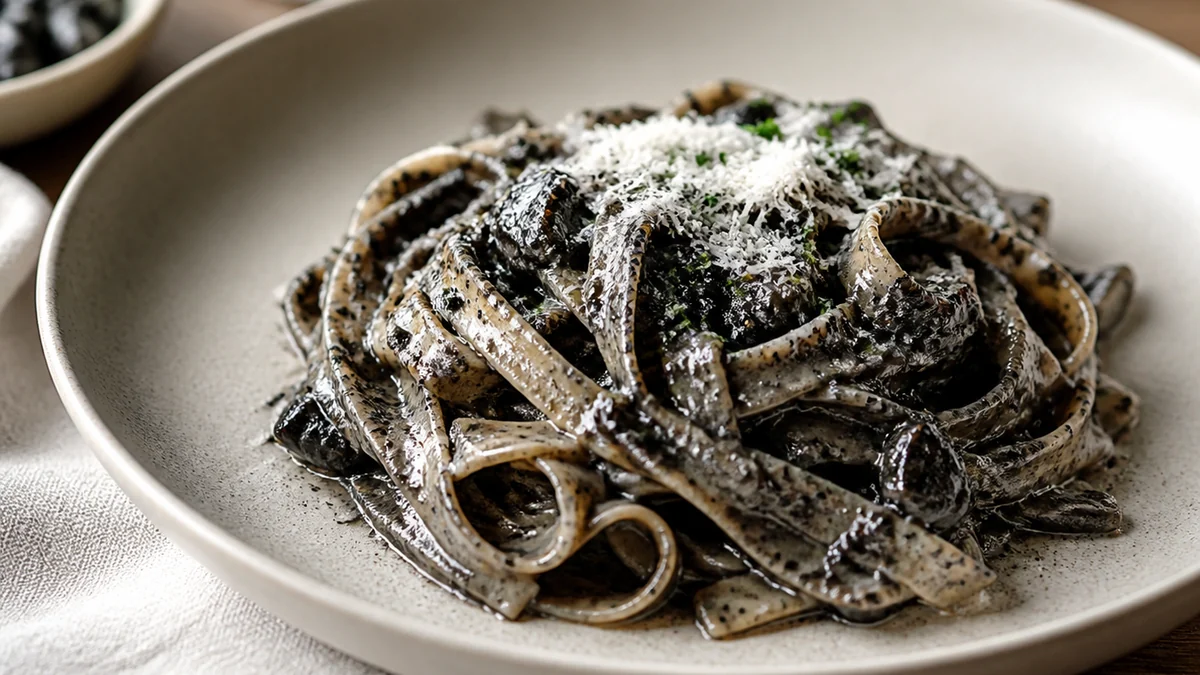
Cream is the case worth looking at, because it is also the dish trumpets suit best. The photograph below is two minutes in.
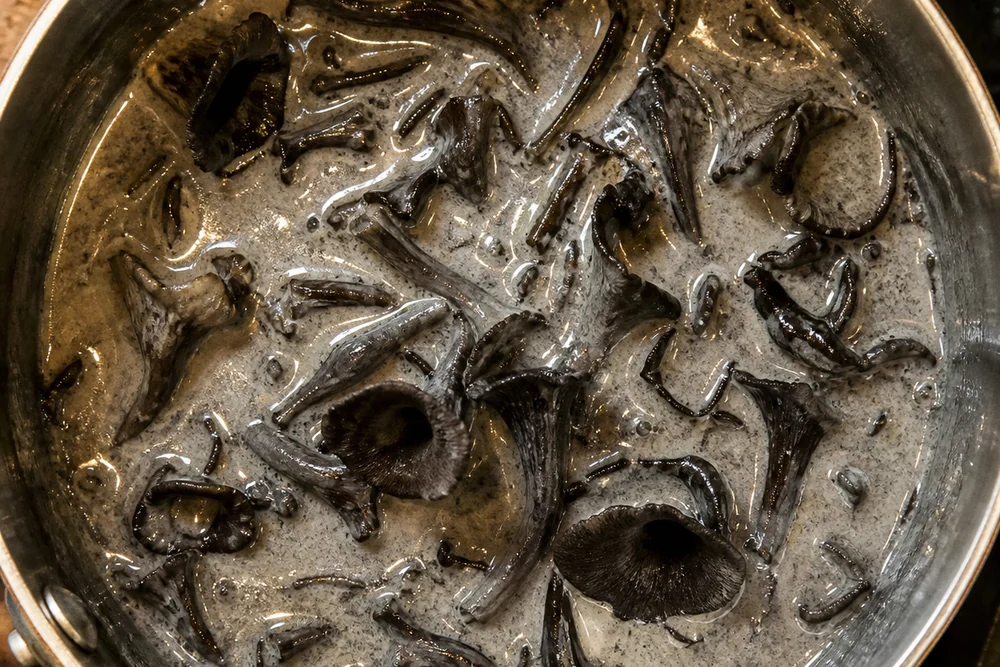
The pigment carries no flavor of its own, so this is entirely a question of how the plate should look. Some cooks love a slate-gray cream sauce and some find it unappetising, and both reactions are reasonable.
Wine behaves differently from cream, so a white wine sauce goes a murky brown-gray that most people dislike while a red wine reduction takes the pigment without anyone noticing.
If you want the flavor without the color, cook them separately in butter and stir them in at the end. You lose some of the transfer that makes the mushroom worth using, so it is a compromise rather than a fix.
Nobody minds it in a risotto.
The one dish to avoid outright is anything meant to be pale and clear. A consommé with black trumpets in it looks like dishwater however good it tastes.
Cooking MushroomsHow to Cook Black Morels: Halve Them, Never Slice ThemCooking them into something else
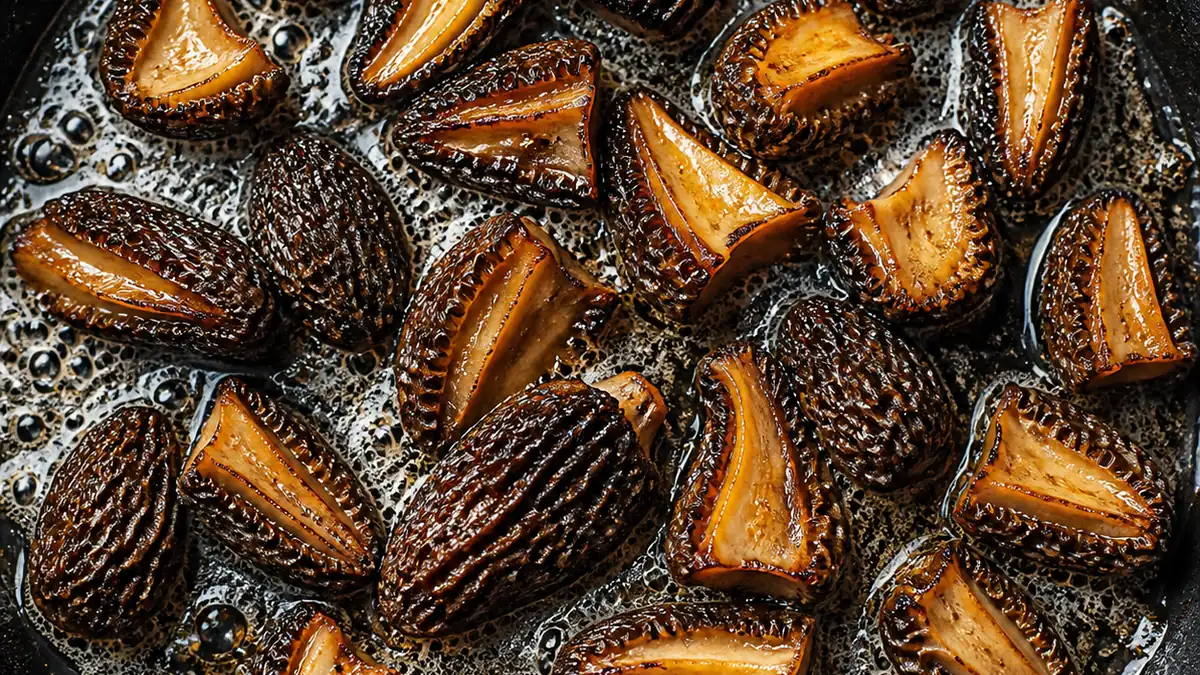
Butter in the pan, then trumpets for three or four minutes. Whatever they were flavoring goes in after that.
The last step catches everyone once, because there is no visual cue to wait for and people keep cooking in search of color that is never coming.
Raw is not worth trying, as our page on eating black trumpets raw covers properly, since the aroma barely exists until heat and fat get at it.
Quantity in the pan matters less than usual, which is a relief given how few you are likely to have. A single layer is ideal and a small heap is survivable, because there is no browning to protect and the aroma moves into the fat either way.
Searing has no purpose here either, since there is no surface to crust and no interior to protect, so the high-heat instinct that suits every other mushroom is misapplied.
Dried is not the fallback
Most species lose something in a dehydrator, and this one arguably does not. It may even be the better form.
The last row is the one that changes how you shop, because a jar of powder is a year of seasoning bought in one autumn afternoon.
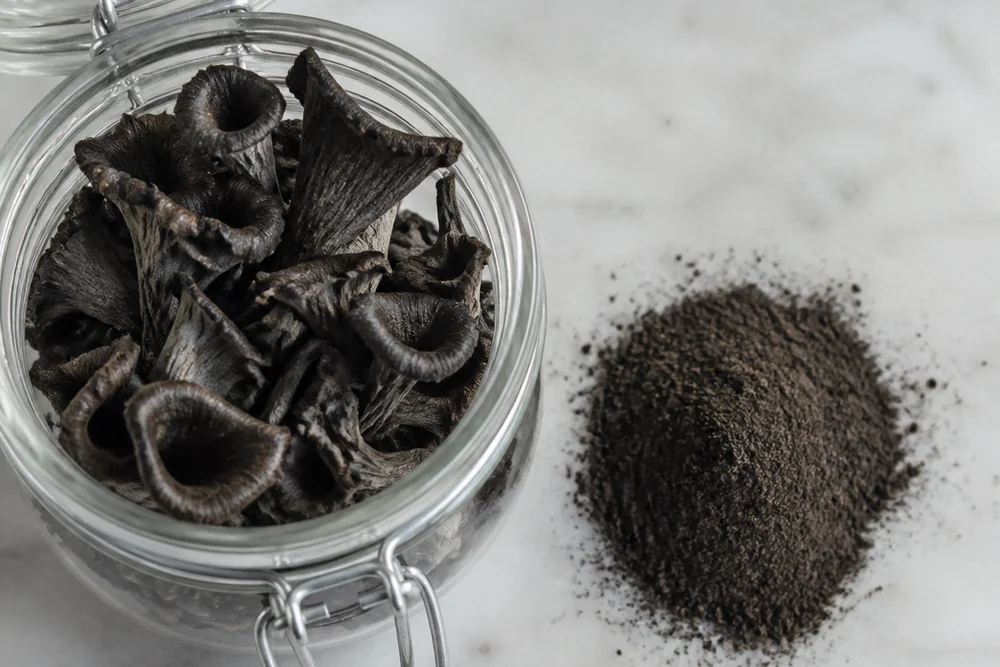
They dry faster than any other mushroom worth drying, so a tray of split trumpets is done in an afternoon and comes out looking like black tea leaves.
The aroma survives that better than it survives three days in a fridge. Our page on drying mushrooms at home covers the method, and this is one of the few species where drying is a first choice rather than a rescue.
Ground to a powder they become something else again, since a spice mill turns a jar of them into a dark seasoning for pasta dough, a butter or a piece of fish with no soaking at all.
Soaking liquid is worth keeping, as it is with any dried mushroom, though the case is weaker here. Most of what makes a trumpet worth having moves into fat rather than into water, so the soaking liquid is useful rather than precious.
Rehydrated pieces come out limp, and here that hardly matters. There was no texture to lose, which is the one advantage of an ingredient that never had any.
Cooking MushroomsHow to Cook Black Truffle Without Losing Its AromaWhat they taste like
Smoky, faintly fruity, and nothing like the earthy flavor people expect from a dark mushroom.
The comparison people reach for is truffle, closer than it sounds without being the same thing, since both have an aroma that fills a room from a small quantity.
It is strong enough that restraint is the harder discipline. A generous hand with trumpets produces a dish that tastes exclusively of them, which is a waste of whatever else was on the plate.
Salt behaves oddly here, because with no flesh to season it goes into whatever the trumpets are flavoring rather than onto the mushrooms, so season the sauce and ignore them.
Key takeaway
Restraint is the whole discipline with this species. A dish that tastes only of black trumpet is a dish where everything else was wasted, and the quantity that gets you there is smaller than it looks.
Aroma survives freezing better than it survives a fridge, which is worth knowing if you have picked more than you can dry.
Cooked into butter and frozen, a season's trumpets keep most of what they had.
Acid is the enemy. Lemon, vinegar and tomato flatten the aroma within a minute, so anything sharp belongs on the plate rather than in the pan.
For anyone eating them often enough to care, the black trumpet nutrition record has the figures. And when the season is over, black trumpet substitutes works through what comes closest, which is honestly not very close.
Where they suit and where they do not
The rule is simple once the mushroom has been reclassified. Anything that can carry an aroma is a good home, and anything that would have carried a texture is not.
- Cream sauces for pasta, where the transfer is the whole dish.
- Scrambled eggs and omelettes, which take the aroma readily.
- Risotto and polenta, where starch holds it and the color looks deliberate.
- Stirred through a finished braise, late, rather than cooked in it.
What wastes them is anything dry and hot, since grilled, roasted or deep fried a trumpet contributes a burnt fragment and the aroma has gone into the air.
Those failures share a mechanism, and three things kill the flavor the same way:
- Acid of any kind, added while they are still cooking.
- Long cooking, past about ten minutes in liquid.
- Strong spice, which simply covers them.
Timing within a dish is the other thing worth getting right. Trumpets added at the start of a long braise have given everything up by the time it is served, and the same handful stirred in ten minutes before the end perfumes the whole pot.
Reheating is fine, which is worth knowing.
Being outnumbered is the subtler failure. Trumpets in a dish with six other assertive ingredients contribute nothing you could name, and that is an expensive way to make a stew.
Buying and keeping them
Dry, papery and loose in the bag is what you want. Damp, matted or smelling of ammonia means they have been sitting.
Tip
If you are not cooking them within a day or two, dry them the evening they arrive. Fresh trumpets are one of the shortest-lived mushrooms you can buy, and dried ones are close enough to fresh that the decision is easy.
They fruit in autumn under hardwoods, and finding them is famously difficult because black on dark leaf litter is nearly invisible, which our page on autumn foraging season covers along with when to look.
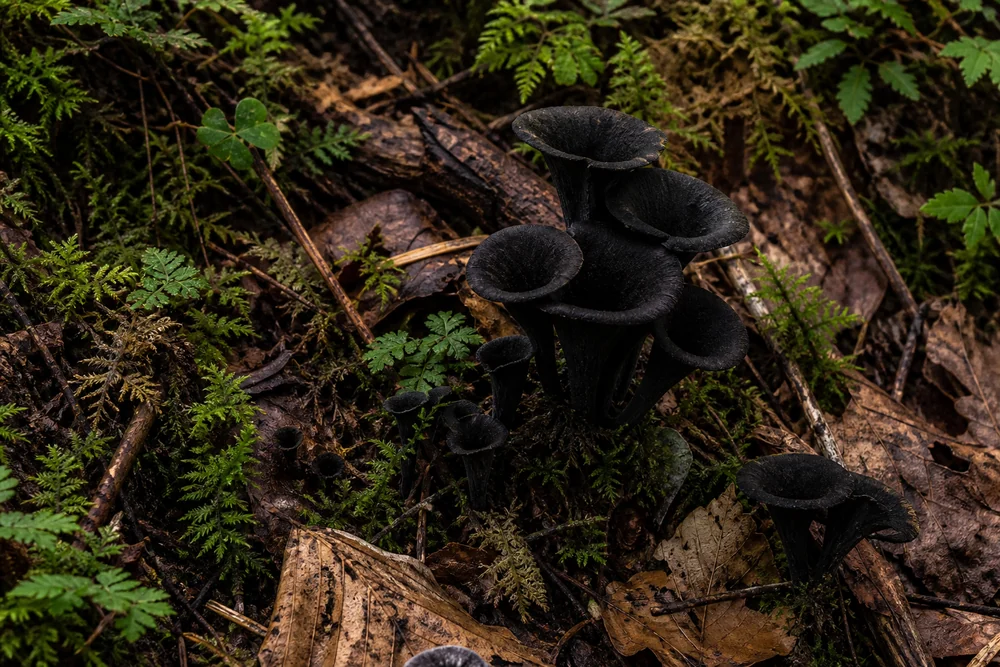
Price is worth a word because it shocks people. Black trumpets cost several times what a cultivated mushroom does by weight, and by usable volume the multiple is larger still, which is the arithmetic behind treating them as a spice.
Fresh ones keep three or four days at best and go slimy at the rim first. That is where to look when you are deciding whether a bag is still worth cooking.
Foraged and bought trumpets behave the same way, which is not true of every species on this site. There is no cultivation to compare against, so a bag in a shop came out of a wood the same as a bag in your basket did.
Two things separate a good bag from a poor one at the counter:
- Loose rather than matted, since matted means damp and damp means a short life.
- Whole funnels rather than a bag of fragments, because fragments have already been handled hard.
Weight is a poor guide here for the obvious reason. A bag that feels like nothing is a normal bag, and judging quantity by hand is how people end up buying half of what they needed.
Our page on storing black trumpets has the container detail and what freezing does to them. The short version is that the freezer is a poor third behind eating them and drying them.
Sources & References
- Craterellus cornucopioides, the black trumpet (Fungi Atlas) Species reference used for the hollow funnel-shaped fruiting body with no true gills, the thin wall, the relationship to the chanterelles and the autumn hardwood habit.
- Black Trumpet Mushrooms (Forager Chef) Cook and forager reference used for the severity of shrinkage, the practice of splitting each funnel to clean it, the pigment bleeding into cream, and the use of dried trumpets as a powder.
- Aroma compounds of Craterellus species (Journal of Agricultural and Food Chemistry) Food chemistry reference used for the volatile aroma profile that survives drying and transfers into fat, which underlies the seasoning argument made here.