What makes a mushroom a black trumpet?
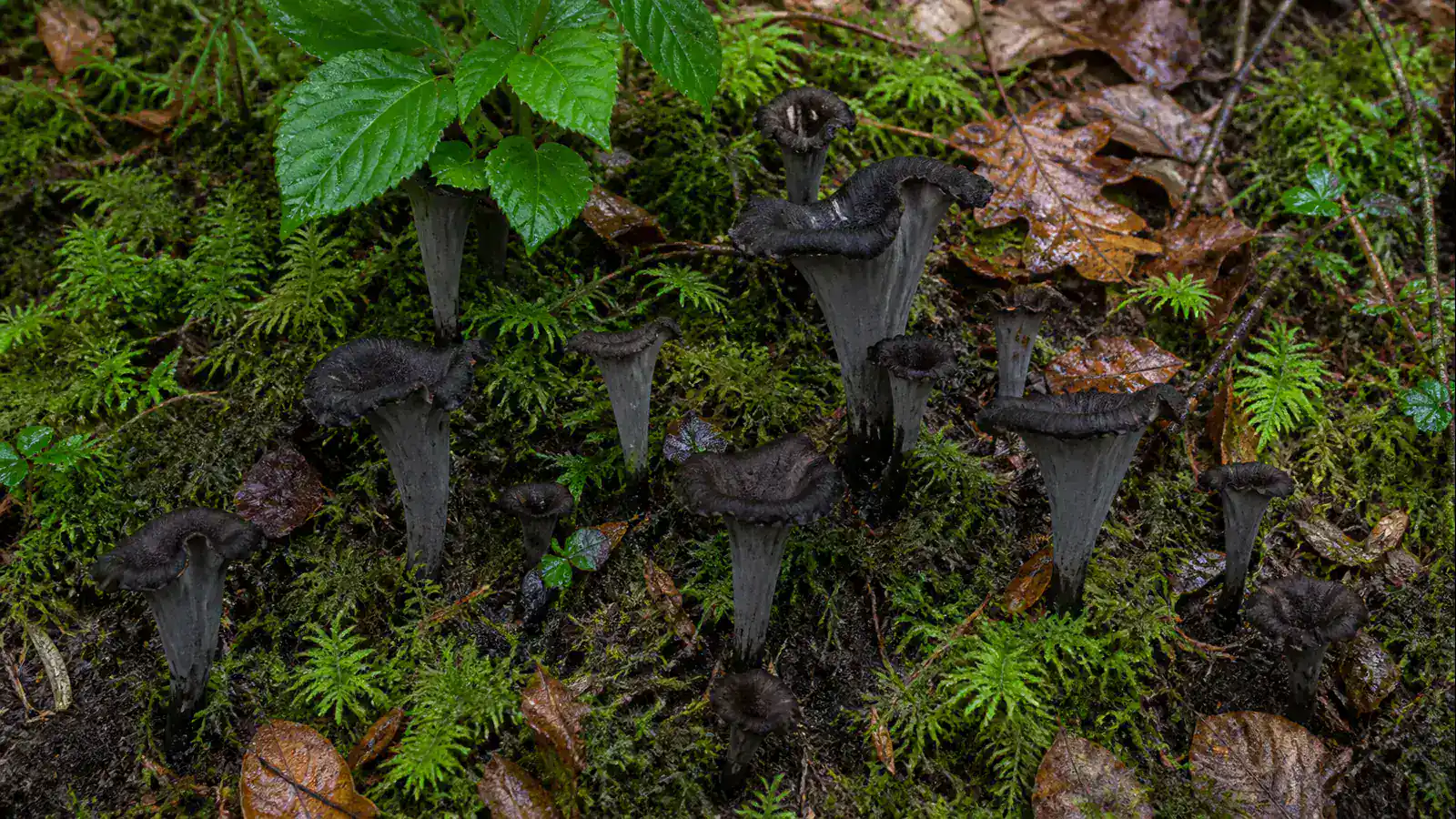
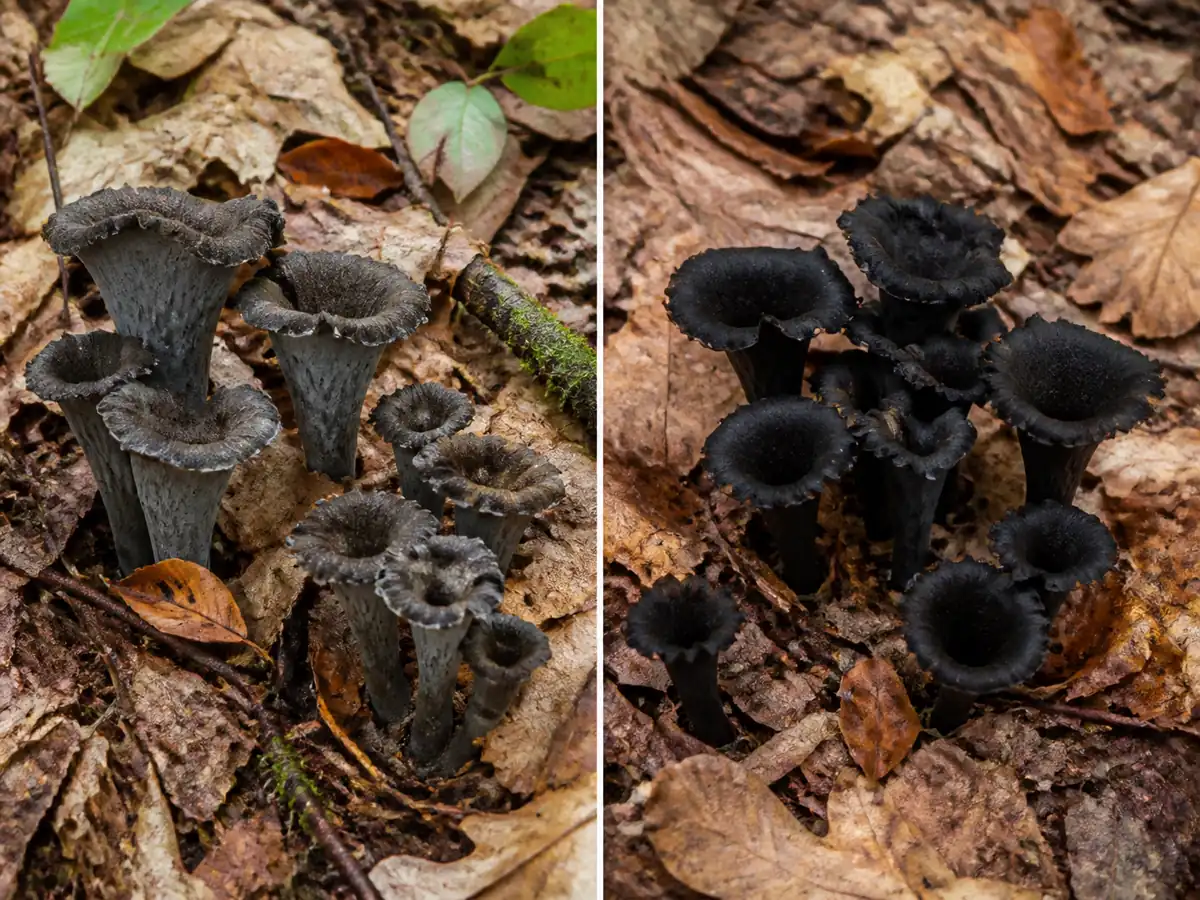
Black trumpets look like charcoal-gray horns rising from leaf litter. The cap and stem are one continuous hollow funnel, and the spore-bearing surface lies on the outside rather than on gills under a cap.
Their dark color makes them surprisingly difficult to see. A forager may find the first specimen only after noticing a curved edge, then discover dozens hidden along the same mossy bank or shallow drainage line.
Key takeaway
A true black trumpet combines a fully hollow body, thin flesh, wavy mouth, smooth to faintly wrinkled exterior, and soil growth. One dark funnel without its base cannot establish the group.
The inner surface ranges from brown-gray to nearly black and often looks slightly scaly or fibrous.
The outer fertile face is usually paler, especially after spores begin to coat it.
Unlike a typical chanterelle, the fruiting body has no developed false gill ridges. Shallow wrinkles may appear, but they do not form thick branching folds or thin blades.
Size changes with moisture and crowding. Small trumpets can mature at only a few centimeters, while a well-watered fruiting may open into broad, deeply split mouths that overlap neighboring funnels.
The popular name trumpet of death describes the dark appearance rather than toxicity.
Correctly identified black trumpets are prized food, but the dramatic name should not weaken the normal requirement for complete identification and a clean collection site.
Fresh aroma is subtle and fruity-earthy. Drying removes water and concentrates volatile compounds, which explains why a small quantity of dried black trumpet can season a large sauce or broth.
To use black trumpets safely, learn to distinguish a real trumpet, understand why the Latin name changes by continent, clean the hidden cavity, and cook the mushroom without losing its aroma.
How do you confirm the hollow trumpet structure?
A thin, hollow funnel 3 to 10 cm tall and about 2 to 8 cm wide, with a wavy or split margin and gray-brown to nearly black inner surface.
No true gills. The outer fertile surface is smooth to shallowly wrinkled and ash-gray, sometimes with a pale bloom from mature spores.
No separate solid stem; the hollow funnel narrows continuously to a dark base.
Very thin, flexible to brittle flesh with a fruity, earthy aroma that becomes more concentrated after drying.
Search slowly around the first specimen because the dark funnels blend into wet leaves and moss. Before picking, photograph the fruiting pattern, nearby trees, slope, litter, and the point where each funnel emerges from soil.
- Lift one mature specimen with the narrow base intact and confirm that it grows from soil rather than wood.
- Follow the hollow center from the mouth all the way to the base.
- Turn it over and check for a smooth or faintly wrinkled gray fertile surface without true gills.
- Note the region, host trees, season, and spore-deposit color before choosing a scientific name.

The mouth is commonly irregular, lobed, or split. Its thin edge can curl outward in dry weather and collapse inward after heavy rain, so shape needs to be read together with texture and the continuous cavity.
A lengthwise cut demonstrates the most useful structural feature. The interior should remain open to the base, with a thin wall rather than a stuffed stem or a separate cap sitting above solid tissue.
The outer surface bears the basidia. It may be smooth on a young fruiting and develop shallow longitudinal wrinkles with age, but those wrinkles never become the crowded sharp gills of a dark agaric.

A conventional print can be faint because the fertile surface is not arranged as a horizontal gill face. Rest a mature trumpet on dark and light material or observe natural deposits on adjacent leaves and fruiting bodies.
In Europe, a white to cream deposit is consistent with C. cornucopioides. Eastern North American C. fallax has been associated with a yellow-orange deposit, which can provide useful regional evidence but should not replace microscopy or sequencing for a formal record.
The base collects soil and often tears.
Keep it attached during identification, then trim it only after the collection has been accepted for food.
A pre-trimmed market basket removes the evidence needed to exclude a dark cup or wood-growing fungus.
Smell the clean fresh flesh before cooking. A fruity-earthy odor supports good condition, while sour, fermented, chemical, or rotten odors require disposal regardless of species.
Microscopy examines smooth, hyaline spores and tissues of the outer hymenium. DNA is particularly useful for regional surveys because visually similar black trumpets have been separated into multiple lineages.
The identification can be strong for the culinary group while remaining conservative at species level. Calling an eastern North American collection black trumpet or C. fallax group is more accurate than borrowing the European name from a cookbook.
Which dark funnels can cause confusion?
The black trumpet shape is distinctive, but common names cover a species complex. The most important checks are a fully hollow funnel, no true gills, terrestrial growth, thin flesh, and a regionally correct Craterellus name.
Black trumpets are safer to recognize as a group than many gilled mushrooms, yet a food identification still needs the complete fruiting body and its substrate. Do not collect dark funnels from contaminated ground, and reject leathery, moldy, waterlogged, or insect-filled specimens.
| Candidate | Underside or outer surface | Range and practical boundary |
|---|---|---|
| Craterellus cornucopioides | Smooth to faintly wrinkled, gray, fully hollow | European concept |
| Craterellus fallax | Smooth to wrinkled, often with orange-yellow spore deposit | Eastern North America |
| Craterellus foetidus group | Dark clustered trumpets with regional morphology | Southeastern North America |
| Pseudocraterellus species | Dark funnels, often with stronger folds or different flesh | Requires a regional key |
| Urnula craterium | Thick black urn or cup, not a thin open trumpet | Spring fruiting on buried wood in eastern North America |
Craterellus fallax is the familiar eastern North American black trumpet. Molecular work separated it from the European C. cornucopioides complex, and its mature spore deposit may be orange-yellow rather than white.
Urnula craterium is much thicker, tougher, and more cup-like, with an inrolled dark margin when young. It commonly appears in spring from buried wood, which conflicts with the thin summer or autumn woodland trumpet.
Dark chanterelles with stronger ridges should be evaluated regionally rather than folded into one market name. A seller may reasonably use black trumpet as a culinary label, but a biological record should retain the region and the narrowest supported species.
A trumpet filled with leaf fragments may hide slugs or grit without showing decay. Split it lengthwise at home, inspect the full cavity, and discard any portion with sour odor, slime, or extensive larvae.
Where do black trumpets fruit after rain?
Black trumpets form ectomycorrhizal partnerships with living trees. Their mycelium associates with fine roots and exchanges soil-derived water and minerals for carbon produced by the host.
European C. cornucopioides is often associated with beech, oak, and other deciduous trees, sometimes in calcareous or neutral woodland soil. Regional black trumpet species may favor different hosts and soil chemistry.
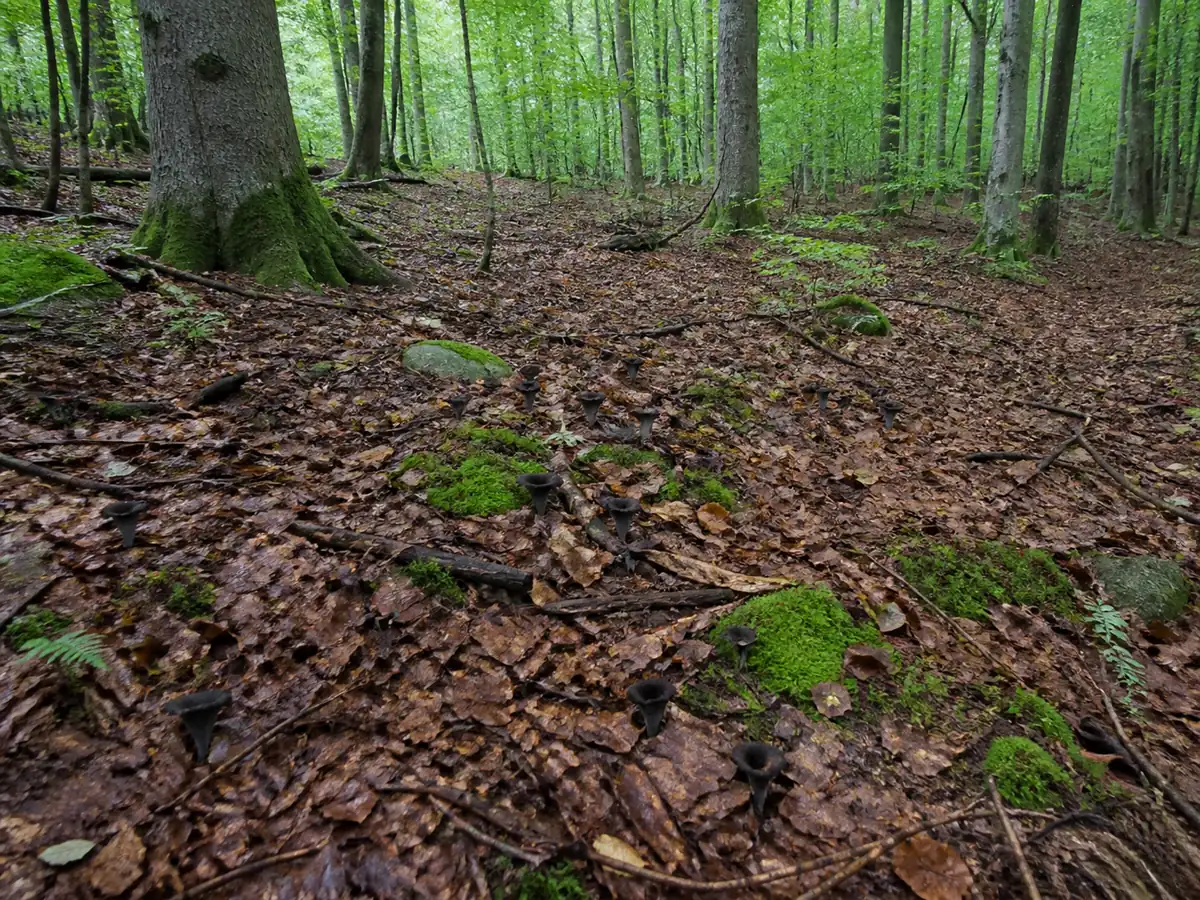
Fruitings frequently follow moisture paths. Shallow depressions, mossy banks, creek terraces above flood level, and leaf-filled washes can hold enough moisture to support a flush after surrounding ground has dried.
Note
A moist depression is not permission to collect from a drainage ditch carrying road runoff, pesticides, sewage, or industrial contamination. Fungi can be correctly identified and still come from an unsuitable food site.
The mushrooms may occur singly, in loose troops, or in dense patches that seem to follow underground roots. Once one patch is found, look along the same elevation and habitat transition rather than trampling the entire forest floor.
Fruit bodies are temporary, while the underground partnership persists.
Cutting mature trumpets at the base or lifting them carefully has less habitat impact than raking moss and litter to expose hidden mushrooms.
Rain timing matters more than a calendar date. Warm-region fruiting may begin in summer, while cooler locations peak later, and a dry year can suppress a familiar patch entirely.
Black trumpets participate in woodland nutrient exchange and also become food for insects and other animals. Leaving old, damaged, and excess specimens in place preserves spores and keeps the patch functioning beyond the human harvest.
Harvest pressure should be judged patch by patch. Take only clean mature trumpets you can use, leave undersized fruiting bodies and damaged old specimens, and avoid widening paths through moss or leaf litter.
A recurring patch record benefits from rainfall totals and soil-moisture notes.
These facts help distinguish a genuine fruiting cycle from a fixed calendar expectation.
Protect the root zone that produces the crop. Repeated raking, compaction, or vehicle traffic can damage the habitat far more than careful removal of a few fruiting bodies.
How should you clean and cook black trumpets?
Black trumpets deliver a deep woodland aroma without the bulk of a thick mushroom. Their thin flesh suits quick sautés, cream sauces, eggs, rice, pasta, poultry, and stocks where the dark color and concentrated flavor can spread through the dish.
Cleaning is the main preparation job. Open each funnel from mouth to base, brush away loose litter, rinse briefly when grit is embedded, and dry before it reaches hot fat.

| Preparation | Best use | Main control |
|---|---|---|
| Fresh sauté | Eggs, toast, pasta, poultry | Cook off surface water before browning |
| Dried whole | Storage and later rehydration | Dry until brittle, then seal away from moisture |
| Ground powder | Sauces, compound butter, seasoning | Grind only fully dry clean mushrooms |
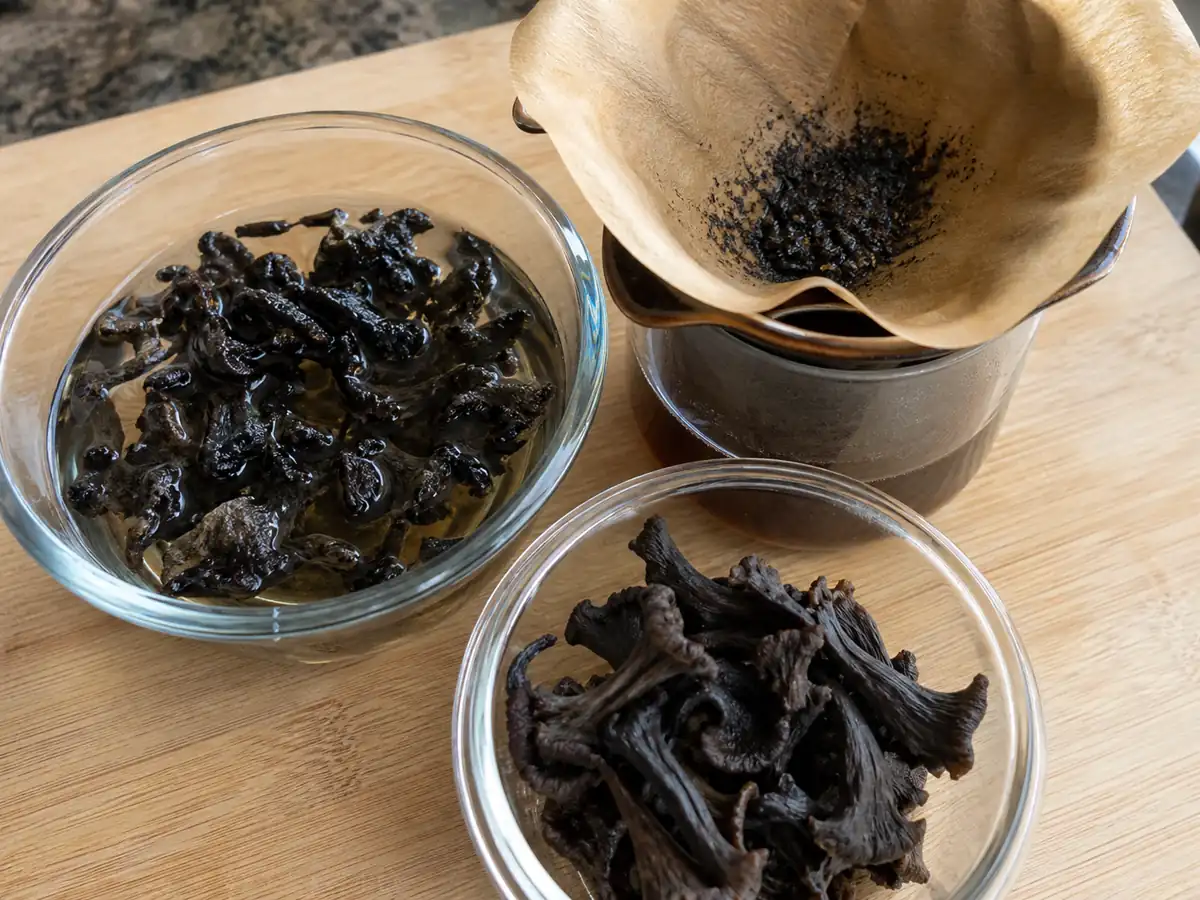
| Rehydrated | Soups, rice, braises | Strain the soaking liquid through a fine filter |
Split before washingThe hollow center can hold soil, tiny slugs, and leaf fragments.
Cook in a broad panCrowding traps water and mutes browning.
Soak for a long timeThin flesh absorbs water and loses aroma into the sink.
Store damp in a sealed bagCondensation accelerates softening and spoilage.
For a fresh sauté, start with a dry pan or a small amount of fat and let released moisture evaporate. Add butter or oil and aromatics after the mushrooms stop steaming heavily, then cook until tender and fragrant.
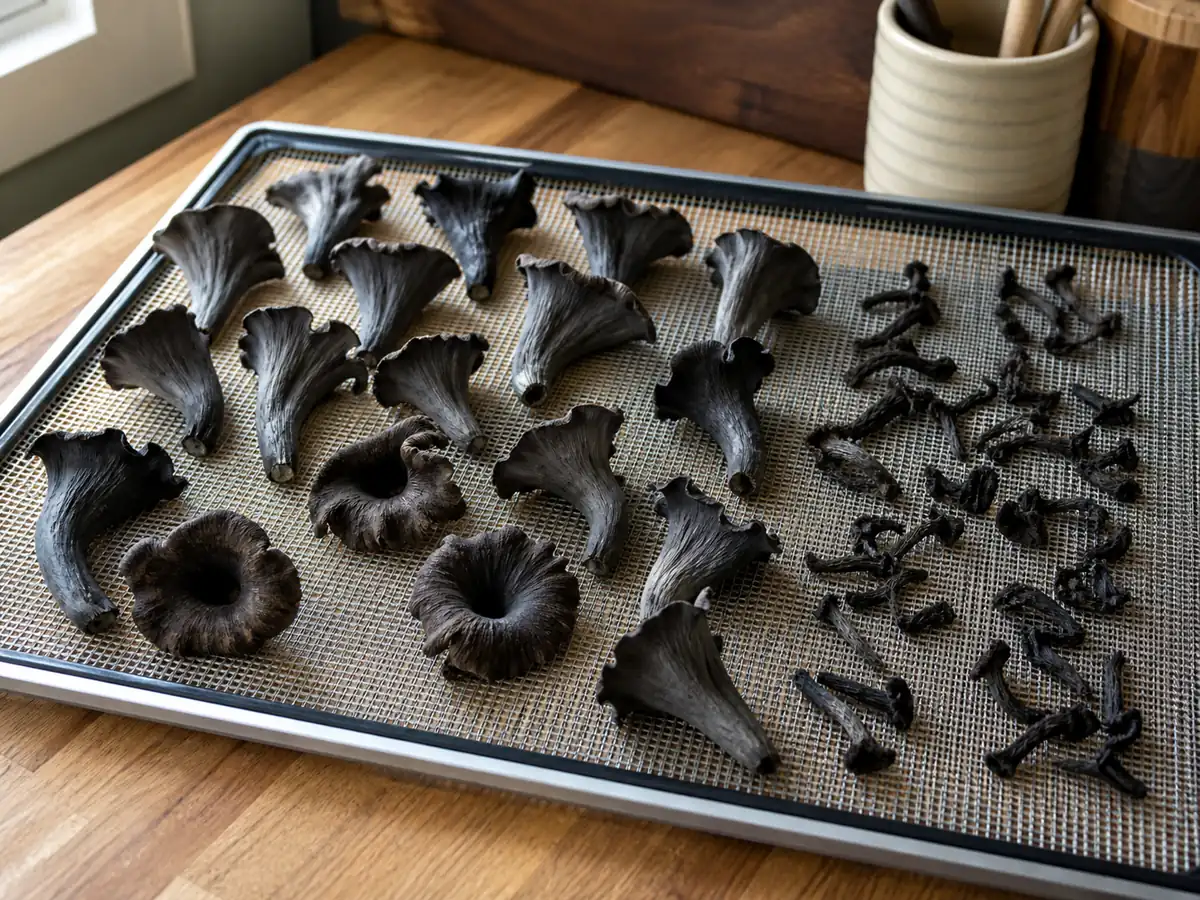
Drying is unusually effective because the flesh is thin.
Arrange clean split trumpets in one layer with moving warm air until they snap rather than bend, cool them completely, then store them in an airtight container.
A leathery bend indicates retained moisture. Sealing that batch can support mold, so return it to the dryer instead of relying on a desiccant to finish wet mushrooms inside the jar.
Rehydration liquid can carry valuable aroma and fine grit at the same time. Pour it through a coffee filter or fine cloth before adding it to a sauce, and leave the last sediment behind.
Powder creates a useful seasoning for sauces and butter, but it also hides species and condition. Make powder only from a documented single-species collection, label the date, and discard it if moisture, clumping, or an off odor develops.
The dark pigment can turn cream sauces gray or black.
That color is expected and can be used deliberately, while a clean aromatic flavor matters more than keeping a pale presentation.
Aroma is strongest when handling stays gentle. Keep fresh trumpets cool and breathable, prepare them soon after harvest, and add most of a dried powder late enough that prolonged heat does not flatten its fragrance.
For a first meal, cook one documented species by itself and serve a modest portion. Keep an uncooked reference in the refrigerator until everyone has passed the normal meal period without a reaction.
Do not can wild black trumpets with an improvised low-acid method. Drying or freezing a cooked preparation is easier to control, while shelf-stable canning requires a tested process for the complete recipe.
Why does the scientific name change by region?
Craterellus cornucopioides is the European horn-of-plenty species. Molecular work on the complex showed that eastern North American black trumpets include C. fallax and other lineages rather than one worldwide C. cornucopioides.
Older cookbooks and field guides often use the European name broadly. That usage may still communicate a culinary form, but specimen records, image labels, and scientific claims should use a regionally supported taxon.
Craterellus is related to chanterelles, yet black trumpets lack the pronounced false gills familiar from many Cantharellus. Their spores develop on the outside of the thin funnel, which explains both the smooth fertile surface and the unusual print method.
- Common name
- Black trumpet is a useful culinary group name across regions.
- Scientific record
- C. cornucopioides should be reserved for collections supported within its taxonomic range.
- Eastern North America
- C. fallax is a central comparison, and other regional species may require sequence evidence.
Black trumpet foraging and cooking questions
Are black trumpet mushrooms edible?
Do black trumpets have gills?
Why should each trumpet be split open?
Is Craterellus cornucopioides found in North America?
Can black trumpets be dried?
What trees grow with black trumpets?
Sources & References
- Matheny et al., Mycologia Molecular and morphological treatment of C. fallax within the black trumpet complex.
- GBIF Backbone Taxonomy Accepted taxonomic record and distribution context for C. cornucopioides.
- USDA FoodData Central General mushroom composition context used conservatively rather than as a species-specific clinical claim.
- British Mycological Society resources Regional recording and field-mycology context for the European species.