What is a hedgehog mushroom?
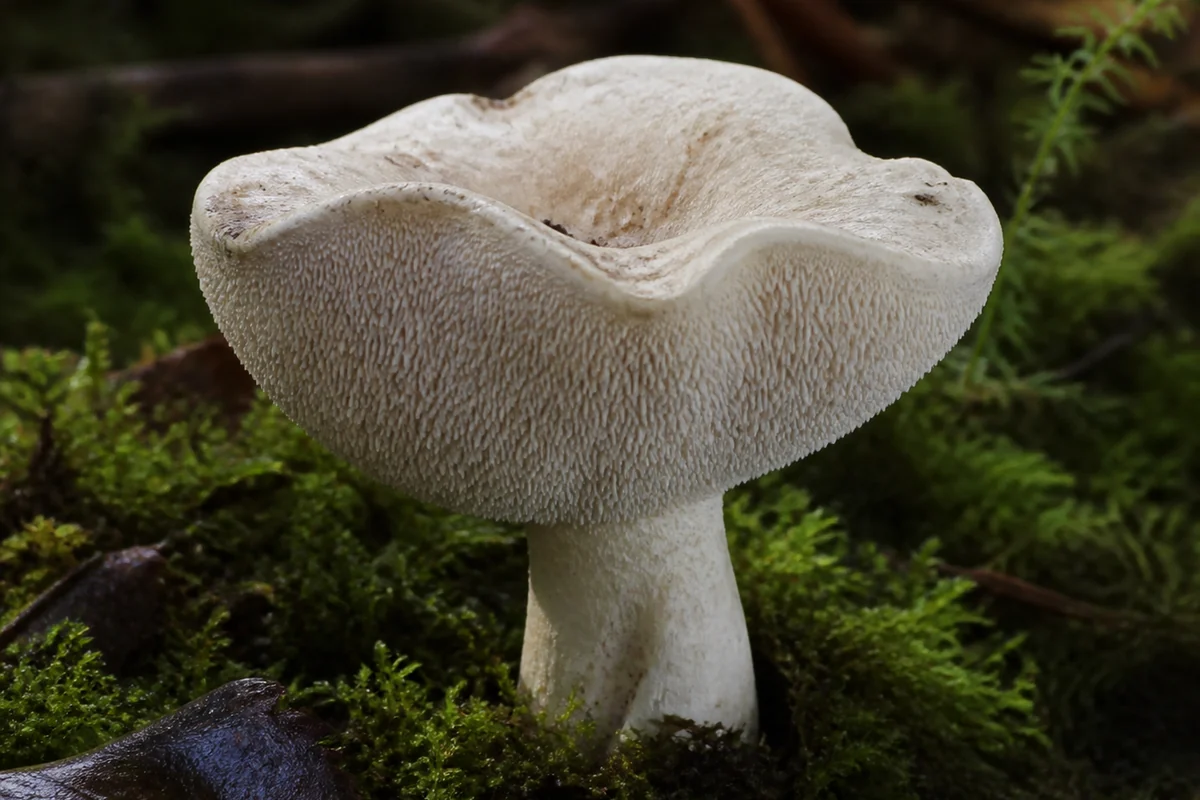
A hedgehog mushroom is a creamy white woodland mushroom with an irregular lumpy cap, a thick off-center stem, and an underside of soft hanging spines instead of gills or pores.
It is a toothed fungus, which is a small group compared with the gilled mushrooms and the boletes, and the group is the reason this species is so easy to place.
Most people meet it face down. From above it is an unremarkable pale mushroom among leaf litter, and it only becomes obvious once it is picked up and turned over.
The French name pied de mouton means sheep's foot, and it describes the thick pale off-center stem rather than the spines that the English name points at. The old English name sweet tooth manages to catch both the underside and the flavor of a young one in two words.
That off-center stem is worth reading rather than just noticing. A hedgehog often grows up through moss and around whatever is in its way, so the lumpy cap and the stem set to one side are both records of an obstacle rather than defects.
How do you identify a hedgehog mushroom?
Creamy white to pale buff or soft apricot, 4 to 15 cm across, irregular and lumpy rather than round, finely velvety, and reddening slightly where it has been handled.
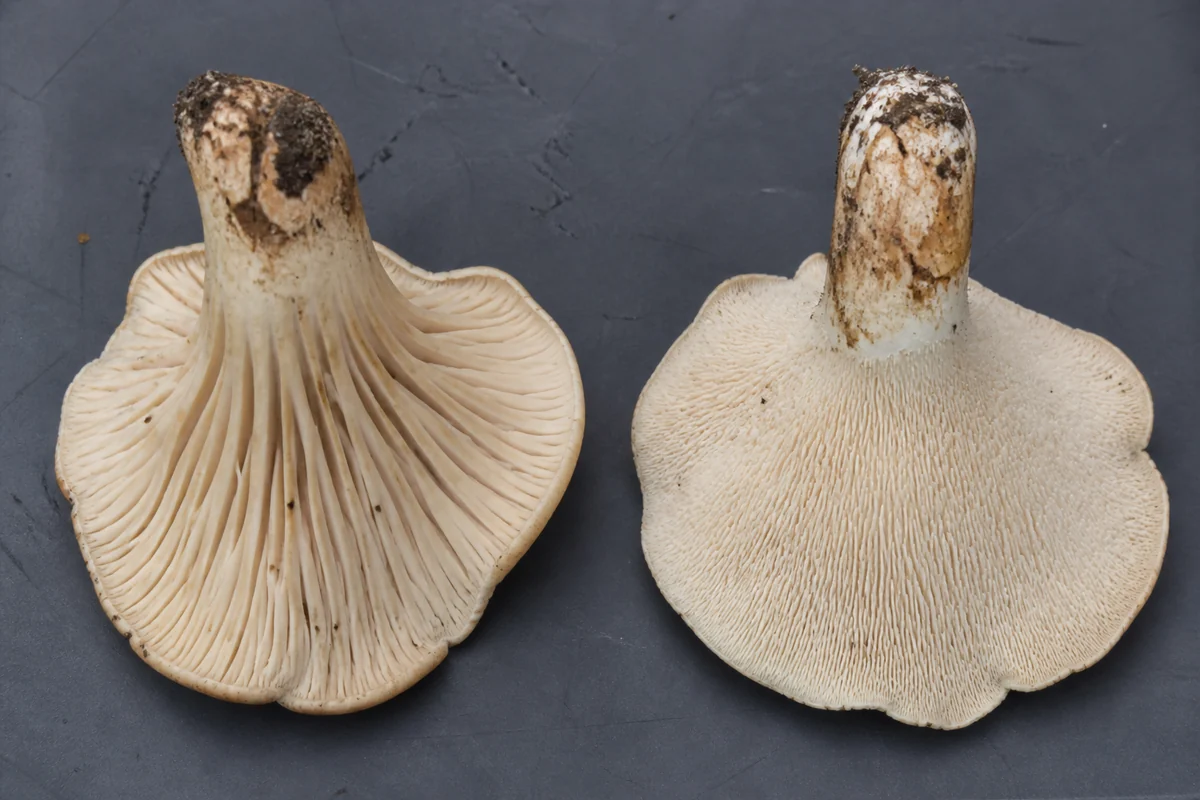
No gills. The underside carries soft brittle cream spines 2 to 6 mm long that hang straight down and run part of the way down the stem.
White, solid, 5 to 10 cm tall and 15 to 30 mm thick, often set off-center under the cap.
White, firm and crunchy, with little smell and a taste that turns bitter a moment after chewing in older specimens.
Start at the underside and the identification is essentially finished.

The spines are 2 to 6 mm long, cream to pale buff, and they run a short way down the stem rather than stopping cleanly where the cap ends.
That rubbing test is the part worth practicing, because it converts a visual judgement into something a hand can settle. The spines feel like short stiff bristles rather than anything soft, and they break at the base instead of bending.

| Character | Hedgehog mushroom | Note |
|---|---|---|
| Underside | Soft spines 2 to 6 mm | Decurrent onto the stem |
| Cap | 4 to 15 cm, irregular and lumpy | Reddens where handled |
| Stem | 5 to 10 cm tall, often off-center | Solid, white |
| Spore print | White | Rarely needed here |
| Taste | Firm and crunchy, bitter with age | Age, not identity |
Turn every cap over before it goes in the basket
Rub the underside to confirm the spines crumble
Pick young firm caps and leave the soft ones
Judge one from above, where it is just a pale lump
Assume a toothed underside on wood is the same mushroom
Keep a cap whose spines have matted together
A spore print is available and is almost never necessary. The underside has already answered the question, and a white print adds nothing that changes the decision.
The cap is worth a look for a different reason, which is condition rather than identity. An old hedgehog goes soft and its spines mat together, and that is the specimen that will taste bitter later.
Very young ones are easy to miss and worth learning.
A button barely out of the moss already has its spines, so the test works at every size the mushroom comes in.
Are there any poisonous hedgehog mushroom lookalikes?
The honest answer to the lookalike question is that there is no dangerous one. Nothing poisonous in temperate woodland carries soft crumbling spines on a fleshy cap and stem, so a specimen that passes the underside test is not going to hurt anybody.
Note
That is an unusual sentence for this site and it is worth being precise about it. The claim is about the underside rather than about the mushroom, so it only holds for somebody who actually turned the cap over and looked. The confusion that does happen is with the terracotta hedgehog, a smaller relative with a deeper apricot to orange cap. It is also edible, so the mistake costs nothing beyond a slightly different texture.
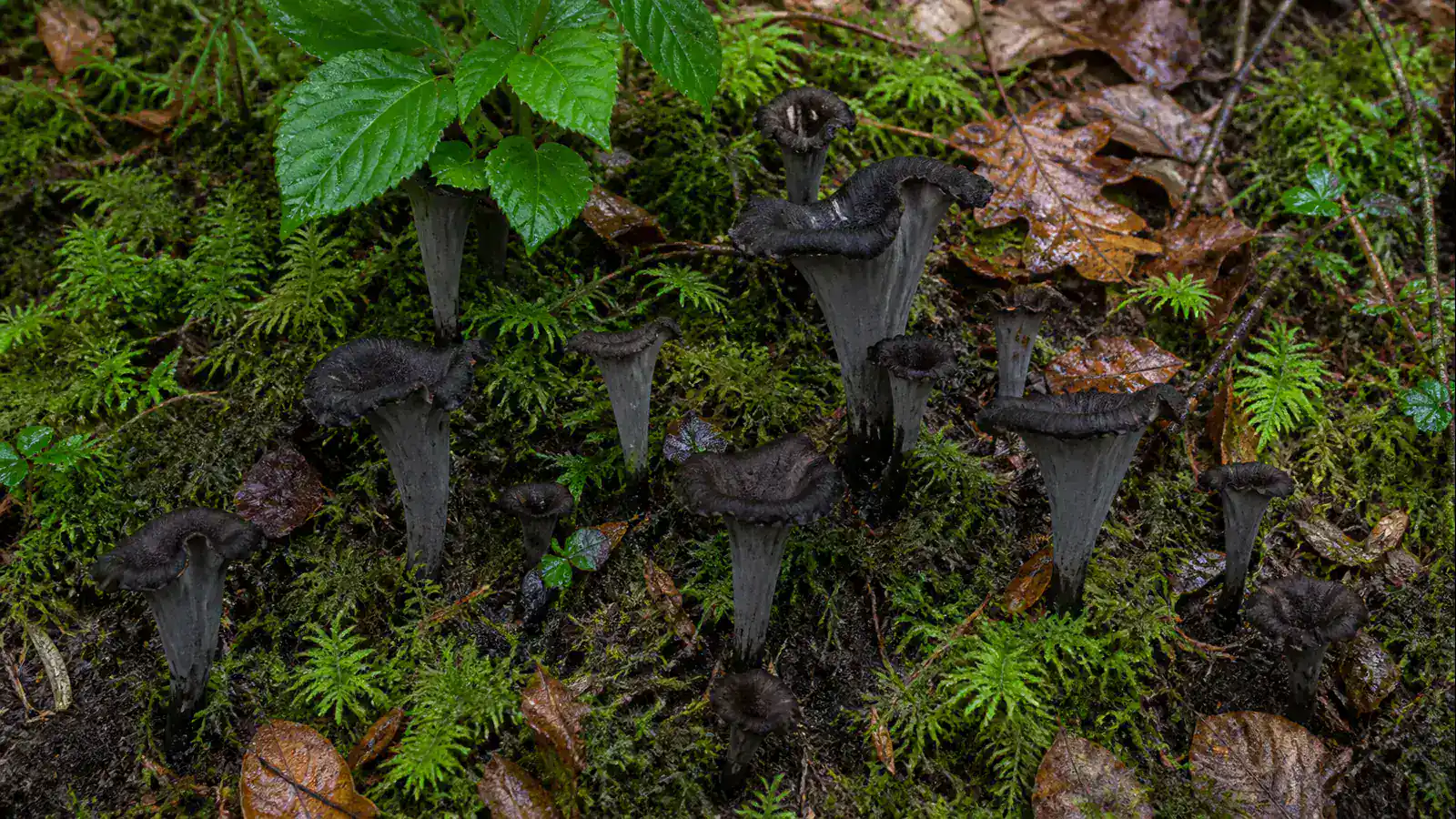
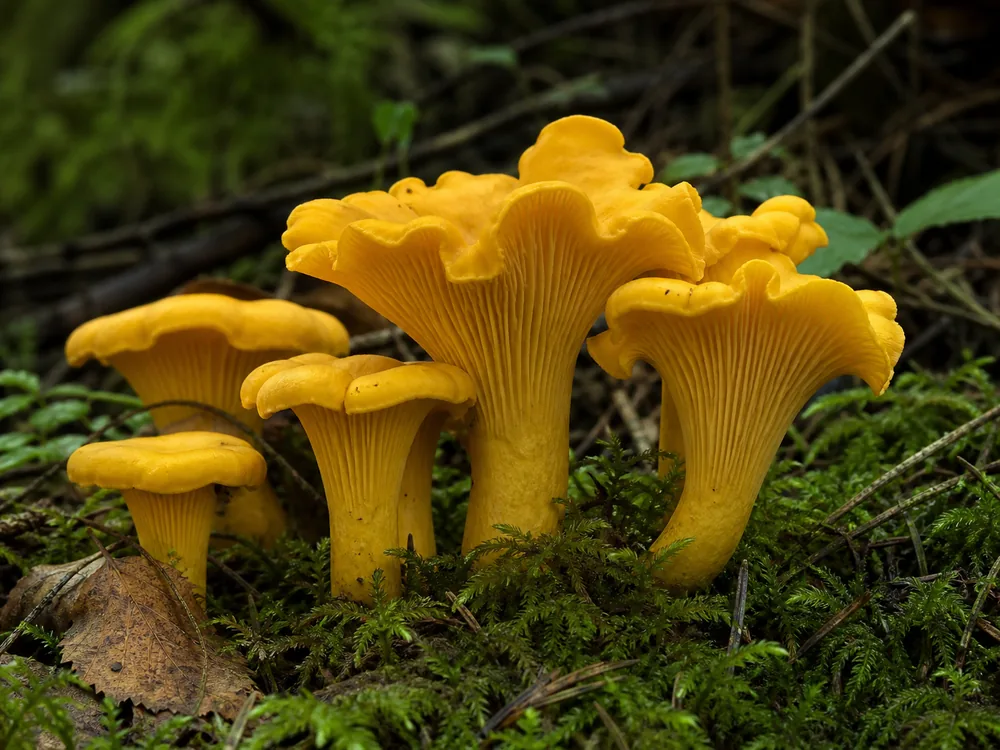
The other thing people compare it with is the chanterelle, and from above the two can look similar enough to be worth checking.
Underneath they are not close at all, because a chanterelle has blunt forking ridges that are part of the flesh and a hedgehog has separate spines that fall off when rubbed.
The other toothed mushroom most people know is lion's mane, and the two are never confused for a simple reason.
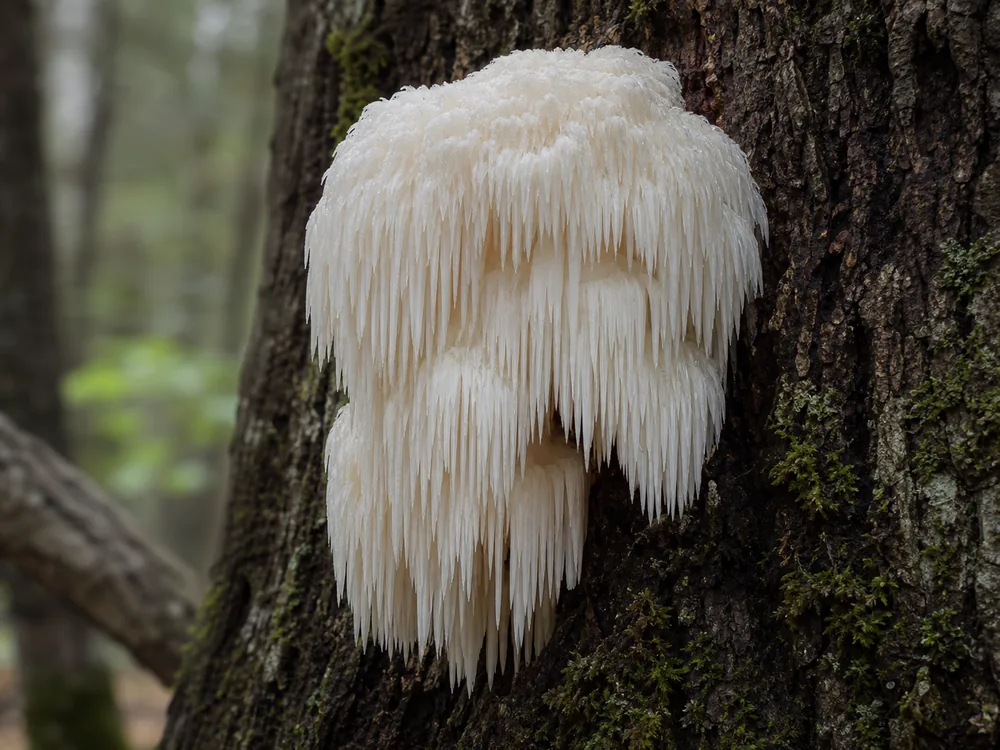
Lion's mane hangs off dead wood in a white shaggy mass with spines several centimetres long, and a hedgehog stands in soil on a stem with spines a few millimetres long. Same idea, entirely different mushroom.
Beyond those there are toothed fungi that are tough, woody or crusted onto branches, and none of them is a candidate for the kitchen or for confusion. A hedgehog is fleshy, pale and standing in soil.
Note
The absence of a dangerous lookalike is not a licence to skip the check. It means the check is quick, not that it is optional, and a mushroom picked without turning it over has not been identified at all.
Why do hedgehog mushrooms taste bitter?
Hedgehogs are firm, crunchy and nutty, and they hold their texture in a pan better than almost any other wild mushroom of their size.
The complaint is bitterness, and it is a real one rather than a matter of taste.
Bitterness comes with age, not with the species. A young hedgehog is sweet and nutty, and a mature one develops a bitter note that arrives a moment after chewing rather than immediately.
Tip
Boiling removes it. A few minutes in boiling water before frying takes the bitterness out of a mature batch, at the cost of some texture, and it is the standard rescue for a pick that turned out older than it looked.
The other move is to prevent the problem at the source, which is to pick young caps and leave the big soft ones where they are. A basket of young hedgehogs never needs rescuing.
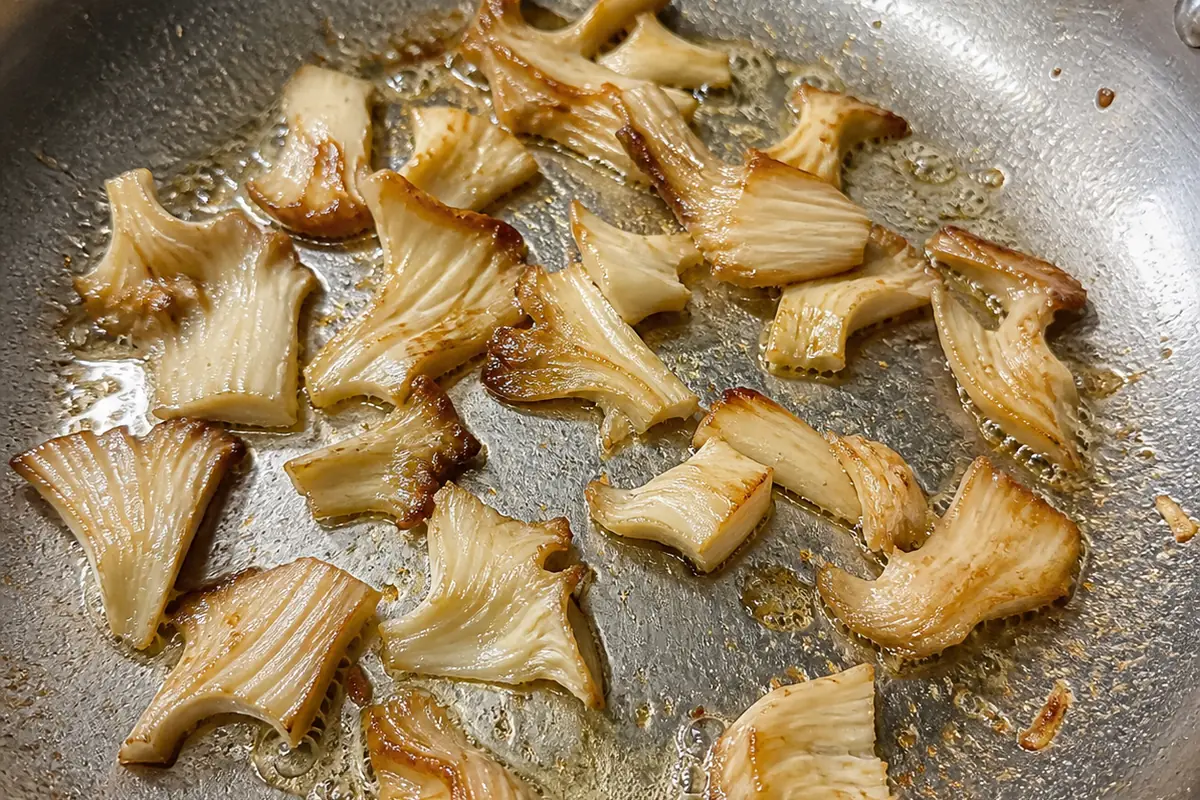
Freezing works better after cooking than before. A pan-fried batch freezes and reheats without turning to water, which raw pieces of most wild mushrooms do not manage.
Cleaning is easy and dry. Brush the moss and grit off, and if the spines are full of debris a quick scrape with a thumb removes both the spines and the problem.
The spines are edible and most people leave them on, but scraping them off a gritty batch costs nothing and saves the texture of the dish.
They dry well and rehydrate better than most, which follows from the same firm flesh. A dried batch keeps its bite where a dried soft mushroom turns to fabric.
They suit hard frying, and they suit slow dishes too, because the crunch survives what softer mushrooms do not. Tearing rather than slicing gives more browned surface, and the torn edges take color better than knife edges do.
Can hedgehog mushrooms be cultivated?
The hedgehog cannot be cultivated, because it fruits only from a living partnership with tree roots and has no substrate-grown form. Every hedgehog anybody has ever eaten was picked in a wood, and that is unlikely to change.
It does appear for sale, sometimes at a good price, because it travels and stores far better than most wild mushrooms of its class. Firm crunchy flesh that resists bruising is exactly what a supply chain needs, which is why this species reaches shops when softer ones do not.
The price follows the weather rather than the calendar. A wet autumn puts hedgehogs on market stalls cheaply for a few weeks, and a dry one keeps them scarce and expensive through the same months.
Is it worth eating for nutrition?
Cooked hedgehogs give the ordinary wild mushroom profile of mostly water with some protein, B vitamins, potassium and a useful amount of fiber for very few calories.
The flesh is denser than most pale mushrooms of the same size, so a given weight of hedgehog delivers more food on the plate than the same weight of something softer.
Nobody picks them for the nutrition. They are picked because they are easy to be sure about, because they come in arcs rather than singly, and because they hold together.
Where do hedgehog mushrooms grow?
The hedgehog is mycorrhizal, trading minerals gathered from the soil for sugars from living tree roots, and it partners with both broadleaf and coniferous trees.
What it wants is damp woodland floor with moss. Mossy banks, the damp side of a slope and shaded leaf litter under beech, oak or conifer all produce it.
- Partner trees
- Beech, oak, birch, pine and spruce
- Ground
- Mossy, damp leaf litter and woodland banks
- Habit
- In arcs, rings and loose troops rather than singly
- Season
- August into December, best after autumn rain
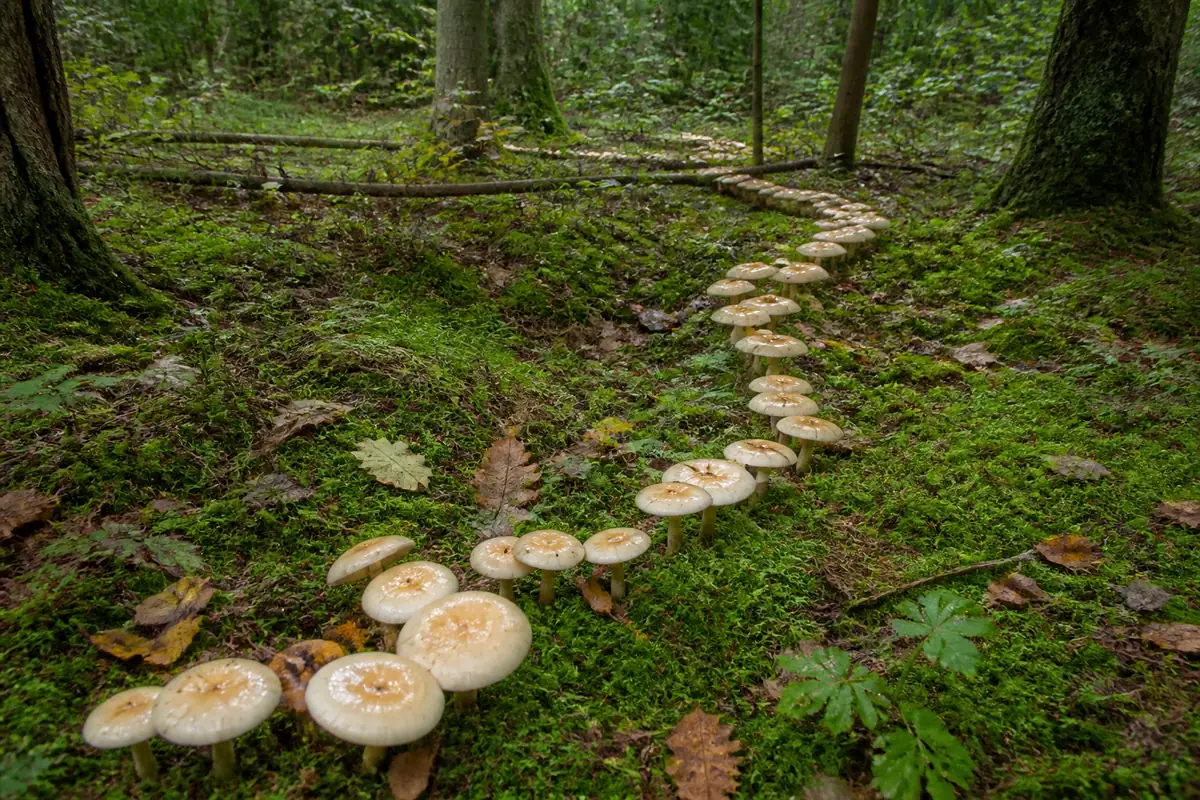
Finding them in arcs matters practically. One cap in moss usually means more within a few paces, and the sensible move is to stop and look along the curve rather than to walk on.
The partnership also means the same ground produces year after year. A mossy bank that fruited last October is worth returning to, because the fungus is living in the roots rather than passing through the litter.
They hide better than their size suggests.
A pale cap under moss and leaves reads as a stone or a patch of light, and most people walk over several before they see the first one.
It is one of the species worth learning early for that reason. Guidance for northern European foraging puts it in a small study set alongside the chanterelle and the porcini, because each of the three is settled by a different single character.
Is there any medicinal use?
There is no established medicinal use of the hedgehog mushroom, and no clinical evidence base behind the compounds that have been looked at in the laboratory.
It is a food mushroom, and an unusually good one, which is the whole of its claim.
Are hedgehog mushrooms related to chanterelles?
The comparison with chanterelles turns out to be more than a kitchen habit.
The hedgehog sits in the order Cantharellales, the same order as the chanterelles, in its own family Hydnaceae.
That relationship explains the resemblance rather than excusing the confusion. Both groups grew their spore-bearing surface downward into a folded or toothed shape from a common starting point, and the two solutions ended up looking related because they are.
The name also covers more than one species. A 2016 genetic study found at least four distinct species inside the broad idea of Hydnum repandum, with different ones in Europe, eastern North America and southern China.
Note
That matters far less here than it does in a genus like Amanita. Everything inside this group is edible, so a name covering several species changes what a specimen should be called and not what happens after it is cooked.
Toothed undersides have also appeared in groups that are not related to this one at all. Lion's mane sits in a completely different order and arrived at spines separately, which is why two mushrooms can share a surface and share almost nothing else.
So a toothed underside places a mushroom in this species only once the rest of it agrees. Fleshy, pale, standing in soil on a stem, with spines a few millimetres long, is the full description rather than the spines alone.
It is worth knowing anyway, because it explains why hedgehogs from different regions are described so differently in guides.
Size, color and exactly how far the spines run down the stem all vary between the members of the group.
Frequently Asked Questions
Is the hedgehog mushroom safe for beginners?
Are there poisonous hedgehog mushroom lookalikes?
Why do my hedgehog mushrooms taste bitter?
Do you have to remove the spines?
How do you tell a hedgehog mushroom from a chanterelle?
When is hedgehog mushroom season?
Sources & References
- Hydnum repandum, Wood Hedgehog mushroom Field description used for the cap and stem dimensions, the 2 to 6 mm decurrent spines, the white spore print, the cap reddening when handled, the firm crunchy flesh and delayed bitter taste, the mossy damp woodland habitat with rings, and the August to December season.
- Hydnum repandum General account used for the placement in the order Cantharellales and family Hydnaceae, the 2016 genetic study finding at least four species inside the broad concept of the name, the statement that mature specimens develop a bitter taste and that boiling removes it, and the comparison with Hydnum rufescens.