
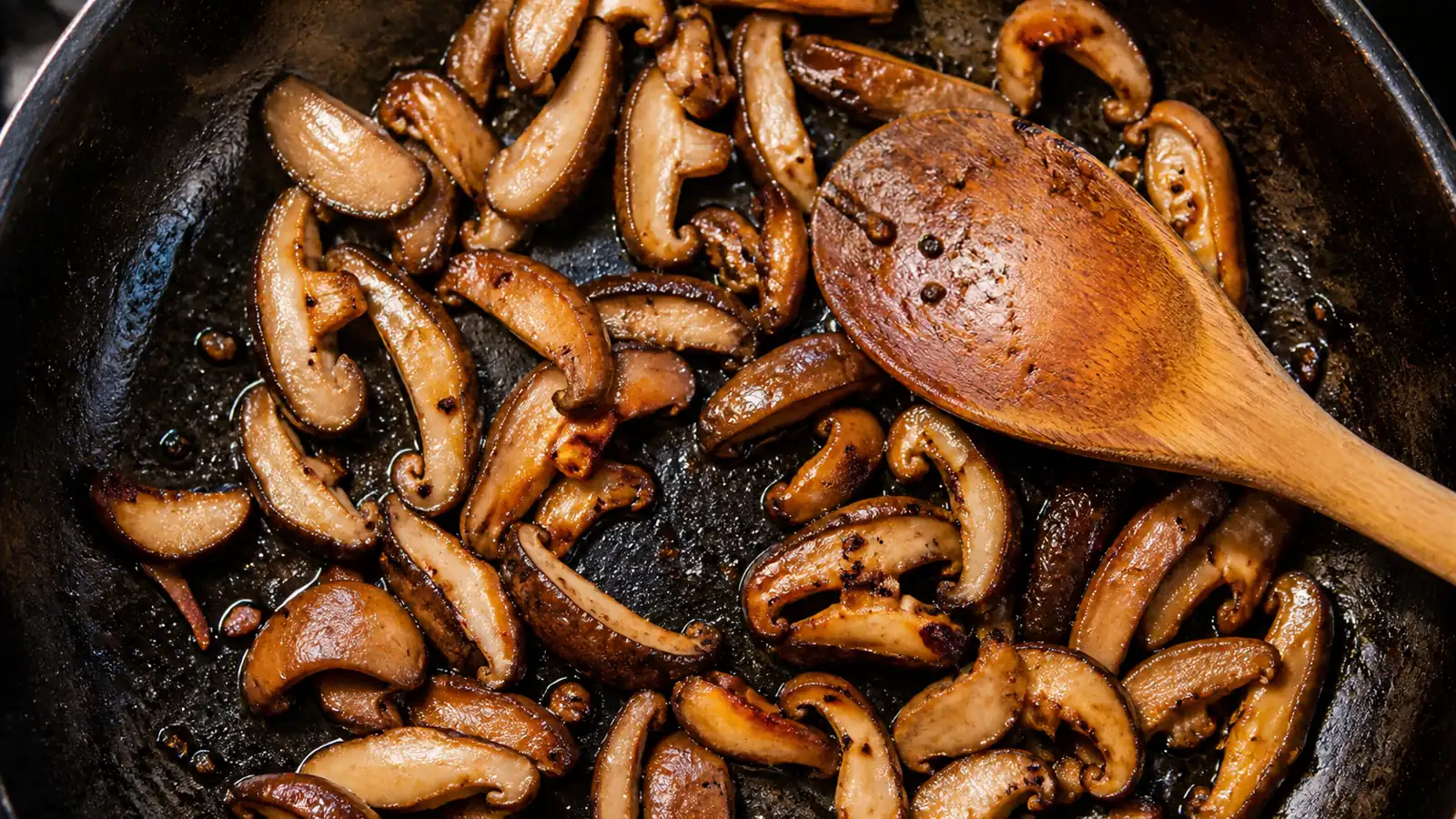
Once you remove the tough stems, you can slice fresh shiitake caps for a pan, roast them on a tray or cook them in broth. Dried caps need soaking first, and neither browning nor a soft texture proves that the shiitake has cooked enough.
Fresh shiitake caps can go into a pan in slices, onto a tray whole, or into a broth. Dried caps need soaking first. Both forms need thorough cooking, and a quick sear on the surface is not enough.
Warning
Cook shiitake thoroughly
Raw or inadequately cooked shiitake can cause an intensely itchy, streaked rash called flagellate dermatitis. Soaking, browning and a soft bite do not establish adequate cooking.
Preparing fresh caps and stems
Shiitake (Lentinula edodes) sold as food has a fleshy cap and a stem that can be far more fibrous, especially at its base. So the cap and stem need different handling, even when they come from the same mushroom. The Hong Kong Centre for Food Safety recommends refrigeration after purchase, with washing and cutting left until shortly before cooking.
Start with firm caps that show no slime and no odd smell, and throw out any that have spoiled. The fridge keeps a sound mushroom in good condition, but it cannot turn a batch that is already going off into good food.
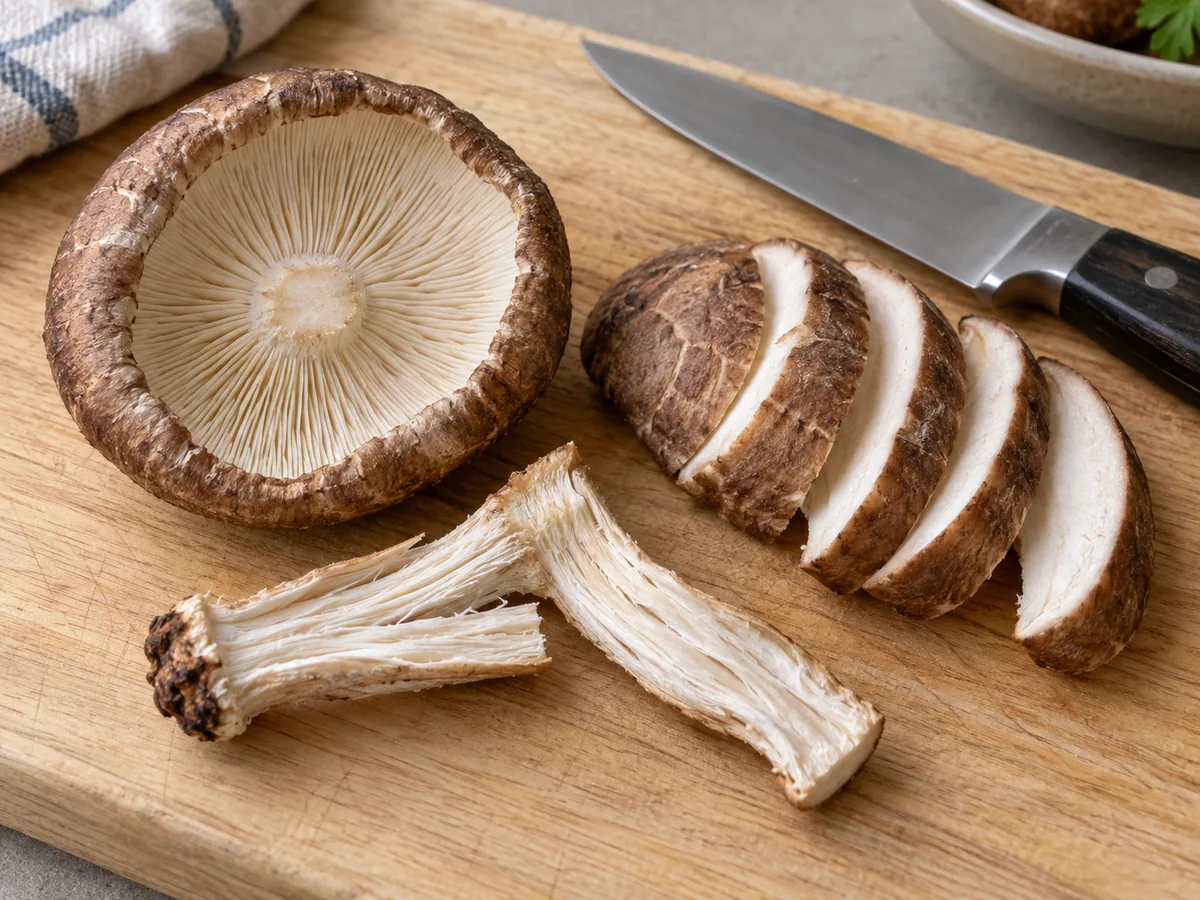
Removing the hard base and deciding on the stem
Cutting or twisting the stem away frees the cap for slicing and separates the woody part from the pieces you will eat. What counts is how tough that particular stem is. No rule says every stem is useless, and none says every stem will soften in a skillet.
You can throw out a hard base, or use a clean fibrous stem to flavor stock and strain it out afterward. Chop a softer upper part finely into a dish when its texture suits the result. In stock, the stem only has to give flavor, so it never needs to be pleasant to chew. On a noodle topping you eat the pieces themselves, and a whole woody stem would fight the soft cap.
Washing the caps briefly under clean running water removes loose debris, including bits caught under the cap. Drying afterward cuts the surface water that would otherwise end up in the pan. Leaving fresh mushrooms sitting in water during storage is a different thing entirely.
Slices of similar thickness cook more alike. Thick caps and thin edges brown and lose moisture at different rates, so matching thickness does more than making every piece the same shape.
Pairings & UsesBest Mushrooms for Stir-Fry: Five Picks by Texture and CutHow do you rehydrate dried shiitake?
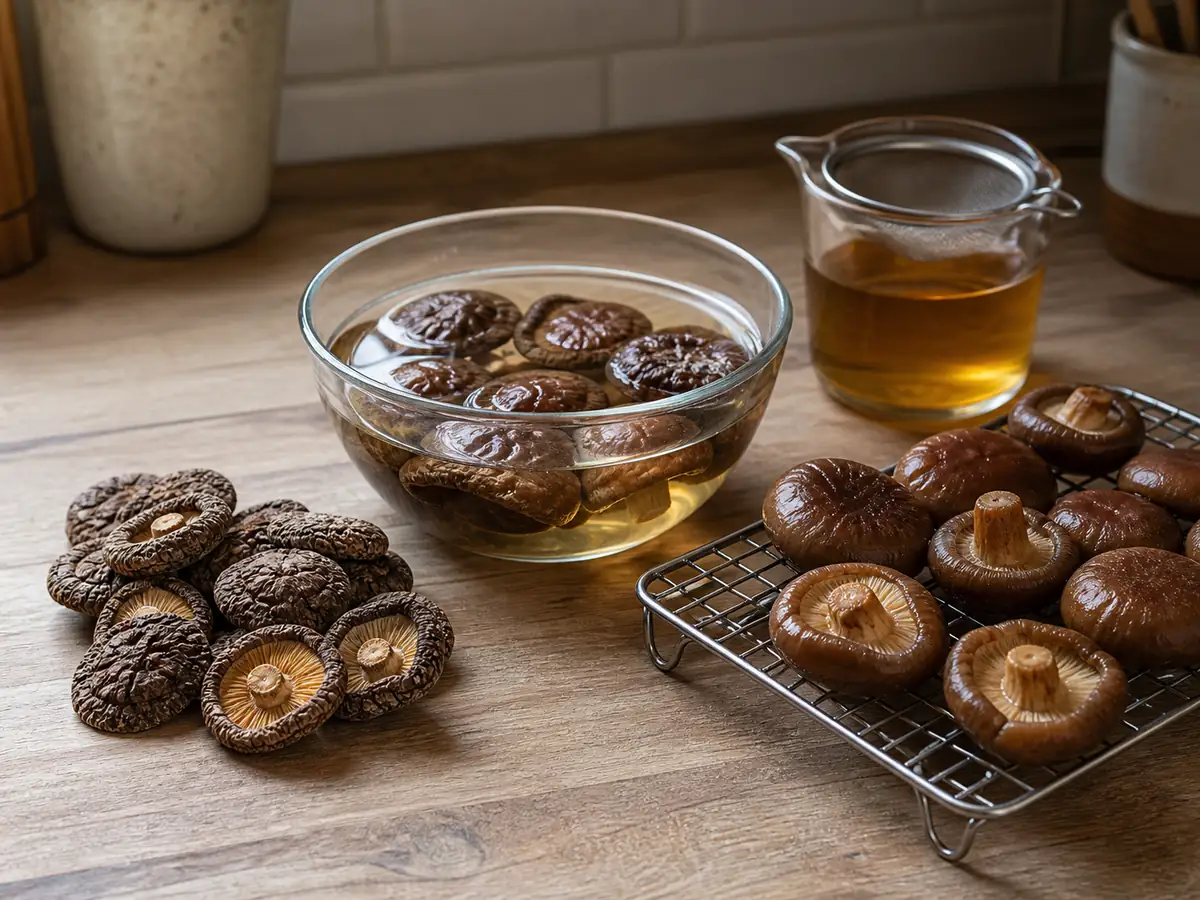
Dried caps are a different starting ingredient, and they cannot go straight into the pan like fresh ones. Water brings back enough flexibility for cutting and cooking, but soaking does not replace cooking. The Centre for Food Safety recommends rinsing dried mushrooms under running water and soaking them in a clean container. Follow the packet directions as well, because whole thick caps and small cut pieces do not need identical preparation.
Warning
Keep a long soak refrigerated
The Centre for Food Safety advises generally no more than two hours of soaking at room temperature. Move a longer soak into the refrigerator. Use soaked mushrooms promptly and discard them if they develop slime or an abnormal smell.
Soaking changes the water inside the cap as well as how its surface feels. Caps that bend on the outside can still have a firmer middle, so cutting one open tells you how to prepare the batch. It tells you nothing about whether you have finished cooking them. After soaking, drain the caps to make them easier to handle, then remove their tough stems and slice the softened flesh for the dish.
The liquid and the caps do different jobs
Soaking liquid can add mushroom flavor to a cooked broth or sauce, while the caps supply the pieces you eat. Pouring it through a fine filter removes grit, but filtering is not a safety treatment for a soak that sat out too long. Any liquid you keep for soup becomes part of that dish's volume. In a concentrated pan sauce it can thin the sauce before it reduces, while in a broth it may replace some of the liquid the recipe already calls for.
Dry and soaked weights describe different states, since the drained cap now holds water that the packet's dry weight did not include. You cannot read a fresh-mushroom quantity as the same quantity of dried caps, and we give no universal conversion ratio here.
Drying changes aroma as well as weight. A 2021 shiitake study compared drying methods and found differences in flavor compounds, including more cyclic sulfur aroma compounds after hot-air drying and changes in compounds linked to umami. That result supports a difference between fresh and dried shiitake that depends on the drying method. It does not mean every dried cap tastes stronger, because the product, its drying method and the amount of liquid in the meal all shape what it adds at the stove.
How do you cook shiitake all the way through?
Browning happens where the cap touches a hot surface, but heat also has to reach the rest of the piece. Thick caps can therefore color at the edges before the whole piece has heated through. The French food-safety agency ANSES warns that rapid cooking, including a quick stir-fry, may not be enough for shiitake.
In its 2021 review, ANSES described 70 skin-reaction cases. Most of those people reported eating raw or undercooked mushrooms, and two reported thorough cooking. Those histories back the cooking warning, but they do not set a tested household cooking time or guarantee that nobody will react after cooking.
Giving released water somewhere to go
Wide pans spread a loose layer across more heat and give released moisture room to evaporate. In a deep, crowded layer, pieces can sit in pooled liquid while only the bottom ones touch the pan. So adding another handful to a skillet that is already watery delays the browned finish, because the new mushrooms bring their own moisture and also deepen the layer.
You can start in a dry pan or add cooking oil at the beginning, and both work. Fat alone does not explain a pale result, since surface water and crowding can keep the same mushrooms stuck in a wet stage. Several simple home methods for shiitake work from the same pan, and the steps below use medium to medium-high heat with a little oil.
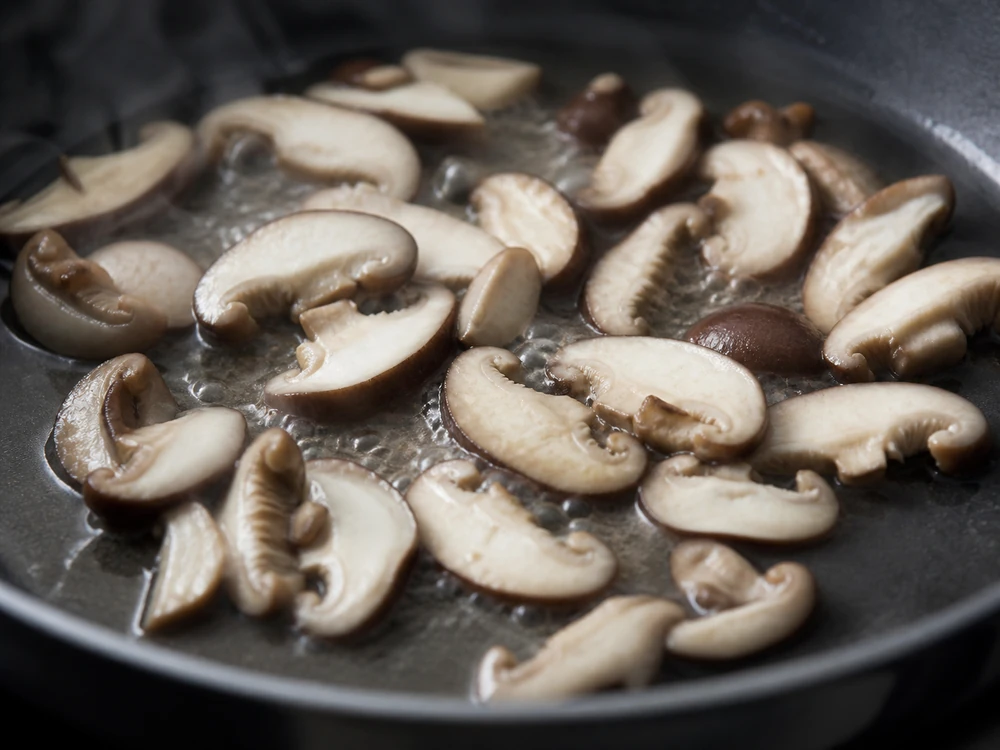
Adding a little liquid lets you keep heating without scorching the outside straight away. It evaporates later, so a moist middle stage does not stop a browned finish. The same order also separates cooking the caps from cooking the finishing ingredients. Garlic or butter belongs in the final sauce, and it does not need to sit against the hot pan for the whole cooking time to get there.
Product instructions and the actual form of the mushrooms still bear on thorough cooking. Surface color and tenderness are useful quality signs, but neither gives you a validated safety endpoint for shiitake.
TechniquesHow to Cook Matsutake Mushrooms: Brief Heat to Keep AromaMatching the method to the dish
Browned noodle toppings and soft caps in broth ask different things of the same mushroom. Pan cooking leans on surface contact and evaporation, braising keeps liquid in the dish, and roasting spreads the batch across a tray.
| Method | Mushroom form and useful result | Attention the method needs |
|---|---|---|
| Pan cooking | Slices for a browned topping, rice or a pan sauce | Released moisture needs room to evaporate, and a colored edge does not establish complete cooking |
| Roasting | Whole or sliced caps distributed on a tray | Gaps help avoid a piled-up wet layer, while thin edges can lose moisture or scorch |
| Braising or simmering | Fresh or hydrated caps incorporated into broth or sauce | The caps need actual cooking in the liquid, rather than being dropped in as a last-minute garnish |
| Grilling | Whole caps with direct surface heat | Exposed edges can scorch or dry while the thicker portion still needs cooking |
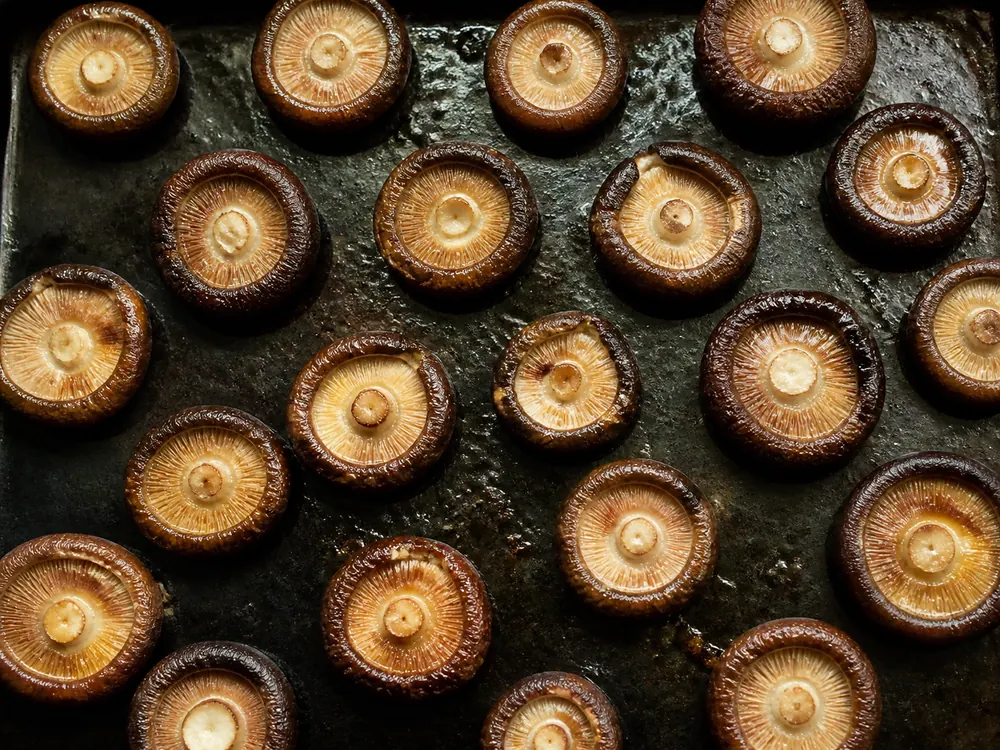
For roasting, a light coat of oil and a single layer keep each piece exposed. Even so, thick whole caps and thin slices still take different amounts of heat when they share an oven setting.
Braising suits shiitake whose texture and flavor belong in the liquid you serve. You do not need a browned crust there, and forcing one onto every cap can dry out an ingredient meant to stay soft in broth. For a noodle soup, for example, you can cook the mushrooms in the broth when soft caps are the goal. If you want a separately browned topping, give the caps their own pan stage before they join the bowl, since the bowl's leftover warmth will not cook them.
Risotto splits the same way, because a creamy mushroom risotto has a mushroom job and a rice job. Combining them in one meal does not turn a nearly finished rice pan into enough cooking for shiitake added late.
Matching substitutions and seasoning to the liquid
Swapping in a shiitake substitute can change both the aroma and the amount of water released into the pan. Replacing fresh slices in a pan is therefore a different adjustment from replacing dried caps along with their soaking liquid. Soy sauce, garlic and ginger suit a savory broth or noodle dish, while butter and stock suit a pan sauce. The liquid already in the dish sets how strong that seasoning tastes, so extra mushroom liquid can thin a sauce, and more soy sauce adds salt as well as liquid.
Why are your shiitake chewy or watery?
Chewiness can come from cap thickness, drying history or a stem left on, while a watery pan can come from crowding or wet surfaces. So one complaint does not point to one certain cause, and none of these signs works as a safety test.
| Observation | Plausible explanation | Response and its limit |
|---|---|---|
| Pale caps sitting in liquid | Water is arriving faster than it evaporates | Reduce the crowded layer and let moisture escape. Raising heat alone does not remove the extra depth of mushrooms |
| Brown edges with a dense middle | Uneven thickness or heat concentrated at the surface | Continue cooking more gently with a little liquid if needed. The browned edge does not certify the middle |
| Woody pieces among softer caps | Fibrous stem portions remain | Remove the hard pieces. More pan time cannot be assumed to make every stem pleasant |
| Leathery thin edges | Those edges have lost too much moisture | A sauce may soften the eating experience, but does not restore the original cap texture |
| Flat flavor | Seasoning, excess liquid or little browning may contribute | Adjust for the actual dish, keeping a broth cap's role separate from a browned topping |
| Slime or an abnormal smell before cooking | Deterioration or poor handling may have occurred | Discard the mushrooms instead of trying to make them usable by frying |
When a thick dried cap has a firm center, look back at its soaking and cutting as well as its time in the pan. Turning up the heat cannot tell you whether the real problem was incomplete soaking, a thick cut or a fibrous piece left attached. Hard stems and browned cap edges also need different fixes. Removing the stem changes the eating texture directly, while gentler cooking keeps the edge from burning further.
No pleasant bite can establish adequate shiitake cooking, and frying cannot make visibly spoiled mushrooms suitable to eat.
Cooling and reheating leftovers
The FDA advises refrigerating or freezing perishables within two hours of cooking, shortened to one hour when the temperature outside exceeds 90°F (32°C). Divide a large remainder into shallow containers so it cools faster in the fridge. The same applies to cooked caps and to mushroom soup, since a deep pot holds liquid and mushrooms together, while small, shallow portions cut the depth that has to cool.
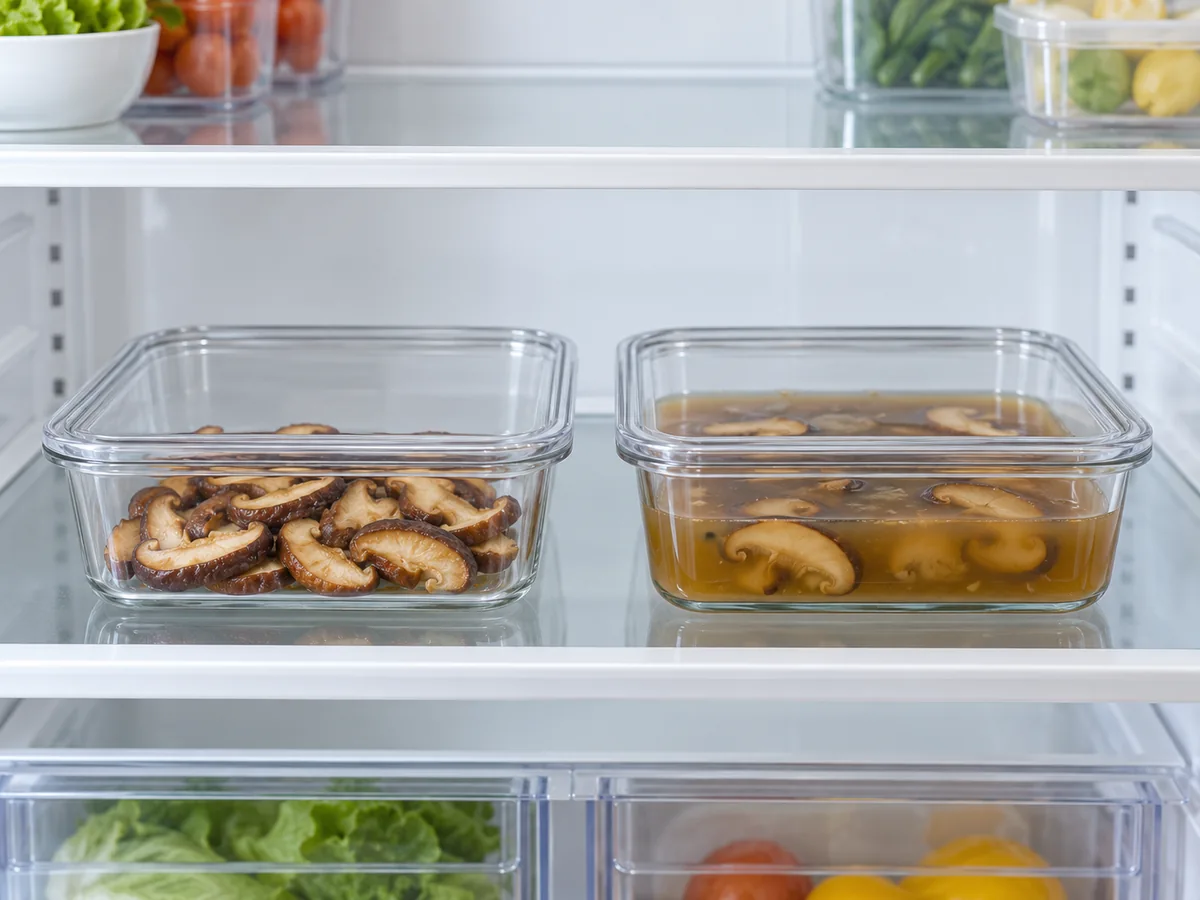
The FDA's safe-temperature table lists leftovers and casseroles at 165°F (74°C) for reheating. That number controls leftovers in general, and it is not a validated first-cook temperature for preventing shiitake dermatitis. Reheating browned slices in a sauce or broth changes their texture, because moisture now surrounds them as they heat. So a portion meant to stay a dry topping needs a different finish from one you deliberately return to soup.


