Shiitake are the best all-around stir-fry mushroom. Oyster mushrooms cook fastest, king oysters give the firmest bite, cremini are the easiest everyday choice, and wood ear supply crisp texture rather than deep mushroom flavor.
Shiitake are the best mushrooms for stir-fry when you want one reliable choice. Their caps keep a distinct chew, take on a glossy sauce, and remain noticeable beside garlic, ginger, chile, or toasted sesame.
The winner changes with the texture job, with oyster mushrooms giving tender folds, king oysters supplying thick batons, cremini offering browned pieces, and wood ear adding a springy crunch.
Pick the Bite Before You Pick the Mushroom
Decide what should remain on the fork after the sauce goes in. A balanced chew points to shiitake, while a soft folded cap points to oyster mushroom and a substantial center points to king oyster.
Cremini work when the rest of the dish already supplies the distinctive character. Their moderate flavor leaves room for beef, chicken, tofu, noodles, or a strong black pepper sauce, but the mushroom must brown or it can disappear into the mixture.
Wood ear solve a different problem. They contribute a crisp, slightly elastic bite and hold sauce in their folds, so they are useful when every other ingredient is tender.
The comparison matters because a hot pan cannot turn one physical structure into another.
Thin oyster caps will not develop the same center as a king oyster baton, and a fleshy cremini slice cannot keep the clean snap of wood ear.
Choose the finished bite first, then compare flavor and price among mushrooms that can actually deliver it.
Use cultivated mushrooms from a reliable seller unless a wild collection has been identified with certainty by a qualified local expert. Once a questionable mushroom is sliced, mixed with vegetables, and coated in sauce, the dish hides the field marks that would have allowed someone to reconsider it.
Warning
Cooking does not make a poisonous wild mushroom safe. Keep uncertain finds out of a mixed stir-fry even when they look similar to a familiar edible type.
The five small portions below show how strongly the same cooking method can diverge once mushroom structure changes.
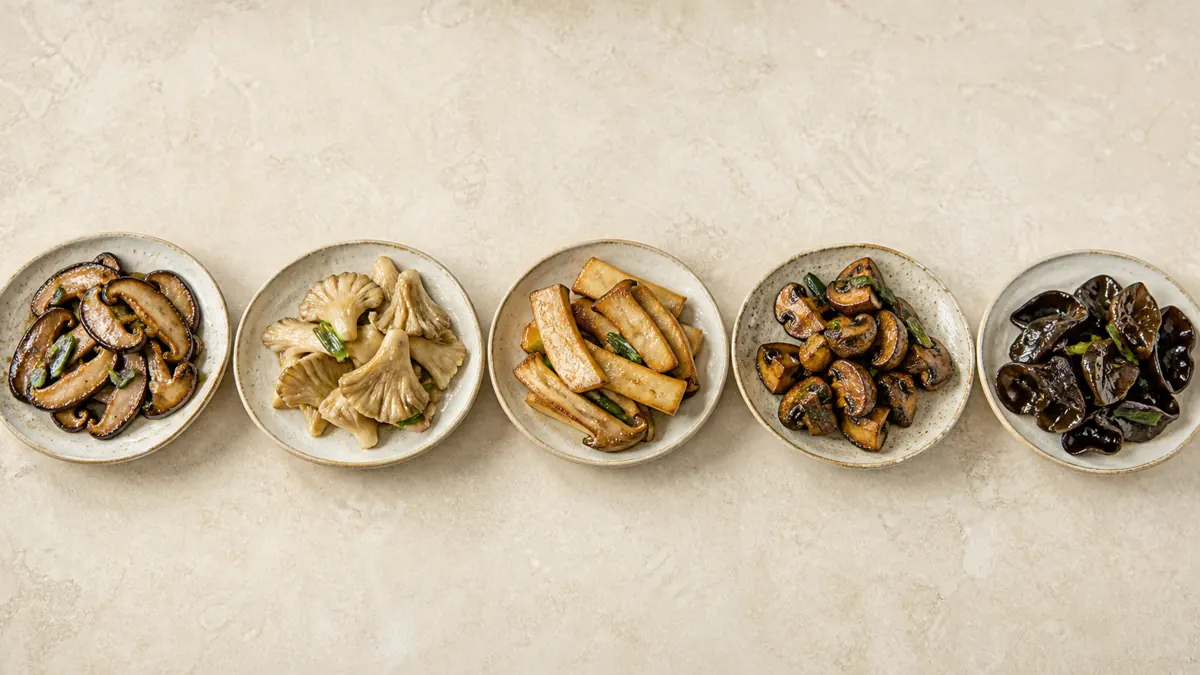
5 Best Mushrooms for Stir-Fry, Ranked by Texture
These five candidates are ranked by usefulness across common home stir-fries.
The amount and ratio beside each one are starting relationships for four servings, with the adjustment tied to what else must fit in the pan.
1. Shiitake: Best Overall
Shiitake caps have enough density to stay recognizable through a fast toss, yet enough surface to take on soy, hoisin, black vinegar, ginger, garlic, or chile. A published four-serving stir-fry uses 170 g of stemmed shiitake, while a mushroom-forward noodle version uses 225 g with three to four cups of vegetables.
Use about 225 g fresh caps when mushrooms should be a clear part of the meal.
Start near one part mushroom to two parts other vegetables by weight, then move closer to one to one if there is no meat or tofu competing for pan space.
Remove the stems because a brief stir-fry will not soften their fibrous texture. Slice the caps 5 to 8 mm thick so the faces can brown without the centers becoming fragile.
Shiitake tolerate strong aromatics better than oyster mushrooms and carry sauce more evenly than king oyster batons.
That advantage becomes a drawback in a very delicate dish, where their dark savor can cover young peas, mild greens, or a restrained broth-based glaze.
Let the first side color before constant tossing begins. Once the cap edges soften and the contact faces turn brown, move them out temporarily if the remaining vegetables need more than a minute or two.
2. Oyster Mushroom: Best for Tender, Fast-Cooking Pieces
Oyster mushrooms suit a quick vegetable stir-fry because their broad caps turn tender rapidly.
The Mushroom Council specifically identifies them as a quick-cooking choice for stir-fries and simple soups, but a cluster does not cook at one speed.
Tear the thin caps into broad pieces and slice the dense central base separately. Start the base with the firmer vegetables, then add cap pieces late enough that their rippled edges stay intact.
Allow 225 to 280 g fresh oyster mushrooms for four servings. Their airy pieces lose volume, so a starting relationship near one part mushroom to one and a half parts other vegetables by weight keeps them visible without stacking the pan.
The broad pieces are good with scallion, ginger, light soy, sesame, or a restrained chile sauce.
Heavy sweet sauce and repeated stirring make the caps soft and anonymous, which removes the reason to choose them over cremini.
One useful exception is a cluster with unusually thick bases. Give those pieces a separate first minute or save them for another dish rather than forcing the tender caps to wait for them.
3. King Oyster: Best for a Firm, Substantial Bite
King oyster mushrooms reverse the usual cap-first logic because the stem is the main attraction. Its dense structure can become a juicy baton with a browned face, giving a mushroom-led stir-fry enough physical weight to sit beside rice or noodles without meat.
Use 280 to 340 g fresh king oyster for four servings when it is the central solid ingredient.
A one-to-one ratio of mushroom to other vegetables by weight is a useful start, but reduce the mushroom share toward one to two when tofu, beef, or chicken already supplies the substantial bite.
Cut stems into 8 to 10 mm batons or halve them lengthwise and score the broad faces shallowly. Pieces much thicker than that can brown outside while the center stays stiff and squeaky.
King oysters need more contact time than torn oyster caps, so give them an uncluttered first batch. Press only long enough to establish contact, then leave the pieces still so moisture can escape from the scored face.
Black pepper, chile, garlic, fermented bean sauces, and a restrained amount of sugar suit their mild flavor.
A thin, delicate sauce can leave the center tasting plain because the dense piece absorbs less surface seasoning per bite than a sliced shiitake cap.
4. Cremini: Best Everyday Supermarket Choice
Cremini are useful when availability and price matter more than a specialized texture. Small mushrooms can be quartered for a juicy center, while larger caps can be sliced about 8 mm thick for more brown surface.
Plan on 280 to 340 g fresh cremini for four servings and begin near one part mushroom to one and a half parts other vegetables by weight.
Use the lower end when noodles, meat, or tofu make the wok crowded, since cremini release enough water to overwhelm a home burner in a single heavy load.
The real tradeoff is that cremini need color to become interesting. Pale slices add moisture and a mild mushroom note, while deeply browned quarters contribute a concentrated savory edge that stays present under soy, garlic, or black pepper.
Cook them as a separate first batch when the skillet is narrower than 30 cm or the vegetable pile is large.
Remove the browned pieces, cook the vegetables in their own order, and return the cremini only for the glaze.
Cremini are less convincing when the dish depends on a crisp snap or a steak-like center. They are the practical fallback, not a physical substitute for wood ear or king oyster.
5. Wood Ear: Best for Crisp, Springy Texture
Wood ear mushrooms are chosen for texture rather than deep mushroom aroma.
FDA describes them as crunchy, sauce-absorbing mushrooms used in Chinese stir-fries, which explains why a modest quantity can change a pan more than its mild flavor suggests.
Start with 15 to 25 g dried wood ear for four servings, then fully rehydrate and rinse it. Use roughly one part rehydrated wood ear to three parts other vegetables by volume because the springy bite works best as an accent.
Trim any hard attachment point and tear broad ears into pieces that can be picked up with the other ingredients.
Very large folds trap sauce and can slap hot liquid from the wok, while tiny shreds lose the clean bite you bought them for.
Imported wood ear has been linked to a Salmonella outbreak, so handle packages and preparation surfaces carefully and cook the mushroom thoroughly. Rehydration restores shape and removes some grit, but it is not the cooking step.
Wood ear belongs late enough to keep its snap but early enough to heat through. It pairs especially well with black vinegar, garlic, chile, ginger, celery, bamboo shoots, or other ingredients that benefit from a contrasting crunch.
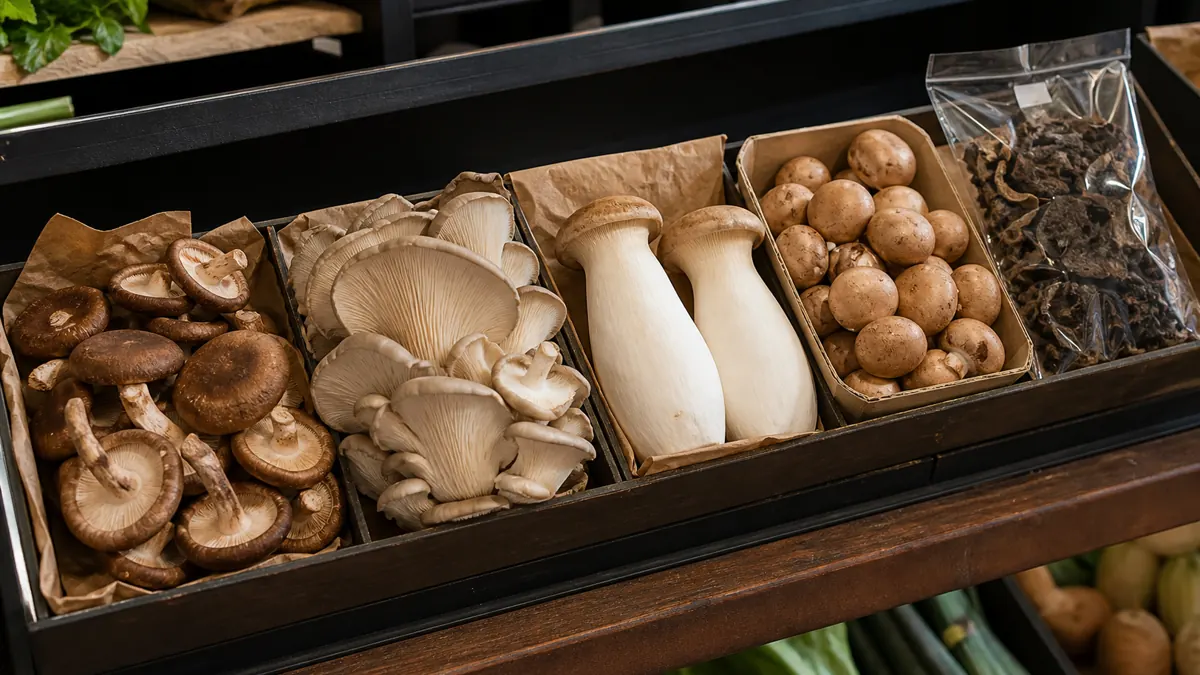
The market lineup makes the candidates easy to distinguish before any cutting hides their original form.
Cut for Equal Cooking Time, Not Equal Shape
Uniform slices look orderly on a board but ignore the reason the mushrooms cook differently. The useful goal is to make unlike structures reach tenderness in the same window.
Shiitake caps need medium slices because paper-thin pieces dry before developing a satisfying center, while small cremini can stay quartered so their curves protect moisture as the cut faces brown.
King oyster stems need batons with a controlled narrow dimension. Cutting each piece 8 to 10 mm thick matters more than making every baton the same length, because thickness determines how far heat must travel to the center.
Oyster clusters should be separated by density rather than torn randomly. Slice the compact base, preserve broad cap folds, and place the two piles in different positions in the cooking order.
Rehydrated wood ear needs trimming and tearing, not fine slicing. Pieces about the width of a bite keep their snap and distribute more evenly than one large folded ear.
- Slice shiitake caps 5 to 8 mm thick after removing the stems.
- Tear oyster caps broadly and slice dense cluster bases into smaller pieces.
- Cut king oyster stems into 8 to 10 mm batons or scored halves.
- Quarter small cremini and slice large caps about 8 mm thick.
- Tear rehydrated wood ear into bite-size folds after trimming hard bases.
Note
A mixed mushroom pack rarely belongs in the wok as one prepared pile. Sort dense stems, fleshy caps, thin folds, and rehydrated ears before heating the pan so each group can enter when its structure requires.
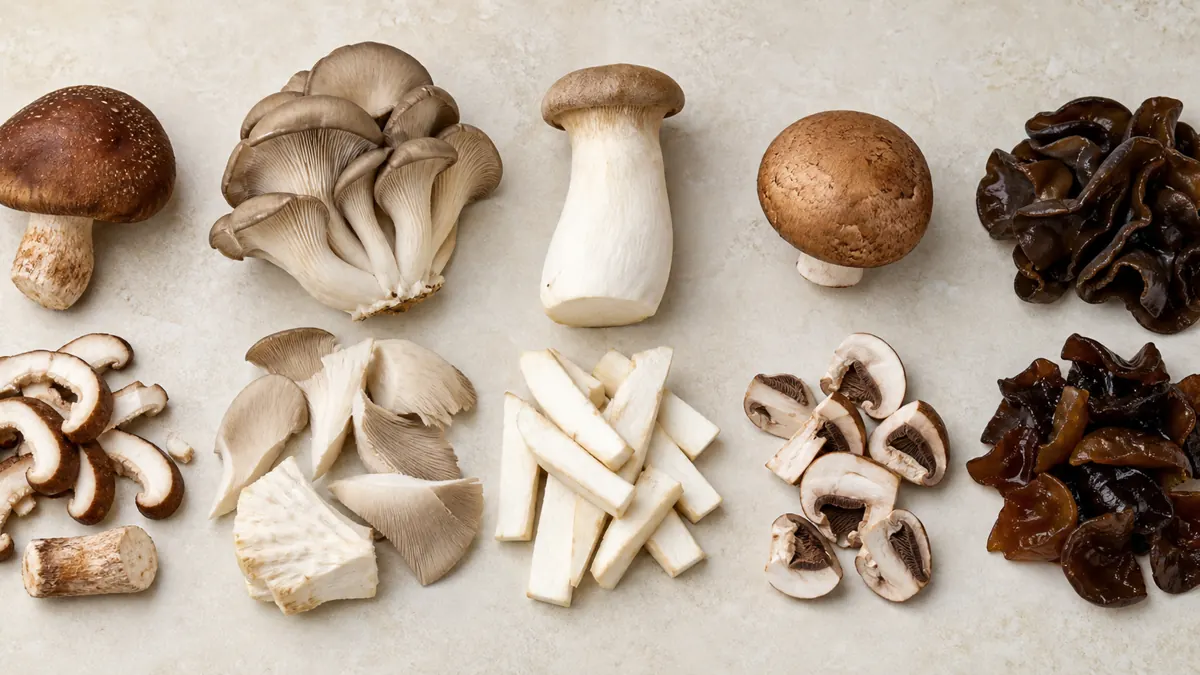
The prepared forms below show why equal thickness, rather than matching silhouettes, keeps the cooking window coherent.
Build the Wok in Heat-Recovery Order
A home burner cannot recover instantly after a cold, wet load enters the wok. Mushrooms begin releasing water while the metal cools, and too much food holds every surface in a shallow steaming environment.
The solution is staged cooking, not frantic stirring.
Heat the empty pan, add a restrained film of oil, and place only enough mushroom pieces to leave visible metal between them.
- Pan load
- Leave visible metal between mushroom pieces
- Dry cue
- Wait until pooled liquid clears and the sharper sizzle returns
- Sauce cue
- Add liquid only after mushrooms and vegetables are nearly done
Listen to the change in sound. The initial sizzle softens as water emerges, then becomes sharper again once free liquid evaporates and dry browning resumes.
Dense king oyster, cremini, and shiitake usually benefit from this mushroom-only first batch.
Remove them after color develops so broccoli stems, carrots, beans, or other firm vegetables can receive direct heat rather than cooking underneath a wet pile.
Thin oyster caps are the exception when the rest of the dish is quick. Add them after firm vegetables have begun softening, then keep the remaining cook brief enough to preserve the folds.
Garlic, ginger, scallion whites, and dried chiles need deliberate placement. They can burn during a long mushroom batch, so add them after mushroom water has cleared or cook them briefly in an open spot before the ingredients return.
Do not chase restaurant wok hei on a small electric hob by leaving an overloaded pan on high. Protect heat through smaller loads, because spacing lets an ordinary burner evaporate water more effectively than extra temperature under a crowded pile.
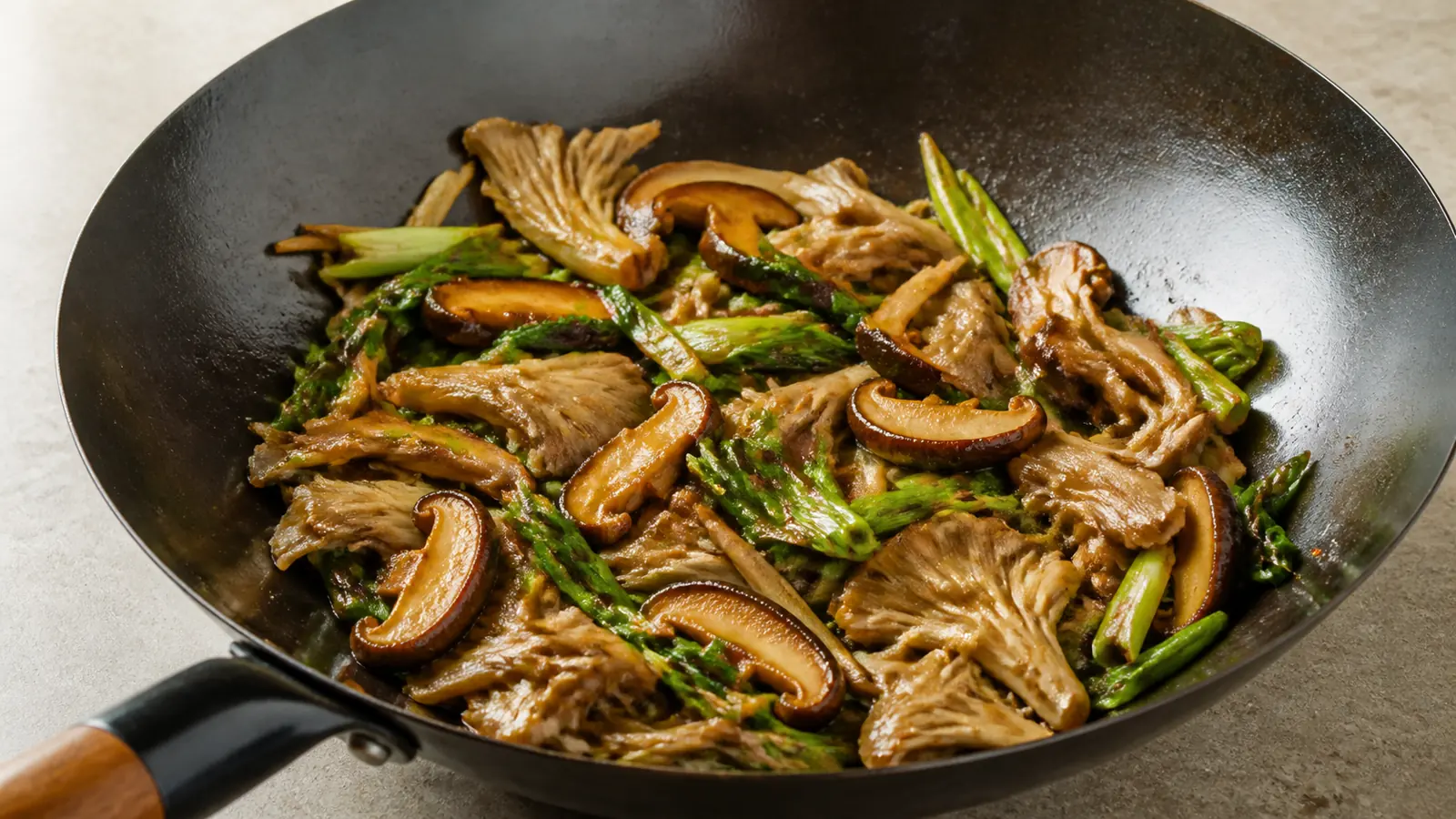
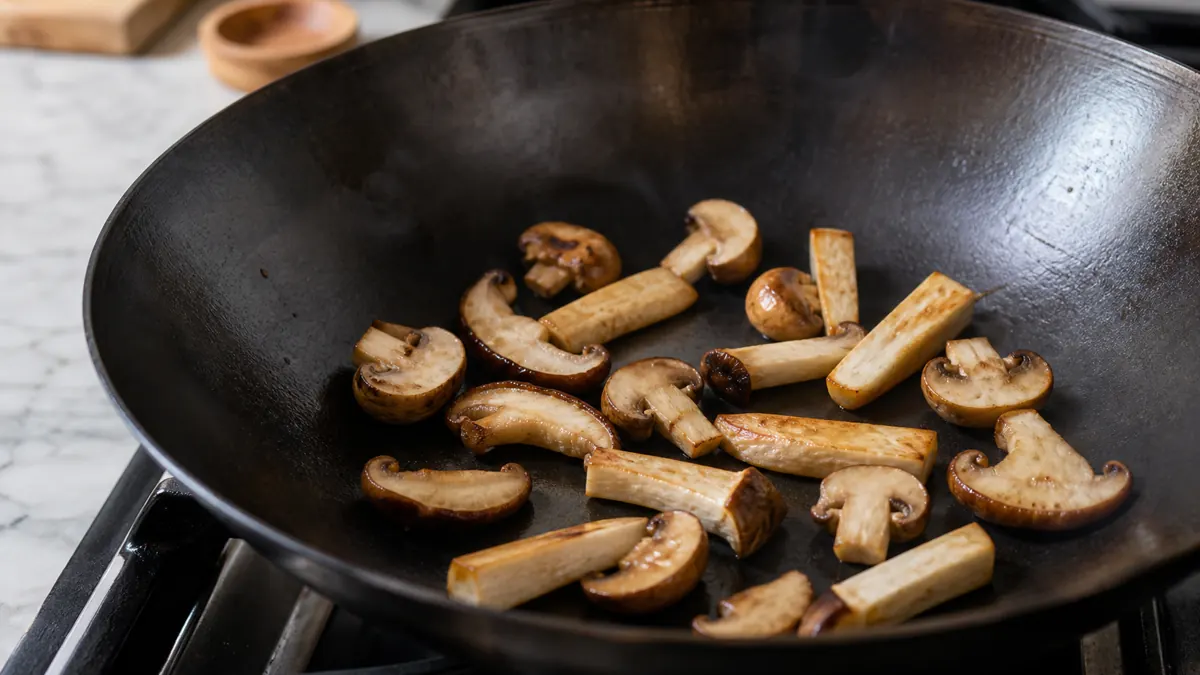
The dry stage is visible below.
Brown contact faces and exposed wok metal show that the pan is ready for the next load, while pooled liquid would mean the first stage is unfinished.
Add Sauce Only After Free Water Is Gone
Stir-fry sauce should arrive when the mushrooms and vegetables are nearly cooked and the pan surface is dry. Adding it earlier cools the metal, dissolves the browned residue, and turns the remaining cooking time into a simmer.
That simmer is useful in mushroom soup, but it defeats the concentrated surface flavor and distinct bite expected from a stir-fry.
The mushrooms continue softening while thin liquid collects beneath them.
Mix the sauce before cooking so soy, vinegar, stock, sugar, and starch enter together in a controlled amount. A starch-thickened sauce needs enough heat to turn glossy, but it cannot hide a pan already flooded with mushroom water.
Pour the sauce around the hot metal rather than onto one cold pile when the pan shape allows it.
Toss only until the liquid coats the pieces and leaves little or no pool at the lowest point.
Taste after reduction because evaporation concentrates salt and sugar. A sauce that seemed mild in the bowl can become salty after it loses water, while a sweet sauce can scorch if it remains over heat after the glaze forms.
If the pan is watery, remove the solid ingredients before trying to reduce the liquid. Keeping tender oyster caps or leafy vegetables in the wok while a large pool boils away trades one defect for another.
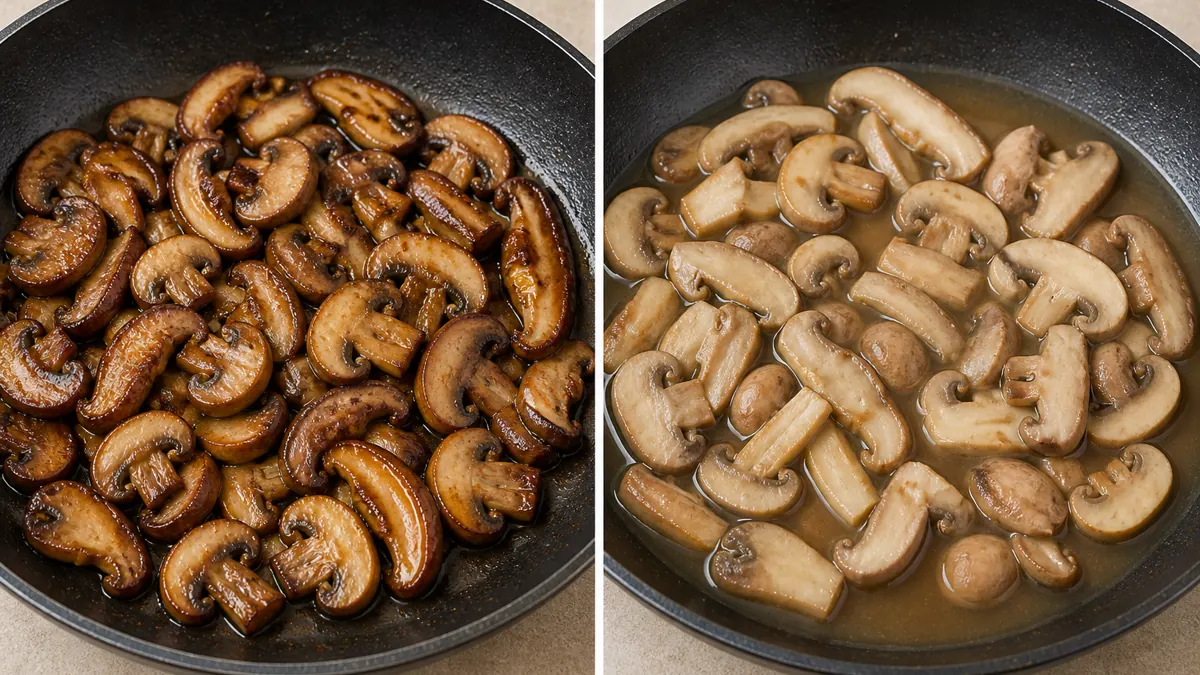
The split image shows the visible finish to seek. A glaze follows the mushroom surfaces, while a thin sauce gathers below pale pieces and keeps cooking them after the pan should be done.
Match the correction to the visible failure because extra heat cannot solve every wet or over-reduced pan.
| Pan symptom | What happened | Best correction |
|---|---|---|
| Pale mushrooms in clear liquid | The load was too large or sauce entered before mushroom water evaporated | Remove solids, reduce the liquid, and use smaller batches next time |
| Brown mushrooms but raw firm vegetables | Everything entered according to flavor rather than cooking time | Cook firm vegetables after the first mushroom batch and return mushrooms later |
| Thick glaze tastes too salty | The sauce began too concentrated for the amount of free water | Dilute in measured spoonfuls and reduce more cautiously next time |
| Sauce scorches around cooked ingredients | Sugar or starch stayed over high heat after the glaze formed | Remove the wok as soon as the coating clings and the raw starch taste is gone |
The finish is complete when each piece carries a thin coating and the wok does not hold a separate puddle. At that point, more tossing only softens the mushrooms and concentrates the seasoning beyond the balance you chose them to support.