Fresh porcini is firm and mild and wants thick slices and a hard sear. Dried porcini is intensely savory and stands in at roughly ten grams for a hundred grams of fresh, and the strained soaking liquid carries more flavor than the rehydrated pieces do.
A recipe says porcini and you have a bag of dried slices, or you have paid a lot for a fresh one and do not want to get it wrong.
Those are two different problems, because fresh porcini and dried porcini are not the same ingredient in different packaging, and almost every disappointing porcini dish comes from treating them as if they were.
Fresh and dried are two ingredients
One is about texture and the other about flavor, and neither does the other's job.
Fresh porcini is firm, dense and mild. It holds its shape through a hard sear better than almost anything else you can buy, and the flavor is nutty rather than powerful.

Dried porcini is the opposite on both counts, with a texture after soaking that is chewy and slightly leathery and a flavor strong enough that twenty grams will carry a dish for four people.
Both forms come off the same mushroom, described on our porcini profile, so what changes between them is what the drying did to it rather than the species itself.
Three questions settle which form a recipe assumed:
- How much does it ask for, since anything under fifty grams means dried.
- Does it say soak, which only dried requires.
- Does it say slice, which only fresh rewards.
None of those three requires knowing anything about mushrooms. They are questions about the recipe, and between them they settle the matter before you open a packet.
Cooking MushroomsHow to Cook Cauliflower Mushroom Without Trapping GritDrying concentrates it
Most people assume drying only removes water. It does rather more than that, which is why dried porcini costs what it costs.
| Fresh | Dried | |
|---|---|---|
| Flavor | Mild, nutty | Deep, savory, meaty |
| Texture after cooking | Firm, holds shape | Chewy, slightly leathery |
| Quantity for four people | 300-400 g | 20-30 g plus the liquid |
| Best use | The center of the dish | The seasoning of the dish |
| Raw | Possible, on a fresh young one | No |
Drying develops savory compounds that the living mushroom did not have in that concentration. That is a chemical change rather than a plumbing one, and it is the reason a dried porcini smells of something a fresh one only hints at.
The working ratio is about ten to one by weight, so ten grams of dried stands in for a hundred grams of fresh in flavor but not in the volume on the plate, which is the trap.
Twenty to thirty minutes in hot water is the whole soak. Longer does not extract more, and after an hour the pieces start giving back the little texture they had.
The ten-to-one ratio is about flavor and not about volume, which is where most substitutions go wrong. Twenty grams of dried will season a dish for four and it will not fill it, so a recipe built around the body of the mushroom needs fresh regardless of how much dried you have.
If you have more fresh porcini than you can eat, our page on drying mushrooms at home covers the method. It is worth doing with this species in a way it is not with most.
The soaking liquid is the point
Here is the part most recipes get wrong by omission.
Key takeaway
The soaking liquid carries more porcini flavor than the rehydrated pieces do. Pouring it down the sink is throwing away most of what you paid for, and it is what the recipe assumed you would use.
That claim sounds overstated until you run the one test that settles it. A risotto made with the strained soaking liquid and no mushrooms at all still tastes distinctly of porcini, and a risotto made with the pieces and plain stock mostly does not.
Grit is the only handling problem. It settles at the bottom of the bowl, so pour the liquid off gently rather than tipping it, and leave the last centimetre behind.
Whatever the pour leaves behind comes out in a strainer.
Straining through a paper towel or a clean cloth catches the rest. That step takes fifteen seconds and it is the difference between a smooth sauce and one that crunches.
There is a second reason to keep it beyond thrift, which is that the liquid arrives already seasoned by the mushroom in a way stock is not, so it needs less salt and carries the flavor into rice or grain unaided.
Two habits make the difference over a year of cooking. Soak in less water than feels comfortable, since a concentrated liquid is more useful than a dilute one, and soak in hot water rather than boiling, which extracts just as well without cooking the pieces.
What you do not use freezes well, which turns an expensive packet into something that lasts a season.
An ice cube tray of porcini liquid keeps for months, and two cubes dropped into an ordinary weeknight risotto or gravy change it entirely.
Cooking MushroomsHow to Cook Black Morels: Halve Them, Never Slice ThemCooking fresh porcini
Thick slices, a hot pan, and very little else. The mushroom is expensive and mild, and the method should stay out of its way.
Two of those five steps carry the whole method: the third minute of stillness, and the discipline to keep the butter out until the pan has done its work.
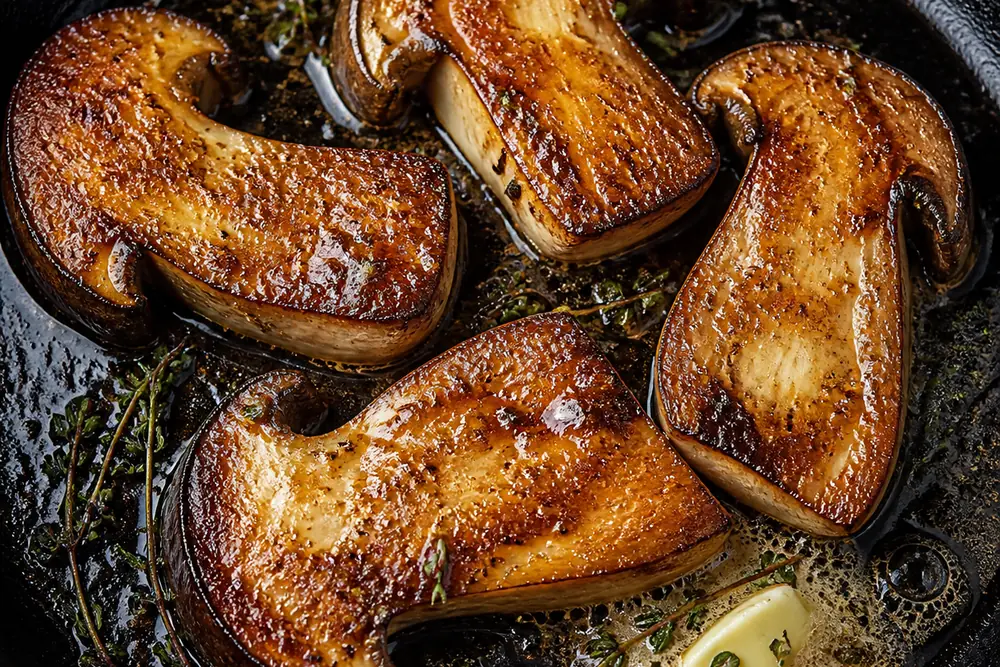
Thin slices are the commonest waste of a fresh porcini. The one thing this mushroom has that a cremini does not is dense flesh that stays firm, and a two-millimetre slice throws that away for no gain in flavor.
The pore layer under the cap is the judgement call, since on a young firm specimen it stays put and on an older one it goes soft and slightly slimy in the pan.
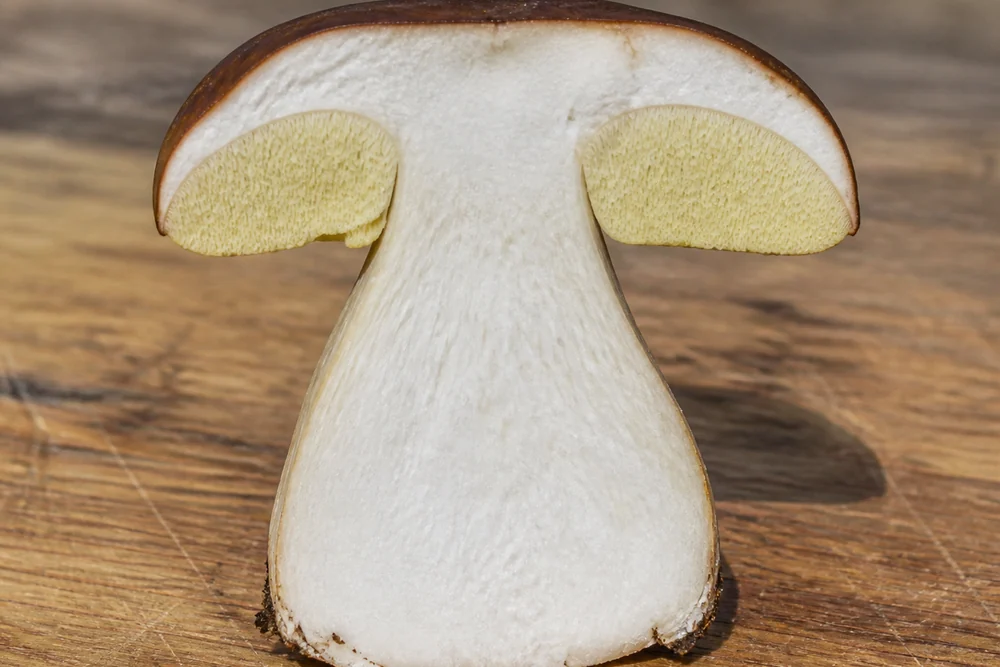
If it peels away easily with a thumb, it was going to fall apart anyway and it should come off. If it resists, leave it.
Cooking time is shorter than the density suggests, since a centimetre slice is done in six or seven minutes total and past ten the flesh goes from firm to rubbery without passing through anything better.
Cleaning a fresh porcini
Wipe the cap and trim the base. Reach for water only if there is no alternative.
The cap skin is smooth and holds nothing, so a damp cloth takes off whatever is on it. The stem base is a different matter, since it came out of the ground and the soil goes into the surface rather than sitting on it.
The base is the only part worth being ruthless about, and a centimetre off the bottom is quicker than any amount of scrubbing while losing nothing worth keeping.
Grit in the pore layer is the one case where washing wins. Our guide to cleaning mushrooms makes the general argument against water, and porcini is dense enough to be the exception if the pores are gritty and you want to keep them.
Cooking MushroomsHow to Cook Black Truffle Without Losing Its AromaBuying fresh without buying trouble
Cut the stem across before you commit to anything. Most mature wild porcini has some insect damage, and the tunnels start at the base and work upward.

Four things are worth knowing before that sight puts you off buying porcini at all.
This is not a sign of a bad supplier or a spoiled mushroom. Porcini grows in soil, insects find it early, and a commercially perfect specimen is rarer than most people expect.
None of that means buying blind, and three checks at the counter settle it, in this order:
- Cut the stem across, or ask for it to be cut, and look at how far the tunnels reach.
- Press the cap, which should be firm rather than yielding.
- Lift it, since a porcini that feels light for its size is hollow or old.
Price is a signal here too, though not the one people assume. Cheap fresh porcini in a shop that usually charges a lot is generally late-season material that needs a hard look at the stem rather than a bargain.
Buy young and firm if you can. A button-stage porcini with an unopened cap is almost always clean, and it is also the one that will still be firm after a hard sear.
Season matters as much as the individual mushroom does. Early-season porcini in a given area is generally cleaner than late-season, because the insects have had less time to find the flush, and a shop selling at the start of the season is usually selling better material.
Weight is the other useful signal, since a porcini that feels light for its size is either old or hollowed out, and neither is worth paying for by the gram.
Our page on storing porcini mushrooms covers how long a fresh one really lasts, and if you are timing a trip rather than a shop, porcini season has the regional windows.
The one mushroom worth eating raw
Thinly sliced raw porcini is a real dish rather than a mistake. That is not something this site says often about any mushroom.

Freshness here is measured in hours rather than days, which is why the dish belongs to people who pick their own.
Tip
Raw porcini needs a young, firm, very fresh specimen with the pore layer and the stem base removed. It is a traditional Italian preparation with lemon and cheese, and it is not a general licence to eat mushrooms raw.
Those conditions do more work than the technique does, and none of them is negotiable. Technique here amounts to a sharp knife and a light hand.
An older porcini raw is unpleasant and a soft one is worse, and anything with tunnelling in it should go in a pan instead.
Our page on eating porcini raw goes through who should skip it anyway, and anyone with a sensitive stomach is better off cooking it.
What it tastes like
Nutty and mild fresh, deeply savory dried, and the gap between the two is larger than most people expect.
Fresh porcini tastes closer to a hazelnut than to a mushroom. It is subtle enough that a heavy sauce will bury it completely, which is why the classic treatments are butter, garlic and something starchy.
Dried porcini tastes of meat and forest floor, one of the few vegetarian ingredients that reads as savory in the way stock does, and a small amount changes the whole character of a dish.
Neither form does much on its own, incidentally, which is worth saying because porcini has a reputation that suggests otherwise. It rewards a dish built around it and it does not rescue one that was not.
The best recipes use both. A handful of dried for the depth and a few fresh slices seared on top for the texture is a combination neither form manages alone.
- Risotto and polenta, where the starch carries the flavor.
- Pasta with butter and garlic, and nothing acidic.
- Roasted or seared as a side, fresh only.
- Stock, gravy and braises, dried only, along with the soaking liquid.
- Anything with cream or butter, where the nuttiness comes forward.
One more combination is worth knowing about, which is porcini with something sweet, since a little cream or slowly cooked onion brings the nuttiness forward in a way salt alone does not.
Quantity is the practical question a recipe rarely answers. Fresh porcini works out at roughly a hundred grams a head as a side and twice that as the center of a dish, and dried at four or five grams a head plus whatever liquid it soaked in.
There is one mistake worth naming because it happens at the sink. A fresh porcini gets rinsed because it came out of the ground, the dense flesh takes up the water, and the sear turns into a steam on the most expensive mushroom in the kitchen.
Tomato is the pairing to avoid. It is loud enough to erase fresh porcini entirely and to argue with dried, and there are cheaper mushrooms that survive it.
Porcini powder is the third form and it deserves a mention, since dried slices ground in a spice mill turn into something you can put on a steak or into a dough and keep for a year in a sealed jar.
Freezing fresh porcini is the option to skip. The dense flesh holds a lot of water, and freezing bursts exactly the structure you paid for, so the thawed slices come out limp and gray.
Anyone eating it regularly will find the figures on our porcini nutrition record, and when neither form is in the shop, porcini substitutes works through what comes closest for which job.
Sources & References
- Boletus edulis, the porcini (Fungi Atlas) Species reference used for the dense flesh, the pore layer beneath the cap, the mycorrhizal habit under conifers and the button-stage form described here.
- Porcini and the flavor chemistry of dried mushrooms (Journal of Agricultural and Food Chemistry) Food chemistry reference used for the development of savory compounds during drying, which underlies the claim that dried porcini is stronger than a simple concentration of fresh would explain.
- Porcini (Forager Chef) Cook and forager reference used for the prevalence of insect tunnelling in mature wild porcini, the judgement call on removing the pore layer, and the traditional raw preparation of young firm caps.