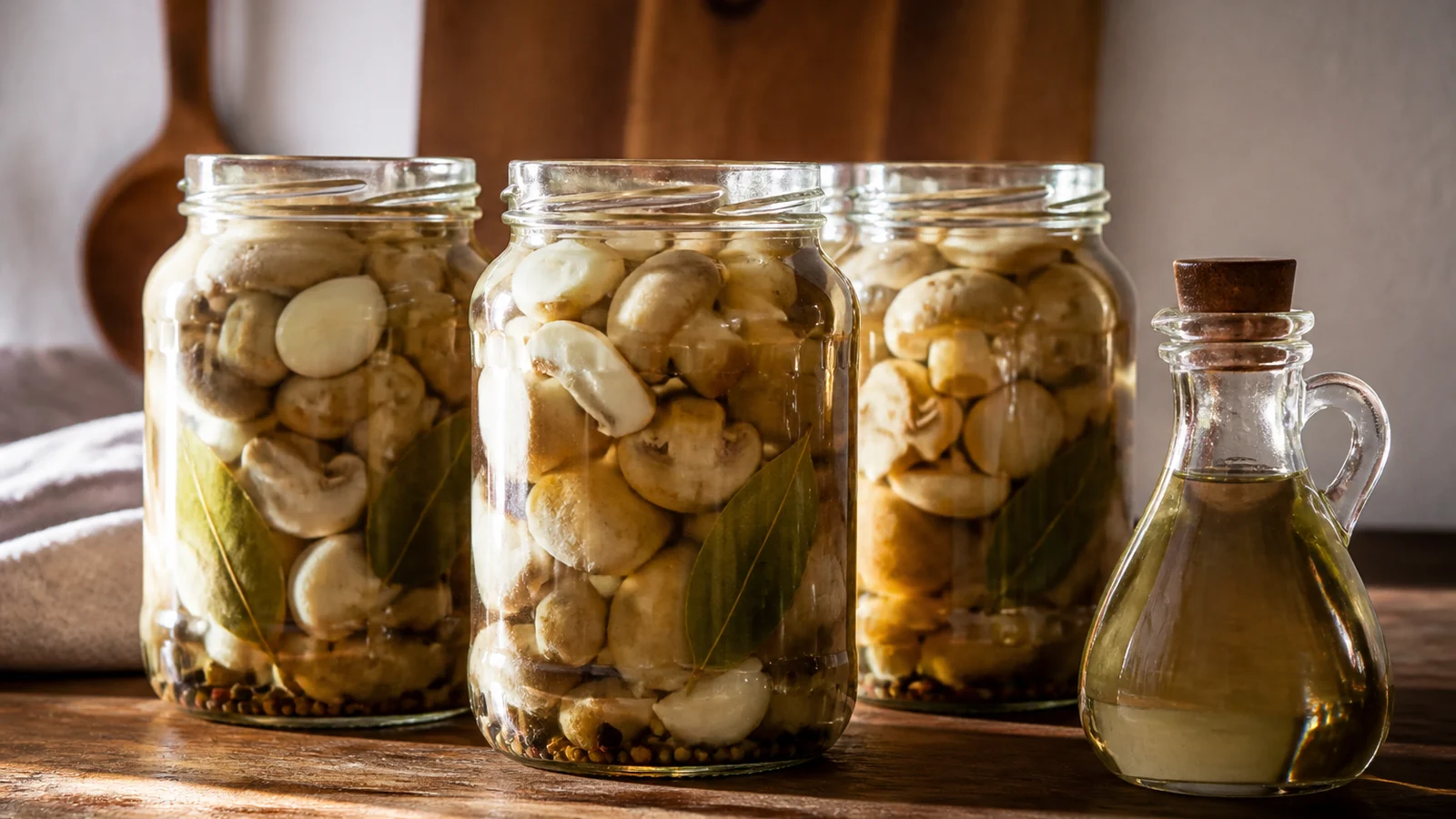
A preservation guide separating two products that share the name pickled mushrooms, covering why a low-acid food cannot be made shelf stable by boiling alone, a complete refrigerator pickle you can adjust freely, the tested shelf-stable recipe with its real proportions and why altering them removes the safety, what oil specifically does in an untested jar, filling and checking seals, and what the finished jar is like.
Two completely different foods are sold under the name pickled mushrooms, and only one of them is something you can invent.
One lives in the refrigerator, keeps for a few weeks, and can be adjusted to taste with no consequences. The other sits in a cupboard for a year, and every proportion in it is doing safety work.
Keep refrigerator pickles refrigerated. Shelf-stable canning requires its own tested recipe and process.
Two different foods share this name
They use the same ingredients. What separates them is what is keeping them safe.
| Version | What preserves it | Where it lives | Can you adjust it |
|---|---|---|---|
| Refrigerator pickle | Cold, mostly | The fridge, for a few weeks | Freely, it is a flavor decision |
| Tested shelf-stable jar | A specific acid load, held throughout | A cupboard, for around a year | No, the proportions are the safety |
| Improvised shelf-stable jar | Nothing reliable | Nowhere it should be | There is nothing to adjust safely |
| Anything packed in oil without tested acid | Nothing at all | Straight in the bin | No |
Two of those four rows describe something you should not be making.

Those middle two rows look identical from the outside, which is the whole problem. An improvised cupboard jar has the same color, the same ingredients and the same seal as a tested one.
If cupboard storage is what you actually wanted and canning is not appealing, there are two easier answers. Drying mushrooms gives shelf stability with no acid arithmetic at all, and freezing mushrooms asks nothing of you beyond fifteen minutes and some drawer space.
Keep refrigerator pickles in the fridge. For shelf-stable jars, use a tested canning recipe without changing its safety-critical proportions.
Cooking MushroomsHow to Cook Cauliflower Mushroom Without Trapping GritWhy mushrooms are the awkward case
Cucumbers are easy to pickle. Mushrooms are not, and the reason is a category rather than a technique.
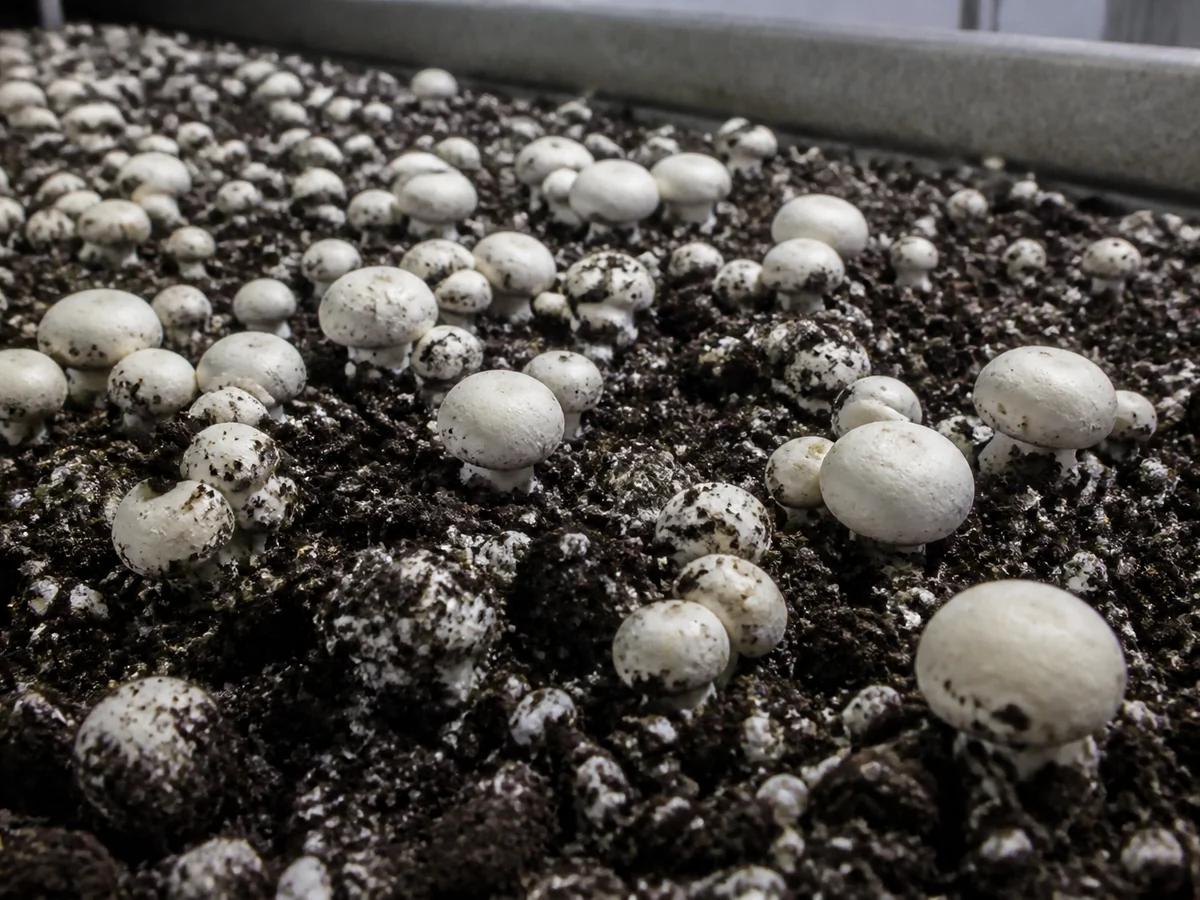
Mushrooms are a low-acid food. That is a formal classification, and it puts them in the group that boiling water processing cannot make safe on its own.
Keep the storage conditions attached to the recipe.
A sealed jar of low-acid food processed only in boiling water is a container that has been cleared of competition and sealed away from air. That is a description of ideal conditions, and the organism it suits produces one of the most dangerous toxins known.
Acid is what closes that gap, because below a certain acidity the spores cannot germinate at all.
So a pickle is not a mushroom with vinegar on it. It is a mushroom moved into a chemical environment where the dangerous organism cannot operate, and the vinegar is the mechanism rather than the seasoning.
One more thing follows from being in the tested-recipe world at all. National guidance excludes wild mushrooms from its preservation recipes and specifies cultivated caps, so foraged material has no tested shelf-stable option.
The refrigerator version, which you can improvise
Here is the good news, and it is most of what people actually want.
A refrigerator pickle is preserved by being cold. Acidity contributes flavor and some inhibition, but it is not carrying the safety load, which is why you can change the recipe as much as you like.
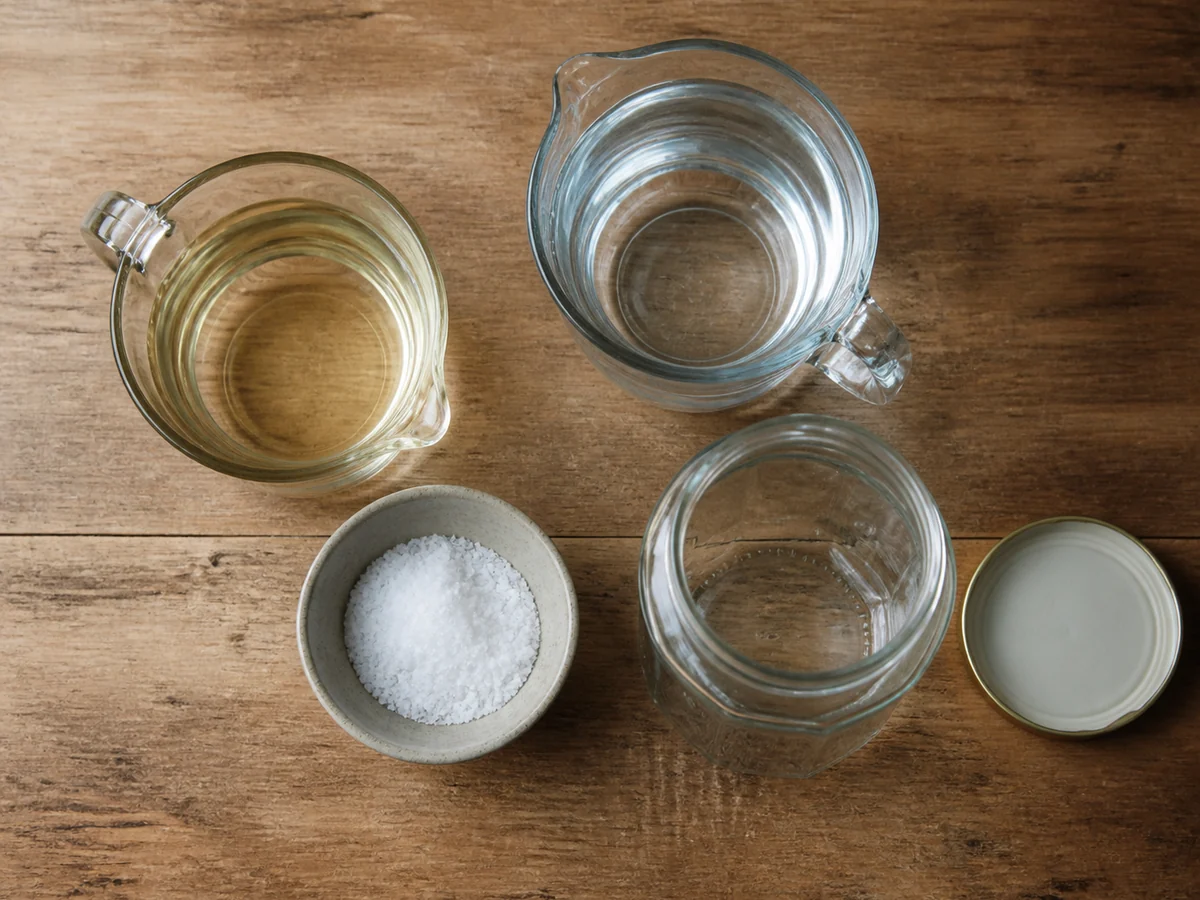
Five decisions cover the whole thing, and only one of them is fixed.
- Brine to start from
- Equal parts vinegar and water, with salt and sugar to taste
- Best material
- Small firm caps, whole or halved, that will hold their shape
- Poor material
- Delicate thin-fleshed species, which collapse into the liquid within days
- Before jarring
- Simmer the mushrooms in the brine for a few minutes to drive out trapped air
- Ready to eat
- Three days minimum, and better at two weeks
That simmering step is the one people skip, and it is the one that changes the result.
Raw mushrooms are full of air, so they bob to the surface and sit above the brine, and anything above the brine is not pickling.
A few minutes in the hot liquid drives that air out and the caps sink and stay down. It also softens them slightly, which is the texture most people are expecting anyway.
Small firm caps are the right material here. Button mushrooms are the standard choice because they are dense and uniform, and delicate species like oyster mushrooms go slack in the brine and turn into something unpleasant within a week.
Aromatics are entirely up to you, and none of them affects anything except the taste.
- Peppercorns and bay for something plain that goes with everything
- Garlic and dill for the version most people picture when they hear pickled mushrooms
- Chili and mustard seed for heat, added whole so you can fish them out later
- A strip of lemon peel, which reads as brighter without changing the acidity meaningfully
If the mushrooms in front of you are not going to be pickled today, how you store fresh mushroom material in the meantime matters more than which vinegar you eventually choose.
Cooking MushroomsHow to Cook Black Morels: Halve Them, Never Slice ThemThe tested version, which you cannot improvise
There is a properly tested shelf-stable recipe for marinated mushrooms, developed and processed to a known acidity. It is worth using and it is worth using exactly.
Every number in that paragraph was arrived at by measurement rather than by taste.
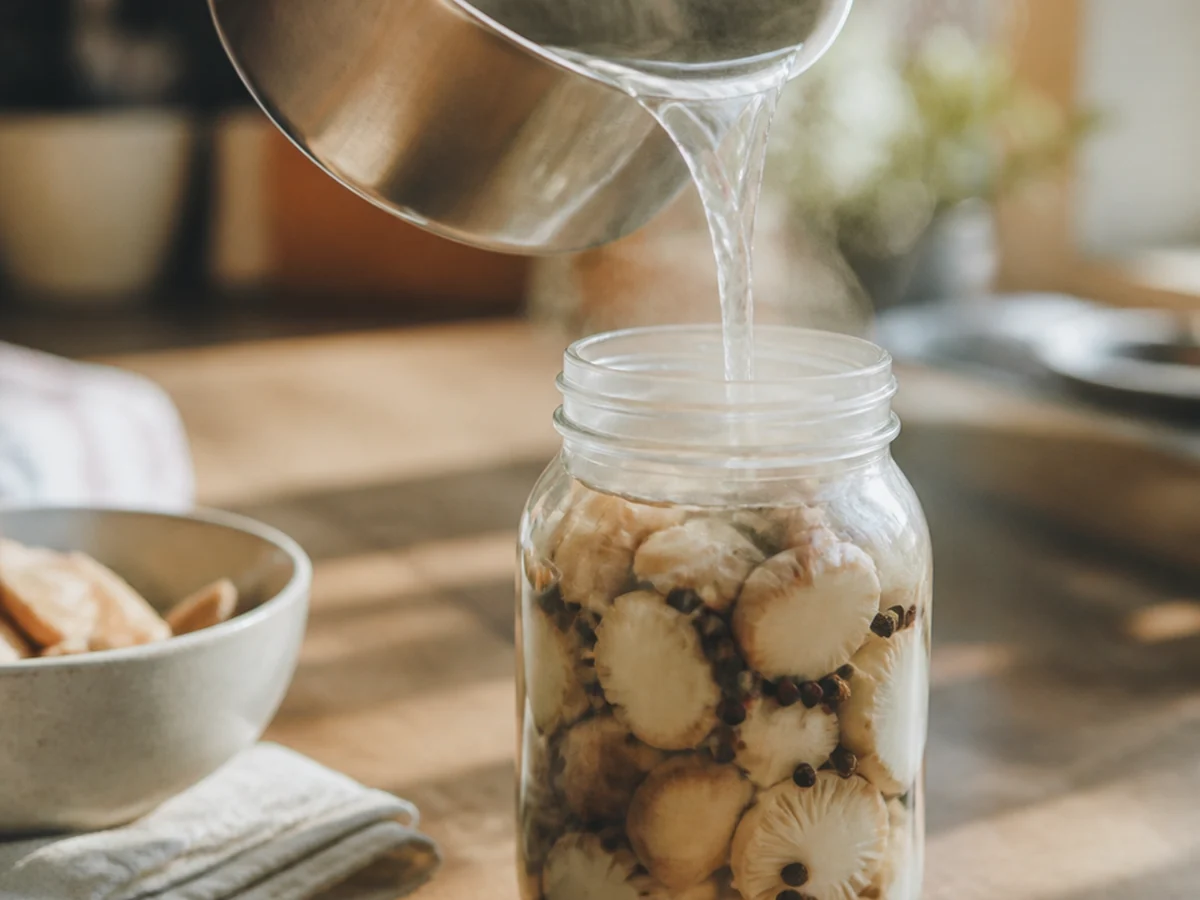
Several details in that recipe look arbitrary and are not.
- Cap size is capped at an inch and a quarter, because a larger cap takes longer for acid to penetrate
- Stems are trimmed to a quarter inch, since stem tissue is denser than cap tissue
- The five minute simmer in lemon juice and water starts the acidification before the jar is even filled
- Half-pint jars are specified, because processing time was calculated for that volume of contents
Two of them are worth expanding on.
Bottled lemon juice is specified rather than fresh. Bottled juice has a consistent acidity that a laboratory can rely on, and fresh lemons vary from fruit to fruit by more than the margin the recipe is working with.
The second is the ratio itself. Two and a half cups of vinegar and half a cup of lemon juice against two cups of oil is an acid load calculated against a known quantity of low-acid material rather than a flavor balance somebody liked.
Warning
Published guidance states that this recipe provides specific acid levels formulated for safe canning, and that modifying the quantities or ingredients could compromise safety and is not recommended without tested research. Adding more mushrooms, using a bigger jar, cutting the vinegar or swapping in a different acid all change the thing the safety depends on.
If what you wanted was plain canned mushrooms rather than pickled ones, that is a different process again. Plain mushrooms need a pressure canner, processed for forty-five minutes at eleven pounds in a dial-gauge canner at low elevation, and a boiling water canner is not an acceptable substitute.
Cooking MushroomsHow to Cook Black Truffle Without Losing Its AromaOil is the ingredient that turns this dangerous
Oil shows up in almost every improvised recipe online, and it is the specific thing that converts an unwise jar into a dangerous one.
It is there because it tastes good and because it looks like a preservative. Everything about a jar of mushrooms under oil suggests permanence, which is exactly the problem.
Warning
Oil does not preserve food and has no antimicrobial effect of its own. What it does is exclude air, which creates precisely the oxygen-free conditions that botulinum toxin develops in. Products stored in oil, including garlic, eggplant and mushrooms, have been implicated in botulism cases, and extension guidance is explicit that oil provides favorable conditions for the toxin rather than protecting against it.
The tested recipe contains oil, which confuses people. In that recipe the oil sits alongside a calculated acid load and a specified processing time, so the acidity is controlling the hazard and the oil is simply a flavor ingredient inside a tested system.
Oil added freely to an untested jar has no such backup, and the oil is not the preservative in either case.
The practical rule is short. Oil in a refrigerated jar eaten within a couple of weeks is fine, oil in a tested recipe followed exactly is fine, and oil in anything else destined for a cupboard is not.
Jars, headspace and knowing the seal held
The mechanical side is ordinary preserving practice, and two details are specific enough to be worth stating.
Two of those four are things you can see through the glass afterwards.

Checking the seal is a two second job that people skip. Once the jars are cool, the lid should be slightly concave and should not move or click when you press the center of it.
A lid that flexes did not seal. That jar is not spoiled and it is not shelf stable either, so it goes into the refrigerator and becomes the refrigerator version from that moment on.
Label the jars with the contents and the date, because in eight months a row of similar jars is unreadable and the one you are unsure about is the one you will open.
What the finished jar is actually like
The acid changes the flesh, and that change is most of what you are buying with the effort.
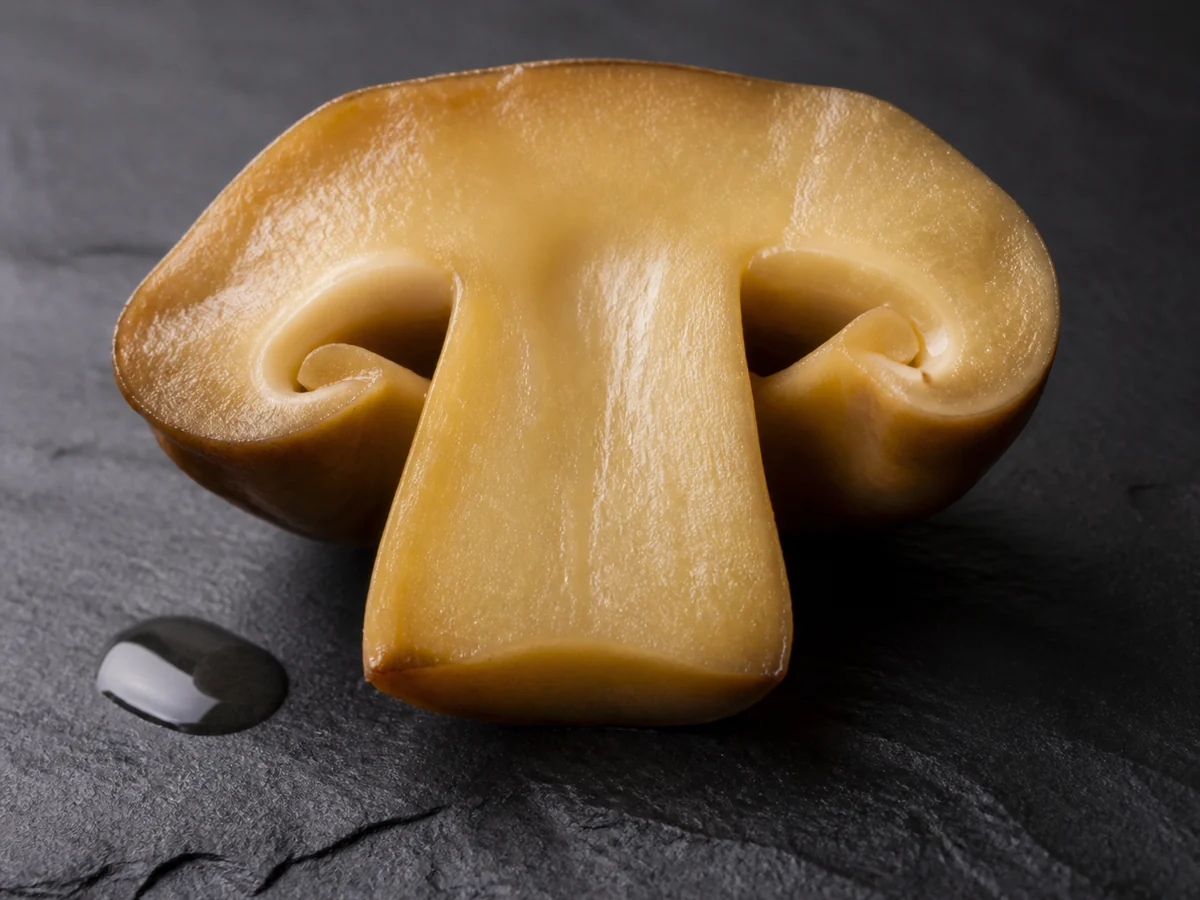
A pickled mushroom is denser and slightly translucent, and it holds its shape under a fork. That is the opposite of what freezing does to the same material.
Which makes the two methods suit different jobs entirely.
- Pickled caps go into salads, on boards, and anywhere they will be seen and bitten
- Frozen material goes into anything wet where its softness disappears
- Dried material goes wherever concentrated flavor matters more than substance
Timing matters more than people expect. A jar opened the next day tastes of raw vinegar and very little else.
That last line is not a general caution. For a shelf-stable jar it is absolute, because the hazard this whole page is organized around is odorless, tasteless and not something you can check by trying a little.
Firmer species behave differently in the jar and are worth experimenting with once the method is familiar, and shiitake caps hold up unusually well because the flesh was dense to begin with.
If concentrated flavor rather than a preserved vegetable was the goal, drying and grinding produces mushroom powder instead, which keeps for a year in a jar and asks nothing of your acid arithmetic.
Sources & References
- National Center for Home Food Preservation, Marinated Whole Mushrooms The tested acidified recipe with its proportions, cap size, jar size, headspace and processing times, and the warning that modifying it could compromise safety.
- National Center for Home Food Preservation, Mushrooms Whole or Sliced That plain mushrooms need a pressure canner at 45 minutes and 11 PSI at low elevation, and that wild mushrooms should not be canned.
- Penn State Extension, Caution: Canning with Fats and Oils That oil does not preserve food and provides favorable conditions for botulism toxin, with mushrooms named among the products implicated.
- National Center for Home Food Preservation, general canning information That pickled vegetables need adequate vinegar or bottled lemon juice to control Clostridium botulinum, and that pressure canning is the only recommended method for low-acid vegetables.