
 Poisonous

Why alcohol can cause illness days after an inkcap meal
The coprine reaction runs on two clocks: the time someone ate the mushroom and the time they later drank alcohol. People who felt fine after the meal can still fall ill after a later drink. Feeling well that evening does not close the exposure history. NAMA reports reactions when people drank alcohol as much as five days after eating common inkcaps. That five-day figure measures the gap after the meal, and it differs from the time symptoms take to appear once alcohol arrives.
The clinical review by Wennig and colleagues puts the onset of coprine syndrome at about 15 minutes to two hours. NAMA notes that symptoms may start within minutes of alcohol. Both set the symptom clock from the drink. Neither means an unidentified mushroom meal becomes harmless after two hours.
Take a meal on Monday and a drink on Thursday. Under the reported five-day window, both dates belong to one exposure history. The example shows why both dates count. It does not predict that a particular person will react, and it is no schedule for testing the mushroom.
The reaction can go beyond an unpleasant flush to a racing heart and low blood pressure. Those cardiovascular effects explain why the medical assessment looks at the person's condition as well as the mushroom's name. The nickname tippler's bane records the link with drinking, yet it cannot identify a specimen or measure the toxin. Someone who guessed inkcap and later fell ill still needs a medical check if the identification or the meal's contents are in doubt.
How gray caps change and where comparisons break down
Young clusters carry far more evidence than a puddle of ink. Intact caps keep their outline and surface. The underside and a complete stem show features that a photo from above cannot capture.
The gray to gray-brown cap starts oval and expands into a cone or convex bell. It stays fairly smooth apart from fine scales or a scruffy patch near the center. Faint radial lines grow clearer as the cap opens.
Kuo's species account gives a young cap height of 3 to 6 cm and an expanded width of up to 10 cm. Height and width refer to different stages, so comparing a closed cap's height with an open cap's width invents a false size gap. Treat both figures as descriptive ranges, never as pass-or-fail identification measurements.
Crowded gills start whitish, turn black and then liquefy. Mycologists call that breakdown deliquescence. As it runs, the cap margin and gill structure disappear, and so do details that could have separated similar mushrooms.
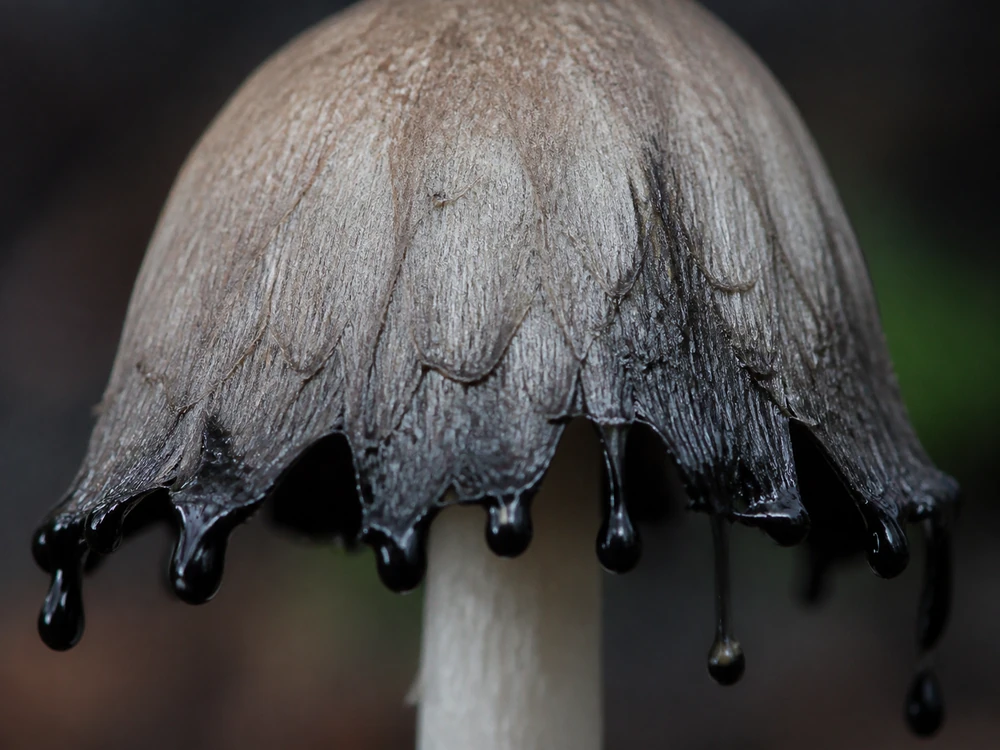
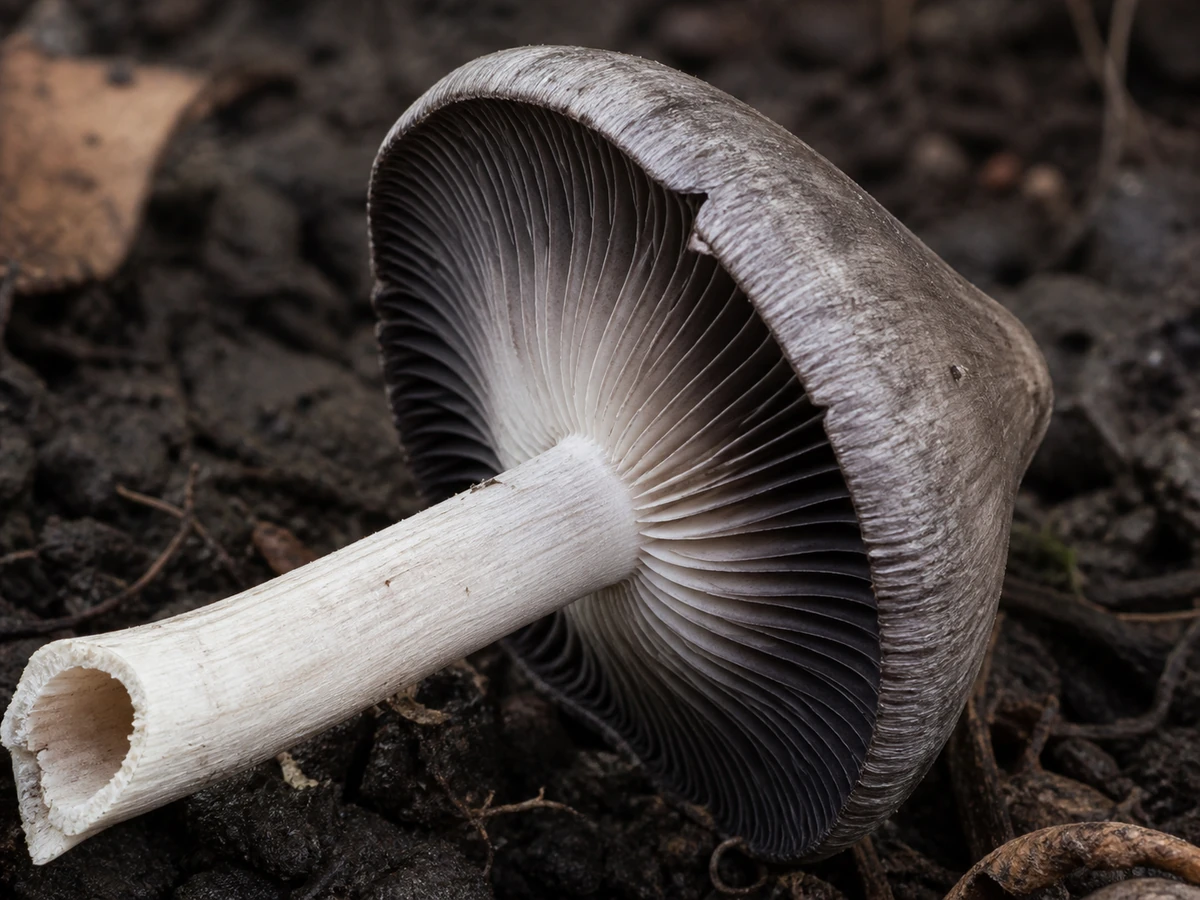
The white, fibrous, hollow stem supports the description, though plenty of other mushrooms have hollow stems too. Kuo's account allows gills that attach to the stem or stand free of it, so no single attachment appearance can confirm this species. The black spore print adds an observation independent of cap color. Liquid from a collapsing cap can stain the paper, though. Black smears tell you less than a print dropped from intact gills.
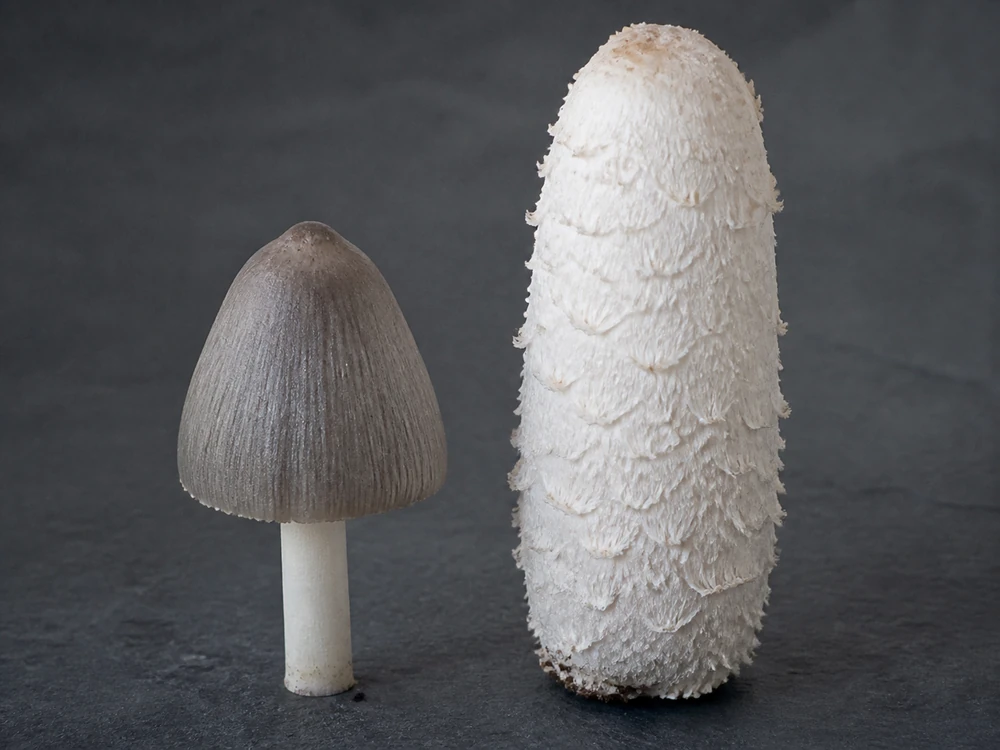
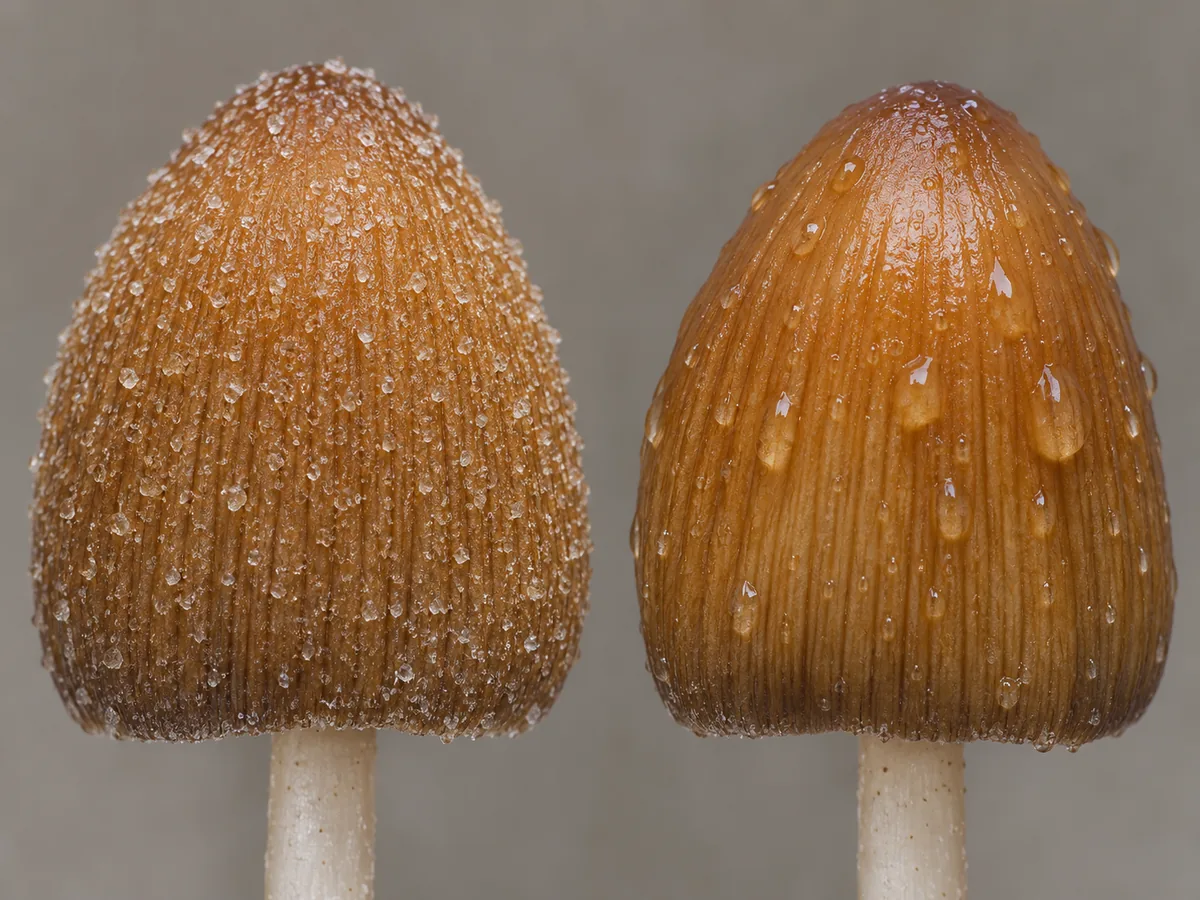
Shaggy mane (Coprinus comatus) has a young whitish, elongated cap with large shaggy scales. Mica cap (Coprinellus micaceus) is generally smaller and honey-brown to amber, with fine glistening granules on fresh caps. Both can grow close to common inkcap, so the contrast has to come from young caps.
| Character | Common inkcap | Shaggy mane | Mica cap |
|---|---|---|---|
| Young outline and surface | Gray oval cap, with fine scales chiefly near the center | Long whitish oval or cylinder with large shaggy scales | Smaller honey-brown or amber cap, initially carrying fine granules |
| Change with age or weather | Expands and loses its margin as it inks | Gills and cap also turn to black ink | Rain or dew can remove granules before the cap breaks down |
| Context | Often clustered over decaying roots or buried wood | Lawns, wood chips and hard-packed ground can overlap | Clusters on visible or buried decaying wood can overlap |
| Limit of the comparison | A smooth gray cap alone is insufficient | Shared ink-making does not establish shared alcohol safety | Missing granules do not establish common inkcap identity |
The large-scale contrast with shaggy mane works best before its white cap collapses. Once both mushrooms have become black remnants, most of the difference the comparison relies on has gone.
Mica cap raises a separate difficulty, because rain can erase a useful surface character. Rain-washed mica caps can lose their familiar glitter and still be mica caps. Growth from buried wood cannot rescue the comparison either, since both species use that substrate.
Close forms inside the common inkcap species group complicate the picture further. Kuo's description of Coprinopsis atramentaria discusses different amounts of veil. It also covers a scaly form treated as Coprinopsis romagnesiana, so the two familiar comparisons fall short of a complete key. Experts may sort close forms with a microscope, and no website image can supply that view of the mushroom in your hand.
Why lawn clusters can hide a wood substrate
Common inkcap is a saprotrophic wood decomposer that feeds on decaying woody material. Clusters coming up through grass may connect to buried roots, timber or an old stump, while the grass itself feeds them nothing. Picture a lawn where someone removed a tree years ago and left its roots in the ground. Inkcaps near that old tree site fit the documented root-associated ecology, although the location alone cannot prove which fungus produced them.
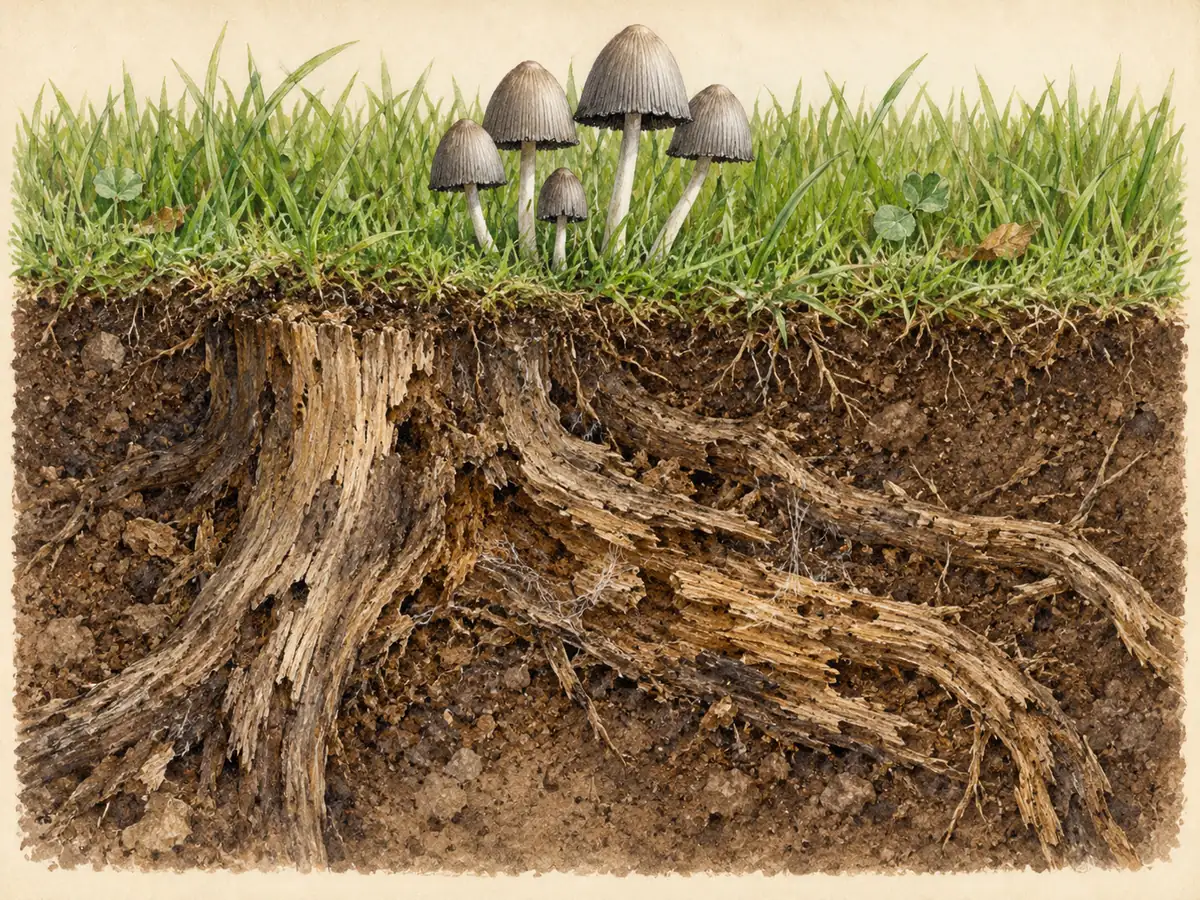
In some woodland finds, visible wood makes the substrate easy to recognize. Urban parks, gardens and paved edges hide it, which explains how a wood-decomposing mushroom becomes familiar in places that seem to offer only soil. The North American species account describes spring, summer and fall fruiting, with occasional winter records. Woodland Trust's UK account gives spring to early winter after rain. Neither gives a fixed date or delay for a particular garden.
Rain and a suitable substrate set the scene for fruiting without guaranteeing an identification. Mushrooms brought up by one spell of wet weather can belong to different species, and matching this broad season cannot establish common inkcap or its safety. The cluster on your lawn still needs the cap, gill and stem evidence.
Why a drinking interval is not an edible classification
Do not collect common inkcap for a meal. Older descriptions call it edible when nobody drinks alcohol. Yet the drink that triggers the reaction can come after the meal. And a past meal that caused no symptoms says nothing about the dose or identity of the next collection.
The Woodland Trust warns about alcohol in the three days before or after eating it. NAMA reports reactions as much as five days afterward and advises even non-drinkers to avoid the mushroom. The Woodland Trust's shorter window cannot erase that later report.
The five-day avoidance advice applies to someone already exposed. It does not recommend eating the mushroom after planning a drink-free week, and it does not replace individual advice from a poison center. No source cited here gives a safe mushroom portion or a safe alcohol amount for any individual.
Warning
No tasting or cooking test
Do not taste common inkcap to investigate its edibility. Cooking is not a reliable way to make a poisonous wild mushroom safe, and this profile offers no heat treatment, portion or drinking schedule that clears it.
Flavor descriptions would not answer the portion question either, because taste reveals nothing about toxin content and cannot predict a later reaction. If someone used alcohol-containing food or another product after suspected ingestion, that product and its amount belong in the exposure history. These sources do not justify treating every such exposure as equal to a drink, or calling a small exposure harmless. The poison center can assess what actually happened.
Why coprine resembles disulfiram without becoming a treatment
Alcohol metabolism produces acetaldehyde, and aldehyde dehydrogenase, usually shortened to ALDH, takes part in processing it further. In coprine poisoning, impaired ALDH-related processing can let acetaldehyde build up after ethanol. That buildup explains how a later drink can make someone ill even though the mushroom meal came earlier.
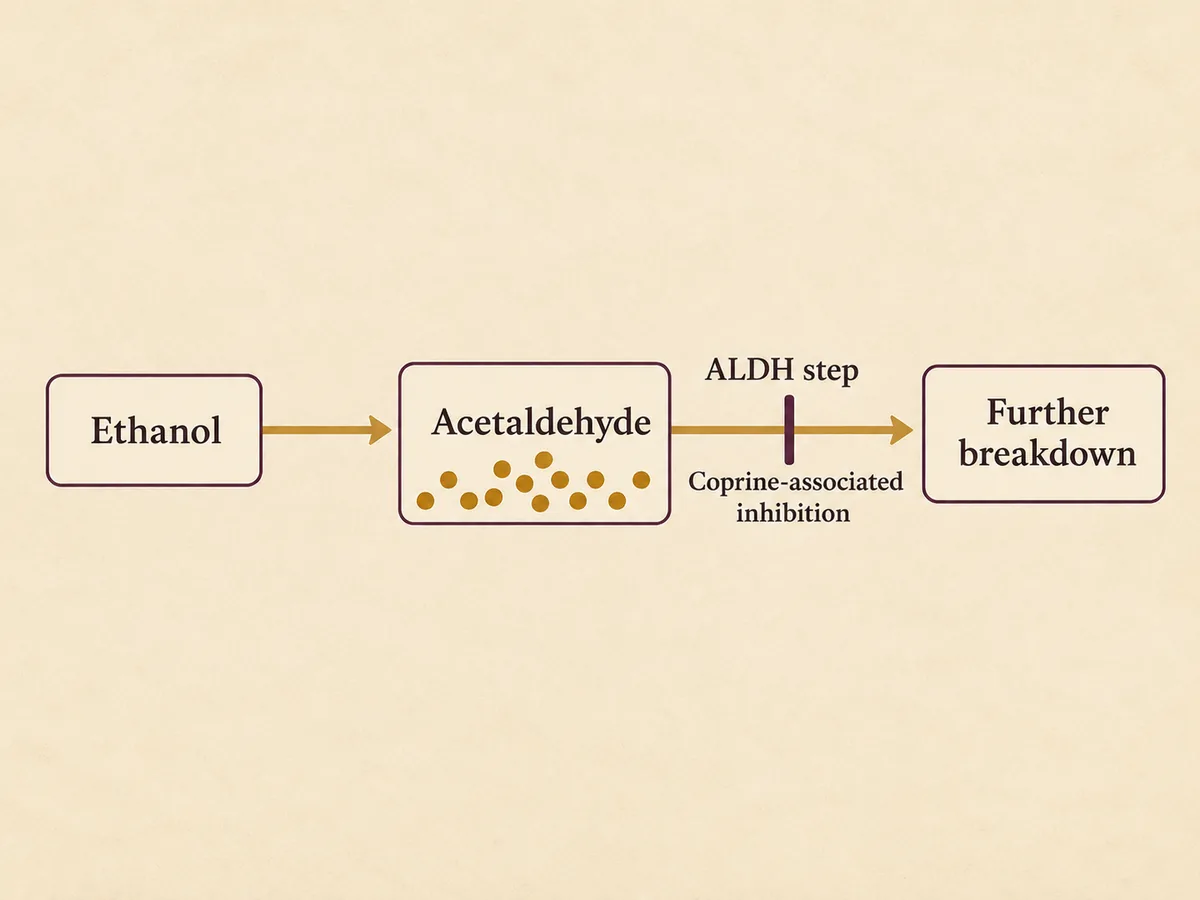
Writers often compare the mechanism with disulfiram, and the comparison has limits. The 1978 rat study measured the ratio of acetaldehyde to ethanol in exhaled air as a sign of ALDH activity. Both compounds raised that ratio after the researchers gave ethanol. Disulfiram also inhibited the study's dopamine beta-hydroxylase measure, while coprine did not. Ethanol lowered blood pressure after either pretreatment, yet a faster heart rate came with that drop only in the coprine-treated animals.
The earlier isolation study found more acetaldehyde after ethanol in living mice. Yet isolated coprine did not block the mouse-liver enzyme in a test tube. The living animals and the isolated enzyme tested different contexts. Their gap warns against assuming that a simple direct test of the isolated compound captures everything that happens after someone eats the mushroom.
Neither paper tested common inkcap as a treatment for people. Experimental compounds, animal dosing and laboratory outcomes cannot establish a usable amount, a benefit or safety for a variable wild mushroom. The resemblance to disulfiram therefore supports no medicinal recommendation.
Why removing caps does not remove the buried fungus
Clusters that come back can signal that their decaying wood substrate is still in place. Pulling the visible caps leaves buried roots and timber untouched, because the mushrooms are only the brief, visible fruiting bodies of the fungus. Fewer caps right after removal show that you removed what was visible, without showing that the buried fungus or its food has gone. Later fruiting would not necessarily mean the cleanup was incomplete, or that new mushrooms migrated in from another lawn.
Finding the old root system or buried wood may be hard without digging up the ground. Presumed inkcap clusters alone do not justify diagnosing a living tree as diseased, removing healthy landscaping or promising eradication with a lawn treatment. Where accidental ingestion is possible, reducing access to visible mushrooms deals with that immediate situation.
Photographs and kept material stay useful before the remaining caps collapse, but collecting evidence must not delay contacting the appropriate poison service. The fungus's ability to decompose wood gives no reason to cultivate it for food. This field ecology supplies no home-growing protocol and no way to make coprine exposure safe.
Which exposure details matter to Poison Control
If you suspect someone ate common inkcap, get prompt poison-center advice and do not wait for an alcohol reaction to confirm the name. In the United States, Poison Control is available at 1-800-222-1222; elsewhere, the local poison or medical service provides the appropriate route. Stop drinking alcohol after suspected ingestion and report any alcohol already consumed. The advice may depend on the actual products, amounts, timing and current condition. The product label itself tells the poison center more than a guessed number of drinks.
Rapid heartbeat and flushing fit the described syndrome, but they cannot diagnose it at home. Mixed dishes or uncertain identifications may involve other mushroom poisoning symptoms, and a later drink does not prove coprine caused every symptom. If the person collapses, has a seizure, has trouble breathing or cannot wake up, call 911 immediately in the United States. Use the local emergency number elsewhere, because waiting for a mycologist's identification would delay the urgent response.
Qualified identification can still inform the medical assessment. The clinical review describes examining mushrooms or leftovers, and microscopic material when needed, alongside the preparation, storage, collection and symptom history. That review found no routine serum or urine coprine test available. Clinical care follows the person's condition, including cardiovascular monitoring when indicated.
Having no toxin test does not rule out a useful assessment. The mention of monitoring is also no instruction to choose a medicine or manage low blood pressure at home. Nutrition tables would leave every one of these decisions open. This profile gives no recommended serving, because food composition cannot remove the species' toxicological and identification problems.
What inkcap names reveal and what they cannot tell you
Older guides and toxicology papers often use Coprinus atramentarius for the species now called Coprinopsis atramentaria. Both names lead to relevant evidence, so an older spelling does not by itself mean a report concerns a different mushroom. The broader word inkcap also covers mushrooms in different modern genera. Shaggy mane remains Coprinus comatus and mica cap is Coprinellus micaceus, so sharing black, liquefying gills does not put all three in one genus.
DNA-based work discussed in Kuo's shaggy mane account places it closer to Agaricus and Lepiota than to these other familiar inkcaps. Ink-making habit and evolutionary relationship therefore answer different questions. Common names, older combinations and new classifications help you read a label or a paper. The specimen in hand and its documented exposure set what anyone can assess about a particular find.

 Caution


