What is a shaggy mane mushroom?
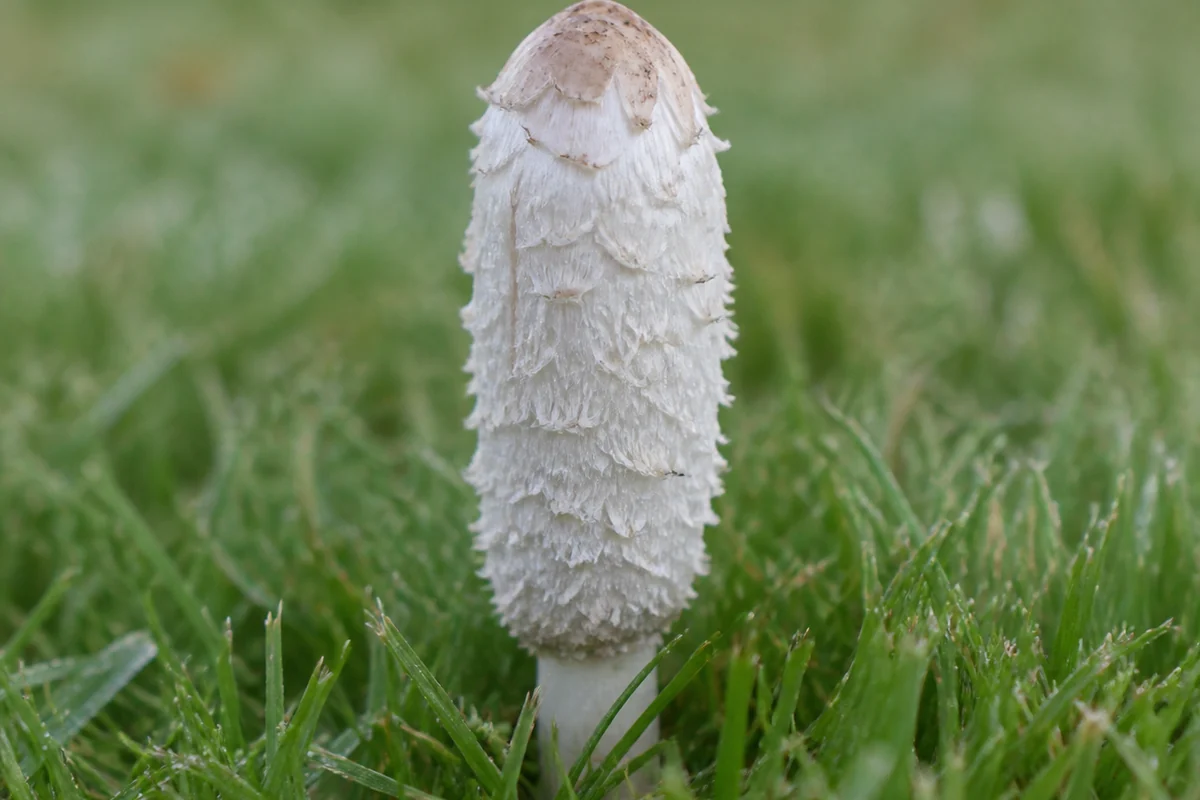
A shaggy mane is a tall white gilled mushroom shaped like a closed cylinder, covered in coarse upturned scales, with a smooth pale brown patch on top.
The scales are what the common names describe. Shaggy mane and lawyer's wig both point at the same ragged white surface, which is the feature that carries the mushroom from a distance.

It belongs to a group of fungi that release their spores by liquefying rather than by drying, and this one is the largest and most conspicuous member most people meet.
Before it is a cylinder it is an egg. The very youngest specimens sit low and rounded in the grass with the scales barely separated, and they are easy to walk past because nothing about them is tall yet.
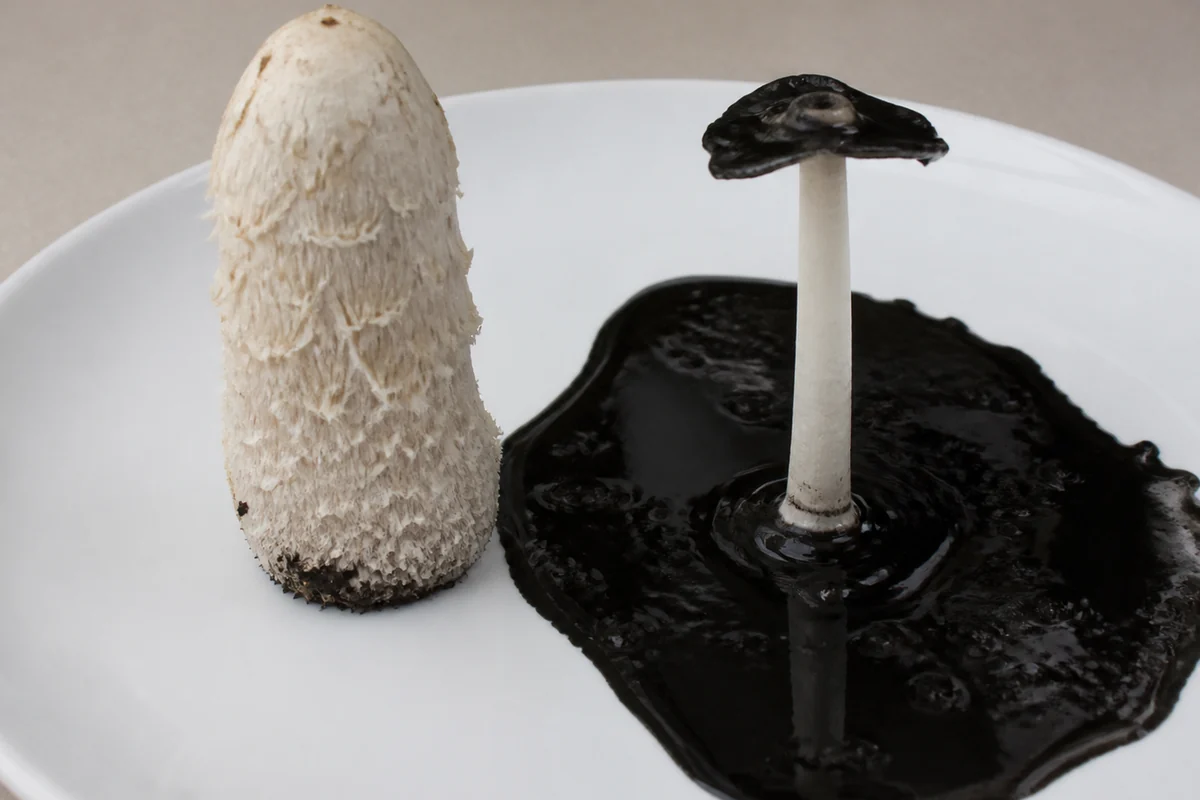
Dissolving is not decay. The mushroom is not rotting when it turns to ink, it is working, and the black liquid is the spore mass being released a layer at a time from the bottom of the cap upward.
How do you identify a shaggy mane?
White with a pale brown top, 5 to 10 cm tall and occasionally 15 cm, up to 6 cm across, standing as a tall cylinder before opening into a bell. The surface breaks into large shaggy scales that curl outward.
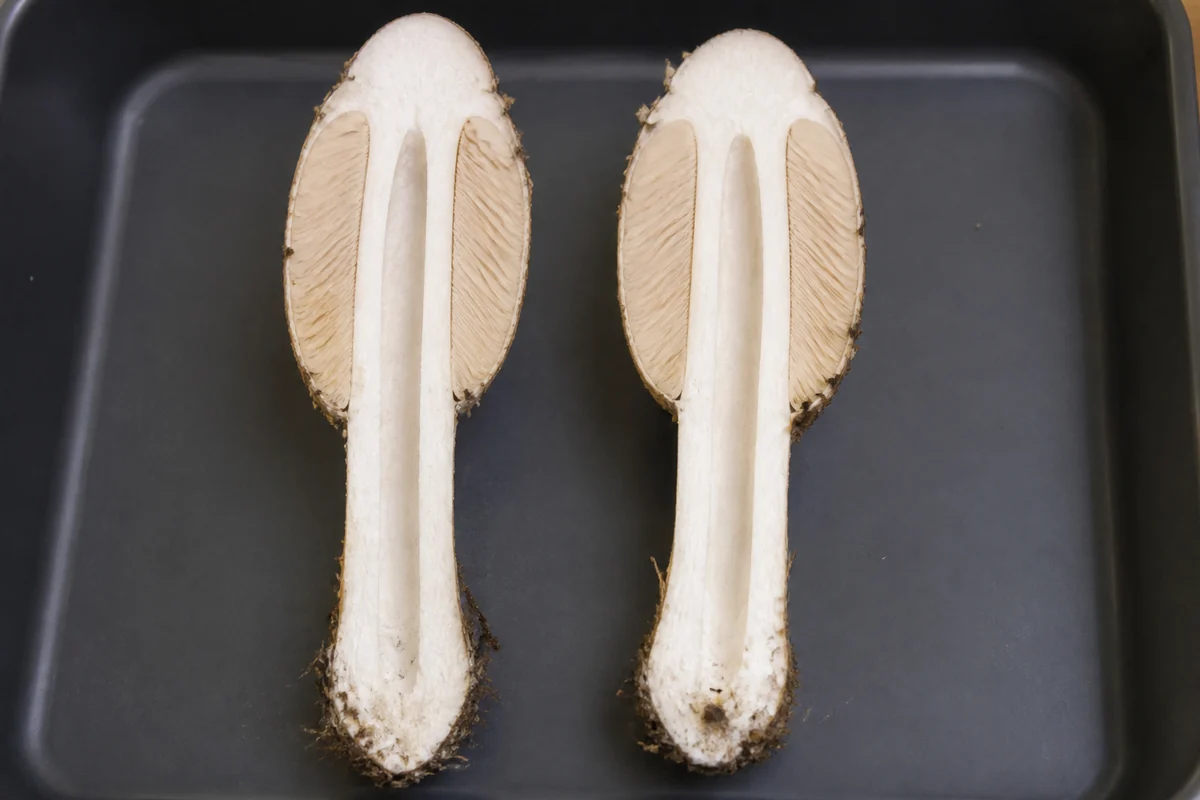
Crowded and free, white at first, then turning pink and finally black before dissolving into liquid from the lower edge upward.
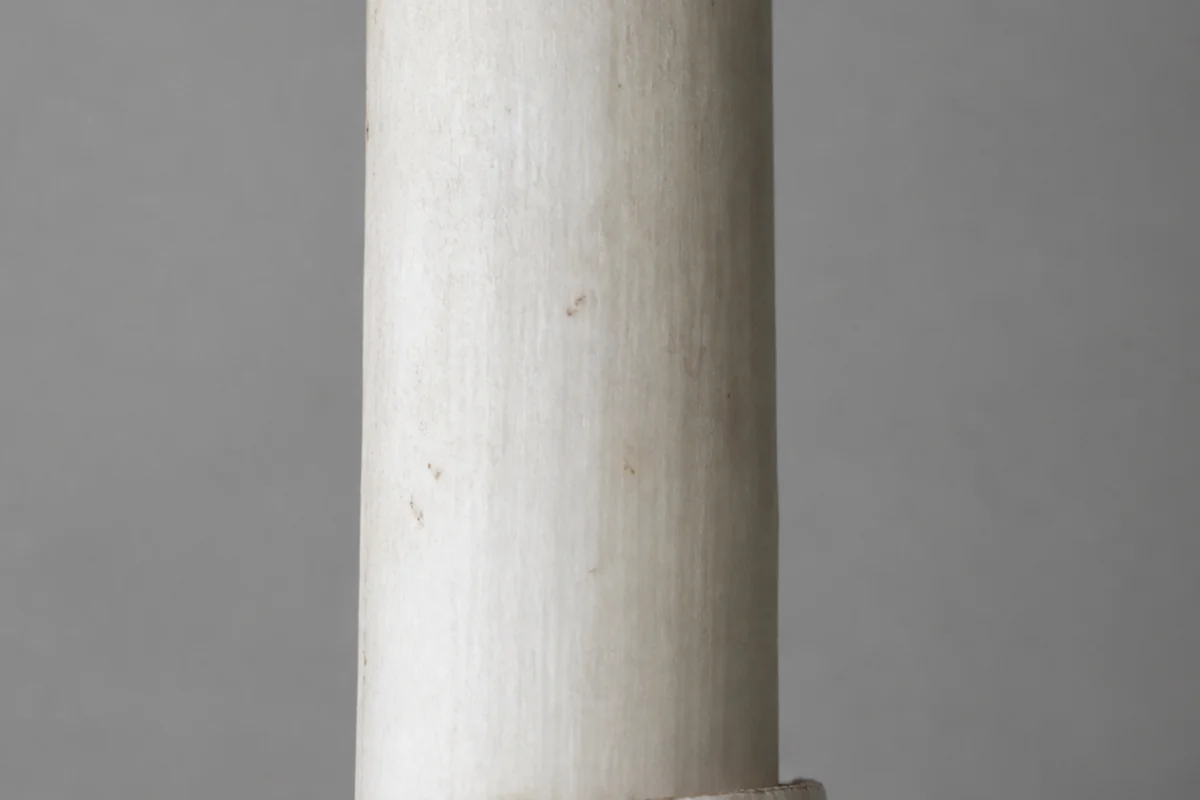
White, smooth, brittle and hollow, up to 30 cm tall and 10 to 15 mm thick, carrying a thin ring that comes loose early and slides down toward the base, where it becomes stained black.
White, soft and thin, with a mild pleasant smell and no distinctive odor.
A shaggy mane is one of the easier mushrooms to name, provided it is young.
Age is a character here rather than a condition, because the features that identify it are the first things the mushroom takes apart.
The measurements are worth carrying because the species is larger than people expect.
| Character | Shaggy mane | Note |
|---|---|---|
| Cap | 5 to 10 cm tall, up to 6 cm wide | Occasionally reaches 15 cm tall |
| Stem | Up to 30 cm, hollow | Brittle and easily snapped in a bag |
| Gills | White, then pink, then black | The color is a clock, not a variety |
| Ring | Thin, loose, slides down | Often found sitting at the stem base |
| Spore print | Black | Rarely needed, since the mushroom prints itself |
The gill color sequence is the most useful thing on the mushroom and the least like a normal field character. White gills mean a young specimen, pink means it has begun, and black means the process is well under way and the mushroom is no longer food.
The word shaggy is doing real work in the name and it is worth being precise about it. The scales are large, they lift away from the surface at their lower edge, and they throw visible shadows across the cap in raking light, which is quite different from the fine flat scales that many mushrooms carry near the center of the cap.
Cutting one lengthwise is worth doing on the first few you find. The hollow stem and the tightly packed pale gills are both easier to read from a cut face than from the outside, and neither takes more than a moment.
A black spore print confirms the group, and it is one of the rare cases where taking one is more trouble than it is worth.
Leave a mature cap on paper for an hour and it will not give you a print so much as a small black pool, because the mushroom prints itself as a matter of course.
What looks like a shaggy mane?
Nothing dangerous closely resembles a young shaggy mane, which makes this an unusually forgiving mushroom to learn. The confusion that does happen is with its own relatives, and the one that matters is the common inkcap.
That mushroom is gray to gray-brown rather than white, smoother rather than shaggy, and squat rather than cylindrical, and it is the species that carries the alcohol problem.
Warning
The common inkcap page holds the full comparison and the detail of the reaction. Anybody who is not certain which of the two they have should read it before eating either.
Smaller inkcaps growing in clusters on wood or in dense troops on the ground are a second group, and they are separated by size and by habit rather than by any subtle character. A shaggy mane is large, it stands alone or in loose groups, and it comes out of soil rather than out of timber.
The other thing people mistake it for is itself at the wrong age. A collapsed black specimen looks like something else entirely, and beginners routinely fail to connect the two.
That confusion runs in a useful direction as well. Somebody who finds a patch of black slumped caps has found a site that will produce again, and the thing to do is note where it is rather than to pick anything.
Warning
The safety question with a shaggy mane is almost never which mushroom it is. It is whether the specimen is young enough, and whether the ground it grew on is ground you would eat from.
How soon do you have to cook a shaggy mane?
The rule is to cook them the same day, and preferably within an hour or two of picking.
This is not the usual advice about wild mushrooms being better fresh. A shaggy mane left on a counter continues doing what it was doing in the ground, and a basket of firm white caps can arrive home as black liquid.
Cleaning is quick because there is very little to clean.
Brush off any grass, trim the base, and split the cap lengthwise if there is grit inside, but do not soak them in water, since they are already mostly water and will not thank you for more.
In the pan they are delicate and mild, closer to a soft young field mushroom than to anything meaty, and they release a lot of liquid.
The volume loss surprises people the first time. A full basket cooks down to a couple of servings, which is part of why the species is treated as a windfall rather than as a crop.
Cooking them hard in a wide pan works better than crowding them, and they suit soups, cream sauces and eggs better than they suit grilling.
Tip
If a batch has started to turn while you were cooking something else, the black liquid is not dangerous and it will color everything it touches. Most people cook the pale ones and discard the rest rather than explaining a gray sauce.
Drying and freezing both work poorly on fresh caps for the same reason.
The mushroom is thin, wet and structurally fragile, so the usual answer is to cook the whole pick immediately and freeze the cooked result if there is too much.
Where do shaggy manes grow?
The shaggy mane is saprotrophic, living on dead organic matter in the soil rather than in partnership with a tree.
What it wants is disturbed ground. Lawns, playing fields, roadside verges, the packed edges of footpaths and the gravel margins of car parks all produce it, often in numbers.
- Ground
- Disturbed soil, grass and path edges
- Habit
- Singly or in loose groups, sometimes in long lines
- Season
- April to November, peaking after summer and autumn rain
- Trigger
- Rain on ground that has been recently disturbed
It fruits after rain and it fruits fast, which is why people describe finding a verge covered in them where there was nothing two days earlier.
The preference for disturbed ground is not a quirk. Digging buries grass, roots and woody scraps and mixes air into the soil, which is precisely the situation a fungus that eats dead plant material is equipped for.
It is also why building sites, new verges and freshly landscaped gardens produce so many. A patch of ground that was turned over last year is often the best shaggy mane ground in a neighborhood.
The long lines are worth recognizing. A row of shaggy manes down the edge of a path usually marks buried material, often the line of an old trench or a strip of ground that was dug and refilled.

That preference for disturbed ground creates the practical problem with this species, and it has nothing to do with identification.
The best-looking specimens tend to grow exactly where mowers, dogs, road salt and lawn treatments are, so the question of whether to pick a particular patch is usually a question about the site rather than about the mushroom.
Can you grow shaggy manes?
The shaggy mane can be grown, and it is one of the few wild lawn mushrooms that can be, because it lives on dead organic matter rather than on tree roots.
Kits and outdoor beds exist, usually sown into a prepared patch of ground or compost, and they fruit on the same schedule as the wild ones after rain.
The method is closer to gardening than to indoor cultivation. Spawn goes into a shallow bed of straw and soil in a shaded spot, the bed is kept damp, and the mushrooms come up on their own timetable rather than on yours.
That timetable is the catch for a home grower. A bed can produce nothing for weeks and then deliver everything at once on a morning when nobody is home to pick it.
Rapid deterioration makes storage and sale difficult.
A mushroom that dissolves within hours of harvest cannot be picked, packed, shipped and shelved, so it stays a garden crop and a forager's mushroom.
Is there any medicinal use?
The shaggy mane appears in laboratory research more often than most lawn mushrooms, usually in work on polysaccharide extracts and blood sugar in animals. None of that supports a medicinal claim for eating it.
There is no clinical evidence base here, and the honest description of this species is a food rather than a remedy.
Is it worth eating for nutrition?
Shaggy manes are mostly water, which is worth saying because the volume you pick shrinks dramatically in the pan. Cooked, they give the ordinary wild mushroom profile of a little protein, some B vitamins, potassium and a useful amount of fiber for very few calories.
This is an edible with a caution attached, and the caution is about timing and about the ground rather than about the food itself.
Nobody picks them for nutrition. They are picked because they appear suddenly in large numbers on ground nobody was watching, and because they are gone again by the weekend.
Can you drink alcohol with shaggy mane?
The question people arrive with is whether shaggy mane causes the alcohol reaction, and the answer runs through a name change. The reaction is caused by coprine, a compound that was isolated from the common inkcap, and it blocks one of the enzymes the body uses to clear alcohol.
Coprine has not been demonstrated in the shaggy mane, and the reference works on mushroom poisoning list the common inkcap and one or two of its close relatives rather than this species.
Note
The two mushrooms were once placed in the same genus, and the warning traveled with the shared name. They are now separated, with the shaggy mane keeping Coprinus and the common inkcap moved to Coprinopsis, but general safety advice still groups them often enough that the caution persists.
The reaction itself is fast and short, which is worth knowing for recognizing it rather than for risking it. It usually begins within a few minutes to a quarter of an hour of drinking, is generally over inside an hour, and the sensitivity can return if alcohol is taken again within a couple of days.
That history is why the two answers you find online contradict each other, and it is worth knowing which kind of source you are reading.
The careful position is that the compound has not been found in this species and that no reference work lists it as a cause, which is different from a guarantee about any individual person.
Anybody who has had a reaction after eating an inkcap of any kind, or who is unsure which species they collected, has a straightforward option available. Leave the alcohol for a couple of days and the question does not arise.
The genus name itself comes from the habit rather than from the appearance. It refers to dung, because the group was first described from species growing on it, which is a reminder that a Latin name records what somebody noticed first rather than what matters most.
Frequently Asked Questions
Is shaggy mane edible?
How long do you have to cook a shaggy mane after picking it?
Can you drink alcohol with shaggy mane?
Why do shaggy manes turn into black liquid?
Is the black ink from a shaggy mane poisonous?
Where is the best place to find shaggy manes?
Sources & References
- Coprinus comatus, Shaggy Inkcap mushroom Field description used for the cap and stem dimensions, the movable ring, the white to pink to black gill sequence, the black spore print, the April to November season, the habitat, and the guidance to eat specimens within an hour or two of gathering.
- Toxic Fungi of Western North America: coprine Reference work used for the account of coprine as a protoxin and for the list of species associated with the alcohol reaction, which names the common inkcap and a close relative and does not include the shaggy mane.
- Coprine Reference summary used for the statement that coprine was isolated from Coprinopsis atramentaria and that other Coprinus species including Coprinus comatus do not contain it, and for the enzyme it blocks.
- Poisoning by Coprinus atramentarius Review of the coprine reaction used as the source for the reaction belonging to the common inkcap rather than to the shaggy mane.