
 Poisonous

Why a familiar lawn parasol can still be poisonous
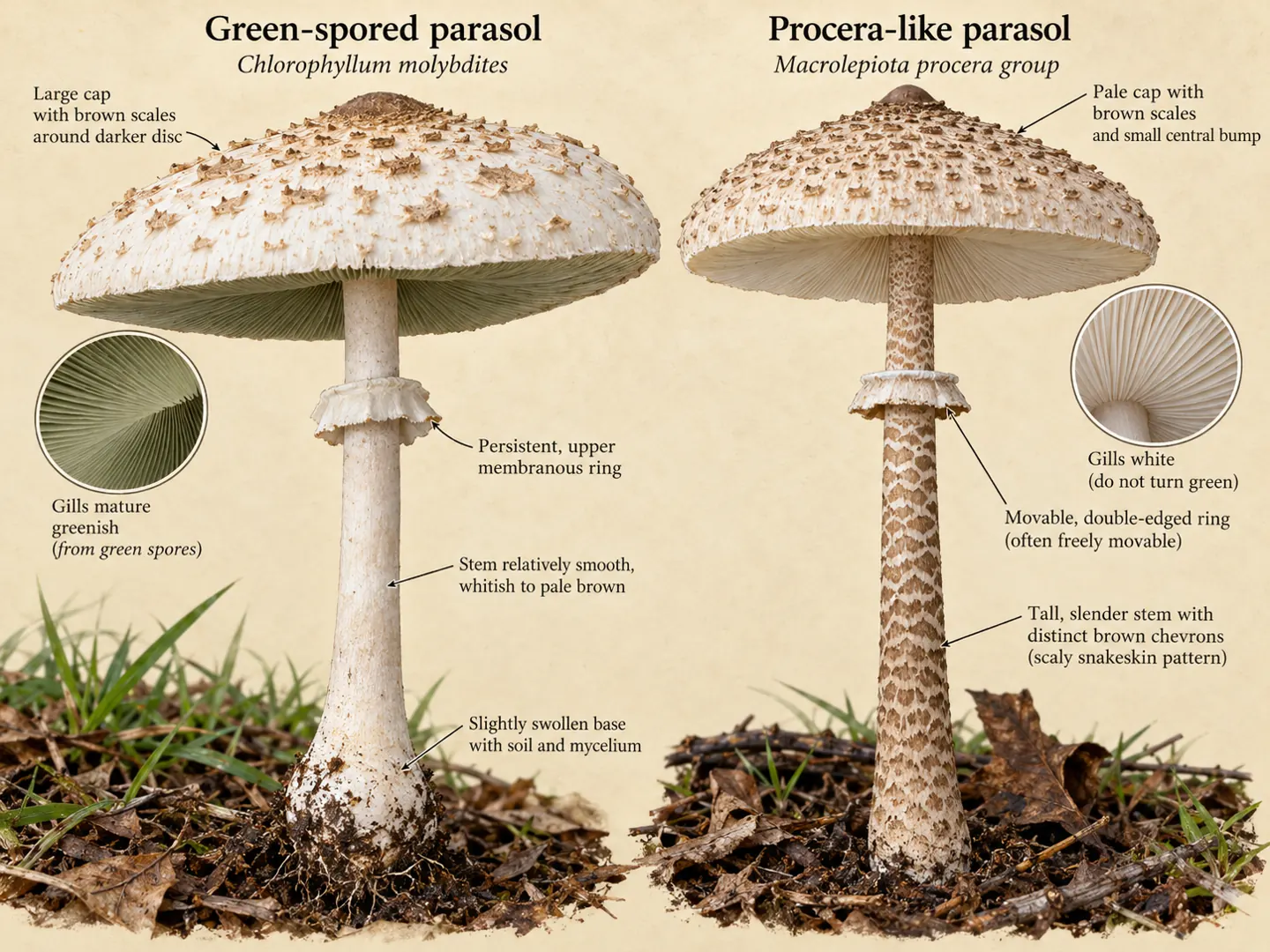
The familiar shape explains much of the confusion: a broad cap with brown scales, a conspicuous stem ring and several similar mushrooms growing in grass. Those features place a specimen among the parasol-like mushrooms without showing that it belongs to an edible species. Chlorophyllum molybdites develops its most distinctive color only as the spores mature. Young caps can therefore lack the very feature the name "green-spored parasol" leads you to expect.
The North American Mycological Association describes it as a frequent cause of mushroom poisoning, including severe gastrointestinal distress. It grows in lawns, where people may gather a meal and children and pets may find fallen caps. Collecting a readable deposit can take several hours, while a suspected ingestion needs poison-center advice right away. Waiting for mature identification evidence must never delay the exposure call.
Cap photographs alone cannot resolve that uncertainty. The underside, the complete stem and base, the specimen's age and its deposit each give a different kind of evidence. You cannot borrow any of them from another cap just because both grew nearby.
Why do the gills change from white to green?
The cap starts rounded or conical and opens into a broad, sometimes nearly flat parasol. Its pale surface breaks into tan, cinnamon or pink-brown scales, often with darker material crowded around the center. Outline and scales stay useful group characters as the cap opens. Other parasols share them, though, so a large scaly cap is a starting observation and never a species verdict.
Gill age changes the meaning of a pale underside
Green-spored parasol has crowded free gills, blades that stop short of the stem. The stem ring is a separate structure, left over from the covering that protected the young underside. Free attachment does not mean the gills are missing, and a ring does not set this species apart from every other parasol. Young blades are white to yellowish, then turn grayish and finally greenish or green-brown. The mature spores building up on them drive much of that change, so a poisonous young specimen can still have a pale underside.
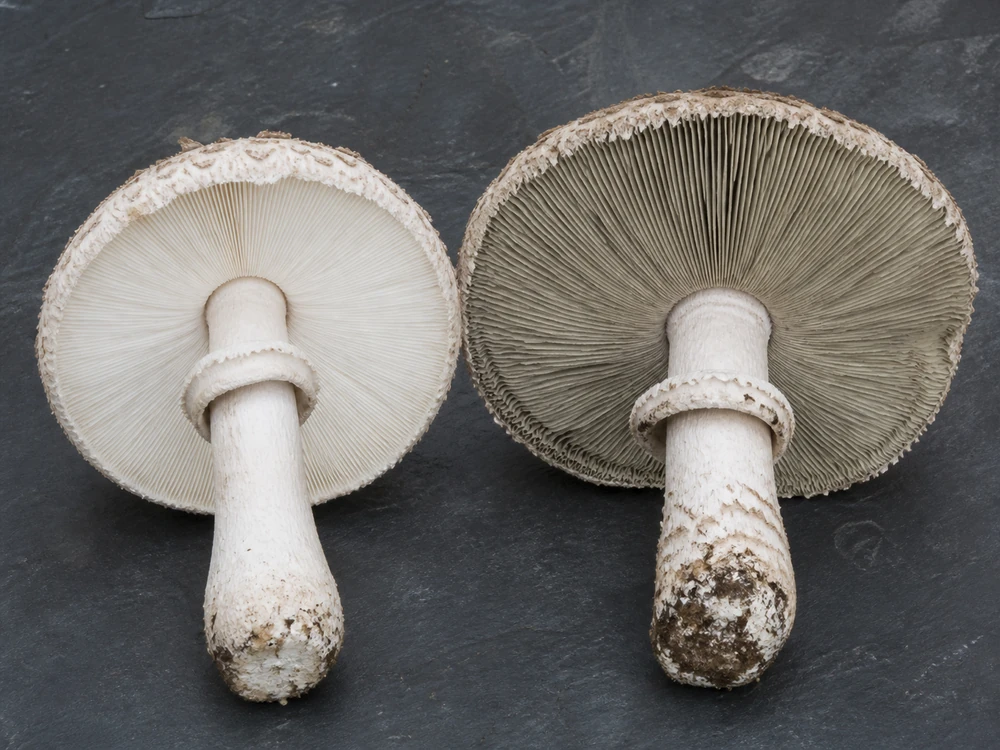
Developing and mature specimens answer different questions. White young blades show that the telltale color is not there yet. Mature greenish blades give positive evidence for C. molybdites when its other structures agree. Arcs that hold several ages can make the sequence visible. It does not prove that every mushroom in the arc is the same species, and one mature cap cannot identify all the young ones.
A spore deposit is a result, not an edibility test
Spore prints collect many spores on one surface, so their combined color becomes easy to see. This species typically leaves a mature deposit of dull grayish green, where shaggy and procera-like parasols leave white. Gills and deposit report the same spores, so they do not count as two independent guarantees of identification.
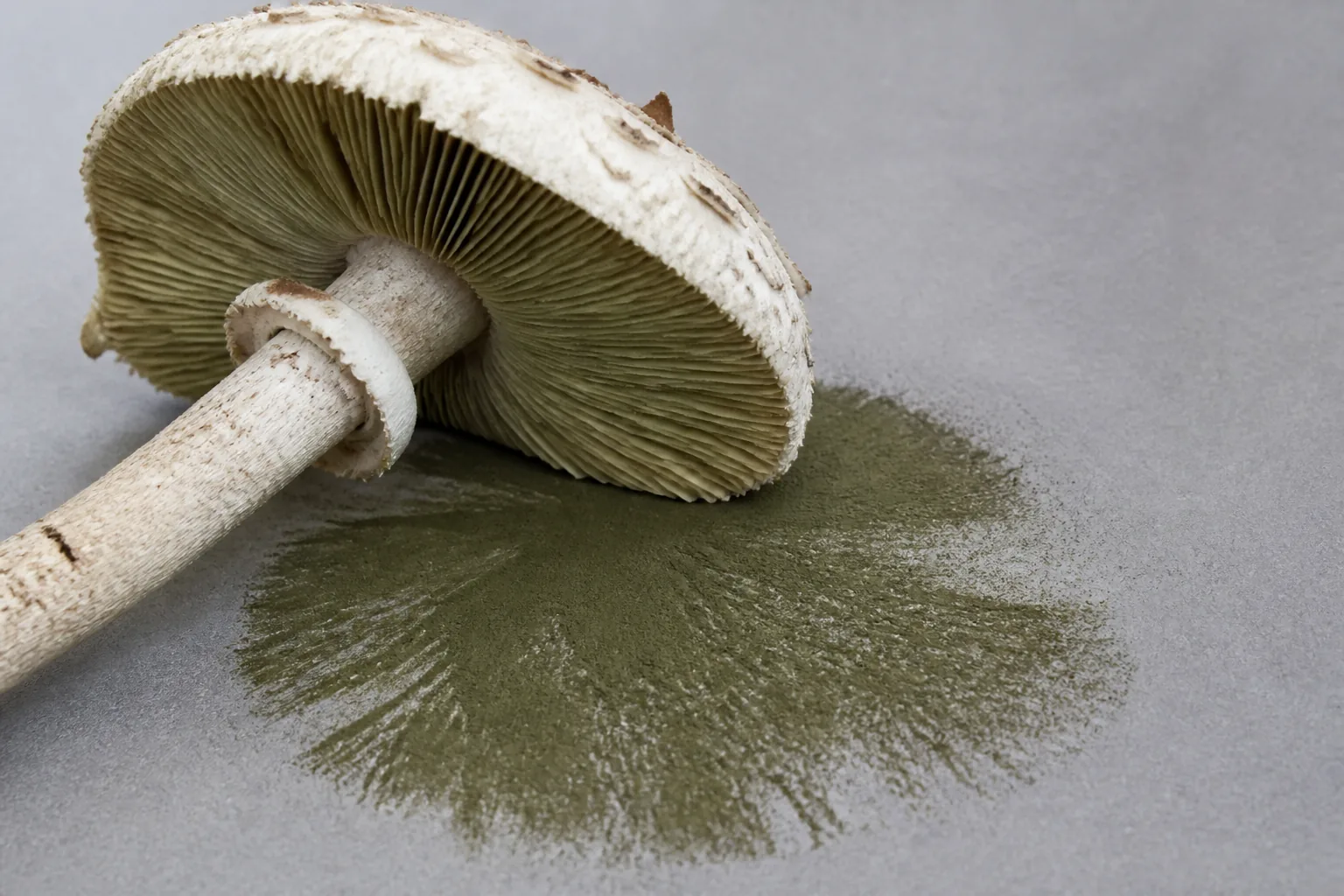
To collect a deposit, rest a fresh cap gill-side down on paper beneath a cover for several hours. Keep the displayed cap identifiable as the source of its own deposit, because mixing material from different specimens breaks that link. The print belongs to identification and is never a taste test.
| Observation | Meaning for this specimen | Remaining uncertainty |
|---|---|---|
| Readable dull green deposit and matching mature structures | Strong support for C. molybdites | Other mushrooms in the collection still need their own assessment |
| Pale gills on a young cap | The mature color may not have developed | This poisonous species remains possible |
| Little or no readable deposit | The test has not supplied a useful color result | Immaturity and occasional sterile specimens can conceal the characteristic spores |
| Readable white deposit from a mature specimen | The observation directs attention toward a different taxon | It does not establish that taxon's exact name or food safety |
Clinicians have warned that occasional sterile specimens lack the characteristic green spores. So you cannot read a blank print as the opposite of a green one. It simply supplies less evidence, and none at all for an edible parasol. Picture a closed lawn cap with white gills and no readable deposit, which has passed no identification test. Its age explains why the expected clue may be missing, and the uncertainty stays with that specimen even if a mature cap nearby looks familiar.
The complete stem adds context. It is usually pale to brownish, smooth or very finely fibrous and a little enlarged toward the base, with a persistent ring whose lower edge can be greenish to brownish. Flesh reactions vary too. The white interior can stay unchanged or slowly turn reddish brown to pale pinkish red, mostly in the base. That rules out the shortcut that any reddening parasol must be a shaggy parasol.
Where the reaction appears carries as much weight as its color. Basal reddening in this species and pink-orange staining near the top of the stem in C. rhacodes overlap as observations, and neither works as a food-clearance test.
What matters after a possible ingestion?
Poison Control advises contacting a poison center while its specialists work with mycologists and emergency staff to assess the exposure. Do not postpone that call to finish a spore print, search photographs or see whether another diner develops symptoms. Treat a child's possible ingestion with the same urgency, even when the amount is uncertain.
Possible ingestion
Contact a poison center immediately and describe the exposureIdentification can continue while specialists assess the person
Emergency signs
Call 911 in the United States if the person collapses, has a seizure, has trouble breathing or cannot be awakenedThese signs require emergency assistance
Mushroom and meal evidence
Keep available intact specimens, meal remnants, photographs and a record of the mealWhole structures and preparation details answer different questions
This illness can be far more serious than the phrase "an upset stomach" suggests. Vomiting and diarrhea drain fluid and electrolytes, and severe losses can lower blood pressure and weaken the circulation. Clinicians call that dangerous loss of circulating volume hypovolemic shock. One published pediatric case stresses that children tolerate fluid loss poorly. That report shows a possible severe outcome, yet it does not predict shock in every child or give a safe amount to swallow.
NAMA also records cases with blood in vomit or stool. Those reports widen the known severity of the syndrome, though bleeding is not a required sign of this mushroom's poisoning. Treatment is supportive and depends on the clinical assessment, including how much fluid the person has lost and their overall condition. Do not induce vomiting, even before the person feels ill. That rule comes from Poison Control's first-aid guidance for swallowed poisons.
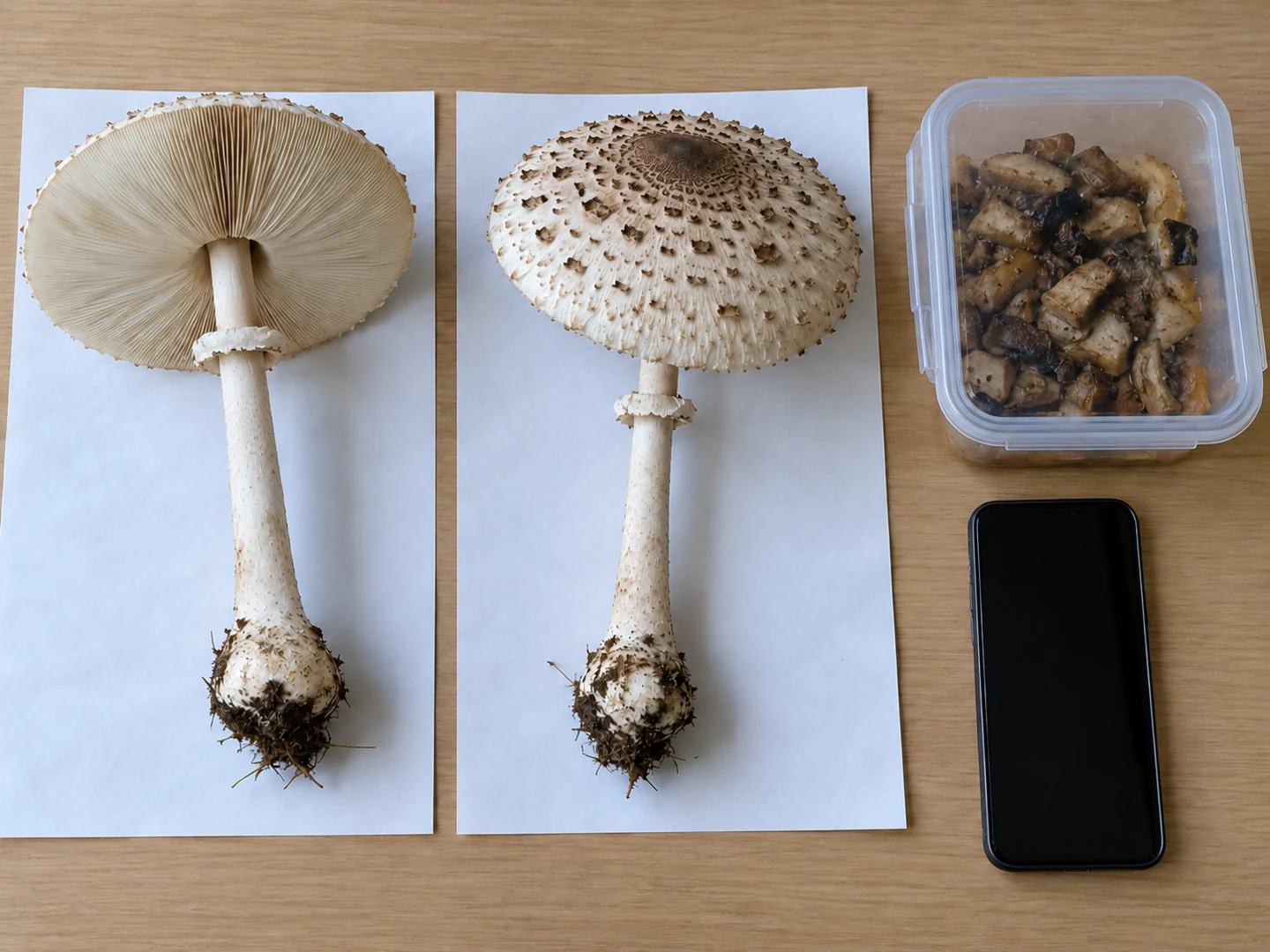
Intact specimens keep the gills, ring and stem base that a chopped meal no longer shows. Keeping each specimen separate leaves its own characters readable. Any cooked food you keep tells specialists what the person actually ate.
The meal time, preparation method, approximate amount and the people who ate it describe the exposure. Photographs of the original patch and of each specimen's underside add context. No image alone can rebuild missing structures or confirm an edible species.
Why can a lawn ring return after the caps are removed?
This fungus feeds saprobically, drawing its food from dead organic material in soil with no partnership with a living tree. Its mushrooms come up in lawns and meadows, and the extension account also records grassy areas and open woods. Growing beside a tree does not mean a mushroom grows from that tree or depends on its living roots.
The conspicuous cap is a reproductive structure, while the fungus itself lives on as mycelium in its growing substrate. Picking a cap removes that fruit body and leaves the fungus below the turf in place. That explains why mushrooms can come back after someone clears a patch.
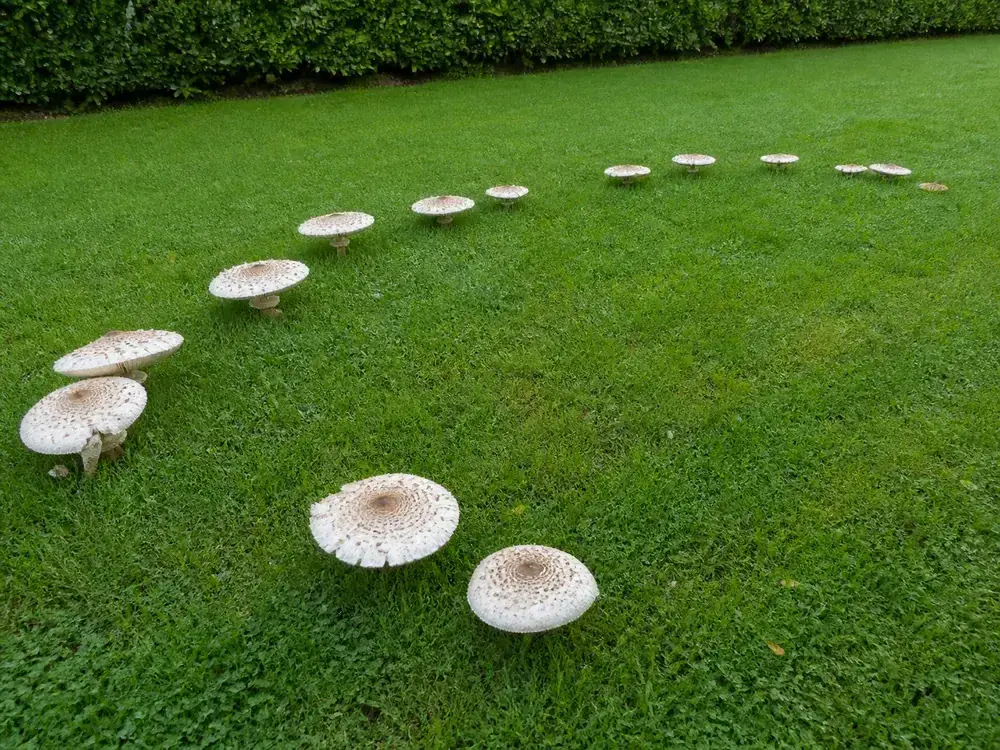
Troops, arcs and complete or incomplete fairy rings all appear in descriptions of green-spored parasol. The pattern describes how it grows and does not identify the species, since other lawn fungi form rings too. One patch may hold mushrooms at several stages, which shows why some undersides are still pale while others have turned greenish. Each specimen still has its own age, structures and deposit.
In North America, Kuo describes fruiting from summer through fall and a broad range, more frequent from the Great Plains eastward. UF/IFAS describes the mushroom as widespread in Florida and the southeastern United States. Those are regional occurrence descriptions, not exclusion boundaries. Warm, wet lawn conditions set the scene for meeting it, yet a mushroom outside the familiar season or region still needs its own assessment. Neither a dry spell nor a cooler location makes a specimen already in front of you edible.
Around a home, the immediate concern is children and pets reaching the fruit bodies. NAMA advises picking and disposing of yard mushrooms and states that they are safe to pick up and throw away. Removing accessible caps takes away that immediate chance to eat them without promising to eradicate the fungus. Any possible ingestion still calls for Poison Control, even after someone has cleared the lawn.
What do the cooked-meal cases actually establish?
Green-spored parasol stays out of food, and ordinary pan-frying cannot clear an uncertain lawn parasol. The clinical evidence comes from real mushroom meals and offers no tested temperature-and-time method for detoxifying this species. One retrospective study of the Reunion Island surveillance database recorded 19 people after six wild-mushroom events in 2020 and 2021. Five events involved shared pan-fried meals, and the remaining event involved a raw mushroom.
Fifteen people had a gastrointestinal irritant syndrome, with recorded onset between 30 minutes and three hours. That finding describes the people affected in this series and gives no universal timetable for every lawn-mushroom exposure.
The counts answer different questions. Events are separate exposures, people are those affected, and identified species are the evidence available for assigning a cause. Lumping those categories together would make the cooking evidence look more certain than the abstract supports. Cooked wild-mushroom meals did occur among these poisonings, and the authors implicated C. molybdites. The study does not establish a safe portion, compare standard cooking treatments or give the odds that a particular diner will fall ill.
One reported symptom-free meal therefore cannot prove a repeatable method that makes the mushroom safe. Nor can the absence of symptoms at one moment identify the mushrooms a group ate. Mixing chopped caps also makes later identification harder, because the gills, stem bases and maturity of the individual mushrooms may disappear. Keeping an uncertain specimen out of the meal protects both the food boundary and the evidence needed to understand it.
After a possible exposure, the remaining meal and any intact mushrooms belong in the account you give specialists. Someone else's opinion that the meal was well cooked does not answer the species question or the patient's clinical needs.

 Caution


