Is deadly dapperling poisonous?
A mature deadly dapperling can fit in the palm of a hand. The cap usually remains under 6 cm, and the slender stem and weak ring make it less substantial than the parasol mushrooms people commonly collect for food.
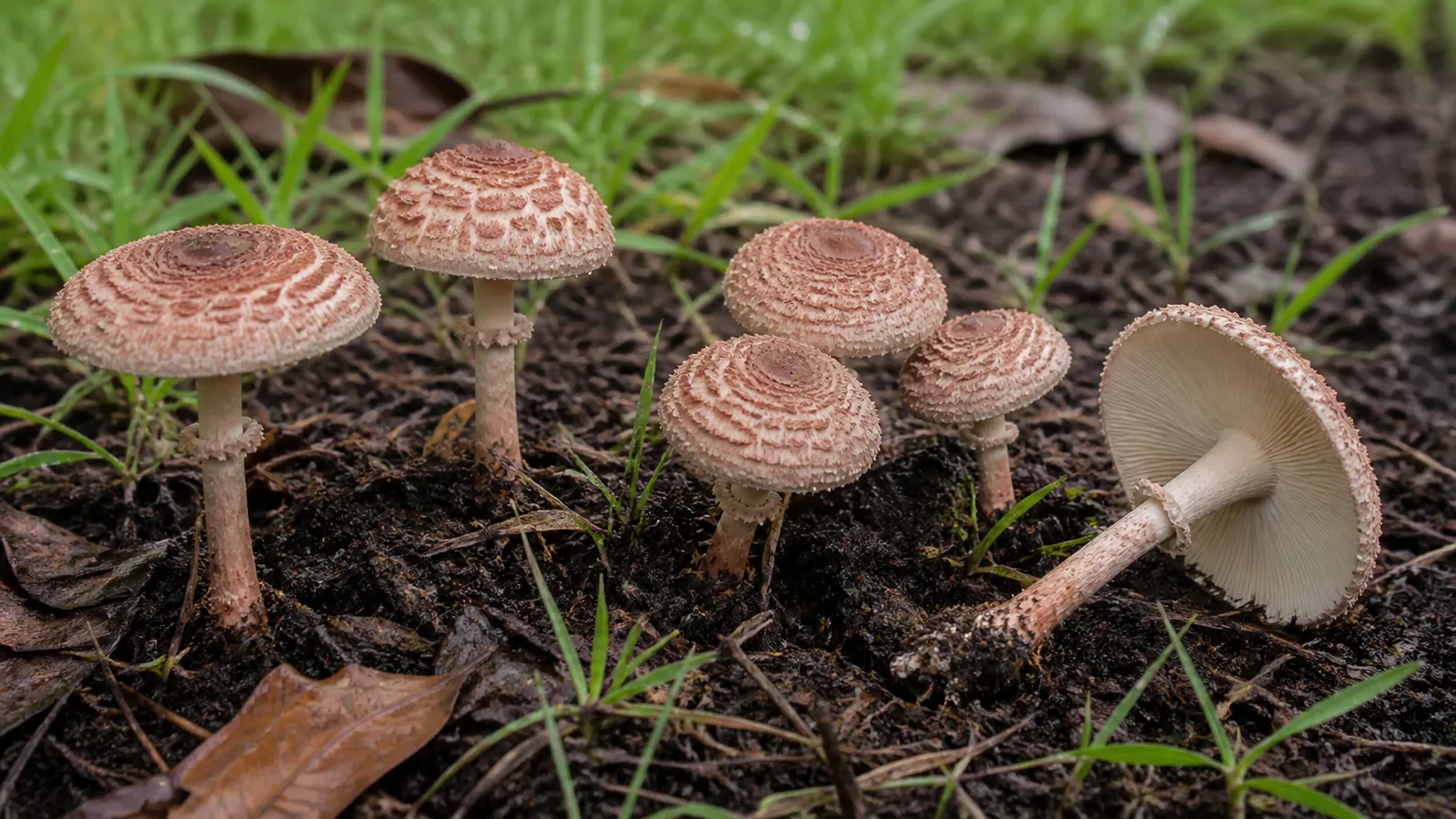
The cap begins rounded, then expands through convex to nearly flat. Its darker central disc stays fairly continuous while the outer coating breaks into pink-brown or reddish-brown scales arranged over a cream background.
Those scales are not decoration.
Their color, spacing, and contrast with the pale ground are among the first clues that place the mushroom among dangerous small dapperlings rather than smooth-capped lawn species.
The crowded gills remain white or cream and stop short of the stem. A white deposit from mature spores supports the genus-level pattern, but several toxic and non-toxic small Lepiota share that print color.
The stem is pale near the gills and often becomes pinkish or brownish below a fragile ring or ring zone. Handling can erase the ring, rain can wash cap scales away, and mowing can separate the cap from the stem, which is why incomplete finds carry less evidence.
A neat, fresh appearance says nothing about amatoxin content. Deadly dapperling may fruit in tended lawns, flower beds, compost-rich borders, or mulched public plantings rather than remote woodland.
Note
The common name deadly parasol is also used inconsistently for related species. Scientific identity and a complete description matter more than a common label.
How do you identify deadly dapperling?
Usually 2.5 to 6 cm across, initially hemispherical or convex, later flatter, with a pink-brown to reddish-brown center and concentric scales over a paler background.
Free from the stem, crowded, white to cream, and remaining pale as the cap expands.
Slender, pale above a fragile ring zone, pinkish brown and fibrillose below it, without a volva at the base.
White flesh that may blush faintly, with a weak fruity or indistinct odor. Never taste it.
Start by preserving the whole mushroom. Lift rather than cut it so the stem base remains visible, then photograph the cap before handling removes loose scales.
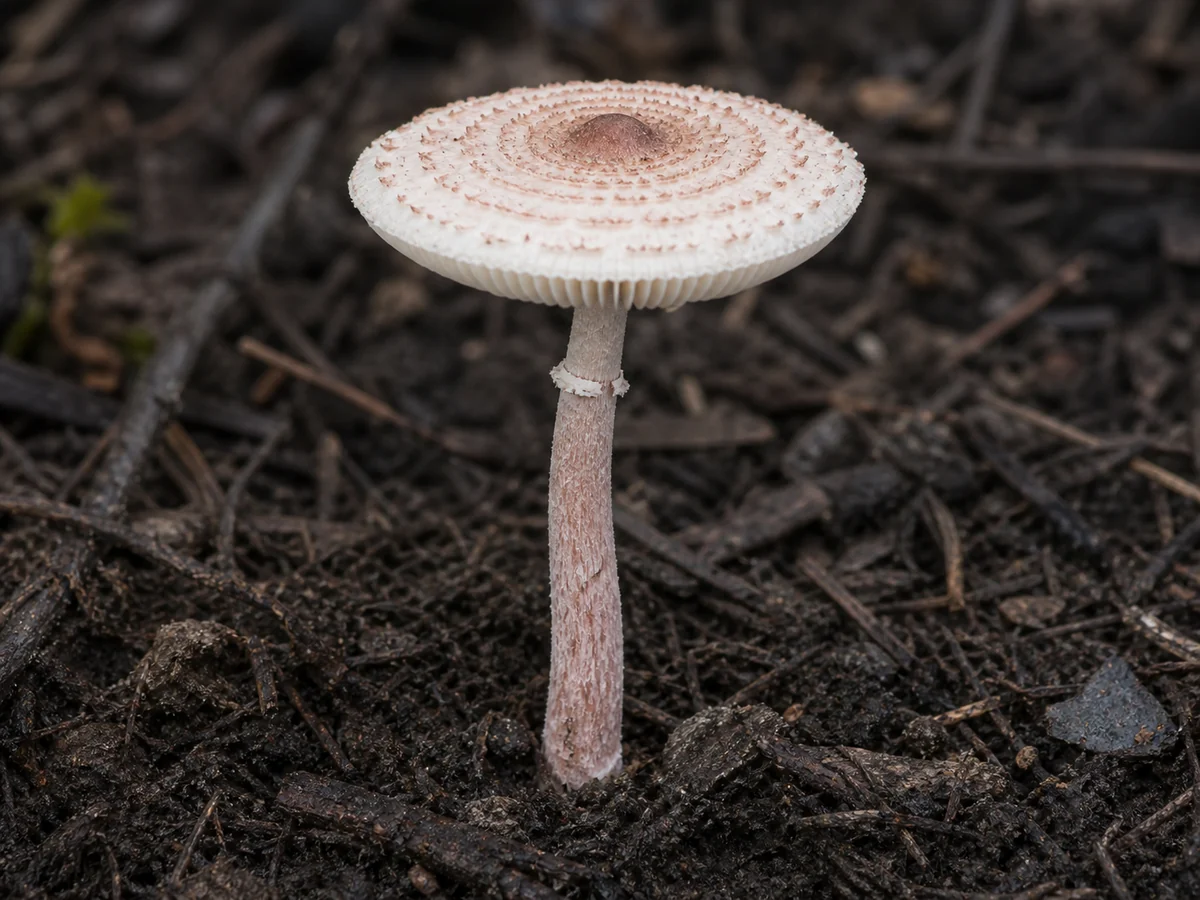
Measure the cap and stem against a ruler. Deadly dapperling is normally a small mushroom, with a cap around 2.5 to 6 cm and a stem commonly 3 to 6 cm tall, though weather and maturity change proportions.
Look across the cap rather than only at the center. A dark pink-brown disc grades into broken concentric scales on a pale surface, and the outer margin may retain finer fibrils.
Turn the specimen over without crushing it. The gills are crowded, pale, and free, leaving a narrow collar-like gap around the stem instead of running down it.
The ring can be slight, torn, or nearly missing. Below it, the stem often carries pink-brown fibrils or bands that echo the cap color, while the upper stem stays paler.
A spore print should be made only from a mature intact cap kept away from food surfaces. Microscopy can examine spore shape and other tissues, while DNA sequencing may be needed where closely related species overlap.
Species-level confidence should fall when rain has washed the cap, the ring is missing, or only a photo is available.
Uncertainty inside small Lepiota is itself a stop signal for consumption.
If someone may have eaten this mushroom, act now. Call Poison Control at 1-800-222-1222 (US) or emergency services before symptoms appear, and save a piece of the mushroom for identification.
What happens if you eat deadly dapperling?
If someone may have swallowed any part, call Poison Control at 1-800-222-1222 in the United States or the appropriate emergency service where you live. Do not wait for symptoms and do not induce vomiting unless a clinician directs it.
Intact mushrooms found in a yard
Photograph and remove accessible fruiting bodies, then inspect the patch again after rainNo ingestion is known, so the immediate job is preventing access while preserving one specimen.
A child or pet may have mouthed or bitten one
Call Poison Control for a person or a veterinarian for a pet, then report body weight, possible amount, and earliest exposure timeSmall missing pieces and delayed symptoms make home observation unreliable.
A wild mushroom entered a meal
Stop serving the food, call for urgent advice, and keep the meal, trimmings, and uncooked mushrooms separateCooking does not neutralize amatoxins, and mixed dishes can destroy identification evidence.
Save uncooked specimens, trimmings, and meal remains in separate paper containers. Photograph the cap, gills, full stem, stem base, collection site, and any other mushrooms from the same basket because mixed collections can contain more than one species.
Amatoxin illness often begins after a symptom-free delay.
Severe vomiting and watery diarrhea can then improve temporarily while liver injury continues, so feeling better does not provide an all-clear.
A person who shared the meal should be identified even when that person feels well. Different serving sizes and uneven distribution of small caps can produce different symptom times, so one unaffected diner cannot clear the dish.
Write down every mushroom meal from the previous three days rather than only the most recent one. Leftovers, photographs taken while foraging, location history, and messages exchanged about the collection may help reconstruct what was eaten.
Do not wash or combine every saved specimen. Separate fresh mushrooms from cooked material, keep each collection site distinct, and use paper rather than a sealed wet plastic bag when a mycologist needs intact morphology.
For a yard exposure, collect neighboring intact mushrooms from the same patch and photograph where each one grew. Keep human and animal case details separate because a poison center and a veterinarian need different information.
A home urine strip, online toxin reagent, or app result cannot rule out amatoxin exposure. Sampling error, reagent failure, and wrong species selection can all produce false reassurance while the clinical window is narrowing.
Warning
Any delayed gastrointestinal illness after a wild mushroom meal needs urgent poison-center or emergency assessment. Tell clinicians the collection time, meal time, first symptom time, and whether anyone else ate the same dish.
Where do small parasol comparisons break down?
Small parasol-shaped mushrooms create a dangerous visual shortcut because cap scales and a stem ring appear in edible and lethal groups. Size, ring position, cap pattern, and the untouched stem base must be considered together.
Deadly dapperling also overlaps other small Lepiota species that cannot be separated confidently from a casual field view.
A photograph can document the specimen, but it cannot turn a difficult genus into a safe food decision.
The field parasol and shaggy parasol groups are generally much larger and more robust, yet young buttons or broken specimens can hide that scale difference. A movable double ring, snakeskin stem pattern, or green spore print can point elsewhere, but no single absent feature proves a small parasol safe.
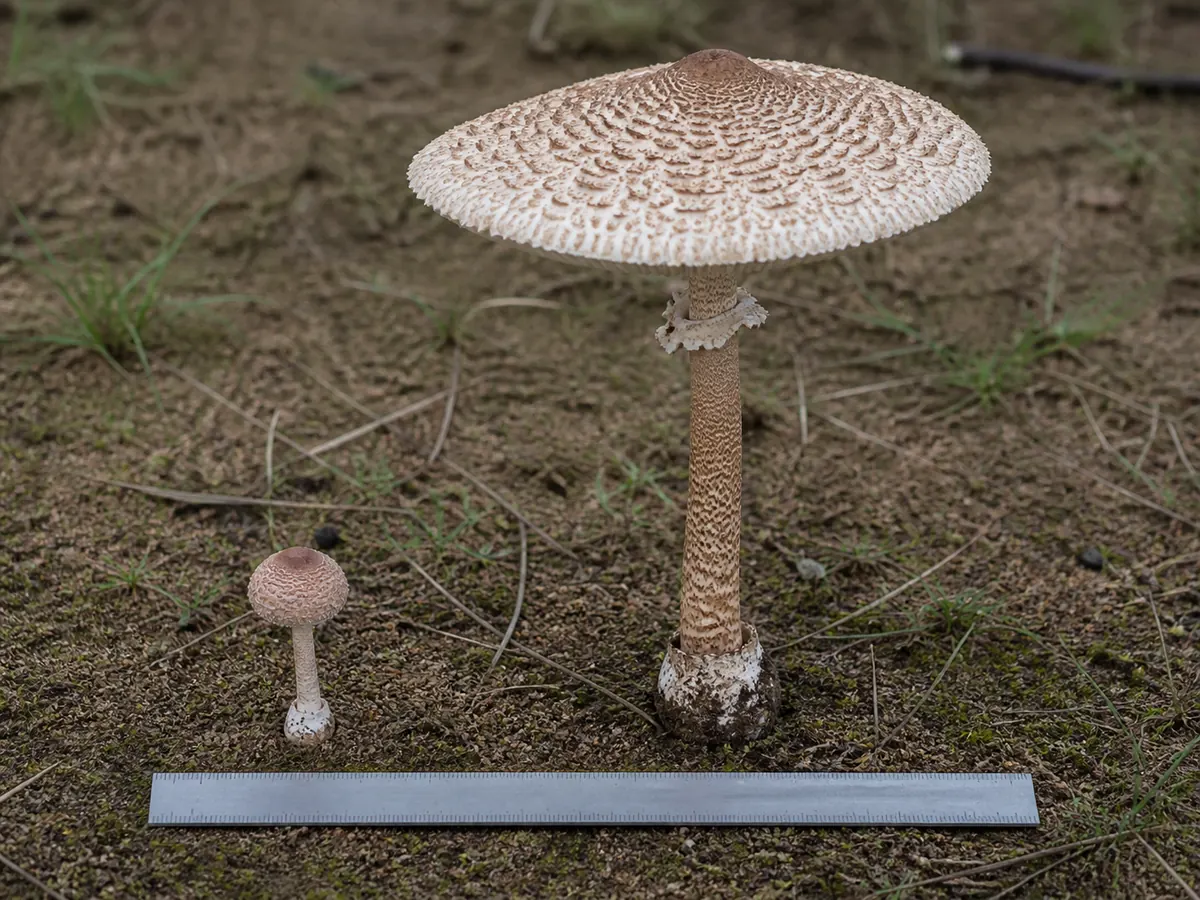
| Comparison | Deadly dapperling | Why the shortcut fails |
|---|---|---|
| Large parasol mushrooms | Small cap, delicate ring zone, pink-brown scales | Young or damaged large parasols may look compact |
| Fairy ring mushroom | Smooth tan cap, tough wiry stem, no cap scales | Lawn habitat and pale gills overlap |
| Field mushroom | Free gills that turn pink then chocolate, brown print | Very young field mushrooms still have pale gills |
| Other small Lepiota | Similar white gills, scales, and fragile ring | Microscopy or DNA may be needed |
A field mushroom develops dark brown gills and a brown spore deposit, unlike the persistently pale gills and white print of deadly dapperling. The comparison only works when the specimen is mature enough to show the change.
Key takeaway
Reject every small parasol-like mushroom from a food basket unless a qualified local identifier has established the species from a complete specimen.
Why does it appear in gardens and mulch?
Deadly dapperling decomposes organic material rather than partnering with one required tree host. That ecological flexibility helps explain records from gardens, compost-rich beds, parks, path edges, grassy ground, and open woodland.
Warm periods followed by rain can bring fruiting bodies through soil or mulch from summer into late autumn. They may appear singly, scattered, or in small groups, and the underground mycelium can persist after the visible caps are removed.
Mulch and landscaping soil can move fungal material between sites. A new planting bed therefore deserves the same caution as an old lawn when children or pets have access.
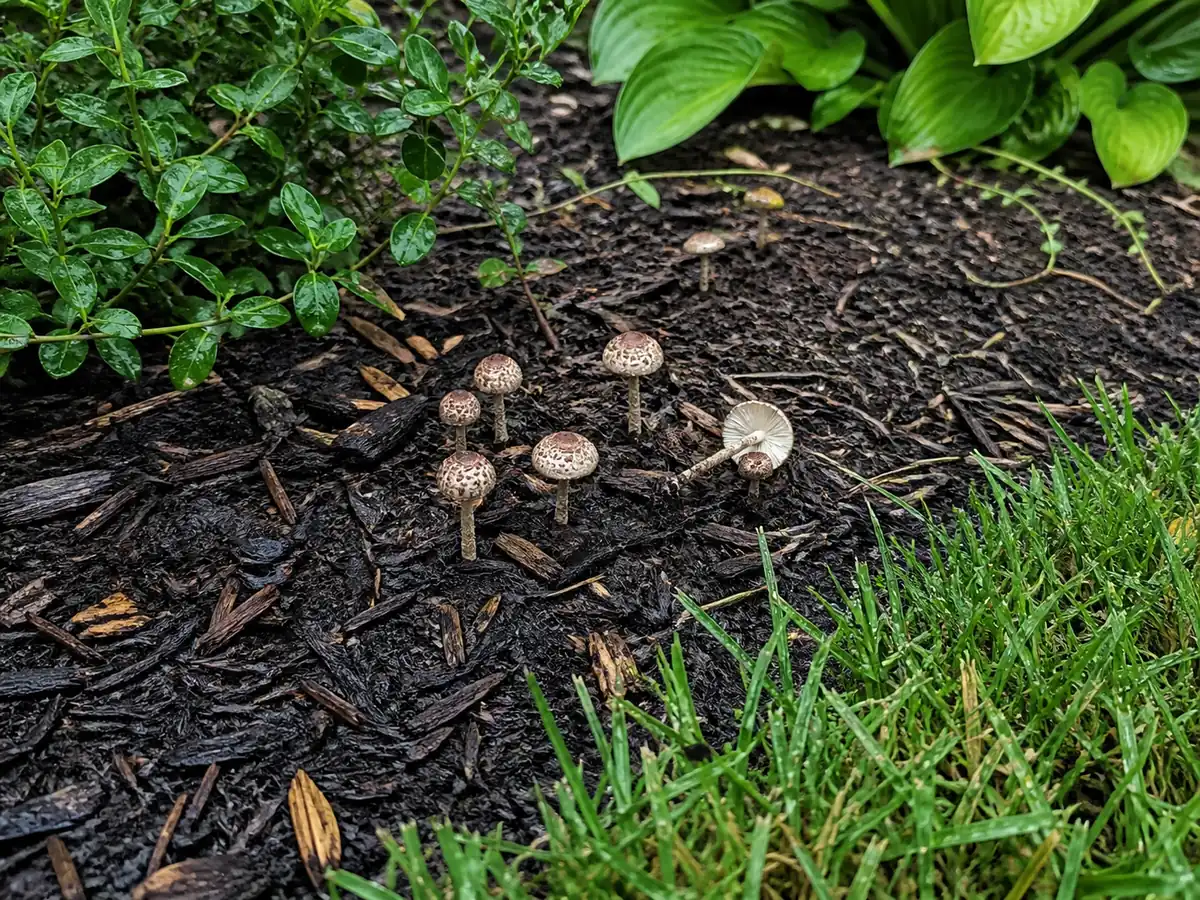
Removing fruiting bodies with gloves reduces immediate access but does not eradicate the fungus. Place specimens in a sealed bag for disposal, wash hands after handling soil, and inspect the area again after rain.
The mushroom does not transmit poison through nearby edible plants.
The practical risk comes from a person or animal eating the fruiting body or from fragments entering a mixed harvest.
Habitat supports identification but cannot clear a mushroom for food. An edible and a lethal species can fruit within the same lawn or mulch bed.
How do you reconstruct a possible exposure when the mushroom is gone?
A child, pet, or diner may be unable to describe what happened, and the original cap may already be crushed, cooked, or discarded. The investigation therefore starts with the scene, the timeline, and material from the same collection rather than waiting for a perfect specimen.
Photograph the patch from above before removing anything, then take close views of intact caps, gills, full stems, and stem bases. Include a ruler or coin in one frame, record whether the mushrooms grew from soil, mulch, buried wood, or lawn, and keep mushrooms from different patches apart.
A missing cap does not close the case. Soil marks, fragments in a basket, photographs taken during the walk, phone location history, and messages about the collection can connect a meal to a patch while clinicians begin treatment.
Preserve uncertainty when the evidence is incomplete. Calling a damaged mushroom a harmless lawn species can delay care, while reporting the uncertainty gives the poison service room to plan for amatoxin exposure.
Why can a measured amatoxin amount never become a safe-dose rule?
Laboratory studies can measure individual amatoxins in a dried specimen, and case reports sometimes estimate how much toxin a patient swallowed. Those numbers describe tested material from one collection, not a safe threshold that can be applied to another cap, meal, or person.
Researchers have measured substantial differences between Lepiota species and between individual collections. Toxin concentration can also vary by mushroom part, maturity, drying method, and the amount of material that survives for testing.
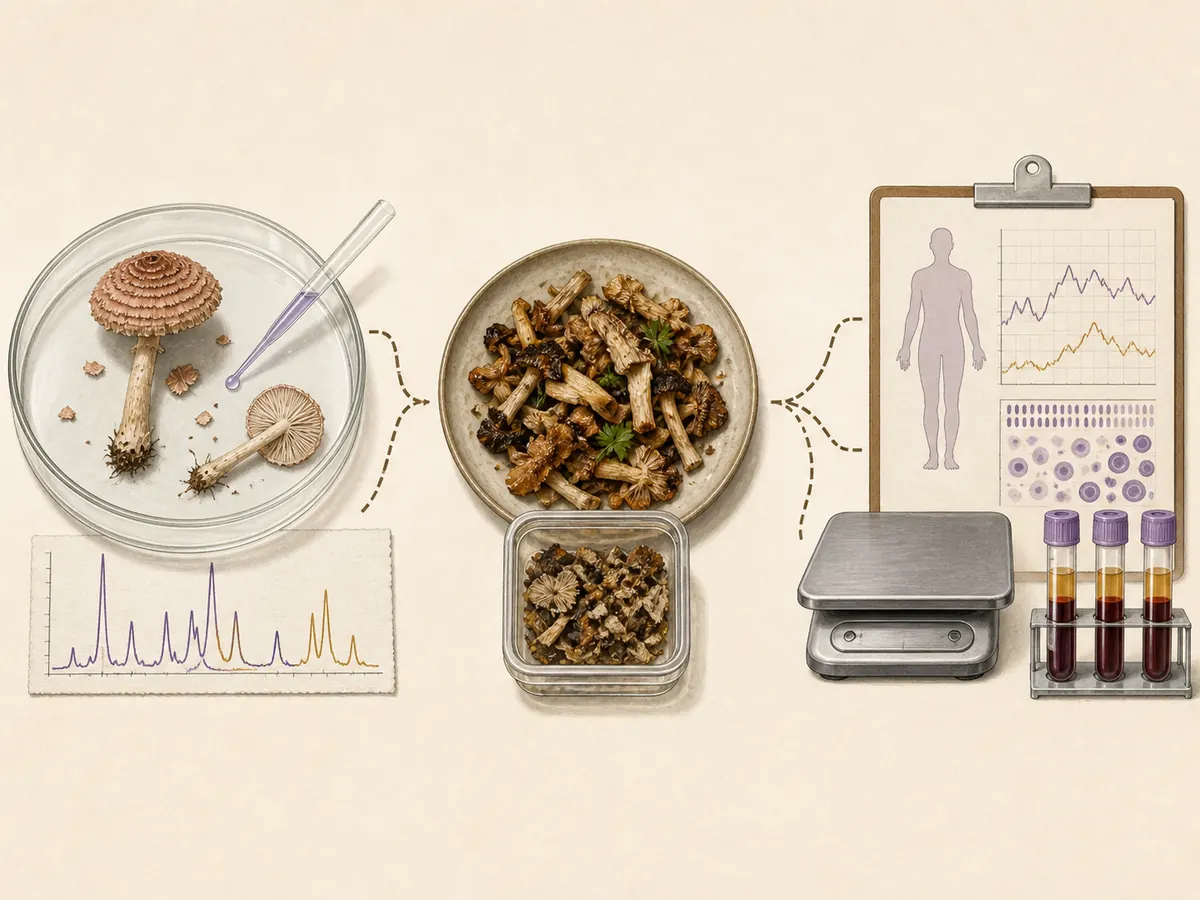
- Specimen result
- Chemical analysis confirms toxins in the submitted mushroom, but it cannot prove that every cap in the meal had the same concentration.
- Meal estimate
- A case report may reconstruct intake, but cooking loss, mixed species, uneven serving, and missing food keep that estimate uncertain.
- Clinical course
- Liver tests show how one patient responded, while body size, delay to care, health history, and treatment prevent prediction for another patient.
A negative home test creates the opposite error. It may miss toxin because the wrong fragment was sampled, the reagent failed, or the eaten mushroom is no longer available.
No amount of deadly dapperling is cleared for tasting or cooking. Measured values help toxicologists understand an exposure, while the reader-facing decision remains complete avoidance and immediate poison-center contact after possible ingestion.
Can heat or preparation destroy its toxins?
Deadly dapperling has no culinary use. The amatoxins are heat-stable, so frying, boiling, pressure cooking, drying, or fermenting cannot be used as detoxification methods.
Small caps are especially easy to lose in a mixed basket. Once chopped, their pale flesh and brown scales can resemble fragments from other mushrooms, and kitchen preparation destroys the intact characters a mycologist needs.
Keep foraged mushrooms separated by species from the moment of collection. If an unknown small parasol enters the basket, discard the intended meal and retain representative specimens for expert review rather than sorting fragments by appearance.
A taste test is never appropriate for a suspected Lepiota.
Flavor has no reliable relationship to amatoxin content, and swallowing even a small sample creates an avoidable medical emergency.
How does amatoxin poisoning unfold?
Amatoxins inhibit RNA polymerase II, which prevents cells from producing essential messenger RNA and proteins. The liver receives a major dose after intestinal absorption and enterohepatic circulation, so damage can continue after stomach symptoms settle.
The first stage often begins more than six hours after ingestion with abdominal pain, repeated vomiting, and profuse diarrhea. Fluid loss can be severe before blood tests clearly show liver injury.
The next stage can feel deceptively quiet. Gastrointestinal symptoms ease, but liver enzymes rise and clotting, blood sugar, kidney function, and mental status can deteriorate over the following days.
| Clinical phase | What may be happening | Why it matters |
|---|---|---|
| Latent interval | No obvious symptoms while toxin is absorbed | Waiting for illness wastes treatment time |
| Gastrointestinal phase | Vomiting, diarrhea, cramps, dehydration | Early care supports circulation and testing |
| Apparent improvement | Stomach symptoms lessen | Liver injury may still be progressing |
| Organ injury | Coagulopathy, low glucose, jaundice, confusion, kidney injury | Intensive care or transplant evaluation may be needed |
A 2015 case report measured about 19.9 mg of amatoxins in roughly 30 g of consumed L. brunneoincarnata and documented marked liver-enzyme elevation. One case cannot define a safe dose, but it demonstrates that a small mushroom can deliver a clinically important toxin burden.
Hospital teams use poison-center and medical-toxicology guidance, serial laboratory tests, fluid management, and treatments chosen for the individual exposure.
There is no dependable home antidote and no safe watch-and-wait period.
This mushroom has no established medicinal application. Laboratory study of its toxins helps analytical toxicology, but that research does not create a therapeutic use for the fruiting body.
Why is the whole small-Lepiota group a safety problem?
Lepiota brunneoincarnata belongs to Agaricaceae, the same broad family that contains several familiar edible mushrooms. Family membership therefore does not predict edibility.
The species name combines references to brown and flesh-colored tones, matching the pink-brown scales and lower stem. Older reports and common names may overlap with other members of the Lepiota helveola complex.
Modern toxin analysis has confirmed alpha-amanitin, beta-amanitin, amanin, and amaninamide in studied specimens.
This chemical evidence supports the deadly classification independently of folklore or taste.
Closely related Lepiota can be difficult to separate morphologically, and names have shifted as microscopy and DNA data improved. The taxonomic difficulty strengthens the public safety boundary around all small dapperlings.
Deadly dapperling questions
Is deadly dapperling poisonous?
Does cooking make it safe?
How quickly do symptoms start?
Where does it grow?
Can a photo confirm it?
What should I save after an exposure?
Sources & References
- Helsenorge Poison Information Deadly status, amatoxins, heat stability, and emergency advice.
- Yilmaz et al., Case Reports in Medicine Measured amatoxin dose and clinical course after confirmed ingestion.
- Enjalbert et al., Toxins LC-MS confirmation of amatoxins in Lepiota brunneoincarnata.
- CDC MMWR Amatoxin phases, delayed liver injury, and urgency of early care.
- Utah Poison Control Clinical mechanism and management context for amatoxin ingestion.
- Amatoxin measurements in deadly dapperling and related Lepiota Measured toxin variation, analytical confirmation, and limits on transferring one specimen result to another meal.