What does a field mushroom look like?
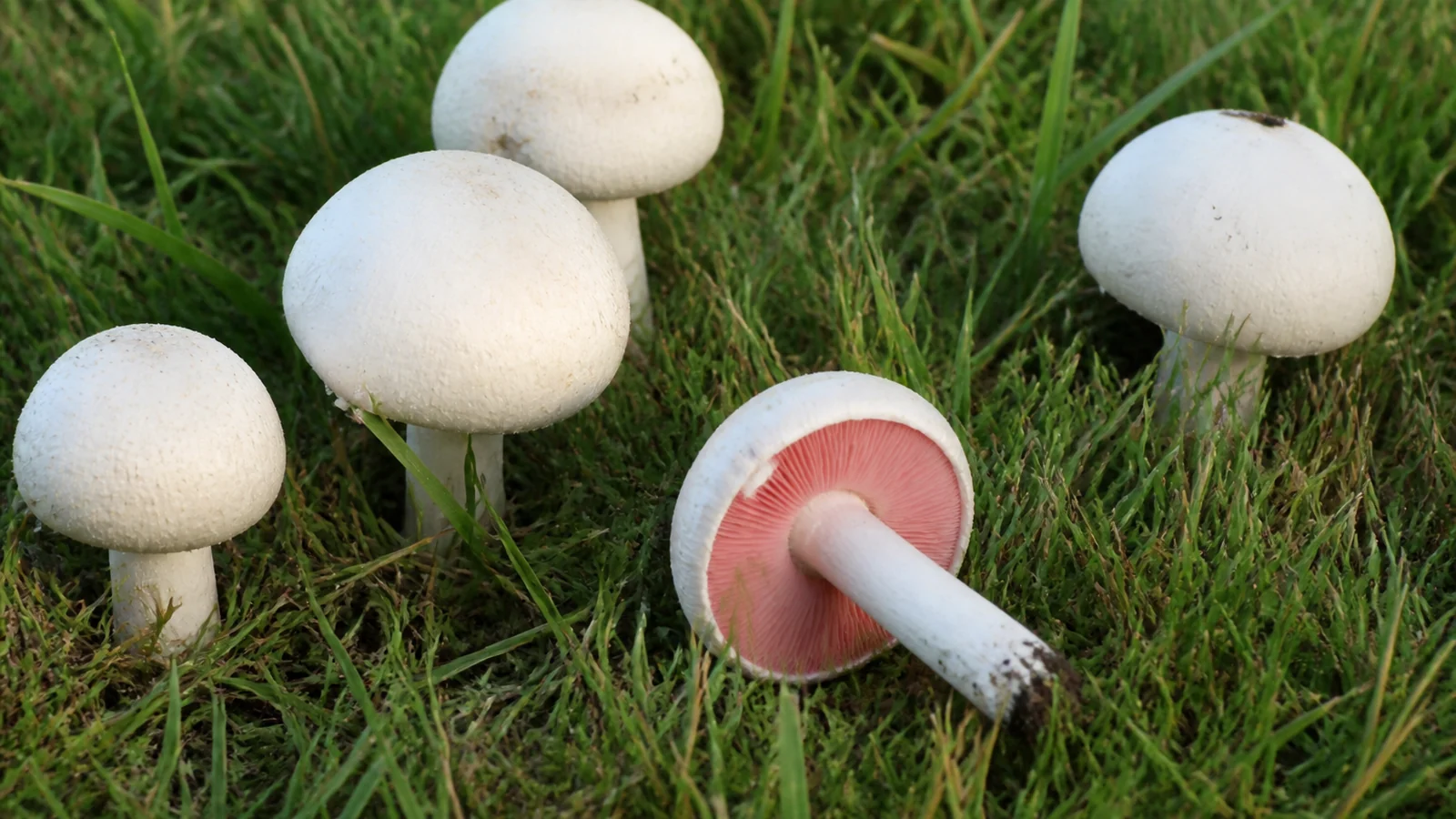
A field mushroom is a plain white mushroom in open grass, three to ten centimeters across, domed when young and flattening as it opens. It is the wild species closest to the cultivated button mushroom, and it looks it.
The cap surface is dry and either smooth or covered in fine flattened scales, and it bruises slowly toward a dull pink or reddish tone rather than toward yellow.

The stem is short and white and tapers slightly toward a plain base. There is no bulb, no sac, and no swelling, and that plainness is worth noticing because it is one of the things that separates it from the mushroom that could kill you.
A small ring sits partway up the stem when the mushroom is young. It is fragile, it often tears away as the cap expands, and its absence in an older specimen means nothing at all.
Underneath is the part that matters. The gills are crowded, free of the stem, and in a young specimen they are a clear bright pink that nothing else in a pasture reproduces convincingly.
How do you identify a field mushroom?
White to pale cream, 3 to 10 cm across, domed then flattening, smooth or with fine flattened scales, dry, and bruising slowly to a dull pink or reddish tone rather than yellow.
Crowded and free of the stem, bright clear pink when young, darkening through chocolate brown to near black with age. The pink stage is the one that identifies it.
Short, white, tapering slightly toward a plain base with no bulb and no sac, carrying a small fragile ring that often tears away and disappears.
White and firm, flushing faintly pink where cut, with a clean mushroomy smell and no phenolic or inky note.
Identify this mushroom by watching a sequence, not by matching a photograph.
The gills begin bright pink, darken through chocolate brown, and finish close to black. Every stage is normal and the mushroom is still a field mushroom throughout, so the color on any given day tells you where it is in that run rather than whether it is the right species.

The stem base check is not optional here, and it answers both dangerous questions at once.

Dig the mushroom rather than cutting it at ground level. What is under the turf is the evidence, and a knife used at the surface removes it before you have looked.
Pink gills plus a plain white base is the pair to confirm, and neither half is sufficient without the other.
What safety details matter for Field Mushroom?
That single habit answers both of the confusions this species carries: a bulbous base flashing chrome yellow means a yellow stainer, and a membranous sac means an Amanita and a medical emergency.
Confirm the gills as well as the base. Bright pink young gills darkening through brown is the sequence, and white gills that stay white through the mushroom's whole life belong to something else entirely.
Do not collect from verges beside busy roads, from ground that may have been sprayed, or from paddocks treated with herbicide. A grassland decomposer takes up what is in the soil around it.
Cook them, and eat a small portion the first time. Raw Agaricus disagrees with some people, and individual tolerance for the wild species varies in a way nobody can predict from the outside.
If a meal is followed by symptoms, note what was eaten and exactly when the symptoms began.
Quick onset and delayed onset point at completely different problems, and that timing is the most useful thing a clinician can be given.
What can be mistaken for a field mushroom?
Two confusions matter and they sit at opposite ends of the consequence scale.
The first will make you ill. The yellow stainer shares the pastures and the lawns, and it is the most commonly eaten poisonous mushroom in several countries precisely because it turns up in the same places as this one.
It separates on two things. Its young gills run grayer than the clear bright pink of a field mushroom, and its bulbous stem base flashes bright chrome yellow within seconds of a thumbnail scratch.
Field mushroomBright pink young gills, plain tapering base, no yellow when scratched
Yellow stainerGreyer young gills, bulbous base, immediate chrome yellow, phenolic smell
The second confusion can kill, and it is the reason the stem base gets dug rather than cut.
A young destroying angel is a white mushroom on a white stem, and at the button stage before its cap has opened it can pass for a field mushroom to somebody working quickly.
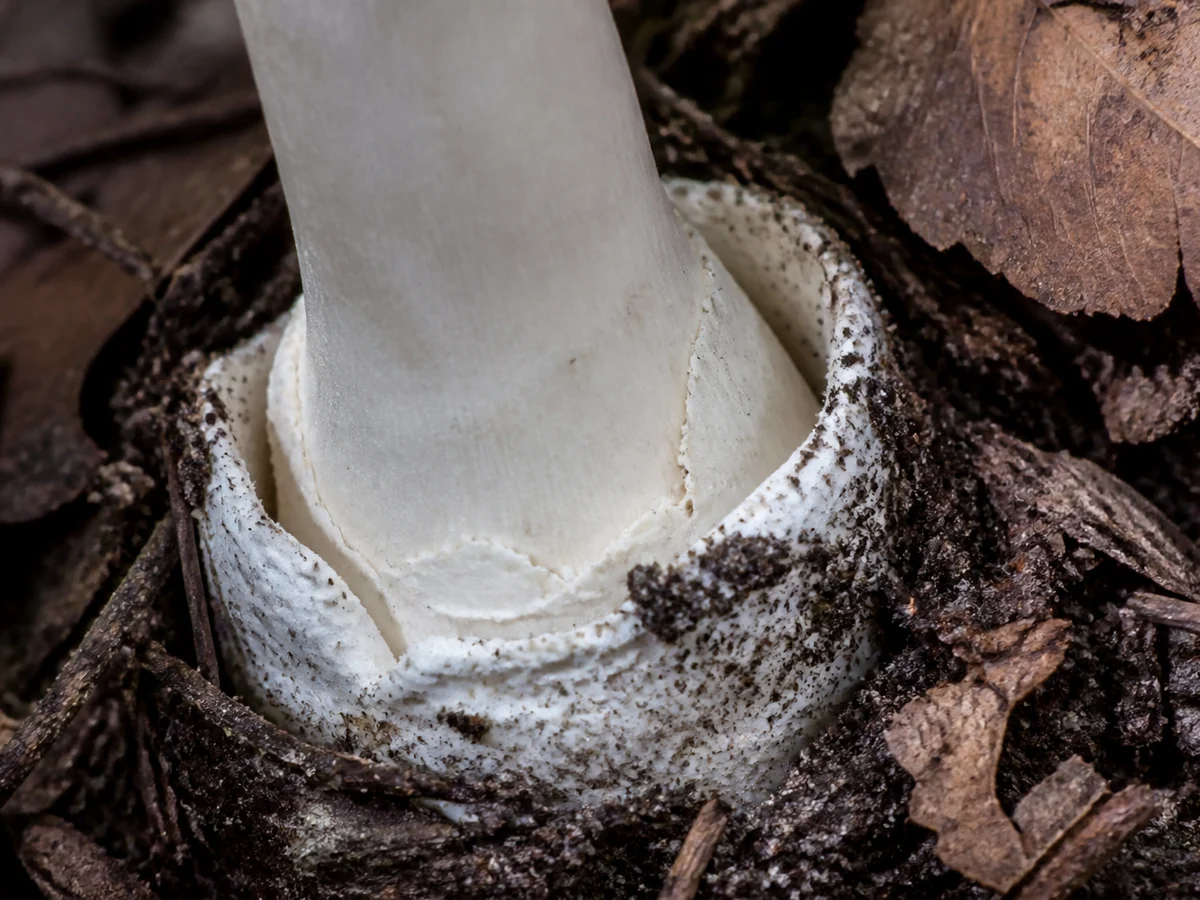
It fails the sequence completely. An Amanita has white gills that stay white through its whole life, never passing through pink or brown, and it sits in a membranous sac at the base that a field mushroom does not have.
Habitat helps as well, though it is not sufficient on its own. Destroying angels associate with trees, so a white mushroom in open pasture well away from any tree line is in the wrong place for one.
Horse mushrooms are the third species people meet, and they are edible. They are larger, they smell faintly of aniseed, and they bruise slowly yellow in a way that is dull and slow rather than the chrome flash of a yellow stainer.
Warning
Never take a white gilled mushroom without seeing its stem base. The feature that separates an edible field mushroom from a deadly Amanita sits below the turf, and a mushroom cut at ground level has had that evidence removed. White gills that never turn pink, or any cup or sac at the base, mean stop.
The consequences of the two confusions are not comparable and it is worth being blunt about that.
A yellow stainer causes vomiting and cramps for a few hours and is over. Amatoxin poisoning damages the liver, the early symptoms fade before the serious phase begins, and it is a medical emergency measured in days rather than hours.
That asymmetry should shape the habit rather than the anxiety. Digging the base costs nothing on every mushroom, and it is the one action that answers the question that actually matters.
Field mushrooms themselves disagree with some people even when correctly identified, which is why this profile carries a caution rather than a clean bill. Eat a small portion the first time, and cook them rather than eating them raw.
If symptoms follow a wild mushroom meal, onset timing is the most useful thing a clinician can be told, because a delay of many hours points somewhere far more serious than a quick upset does.
Where do field mushrooms grow?
The field mushroom is a grassland decomposer, and its habitat is part of its identity rather than a detail.
It lives on organic matter in pasture soil, favoring ground that carries nutrients from grazing, and it fruits in open grass rather than in woodland litter.
The habitat requirement does more identification work than people expect. A white gilled mushroom under trees in leaf litter is in the wrong place for this species, and that observation alone excludes it long before anything is picked up.

Old permanent pasture is the classic ground. Grassland that has not been plowed or fertilized heavily supports the fungus over decades, which is why the same fields produce year after year while newly seeded ones produce nothing.
That makes it a species in slow decline in intensively farmed landscapes. Plowing breaks the mycelium and heavy fertilizer changes the soil it depends on, so the mushroom is often more abundant on rough grazing than on improved fields.
The same grassland habit puts it into lawns, verges and playing fields, which is how most people first meet it and also why the yellow stainer meets them in the same place.
How do you cook field mushrooms?
This is the wild mushroom that needs the least explaining in a kitchen, because it behaves like the one people already cook.
The flavor is stronger than a cultivated button and the flesh is thinner, so it cooks faster and gives up more water. A pan that would suit shop mushrooms will flood with these unless it is hotter and less crowded.
Young specimens with pink gills hold their shape best. Older ones with dark gills cook down to a black liquor that colors everything in the pan, which is excellent in a soup and unwelcome in anything pale.
Clean them dry if you can. Grass and grit sit on the cap surface rather than embedded in it, so a brush or a cloth usually does the job without water.
They do not keep.
Thin flesh and open gills mean a field mushroom deteriorates faster than almost anything from a shop, so a morning's collection is a lunch rather than a week's supply.
Cook them rather than eating them raw. Raw Agaricus disagrees with a noticeable number of people, and the flavor is better cooked in any case.
Is there a medicinal use?
No medicinal claim attaches to the field mushroom, and none is needed.
It is a food species with a long culinary record, and the literature on it is about cultivation and composition rather than about treating anything.
Is this the mushroom sold in shops?
The field mushroom is not the cultivated species, which surprises people who assume the shop mushroom came from this one.
Commercial white button, cremini and portobello are all Agaricus bisporus, a different species that took to controlled composting in a way this one never has. Agaricus campestris has resisted reliable cultivation for as long as people have tried.
What does work is looking after the ground it already occupies. Permanent pasture left unploughed keeps producing, and that is closer to management than to growing.
Is it more nutritious than a shop mushroom?
As a food this is close to the cultivated mushroom most people already eat, which makes the nutritional question uninteresting in the useful sense.
It is mostly water, low in calories, and worth eating for flavor rather than for any nutrient it delivers in quantity. Nothing about the wild version changes that arithmetic.
The one figure worth knowing is not nutritional. Mushrooms growing in pasture take up what is in that soil, so verges beside busy roads and ground treated with herbicide are worth avoiding regardless of species.
Why are its relatives both edible and poisonous?
Agaricus campestris is the type species of a genus that contains both the safest and the most commonly eaten poisonous mushrooms in temperate grassland.
That is the taxonomic fact with practical weight. The cultivated button, the field mushroom, the horse mushroom and the yellow stainer are all Agaricus, which is precisely why the genus cannot be treated as a shortcut to safety.
The genus splits usefully on the reactions rather than on the shapes. One group bruises yellow and smells phenolic, another bruises red or not at all and smells of mushroom or aniseed, and the second group holds the edible species.
So knowing that something is an Agaricus narrows the field and settles nothing. The stem base and the gill sequence still have to be checked.
Field mushroom identification and safety questions
How do you identify a field mushroom?
How do you tell a field mushroom from a yellow stainer?
Could a field mushroom be a destroying angel?
Is the field mushroom the same as a shop mushroom?
Where do field mushrooms grow?
Why do field mushrooms turn black when cooked?
Sources & References
- Agaricus xanthodermus, Yellow Stainer mushroom, First Nature The staining reaction, gill sequence and phenolic odor of yellow stainer, a poisonous lookalike of field mushroom
- Yellow Stainer, Agaricus xanthodermus, iNaturalist The shared grassland distribution that puts the two species in the same pastures and lawns across Europe, North America and Australia