
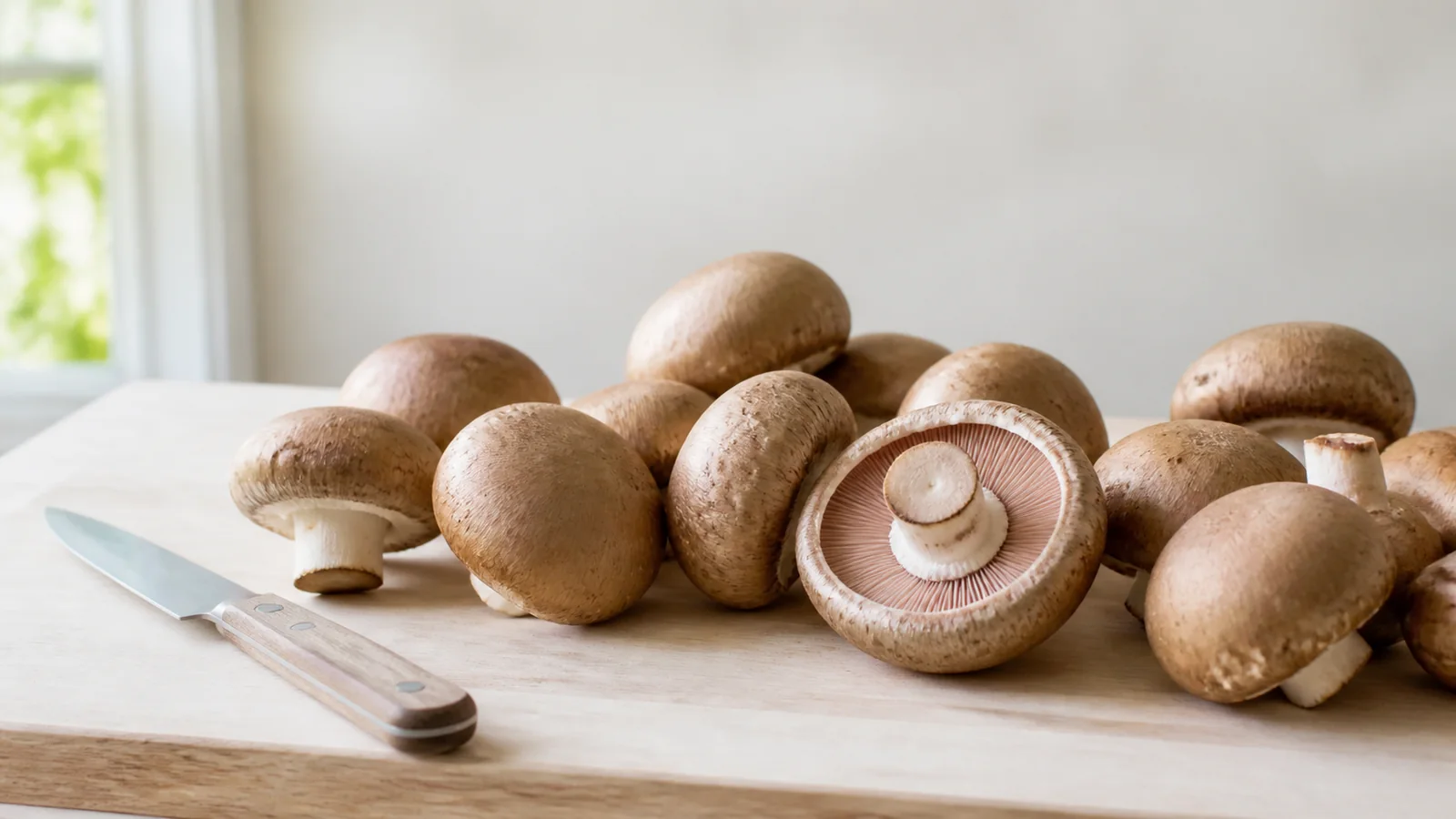
You have almost certainly eaten these raw. Sliced into a salad, put out with a dip, or picked off a crudite plate at somebody's party.
Then you read the word carcinogen next to the word mushroom and now you are standing at the chopping board wondering.
Can you eat cremini raw?
Yes, and nothing about the honest answer requires you to change what you were doing.
Note
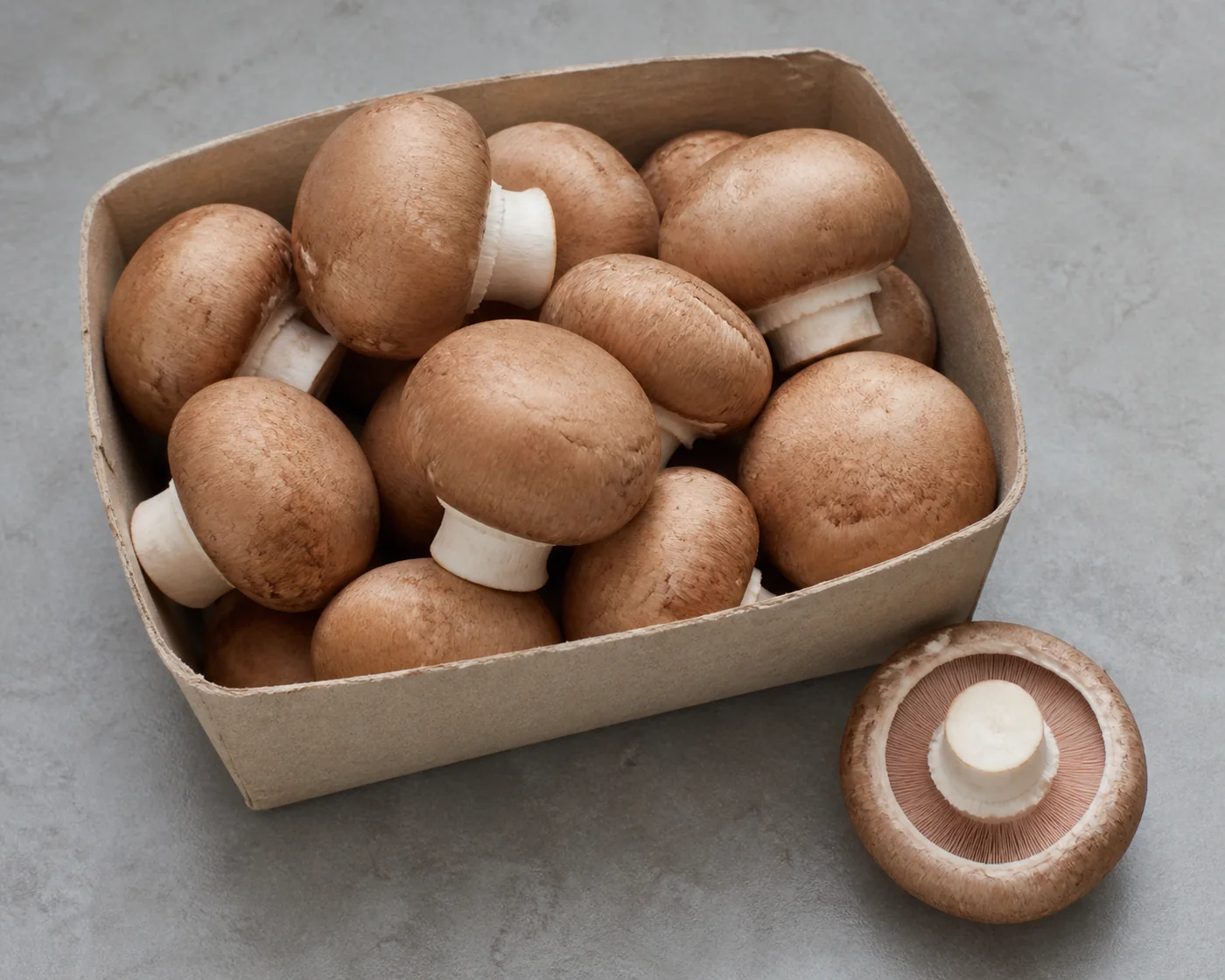
Cremini is the brown strain of Agaricus bisporus, the same species sold as white button when it is picked young and as portobello when it is left to open. The compound people worry about is agaritine, an aromatic hydrazine that occurs naturally in the flesh. It is real, it is reduced by cooking, and no dietary risk to people has ever been established from it.
Those three clauses are the whole page, and most of what is written about agaritine keeps one of them and drops the other two. Somebody who keeps the first clause writes a warning, and somebody who keeps the third writes a dismissal.
The reason to hold all three is that a reader deserves the size of the thing rather than a verdict on it. A compound that is present, reducible and unproven in humans is a different object from either a poison or a myth.
That one species point settles several questions at once. Raw cremini, white button, and portobello are forms of the same species, so the name alone does not create three different food-safety risks.
None of this is about identification, which is unusual for this series.
What agaritine actually is
Agaritine is a hydrazine, which is a chemical family this site has met before under much worse circumstances. It is the same broad class as the compound that makes raw morels dangerous.
The range is the first thing worth sitting with. A figure that spans seventeenfold is not a dose, it is an admission that the amount in the punnet in front of you is unknown.
Growth stage is the biggest single mover inside that range. An unopened button and a fully opened portobello off the same farm are not carrying the same amount, and nothing on the packaging tells you which end of it you have bought.
That is also why peeling or washing does nothing here.
The compound is distributed through the flesh rather than sitting on the cap, so the fixes people reach for with pesticide residue have no effect on it at all. Cutting a mushroom in half does not get you past it either.
The morel comparison is worth making carefully, because the two situations are not alike. A raw morel carries enough of its hydrazine to put people in hospital, and a raw cremini has never done that to anyone.

How much cooking actually removes
If you do decide to cook them, the numbers are unusually clear for this subject.
Half in five minutes is a large effect for a small amount of work. Anything you would normally do to a mushroom in a pan is already most of the way there, and nobody needs to boil mushrooms for two hours to get a result.
The canned figure is the one that surprises people who cook mushrooms.
A tin of mushrooms carries a fraction of what a fresh punnet does, which makes the least fashionable form of the ingredient the one with the least of the compound in it. That is not a recommendation, and it is a useful reminder that processing is not automatically the villain.
One more thing falls out of those numbers. Every treatment on that list is something people already do to mushrooms for completely different reasons, so nobody has to change how they cook to get the effect.
The last line is the awkward one. Agaritine falls during storage too, so the oldest mushroom in your fridge has the least agaritine in it and is still the one you should not be eating raw.
Where the argument actually stands
This is where most writing on the subject stops being careful, so it is worth laying the two sides out separately.
| What is established | What is not |
|---|---|
| Agaritine is present in fresh Agaricus at the levels above | That those levels harm anyone eating ordinary food |
| Its breakdown products show mutagenic activity in animal models | That the same happens at dietary amounts in people |
| It causes DNA damage under some laboratory conditions | That any human cancer has been traced to it |
| Cooking and processing reduce it substantially | That reducing it produces any measurable benefit |
The left column is why the question keeps coming up and the right column is why nobody has acted on it. Consider both findings when deciding how to prepare them.
The actual health risk to humans from dietary intake of agaritine remains controversial and not conclusively proven.
A review of the compound, on where the evidence currently sits
Controversial is doing something specific in that sentence. It does not mean the evidence is evenly split, it means the question has been asked, the laboratory answer was uncomfortable, and nothing has followed it into a human population.
That phrasing is unsatisfying and it is the correct one. Ordinary consumption frequency does most of the work in the risk calculations, which is another way of saying that a salad twice a week is not where this would show up if it were real.
SafetyCan You Eat Beefsteak Polypore Raw? Yes, If You Slice It ThinThe thing more likely to trouble you is the punnet
There is a risk in a punnet of cremini and it is not the one you came here about.
What you should actually be watching for is on the outside of the mushroom instead of inside it.
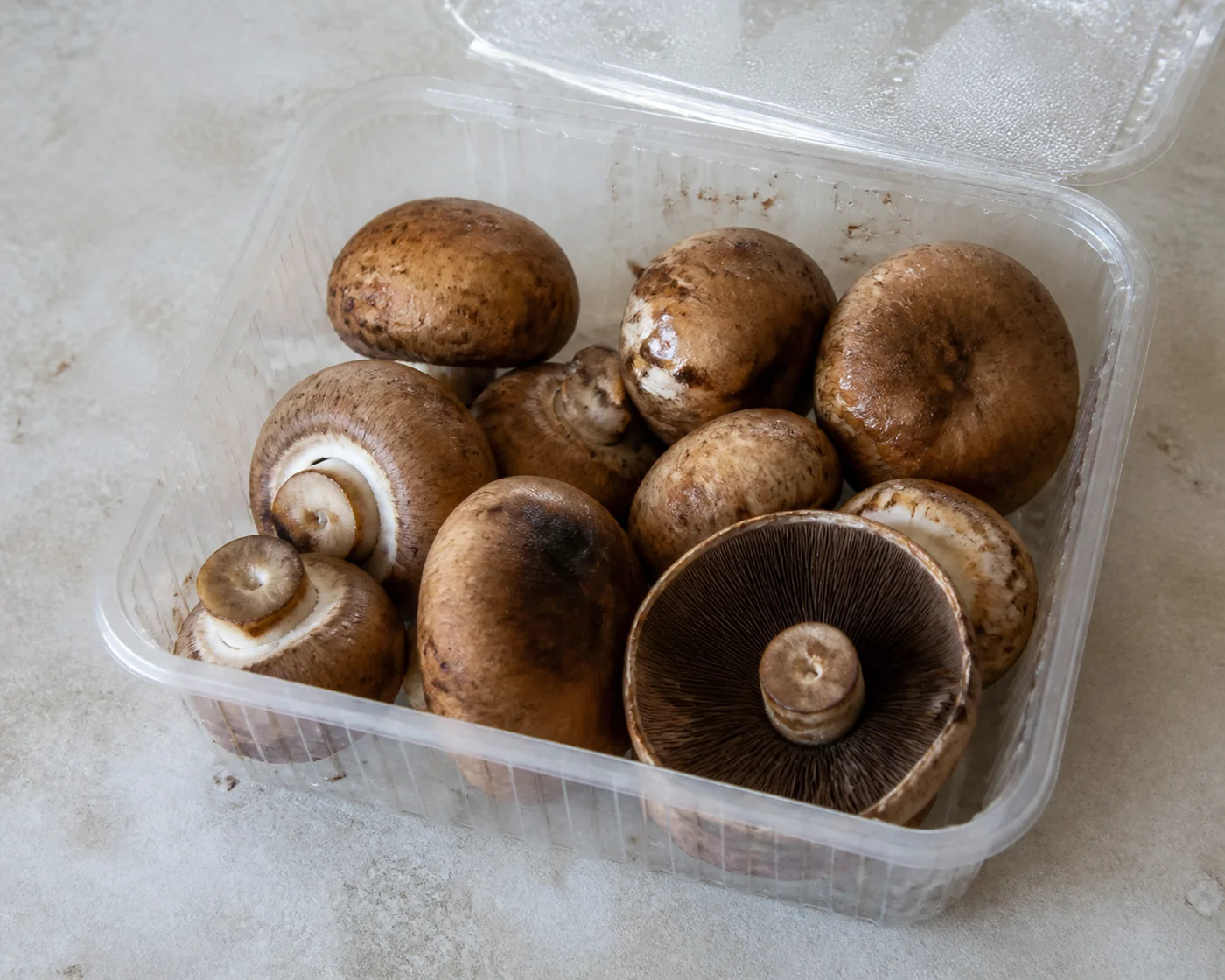
Sealed film is the part most people never think about. It keeps the mushrooms from drying out and it also keeps every bit of moisture they release sitting against them, which is exactly the condition that turns a firm cap into a wet one.
The date printed on the film is the least useful thing on it. A punnet opened three days ago will be further gone than a sealed one a week past its date, and the gills tell you which is which in about a second.
Taking them out of the plastic and into a paper bag is a small change with a visible effect. The mushrooms lose a little water and stay firm rather than sweating, and a punnet treated that way is usually still worth slicing raw several days after one left in its film has stopped being worth anything.
Use those differences to decide what belongs in the meal.
What to do with the punnet in your fridge
None of this needs a decision about agaritine.
- Fresh and firm
- Slice them raw and think no more about it
- Tired but sound
- Into a pan, where they will be better anyway
- Wet, dark or patchy
- Cooked or composted, and not raw
- If you want less agaritine
- Cook them, which halves it in about five minutes
- If you want to worry about something
- Worry about how long the punnet has been open
The last two lines are ranked in that order deliberately. One of them is a lever you can pull for a measurable chemical effect that may not matter, and the other is the reason people actually get an upset stomach from mushrooms.
Washing them is still worth doing, for a reason that has nothing to do with any of this. Cremini are grown on a composted substrate with a casing layer over it, and a quick rinse takes off what is left of that.
A rinse just before slicing does not make them soggy the way a long soak does.
Cremini raw is an ordinary thing to eat and always has been.
The compound in it is real, the reduction from cooking is real, the human harm is not established, and the mushroom you should genuinely leave out of the salad is the wet one at the bottom of the punnet.
Sources & References
- Agaritine, Laboratory Notes Gives the chemical identity as an aromatic hydrazine, the range of about 100 to 1700 mg per kg in fresh Agaricus bisporus and what moves it, the description of the compound as water soluble and heat labile, the reduction of more than 50 to 90 percent from cooking, blanching and drying, the degradation into hydrazine compounds with mutagenic and carcinogenic activity in animal models, and the statement that the actual health risk to humans from dietary intake remains controversial and not conclusively proven.
- Agaritine content in processed foods containing the cultivated mushroom (Agaricus bisporus) on the Nordic and the Czech market, Food Additives and Contaminants The source for the processing figures, including the more than tenfold reduction during wet canning and the resulting levels of about 14.9 mg per kg in whole canned mushrooms and 18.1 mg per kg in cut ones, alongside fresh market samples at 212 and 229 mg per kg.