
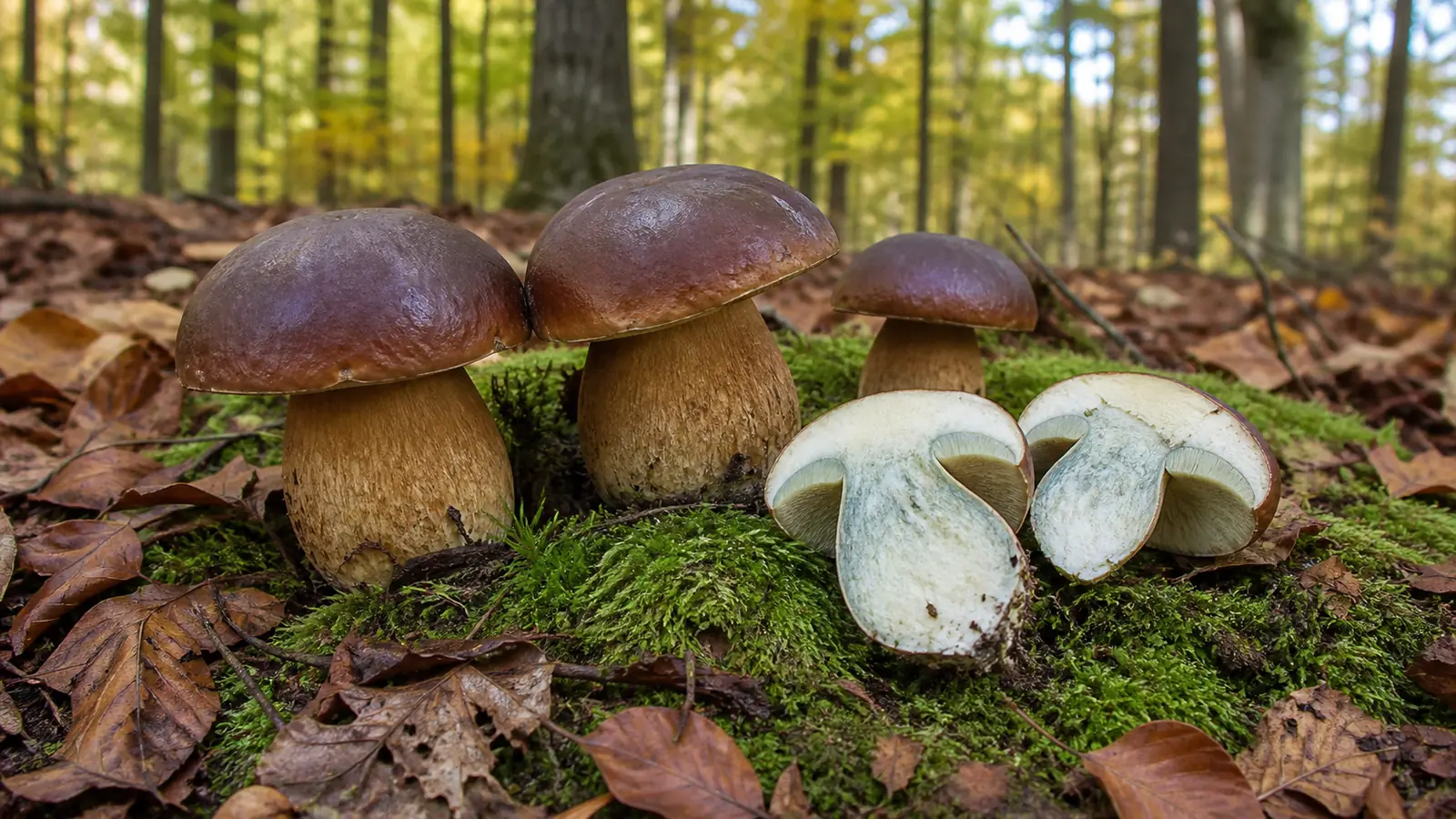
You cut a bay bolete in half to check it, and the pale flesh flushes blue-green while you are looking at it.
That is the moment most people arrive at this question, and it makes the raw question and the poison question land at the same time.
Both have answers. One of them is more reassuring than you are expecting.
Can you eat bay bolete raw?
No, and not for the reason you are currently worried about.
Raw bay bolete is reported to cause gastric upset, which is a digestion problem rather than a poisoning one. The blue stain that prompted the question is a separate matter entirely, and it is the less serious of the two.
- Verdict
- Cook it, because raw bay bolete causes stomach upset
- The blue stain
- Oxidation on contact with air, not a toxicity signal
- Where it shows
- Pale blue-green in the cut cap flesh, and faster on the pores
- Pore color
- Pale yellow, bruising rapidly to blue-green under a thumb
- What heat does
- The faint blue fades away in the pan
Take the two questions in the order they actually matter.
Color change alone cannot establish whether a bolete is safe to eat. It does not, so the rest of it is worth reading.

It turns blue when you cut it
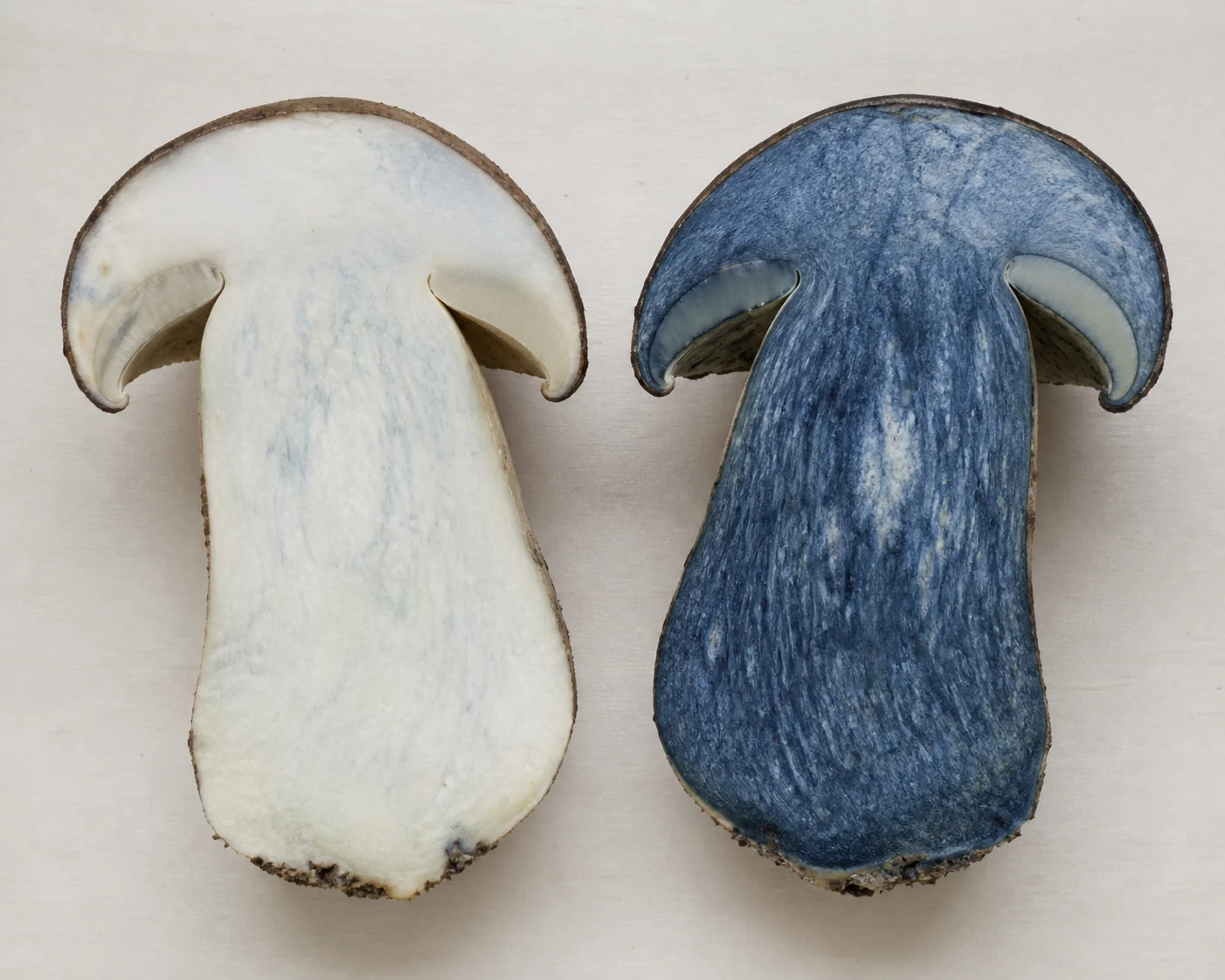
Blue staining in a bolete is oxidation. Compounds in the flesh meet air at the cut surface and change color, in much the same way a sliced apple browns.
That is not a toxicity test, and treating it as one throws away a large number of good edible mushrooms.
The reaction is usually attributed to variegatic acid, a pigment sitting in the flesh that turns blue as soon as oxygen reaches it.
Whether a bolete blues therefore depends on how much of that pigment it happens to carry, which is a fact about its chemistry rather than a verdict on whether you should eat it. Several excellent edibles are strong stainers and several dangerous species barely stain at all.
None of the beliefs attached to a blueing bolete survive contact with one.
Staining does not mean poisonous, because many edible boletes do it. A stained mushroom is not ruined either, because the pale blue in a bay bolete disappears in the pan.
The reaction is also not reliable on its own, because pore and stem color carry far more information about a bolete than its flesh does.
Bay bolete is not even a strong stainer.
The flesh takes several seconds to shift, the color that arrives is pale rather than vivid, and plenty of specimens barely react at all. A mushroom that hesitates like that is telling you something different from one that does not.
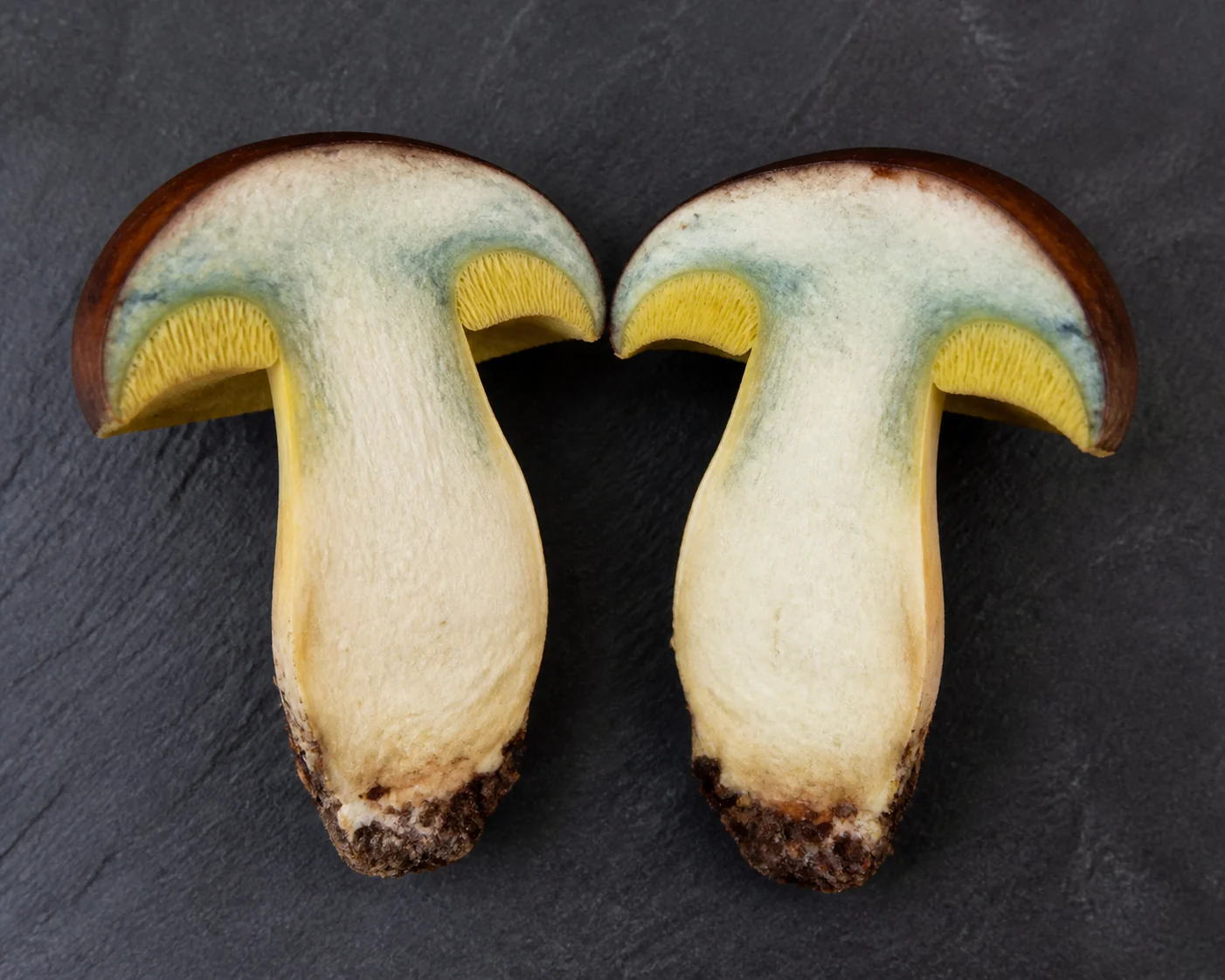
Reading the stain
Two observations separate a harmless reaction from one that should stop you, and both take seconds.
| What to check | A bolete to leave alone | Bay bolete |
|---|---|---|
| Time to stain | Dark or strong blue within two to three seconds | Several seconds, and often nothing much at all |
| Color it reaches | Deep indigo | Pale blue-green |
| Stem and pores | Red anywhere on stem, pores or cap | Pale yellow pores, no red |
| What it means | Put it back | Take it home and cook it |
The second observation is the one that does the real work.
That observation is about color on the stem and pores, which is a far steadier signal than the speed of a bruise. The practical rule most foraging references settle on is to leave alone any bolete showing red on the stem, the pores or the cap, along with any whose flesh floods blue immediately.
Avoid boletes with red on the stem, pores or cap, and those whose flesh turns blue rapidly.
The rule most foraging references settle on
Red is steadier because it does not depend on timing, lighting, or how fresh the cut is. A bruise you are trying to time can be argued with, especially in poor light at the end of a walk, where a red pore surface is either there or it is not.
Neither observation replaces knowing what you picked.
They narrow a field quickly, and they are worth having, but a confident name still comes from cap, stem, pores and habitat together rather than from one reaction.
What raw actually costs you here
Now that the alarming part is settled, the actual answer is fairly ordinary.
Raw bay bolete is reported to cause gastric upset. That is nausea, cramping and a generally unhappy few hours rather than anything requiring attention, and it is the same complaint raw mushrooms of most species produce.
The shape of that upset is worth knowing in advance. It starts within a few hours rather than the next day, settles on its own, and responds to nothing more complicated than fluids and time.
A reaction that begins much later, or one that keeps getting worse, is a question about what was actually picked rather than about how it was prepared.
The blue point is worth a second of attention. A raw slice keeps its faint blue-green on the plate, which is unappetizing in a way that has nothing to do with safety, so the pan solves an aesthetic problem alongside the digestive one.
SafetyCan You Eat Birch Bolete Raw? Raw Is the Smaller QuestionThe pores are their own decision
Press the pores with a thumb and watch how fast the blue arrives
Cut one lengthwise before the basket fills up
Reject a bolete because it turned blue at all
Trust a bruise you timed in poor light at the end of a walk
Underneath the cap is a spongy layer of pale yellow tubes, and it is not the same material as the flesh above it.
References recommend bay bolete fresh with the pores removed, and the reason becomes obvious with age. The layer is doing several unhelpful things at once.
- Holding water, which is why it turns to padding in an older cap
- Refusing to dry evenly, so it spoils a tray of otherwise good slices
- Going slimy first, well before the flesh above it shows anything
- Darkening the pan, since the tubes break down faster than the cap does The layer softens, absorbs water, and turns to something closer to wet padding than to mushroom.

Raw slicing makes the pores your problem straight away, and so does drying, because a water-holding layer is the part of a cap that refuses to dry evenly.
A firm young cap with the pores left on will still slice cleanly, but anything past its first day gives you a slice that is half sponge, and no dressing rescues it. On a fresh specimen the layer lifts away in one piece with a thumb, which takes about as long as deciding whether to bother with it.
Where bay bolete beats its famous relative
It is usually described as the lesser porcini, and in pure flavor terms that is fair enough.
It also arrives more often, over a longer stretch of the year, from August into November across ordinary mixed woodland rather than from the handful of spots people guard.
Two months of reliable fruiting is what makes a drying tray worth setting up.
Tip
Bay boletes do not often host maggots, which is the single practical advantage over porcini. A basket of bay boletes is usually a basket you can actually use, where a good-looking porcini haul can lose half its weight to trimming once the stems come apart.
That advantage points somewhere specific. Bay bolete is rated better dried than fresh, and clean unmaggoted caps are exactly what a drying tray wants, so the species rewards the preparation furthest from a raw plate.
Being common is the other half of it, and it changes what a drying tray is worth.
Porcini is a species people go looking for in particular places on particular days, where bay bolete turns up across ordinary mixed woodland through most of the autumn. A mushroom you can reliably gather in quantity is worth a drying tray in a way that a lucky handful never is.

Drying also settles the raw question in a way worth being clear about.
Dried slices go into stocks, sauces and braises that get heat anyway, so nobody ends up eating a dried bay bolete uncooked. The preparation this species is best at happens to be the one furthest from the plate of raw shavings that started the question.
Note
The blue stain is not the thing to fear, and the name still is. Check the stem and pores for red, take the whole specimen rather than a cap, and settle the identification before any question about raw or cooked is worth asking.
Sources & References
- Bay Bolete, Wild Food UK Records the pale blue-green staining of the flesh and the rapid blue-green bruising of the pale yellow pores, the two to three second threshold that separates dangerous boletes, the rule about red on the stem, pores or cap, the recommendation to serve it with the pores removed, and the low rate of maggot infestation.
- Bay Bolete, Imleria badia States that bay bolete can cause gastric upset when eaten raw and should be cooked thoroughly, and that blue staining reflects oxidation rather than toxicity.