
POISONOUS
Gastrointestinal mushroom poisoning often starts within hours. But vomiting and diarrhea don't prove the cause was a harmless irritant. The hour symptoms began, how much fluid the person has lost, everything in the basket, and signs of late organ damage shape the next step.
Gastrointestinal Mushroom Poisoning: Timing and Care
Gastrointestinal mushroom poisoning brings on nausea, vomiting, abdominal cramps, and diarrhea after a mushroom meal. Many of these irritant syndromes start within a few hours and clear up with supportive care. But the same stomach symptoms can also open a delayed liver or kidney poisoning. So the hour they began and the mushrooms in the dish shape what happens next.
Warning
Call Poison Control at 1-800-222-1222 in the United States after illness from any wild mushroom. Call 911 for fainting, confusion, seizure, breathing trouble, blood in vomit or stool, severe abdominal pain, or signs of shock.
What should you do when vomiting starts?
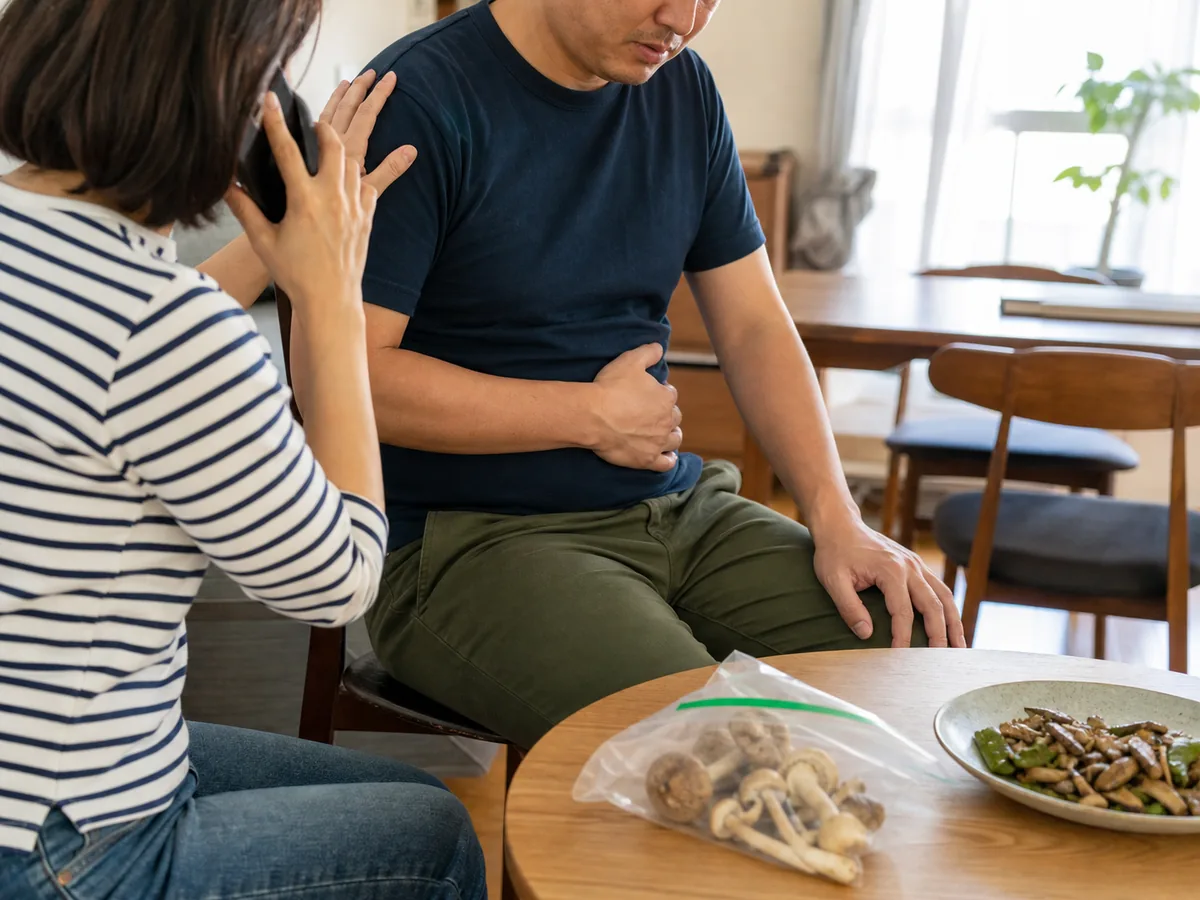
Stop the meal and keep every other diner away from the leftovers. Move the sick person away from stairs, a shower, or any spot where dizziness could cause a fall. If they're drowsy or keep vomiting, follow the emergency dispatcher's advice on how to position them. Don't give them food, alcohol, medicine, or large amounts of liquid.
Do not induce vomiting. Mushroom toxins and food may already have moved past the stomach. Forced vomiting can cause choking or aspiration, and household charcoal carries an airway risk too. Only a poison specialist or doctor should give charcoal, once they judge that the timing and the person's alertness make it safe.
Before anyone talks about clearing the gut, write down when the meal happened and when the first symptom began. List every mushroom species that may have gone into the dish. Add where someone picked it, how they stored and cooked it, and how much each person ate. Keep raw mushrooms, cooked leftovers, photos, and packaging, but don't let that delay the call.
How violent one bout of vomiting looks doesn't measure the danger. Repeated vomiting and watery diarrhea can drain body fluid fast. Even one vomit followed by fainting, confusion, severe weakness, or an irregular pulse can point to a wider problem. On the call to the poison center, mention the person's age, pregnancy, heart or kidney disease, diabetes, medicines, and other possible exposures.
- Keep the person under direct observation.
- Note every vomit and diarrheal episode without tasting or handling the material unnecessarily.
- Save the remaining mushrooms in a container separate from food.
- Report whether other diners are ill and when their symptoms began.
- Follow the destination and transport advice given by the poison specialist.
How soon do gastrointestinal irritants act?
The classic irritant syndrome usually starts fast, often about 30 minutes to four hours after the meal. Some references stretch that early range toward six hours. Treat that boundary as a clue for doctors, never a guarantee.
| Interval from meal | What it suggests | What it cannot prove |
|---|---|---|
| Under 30 minutes | Food intolerance, anxiety, contamination, allergy, or a very rapid toxin effect remains possible | That mushrooms are innocent |
| 30 minutes to 4 hours | Common range for local gastrointestinal irritants | That no other species was eaten |
| 4 to 6 hours | Overlap zone requiring careful history and observation | That the illness is mild |
| More than 6 hours | Greater concern for amatoxin or another delayed syndrome | Which toxin is responsible |
The clock starts when each person actually ate, which may be well after the group sat down. Someone may even have started tasting while the cook made the dish. Long meals, several courses, alcohol, a full stomach, portion size, and repeated tasting can all stretch the gap.
In a group case, keep one meal timeline and portion record for each diner. Say four people shared a dish and only two got sick. Compare their portions, the species on each plate, the side dishes, and when each one fell ill. One toxic cap can end up in a single serving, so the table never counts as one shared exposure.
Early onset supports an irritant syndrome when the rest of the story fits. It doesn't end the worry if the basket held mixed species, nobody knows the mushroom, symptoms keep getting worse, or another diner falls ill later. One meal can hold both a fast irritant and a species that damages organs. Then two illnesses run side by side.
The timing still shapes what doctors watch next. Fast vomiting points them toward fluids and symptom control. Late illness calls for liver, kidney, clotting, blood sugar, and other targeted tests. Give the poison team the actual times symptoms started and let them do the reading.
Late vomiting and the deadlier toxins
Vomiting that starts more than six hours after a wild mushroom meal raises real concern for a toxin that harms organs. The delay reflects the time the body takes to absorb the toxin and the damage it then does inside cells. Plain irritation of the stomach lining can't explain it. The death cap is the best-known example that harms the liver this way.
Amatoxins can cause severe vomiting and diarrhea after a quiet stretch. Then comes a short-lived improvement while liver injury goes on. The person may feel better just as lab tests start to show liver failure, low blood sugar, poor clotting, or kidney injury.
False morels cause a different delayed problem that reaches the liver and the nervous system. Their toxin, gyromitrin, can bring a late stomach illness. Headache, dizziness, liver injury, seizures, or altered mental status can come with it.
Kidney-toxic mushrooms can start with nausea and vomiting. Flank pain, less urine, or rising kidney markers show the deeper injury later. After any of these late starts, easing symptoms can mislead you. When vomiting slows, the gut may simply be empty, and that's no proof the body has cleared the toxin.
Nobody should leave care, drink alcohol again, or eat the leftovers because the stomach has settled.
Mixed meals blur the early and late groups. One basket can hold an early irritant and a mushroom with amatoxins. Someone with delayed poisoning may recall only one small cramp from much earlier. Doctors read the whole trend and don't force the story into one numbered box.
Any late onset, mixed basket, unknown mushroom, or change in mental state calls for a prompt medical check.
What are the stomach and intestine reacting to?
Gastrointestinal irritant syndrome is a clinical group, and no single toxin defines it. The name tells you where the illness lands, not which compound caused it. Several unrelated mushrooms carry compounds that irritate the gut, and science still knows little about many of them. Each one inflames or stirs up the gut and brings nausea, cramps, vomiting, and diarrhea. The liver, kidney, cholinergic, or nerve pattern of other syndromes is missing.
- Main site
- Stomach and intestinal symptoms dominate the early illness
- Chemistry
- Different species may act through different or poorly defined irritants
- Typical course
- Many cases improve after fluid and electrolyte losses are corrected
- Diagnostic limit
- The label remains provisional until delayed and mixed-species risks are addressed
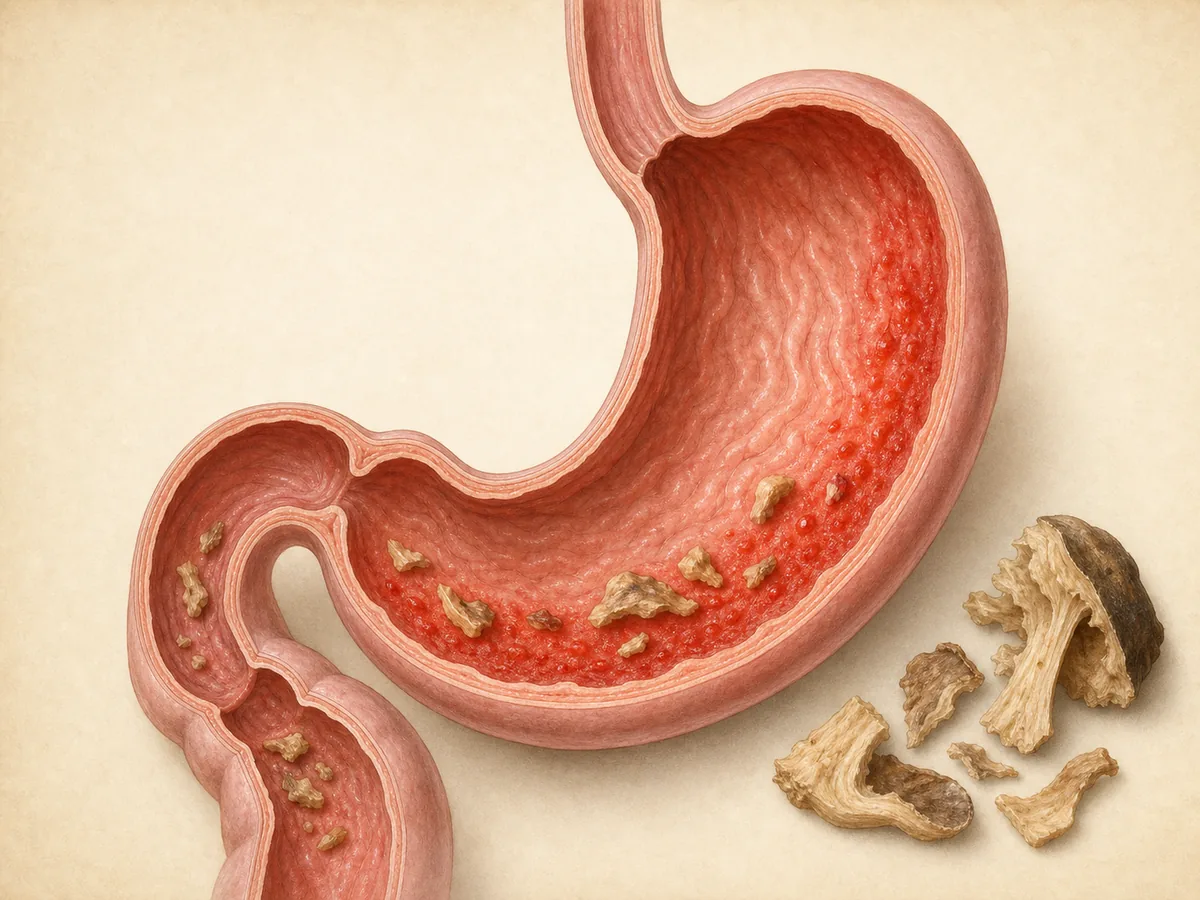
Mushrooms can also make you sick with no classic wild-mushroom toxin at all. Edible kinds eaten raw, undercooked, spoiled, or in very large amounts can be hard to digest. They can also carry germs. Personal intolerance or allergy can add vomiting, belly pain, hives, swelling, wheezing, or trouble breathing.
These other causes change both the treatment and the public-health follow-up. When several diners fall ill after the same stored dish, germs or spoilage become more likely. When one diner reacts to a mushroom they've eaten many times before, the question turns to that person's own sensitivity. Neither pattern safely rules a mushroom toxin in or out, because portions and species can differ from plate to plate.
Cooking can't fix every toxin or germ problem. Heat makes ordinary edible mushrooms easier to digest. But it doesn't turn an unknown species into food or break down every toxin. Reheating spoiled leftovers also can't undo toxins that germs have already made.
So the label stays narrow, even after cooking. It tells doctors the gut drives the current picture and that supportive care often works. It doesn't confirm the species or predict how long the illness lasts. And it gives no one permission to eat the rest of the mushrooms.
SafetyCoprine Mushroom Alcohol Reaction: Symptoms and When to ActSpecies behind gastrointestinal poisoning
The green-spored parasol, Chlorophyllum molybdites, is a frequent cause of stomach poisonings in North America. It fruits in lawns and grassy areas, often in rings. There, people can mistake its pale cap for an edible parasol.
- Lawn exposure
- Green-spored parasol is a prominent North American cause
- Wood clusters
- Jack o'lantern species can produce severe vomiting and cramps
- Additional genera
- Agaricus, Entoloma, Lactarius, Russula, Tricholoma, and Boletus include irritant species
- Core limit
- A genus name does not establish the chemistry of a cooked meal
Jack o'lantern mushrooms set a different trap. Their orange clusters grow from wood or buried roots, and a new collector can mistake them for chanterelles. True gills, clustered growth, and what they grow on let an expert tell them apart. Severe vomiting, though, is not an ID feature.
The yellow-staining Agaricus, or yellow stainer (Agaricus xanthodermus), often gives off a strong phenolic odor. It also turns bright yellow near the stem base. In Europe, livid pinkgill, Entoloma sinuatum, is a known cause.
Tiger knight, Tricholoma pardinum, is another known European cause. Bitter or red-pored boletes and acrid milkcaps account for other regional cases. Still, no species list covers every region or sorts out badly kept specimens. Common names shift from place to place, young mushrooms lack adult traits, weather changes color, and cooking strips the surfaces an expert needs.
Photos online flatten size, texture, smell, bruising, gill attachment, and the shape of the stem base. So the specimen and its habitat outrank any symptom match. Whole mushrooms with the full base, underside, cap, nearby ground, and a spore deposit can support a qualified ID. Vomiting after an orange mushroom shows only an exposure pattern, since allergy, germs, another toxin, or an unrelated illness can look the same.
Use the species list to judge what's plausible, never as a home ID key.
Dehydration from vomiting and diarrhea
Repeated vomiting and diarrhea drain water, sodium, potassium, and other electrolytes. They often go faster than a person can replace them. As body fluid drops, the person may feel thirsty, dry-mouthed, weak, and dizzy. Then the pulse may race, blood pressure may drop, and urine output may fall.
Small children can get worse after fewer fluid losses. Older adults and pregnant patients have less reserve too. So do people with kidney disease, heart disease, diabetes, or medicines that affect fluid balance. Their care has to balance what goes back in, because too much or too little fluid can both cause harm.
Anyone in those groups who can't keep down small sips needs medical care. Other reasons to escalate are nonstop retching, marked sleepiness, confusion, fainting, or severe weakness. So are very dark or absent urine, a racing or irregular heartbeat, and worsening belly pain. Blood in vomit or stool, fever, jaundice, seizure, or breathing trouble widens the emergency beyond simple dehydration.
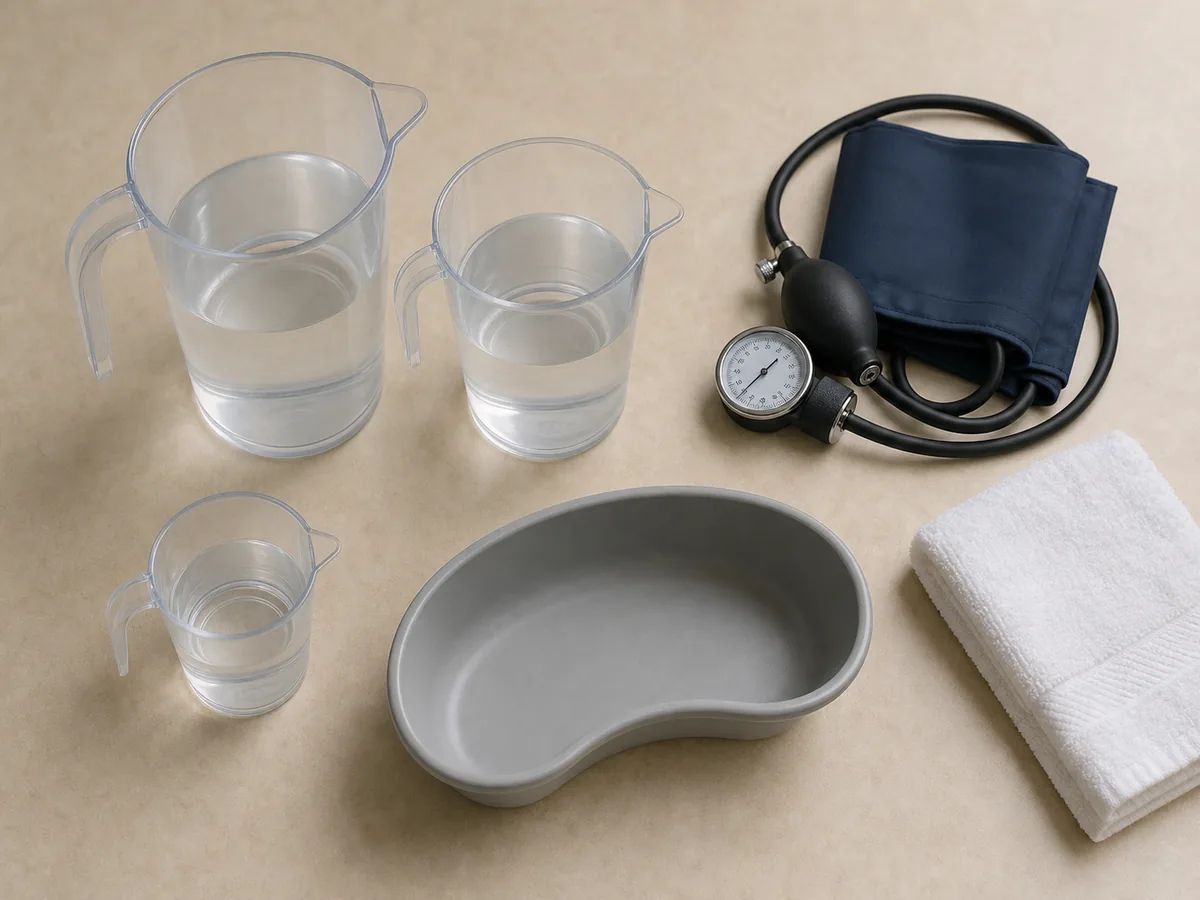
Fluid lost through vomiting and less urine is hard to judge at home. Doctors can use a basin, the number of episodes, how often the person pees, and changes in body weight. But guesses by eye stay rough. Repeated pulse, blood pressure, alertness, urine, and lab checks show whether blood flow is recovering.
Plain water doesn't fix every problem. Large amounts gulped fast can bring on more vomiting. The right salt and fluid mix depends on the person's condition. Poison Control or a doctor can give advice based on age, symptoms, health history, and the time since the meal.
The safest line is what the person can still do. If they can't stay alert, stand safely, pee normally, or keep down the fluids a doctor advised, the illness has gone past home care.
SafetyGyromitrin Poisoning: False Morel Risk and What to DoHospital care for fluid loss and an unknown mushroom
Doctors start with airway, breathing, blood flow, temperature, alertness, pulse, blood pressure, and fluid levels. They also rebuild the meal history, since the timing and the specimen can change the plan before any lab value looks wrong. Blood tests follow the symptoms. Salts, blood sugar, kidney and liver tests, and clotting studies can reveal dehydration or a delayed toxin.
Doctors may order an electrocardiogram (ECG) when weakness, fainting, salt loss, chest symptoms, or an irregular pulse raises concern. Supportive care fits the person more than the mushroom name. Monitored fluids replace losses when needed, and anti-nausea medicine can calm steady vomiting. Doctors correct salt levels from measured values. Oxygen, airway support, seizure care, or treatment for a specific organ comes in when the illness no longer looks like a simple stomach upset.
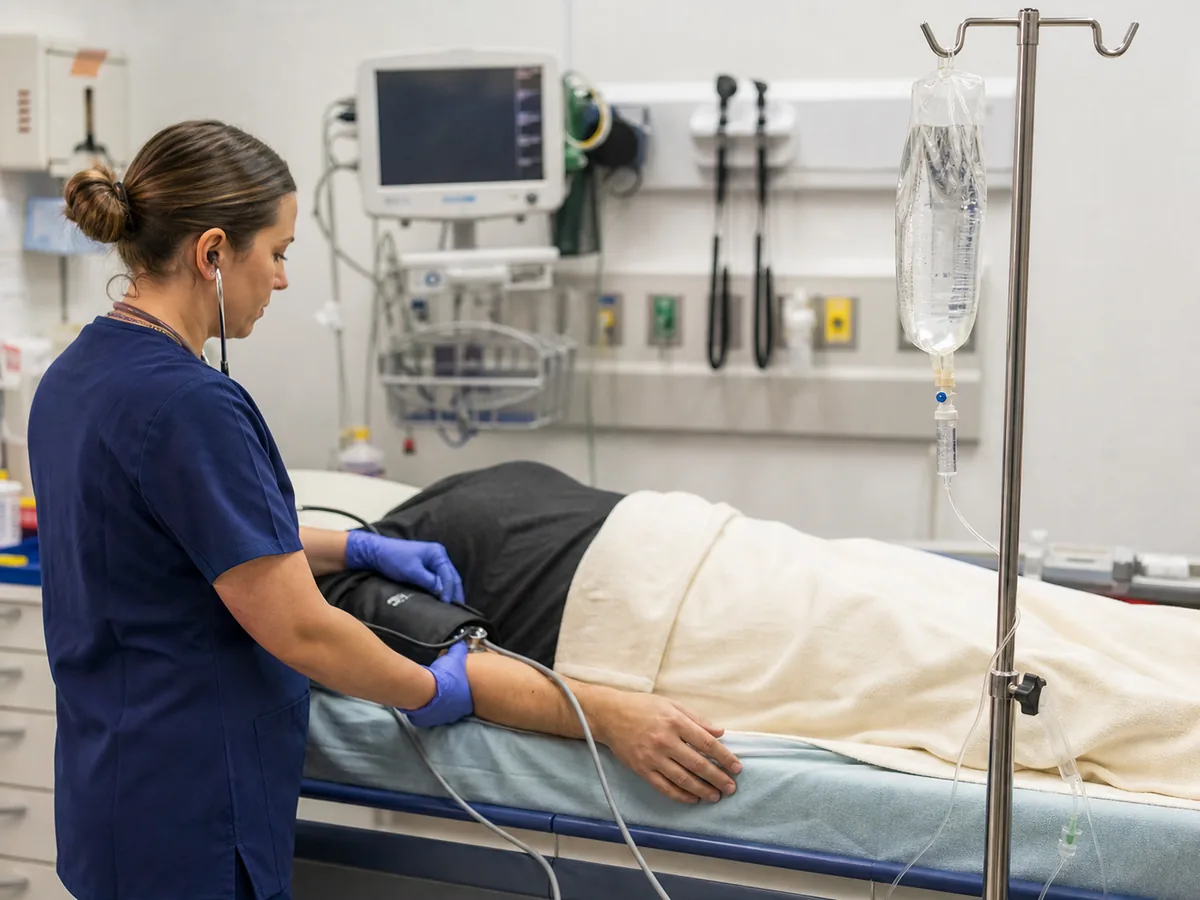
Activated charcoal is a timing and airway decision. Doctors may consider it after some poisonings. But repeated vomiting, low alertness, a late arrival, or the risk of breathing in stomach contents can outweigh a possible benefit. Drinking household charcoal, or forcing it on a sick person, can add lung injury to the poisoning.
Watching the patient is active work. Doctors repeat vital signs, belly and nerve exams, urine checks, and chosen lab tests to see if the trend is improving. New jaundice, confusion, low blood sugar, worse kidney values, or blood pressure that stays low moves the case out of the simple irritant group.
Most confirmed early-onset irritant cases recover with proper support. Steady blood flow, controlled symptoms, good hydration, and no sign of another syndrome mark that good course. Reaching a set hour after the meal can't stand in for them.
Saving evidence from the meal
Save one whole uncooked mushroom whenever you can do it without delaying care. Keep it intact from cap to stem base, then photograph it from several angles beside a ruler. Add a wider photo of where it grew. Show grass, soil, mulch, wood, nearby trees, and whether the mushrooms grew alone, in a ring, or in a cluster.
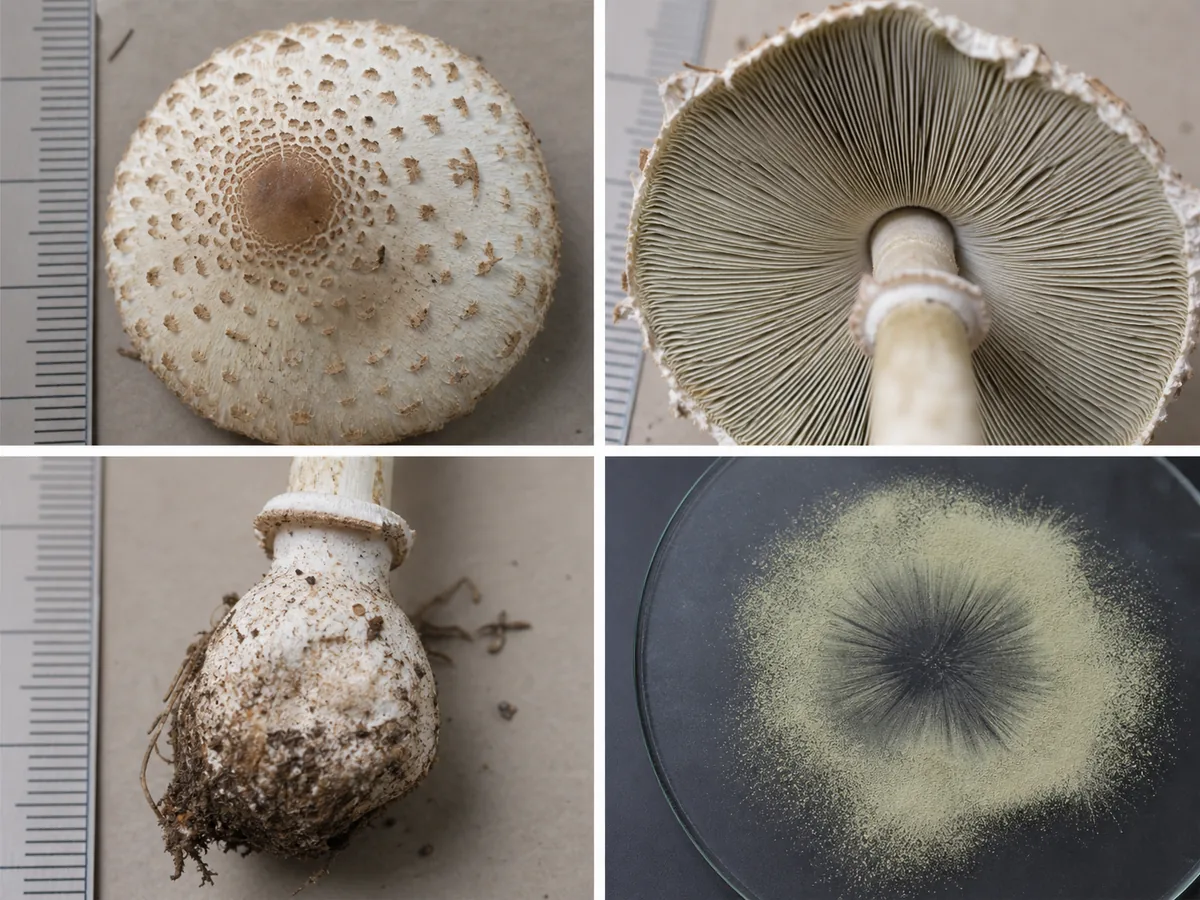
If the leftover mushroom is mature enough, a spore print can support a later ID. It should never delay the medical call. Greenish spores fit the green-spored parasol idea. Brown, white, or other colors point an expert elsewhere without proving the mushroom safe to eat.
Cooked leftovers go in a separate sealed container. Don't rinse them or mix them with raw specimens, since sauces and heat already make the parts hard to read. Save the pan, serving bowl, ingredient packaging, and any photos taken before cooking.
Write one record for each diner. Include portion, first bite, when symptoms began, how many times they vomited or had diarrhea, other foods, alcohol, medicines, current condition, and treatment. Note who ate the same dish and stayed well. Uneven portions and a mixed basket still mean a healthy diner can't clear the meal.
Food handling belongs in the evidence too. Record the picking time, then chilling, cleaning, cooking heat, time at room temperature, and reheating. Those details can separate a mushroom irritant from bacteria or spoilage when the symptoms overlap.
This handling record supports decisions even while the species stays unknown. Meanwhile a qualified expert may narrow down the mushroom, a poison specialist may name the syndrome, and doctors may track organ function. None of those jobs should wait for the others to be perfect.
Preventing another gastrointestinal poisoning
The strongest protection is to eat only a single species. Someone who knows that mushroom well in your region should have identified it from whole, fresh specimens. Photos, phone apps, common names, and a likeness to a store mushroom don't meet that standard.
Mixed baskets add doubt you can avoid. Keep each species in its own container from picking through cleaning. Throw out any specimen that is old, waterlogged, insect-damaged, incomplete, or doesn't match the identified group. Never let an unknown cap into a dish where you can't get it back out.
Cook edible wild mushrooms well, because heat makes them easier to digest and cuts the usual germ risk. Proper cooking still can't rescue a wrong ID or promise to remove an unknown toxin. Try one new wild species at a time. Then an intolerance is easier to spot, and the meal history stays clear if someone gets sick.
Children, pregnant people, older adults, and people with serious health problems need an extra-careful choice, because dehydration hits them harder. Past tolerance is weak evidence. Another species can share the same common name, a picker can misidentify one specimen, a batch can pick up germs, and personal reactions can change. After any unexplained illness, stop serving that collection and keep the evidence for expert review.
The meal is complete only when you've accounted for every specimen before it reaches the pan.
Sources4
- Mushroom Poisoning Syndromes, North American Mycological Association GI irritants are a wide variety of mushrooms; green-spored parasol is the most common North American cause
- Clinical Toxicology of Mushroom Poisoning (Dtsch Arztebl Int 2020) GI irritant onset 30 min to 4(6) h; charcoal may be given; livid pinkgill and leopard (tiger) knight listed as irritant causes
- Mushroom poisoning: an updated review, Turkish Journal of Emergency Medicine 2025 Amatoxin: quiet interval with symptom improvement while liver injury develops
- MedlinePlus: Dehydration Very dark urine or no urine as a dehydration warning sign
Frequently Asked Questions
How soon does gastrointestinal mushroom poisoning begin?
Many irritant syndromes start about 30 minutes to four hours after a meal. Later onset, a mixed basket, or an illness that keeps getting worse means a doctor needs to check for other toxins.
Which mushroom commonly causes severe vomiting on lawns?
In North America, the green-spored parasol, Chlorophyllum molybdites, is a prominent cause. Symptoms can't confirm the species, so keep a complete specimen for an expert.
Can cooking destroy gastrointestinal mushroom toxins?
Cooking makes known edible mushrooms easier to digest. It doesn't break down every toxin or make an unknown species safe to eat.
When should someone seek emergency care?
Call emergency services if the person faints, gets confused, has a seizure or breathing trouble, or has blood in vomit or stool. Severe weakness, signs of shock, or being unable to wake the person also need an emergency call.
Should vomiting be induced after a wild mushroom meal?
No, because forced vomiting can cause aspiration. Poison Control or a doctor makes any call on clearing the gut.