
DEADLY POISONOUS
Orellanine poisoning is a delayed kidney emergency. It comes mainly from certain Cortinarius webcaps. Symptoms may wait days, so a mushroom meal from long before still belongs in the medical history.
Orellanine Poisoning: Kidney Injury and Delayed Onset
Orellanine poisoning is a delayed kidney emergency. It may not show itself until days after a wild-mushroom meal. In the United States, call Poison Control at 1-800-222-1222 for any suspected webcap meal, even if everyone still feels fine. Call 911 for collapse, confusion, breathing trouble, a seizure, or a person you can't wake.
| Time from meal | What may be happening | What the delay means |
|---|---|---|
| First hours | The person may feel normal or have vague stomach symptoms | Feeling well does not clear the exposure |
| About 36 hours to 3 weeks | Thirst, headache, nausea, flank or abdominal discomfort, and urination changes may emerge | Reconstruct the older mushroom meal and seek urgent testing |
| Established kidney injury | Urine output may fall, waste products and potassium may rise, and fluid balance may fail | Hospital monitoring and renal support may be needed |
| Following weeks or months | Kidney function may partly recover or remain severely impaired | Nephrology follow-up can continue long after the meal |
How long does orellanine poisoning take to show?
The long quiet gap after the meal is the main clue. NAMA's poisoning summary puts the first symptoms anywhere from 36 hours to three weeks after the meal, about eight days on average. Timing varies that much from person to person, so it can't name the toxin by itself. By then, new thirst, tiredness, nausea, flank pain or a change in how you pee may seem to have nothing to do with an old meal.
So tell doctors about every wild-mushroom meal in the weeks before, not just the last thing you ate. Even a forgotten camping dinner or a jar of preserved mushrooms can explain a kidney injury that has no other cause. Because of the delay, the state of the kidneys tells doctors more than any dramatic early symptom.
Get medical help right away for less urine, faintness, confusion, swelling, shortness of breath or severe weakness. The same goes if you can't keep fluids down.
If someone may well have eaten a webcap, they can need urgent blood and urine tests even while they still pee normally. Don't wait for back pain or for urine to stop, because neither one has to happen. And some mushrooms cause faster stomach, nerve or liver signs that fall outside the delayed kidney pattern on this page.
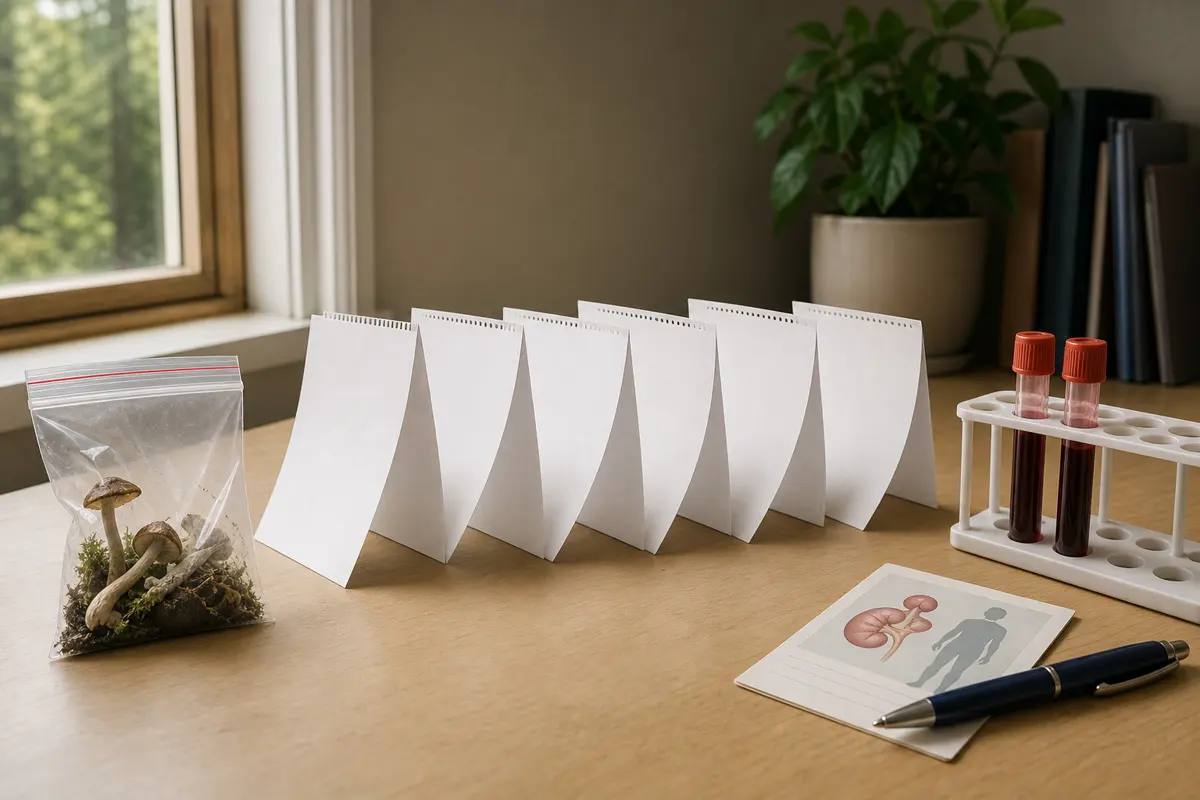
Which mushrooms contain orellanine?
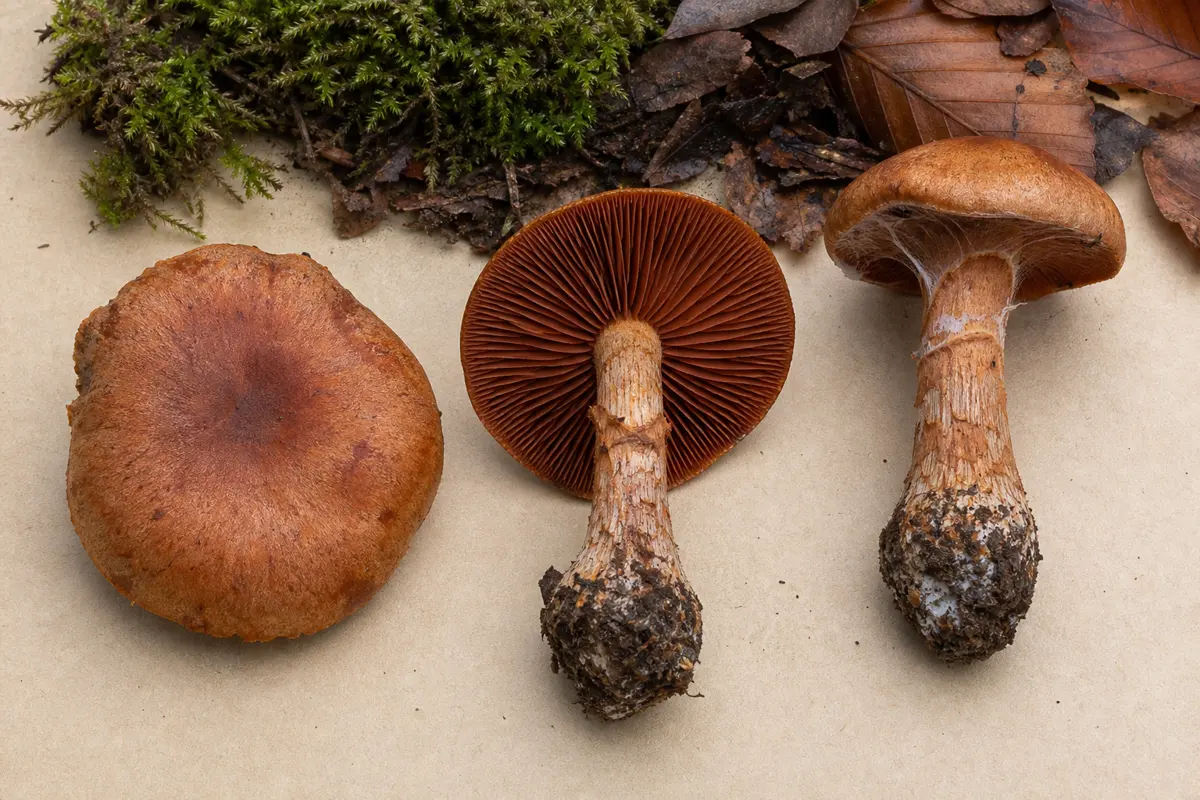
The best-known sources are Cortinarius orellanus, the fool's webcap, and Cortinarius rubellus, the deadly webcap. Both grow in parts of Europe and other northern regions. Some related Cortinarius species are on the list too, some implicated and some only suspected. So keep the whole collection for an expert to check, and never guess from one familiar name.
Webcaps are a large and hard group to sort. Age, rain, handling and light can change the cap and veil. In a phone photo, some harmless kinds and some poisonous webcaps can look much the same. The profiles above give detail on each species, but no profile can turn part of a mushroom into a safe ID.
Keep caps, gills, stems and stem bases in separate paper bags or boxes. Label each one with the place you picked it. Keep raw scraps, cooked leftovers and field photos too, because a mixed dish can hold more than one species. Cooking can't identify a webcap, and you shouldn't count on it to remove the toxin.
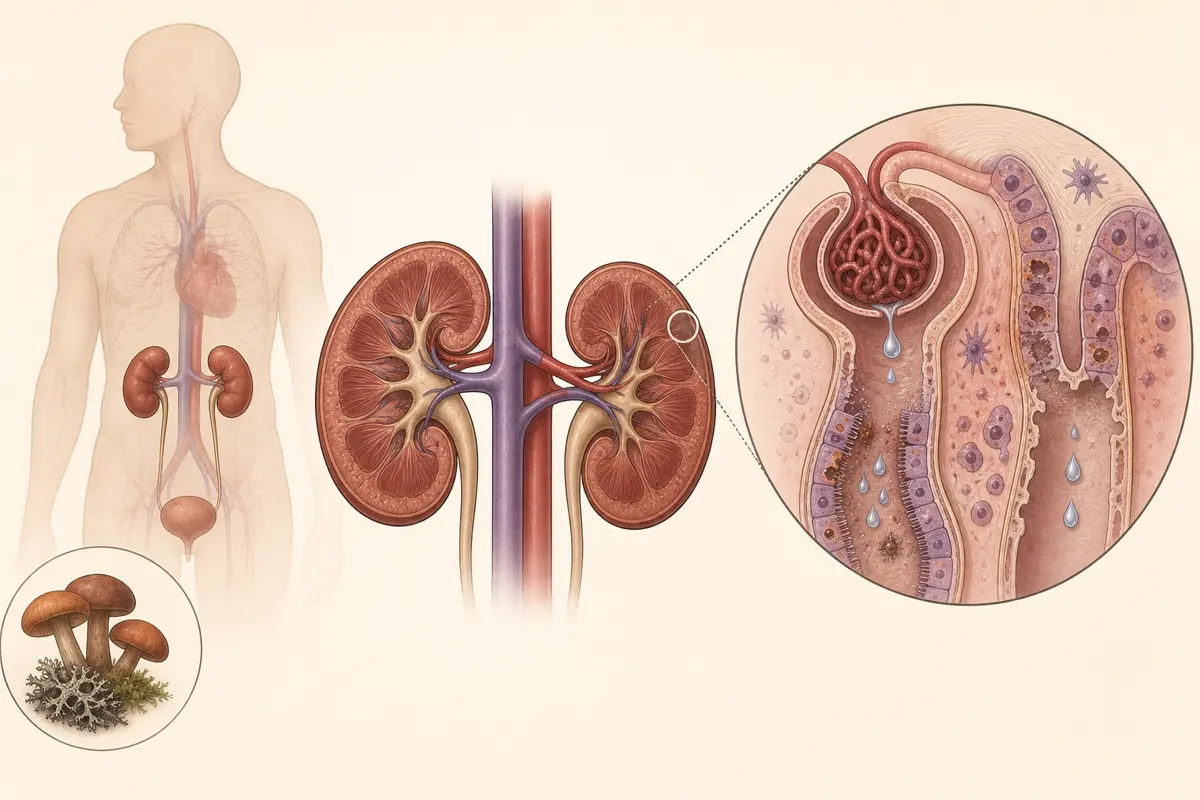
How orellanine damages the kidneys
Orellanine does its damage in the kidneys. It hits the tubules hardest, the tiny tubes that filter blood and keep water, salt and acid in balance. One review of orellanine's human and experimental toxicology describes the kidney injury as delayed. Lab and patient evidence points to oxidative damage that keeps getting worse in the tubules, so the harm doesn't end when the vomiting stops.
- Primary organ
- Kidneys, with prominent tubular injury
- Hidden phase
- Cellular injury can develop before the person recognizes a renal symptom
- Functional result
- Filtration and control of fluid, potassium, and acid-base balance may deteriorate
- Clinical consequence
- A normal-feeling interval cannot substitute for kidney testing
The delay changes how you read the signs. Even when nothing went wrong at the table, the meal can still be medically important. Early stomach upset may never come, or people may forget it. Once the kidneys start to fail, thirst or frequent peeing may give way to little urine, swelling, weakness, nausea or breathlessness.
Orellanine doesn't cause the main liver-failure pattern seen in amatoxin poisoning. That difference shapes what doctors watch. Still, with a mixed basket or an unsure species, they may check more than one organ.
The science still can't predict how one person will do. Dose, species, how sensitive the body is, time to care, dehydration, other medicines and past kidney health can all change the course. At the bedside, doctors follow which way kidney function is heading. They also treat the problems that the decline causes.
For the same reason, an early normal test is no all-clear on its own. If the test came before the kidneys changed, doctors may repeat it. They weigh the meal date, the suspected species and current symptoms. Even a good result means more once it stays stable over the risky days and the meal history no longer points to orellanine.
Symptoms and urine changes to watch for
Early complaints are often vague, so the meal history carries extra weight. Thirst, dry mouth, headache, tiredness, nausea, vomiting, belly pain and pain near the flanks are common. They can look like dehydration, an infection or a plain stomach bug.
Urine changes add clues, yet they follow no single script. Some patients pee often and feel very thirsty before the kidneys get worse. Others reach care after their urine has already dropped. Oliguria means too little urine and anuria means almost none, and only a clinical measurement can confirm either one.
Warning
New thirst, flank pain, vomiting, or changes in peeing in the days after someone eats an unknown webcap need urgent poison-center and medical care. Do not try to flush the toxin out by forcing water.
Extra water can be dangerous when hurt kidneys can't get rid of it. Advice on fluids has to follow an exam, blood tests, urine output and blood pressure. Doctors also look for signs of too little or too much fluid.
More problems can appear as the kidneys lose control. High potassium may upset the heart rhythm, and acid can build up. Trapped fluid may cause swelling or trouble breathing. Uremia, a buildup of waste in the blood, can add nausea, itching, drowsiness, confusion or other nerve changes.
None of these late signs has to appear before the meal deserves attention.
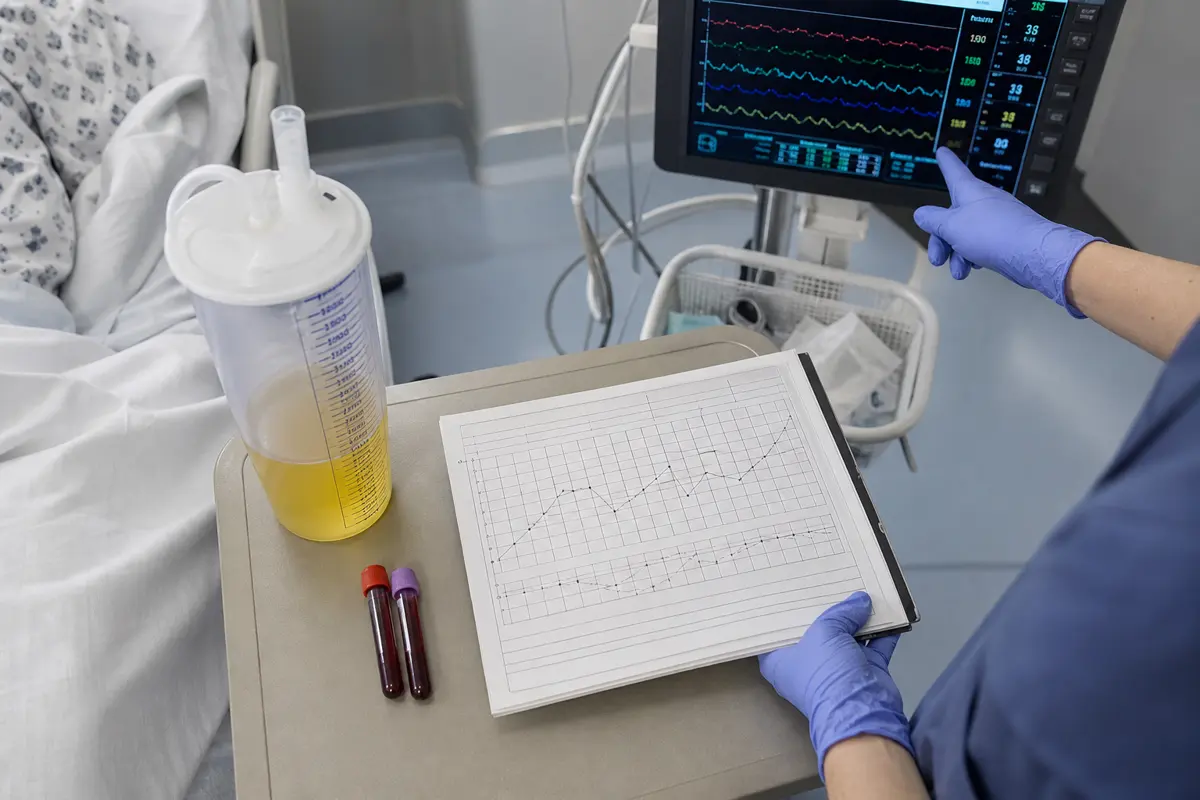
What doctors test and repeat
The first check pairs the meal history with kidney tests, salts in the blood, hydration, blood pressure and measured urine output. Creatinine and urea show how well the kidneys filter. Potassium, bicarbonate, sodium, calcium and other results show the problems the kidneys normally keep in check.
The first creatinine result only starts the picture. Creatinine can keep rising after the person arrives. What it means depends on past kidney health, muscle mass, hydration and how fast it changes. Repeat tests show whether the injury is settling, getting better or getting worse.
Old creatinine results from before the meal can show whether the drop in kidney function is new. Still, a missing old result doesn't make today's change harmless. Doctors read the new value along with urine volume, fluid balance, potassium, acid levels and the trend of repeat tests.
Urine output needs the same care, because a person may still pee while the kidneys filter less. Falling output, more swelling, breathlessness, confusion or nausea that won't settle can show that the kidneys no longer clear fluid and waste safely. Urine tests may show tubule damage or point to another cause of kidney injury. Scans can check for a blockage, but a normal scan doesn't rule out toxic damage to the tubules.
Doctors also look at medicines, supplements, infections, heat, dehydration and existing kidney disease. Any of these can sit alongside a mushroom meal and may change which treatments are safe. They also run different courses. Dehydration may improve once doctors fix fluid balance, while a blockage may need a scan and a procedure.
Doctors compare that response with urine results, lab trends and the time since the meal. Only then do they name toxic tubule damage as the cause. The mushroom name supports the diagnosis, but it never replaces the kidney workup.
Kidney biopsy isn't automatic either. Kidney doctors may consider taking a tissue sample when the cause stays unclear or the result could change care. The procedure has risks, though, and it may not identify a mushroom species. Sometimes a clear meal history, an expert look at the specimen and a matching course explain the case without one.
How kept mushrooms and records shape the diagnosis
Write a separate line for each person who ate the meal. Note the meal date, rough portion, first symptom, urine changes and how they are now. People who shared a pan can get different doses, so one person who feels fine does not clear the food. For each person, also note when thirst, tiredness, headache, flank pain, nausea and urine changes first appeared.
That order lets doctors compare the time since the meal with dehydration, infection, blockage, medicine effects and other causes of kidney injury. It also shows whether several people got matching problems on different days after the same collection.
Old calendar entries, receipts, message threads and photos can recover a missing date. Tie that date to a place and a meal, so it never floats free as a guess. Picking spots, travel history, restaurant or market details and messages between diners can separate one mushroom meal from another event during the long silent gap.
Photos should show more than the cap. Include the underside, the whole stem, the intact base, mushrooms at several ages, the nearby trees and the material they grew on. Keep the original image files, because their time stamps and location data can date and place a collection made weeks earlier.
Store raw and cooked material apart and label it, but never taste any of it. While you get someone to care after a suspect webcap meal, never delay the trip to improve your specimens. Put food evidence in the fridge only when poison specialists advise it.
This evidence can narrow the cause and warn other diners. But treatment doesn't wait for a mycologist to give the final species name. Give the poison team what you have now, and say clearly what is missing.
Older lab records add a second timeline. Recent normal creatinine results can show that a drop is new. Known chronic kidney disease changes the starting point and leaves the kidneys less reserve during a sudden injury. Neither record proves orellanine, but both make repeat results easier to read.
Experts who identify mushrooms may look at spore color, cap and stem tissue, veil remains, odor, habitat and features under a microscope. These clues can separate similar webcaps. Toxin testing needs a special lab, though, and it may not come back fast enough to guide early care.
Missing material limits all of this. Throwing away the stem base, or taking photos only from above, can lose the one feature that would have narrowed the name. Doctors need to hear exactly what is missing, because a confident name built from part of a mushroom can mislead them.
SafetyGastrointestinal Mushroom Poisoning: Timing and CareHow do hospitals treat orellanine poisoning?
No proven antidote can reverse orellanine kidney injury once a person is ill. Hospital care focuses on keeping the patient stable and on preventing avoidable harm. The team manages fluid and blood salt problems, and it brings in kidney and poison specialists early.
Treatment follows the person's actual fluid state. Someone drained by vomiting may need fluids given with close watching. Someone holding on to fluid may need a different plan. When it's medically right, doctors also stop or avoid medicines that could put more strain on the kidneys.
Dialysis supports the body when the kidneys can't safely control potassium, acid, fluid or waste buildup. It is no home-style toxin cleanse, and it doesn't promise that the kidneys will recover. Doctors time it by how the body is doing and by dangerous problems, not by creatinine alone. Rising lab numbers get attention, but high potassium, acid buildup, fluid in the lungs or uremic effects can make dialysis urgent.
Once dialysis starts, the team keeps watching for kidney recovery. Urine output, blood tests between sessions and the body's own balance show whether the team can scale dialysis back. Stopping or continuing is a medical choice made from repeat evidence. The number of days since the meal doesn't decide it.
Some patients need dialysis only for a while as the kidneys recover. Others stay dependent on dialysis or get a kidney transplant. Early specialist care keeps options open for access, monitoring and referral if the course gets worse.
Unproven remedies can delay that care or hurt the kidneys more. Follow the poison center and the hospital team. Don't take diuretics (water pills), herbal products, high-dose supplements or another person's prescription.

Recovery and long-term kidney follow-up
Outcomes range widely. Some people get much of their kidney function back, while others live with chronic kidney disease, long-term dialysis or a transplant, and some cases end in death. No article can turn the first creatinine value or the day symptoms began into a forecast for one person.
Long-term follow-up of orellanine patients shows why leaving the hospital doesn't end the case. Kidney function may improve slowly over weeks or months. Some damage can remain even after dialysis stops. Follow-up with a kidney specialist may track filtration, blood salts, protein in the urine, blood pressure, anemia, fluid status and which medicines are safe.
Transplant checks don't mean a transplant is certain. It gives specialists time to judge lasting damage, overall health, support needs and the chance of recovery while dialysis keeps the patient going. If the person's own kidneys recover enough, they may no longer need a new kidney. If kidney failure persists, a transplant can become the lasting answer.
Recovery also changes daily choices. The medical team may set limits on salt, fluid, activity, store-bought pain pills, supplements or scans that use contrast dye, based on how well the kidneys work. Those limits belong to that one patient, because the safe choice shifts as kidney function changes.
After discharge, get checked again quickly for less urine, swelling, breathlessness, fainting, confusion, constant vomiting, chest symptoms or new severe weakness. Don't wait for a booked appointment when a new emergency sign appears.
The emotional timeline can run long too. Families may need help to see how a meal eaten days earlier caused an illness that lasts months. Clear records of the species check, the hospital stay and the follow-up plan make future care safer.
How to avoid another webcap exposure
Don't eat a webcap unless a qualified expert has named the exact edible species from whole, fresh mushrooms, and local advice says it is safe to eat. For many pickers, the safer choice is to leave this whole hard genus off the menu.
Keep every possible species apart in the field. One unknown webcap in a mixed basket can break the trail of evidence later. Chopping or cooking also destroys features an expert needs. Keep doubtful mushrooms away from food, children, pets, cutting boards and the boxes you use for edible finds.
Cooking, drying, freezing or tasting a tiny bit can't prove a mushroom is safe. Only a correct ID before any mushroom enters the kitchen protects the people at the table.
Good habits also keep the evidence you might need later. Teach everyone in your group to stop the basket when a mushroom doesn't match the species you meant to pick. Speaking up at the sorting table keeps a doubt from turning into a hidden ingredient. Notes on where you picked, whole specimens and a clear meal record give poison specialists a real starting point if symptoms appear long after dinner is forgotten.
Sources3
- Human and experimental toxicology of orellanine, Human & Experimental Toxicology 2016 Abstract: onset typically delayed 1-2 weeks; renal injury with tubular damage; no specific antidote; treatment is prevention of kidney-failure complications and adequate dialysis
- Long-Term Clinical Outcome for Patients Poisoned by Orellanine 28 deadly webcap patients followed 16.9 years on average: 22 needed dialysis, 75% reached CKD stage 5, 15 transplanted
- Mushroom Poisoning Syndromes, North American Mycological Association Orellanine sources C. orellanus and C. rubellus; symptoms 36 hours to 3 weeks after ingestion, average about 8 days
Frequently Asked Questions
How long can orellanine poisoning take to appear?
Symptoms may begin anywhere from about 36 hours to three weeks after someone eats the mushroom, most often after one to two weeks. So doctors need to hear about every wild-mushroom meal from the weeks before.
Which mushrooms cause orellanine poisoning?
The best-known sources are Cortinarius orellanus and Cortinarius rubellus. Related webcaps may also play a part, so the risk doesn't stop at those two names.
What symptoms suggest orellanine kidney injury?
Thirst, nausea, tiredness, flank pain, peeing more often, less urine, swelling and weakness can all occur. These signs are vague, so a possible webcap meal calls for urgent kidney tests.
Is there an antidote for orellanine poisoning?
No established antidote reverses the kidney injury. Hospitals treat fluid and blood salt problems and bring in kidney specialists. They use dialysis or a transplant when the patient needs it.
Can cooking make an orellanine mushroom safe?
Home cooking, drying, freezing or soaking can't show that a mushroom known to hold orellanine is safe. No kitchen method can do that.