
 Poisonous

Why a suspected meal needs help before symptoms
Treat a suspected deadly webcap meal as urgent even when everyone still feels well. In the United States, Poison Control answers possible exposures at 1-800-222-1222. Share the mushroom-meal history early, before any stomach upset or change in urination appears.
No symptom-free interval rules out orellanine poisoning. The toxin can harm the kidneys long after the meal, so a dinner that caused no trouble is a poor test of safety. The Norwegian Poisons Information Centre describes symptoms beginning no earlier than 36 hours and severe kidney failure developing over 3 to 14 days. Those figures describe poisoning cases, and they never tell anyone to wait until a particular day.
Save an intact leftover mushroom if one exists, because it may still show the underside, veil, and stem that vanished into a chopped dish. Cooked remnants are worth saving too. Investigators have identified mushroom spores and orellanine in leftovers, although a fragment may not allow an exact species identification.
The dates also connect a later kidney problem to an earlier meal. Without them, the person may describe only the current nausea or fatigue and leave out mushrooms eaten many days before. Symptoms, appearance, and the amount reportedly eaten answer different questions. Field identification can show what someone collected, while clinical assessment works out what the exposure may have done to the person.
How the webcap changes as its cap opens
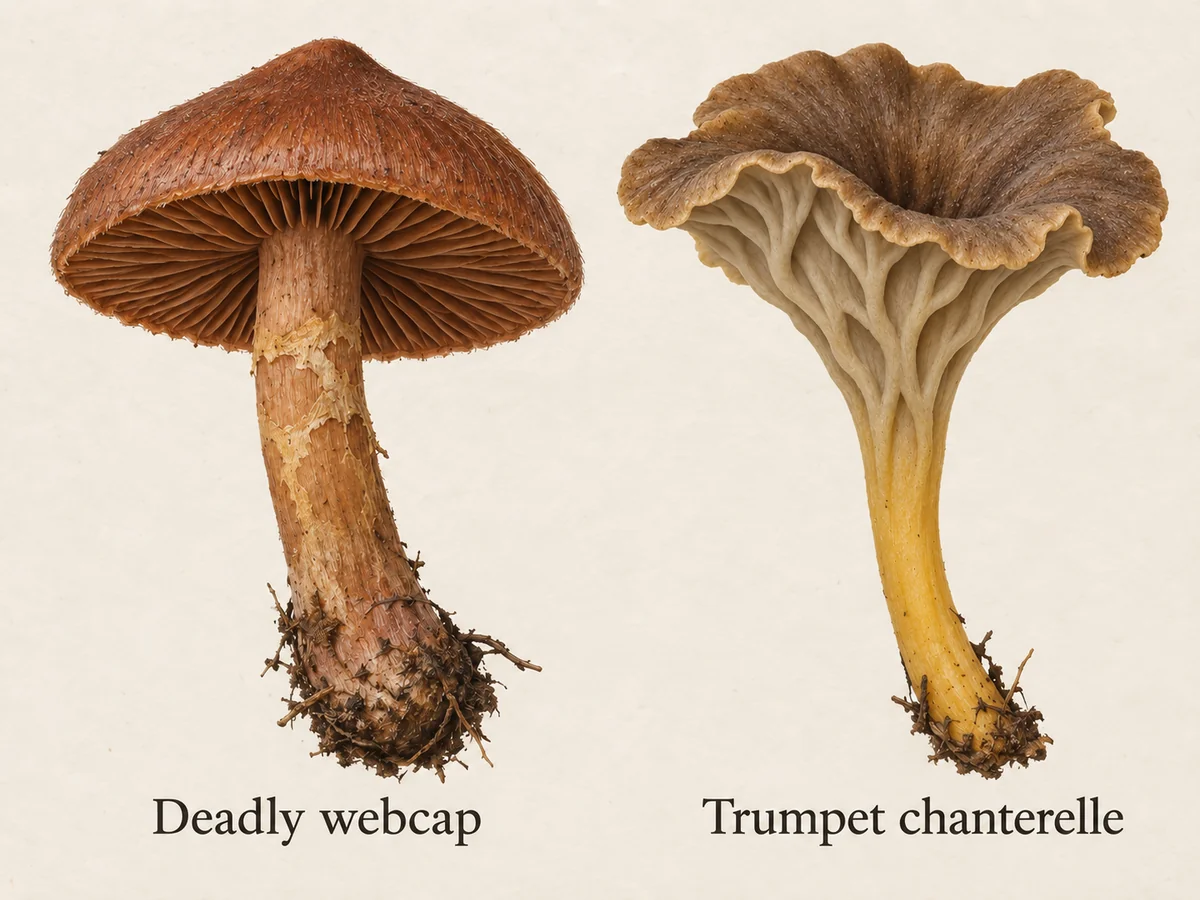
Deadly webcap has a dry, reddish-brown to orange-brown cap with fine fibers or small scales. Young caps may be bell-shaped or conical, and expanded ones can turn broadly convex with a central bump called an umbo. That outline is useful in context, though other species also have pointed caps. The dry fibrous surface differs from a shiny, slimy cap, yet wet weather, wear, and age blur that contrast. The whole specimen holds more evidence than any color or shape seen from above.
The underside has true gills, separate blades radiating toward the stem, with shorter blades between some of the longer ones. Their attachment can look narrow or slightly notched, and descriptions range from relatively close to distant spacing. Gill color changes the look of the whole mushroom. Younger yellow-brown gills and older rust-brown gills can belong to the same species, and they do not mark one edible group and one poisonous group.
The cortina is a delicate partial veil, and it never forms a sturdy ring. As the cap expands, its fibers stretch and break, leaving fragments on the cap margin or stem. Mature caps therefore do not keep a permanent web beneath them.
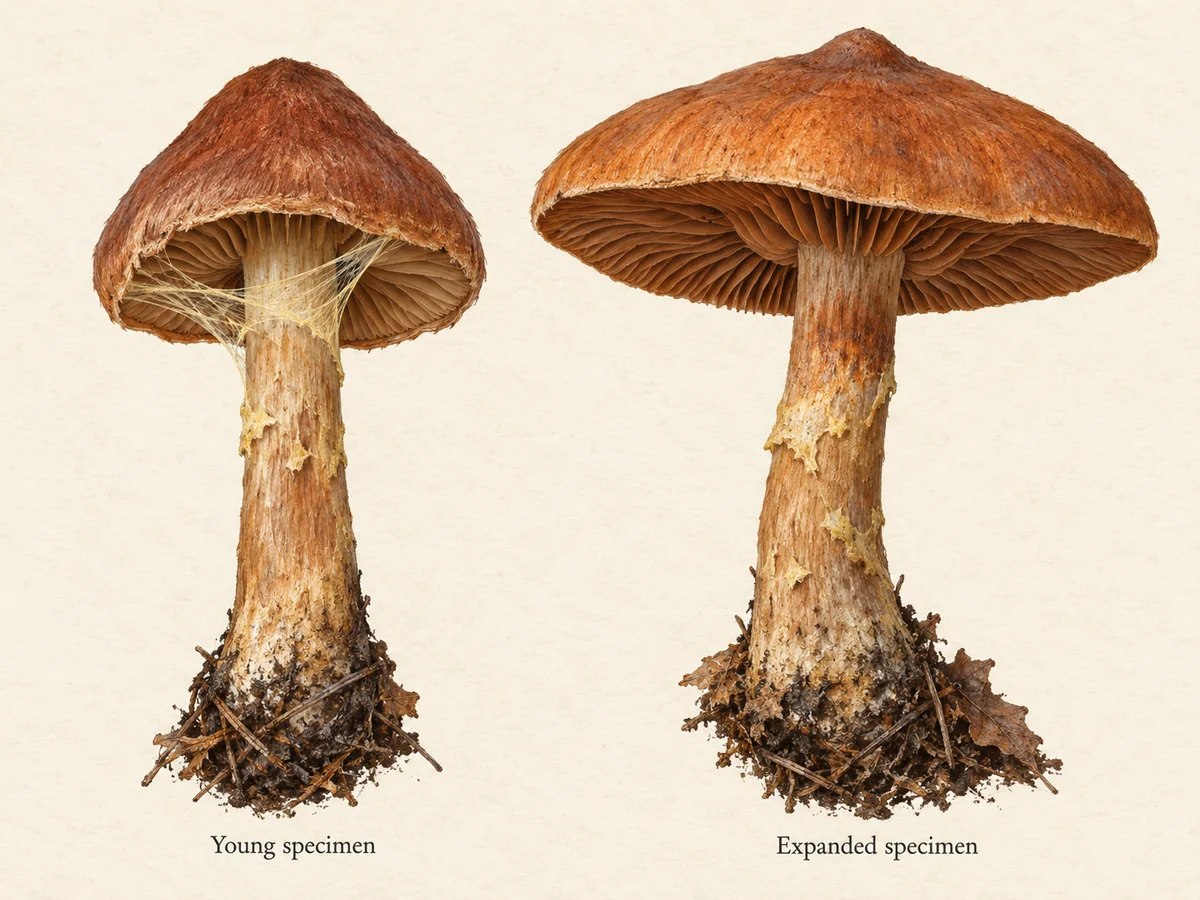
Rust-colored spores can collect on the remaining fibers near the upper stem. Lower yellowish veil bands may persist unevenly. Rain, handling, and aging can leave a far less obvious pattern than a field-guide illustration suggests.
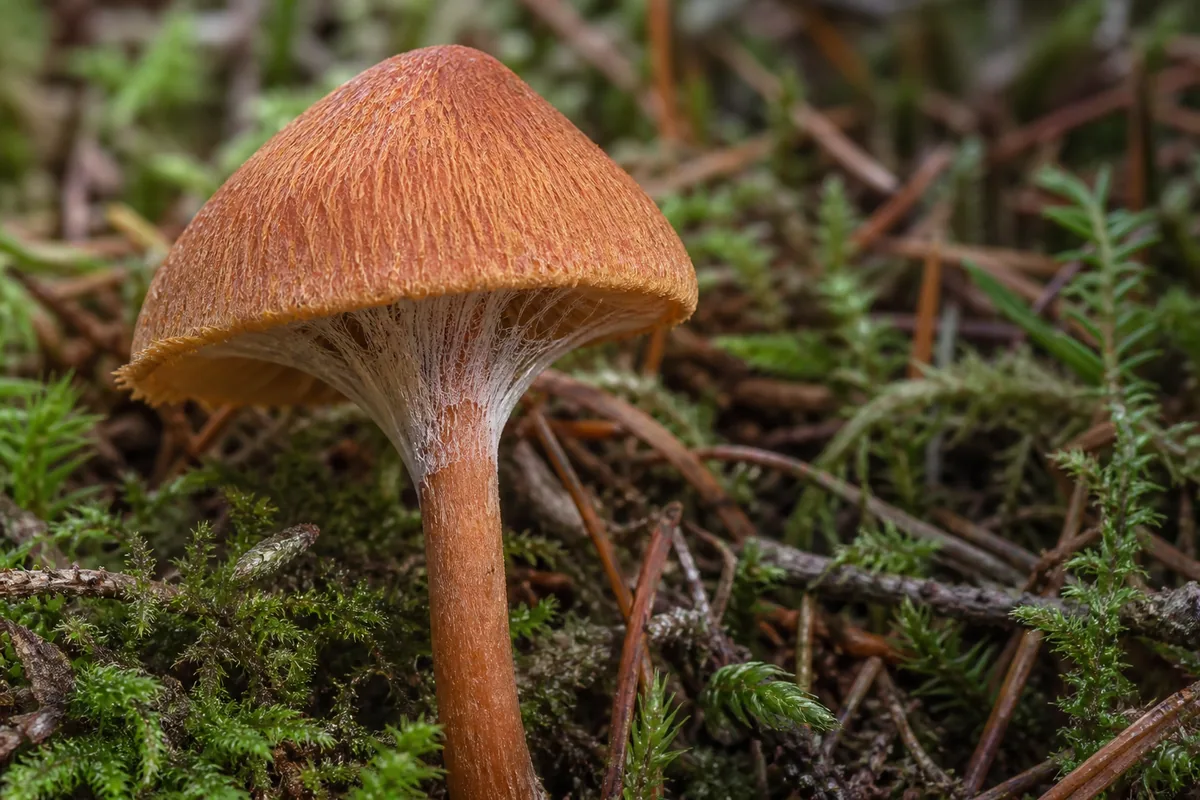
So the veil evidence works in one direction only. Finding a clear web or rusty veil zone points to a webcap-like mushroom, while no visible web proves very little. Nobody can clear a mature mushroom by a feature it may have lost naturally.
The stem is not always thin and even. Regional descriptions include club-shaped or middle-swollen stems. That means a broad base cannot clear a suspect just because a familiar photo shows a straight stalk.
The flesh is usually pale yellow or buff, sometimes with rusty tones near the stem base. Odor descriptions range from radish-like to indistinct, and an ordinary smell gives no reassurance about orellanine. No taste test belongs in this investigation.
Your spore print can show a color that poor light hides on the gills. Other webcaps also leave red-brown deposits, though, so the print is one clue among several. Exact species work may need spore size, shape, and surface detail under a microscope, plus the collection context. No color chart can do that work alone.
The University of British Columbia account records broadly ovate to nearly round, ornamented spores and notes variation between descriptions. Those details explain why an expert may need the mushroom itself and not just a photo. They still do not make any home measurement a test for food safety.
What orellanine injury and its tests can tell us
Orellanine poisoning mainly targets the kidneys, and it does not end when the nausea fades. Doctors describe injury to the kidney tubules and swelling of the tissue around them. Scarring, called fibrosis, sometimes follows.
Tubules are the small channels that process the fluid that becomes urine. Damage in and around them explains why a serious kidney problem can change how much a person urinates. Still, what you can see or feel cannot measure how much injury has occurred.
The delay also varies between reports. One clinical review of orellanine toxicology describes a typical onset after one to two weeks, while a four-case series observed symptoms after 3 to 20 days.
These accounts overlap, and none of them works as a countdown. Symptom onset, the moment doctors recognize kidney damage, and the time of the hospital visit can all differ. That spread makes any single quoted number an especially poor way to rule poisoning out.
One toxicology study examined 87 samples from ten people in six poisoning outbreaks. It found the toxin in small kidney-biopsy samples even though the blood and urine samples tested negative. So a negative result in one sampled fluid does not prove that exposure never happened. Where the sample came from, the time since the meal, and the lab method all affect the result. That holds most of all once the toxin has built up in kidney tissue.
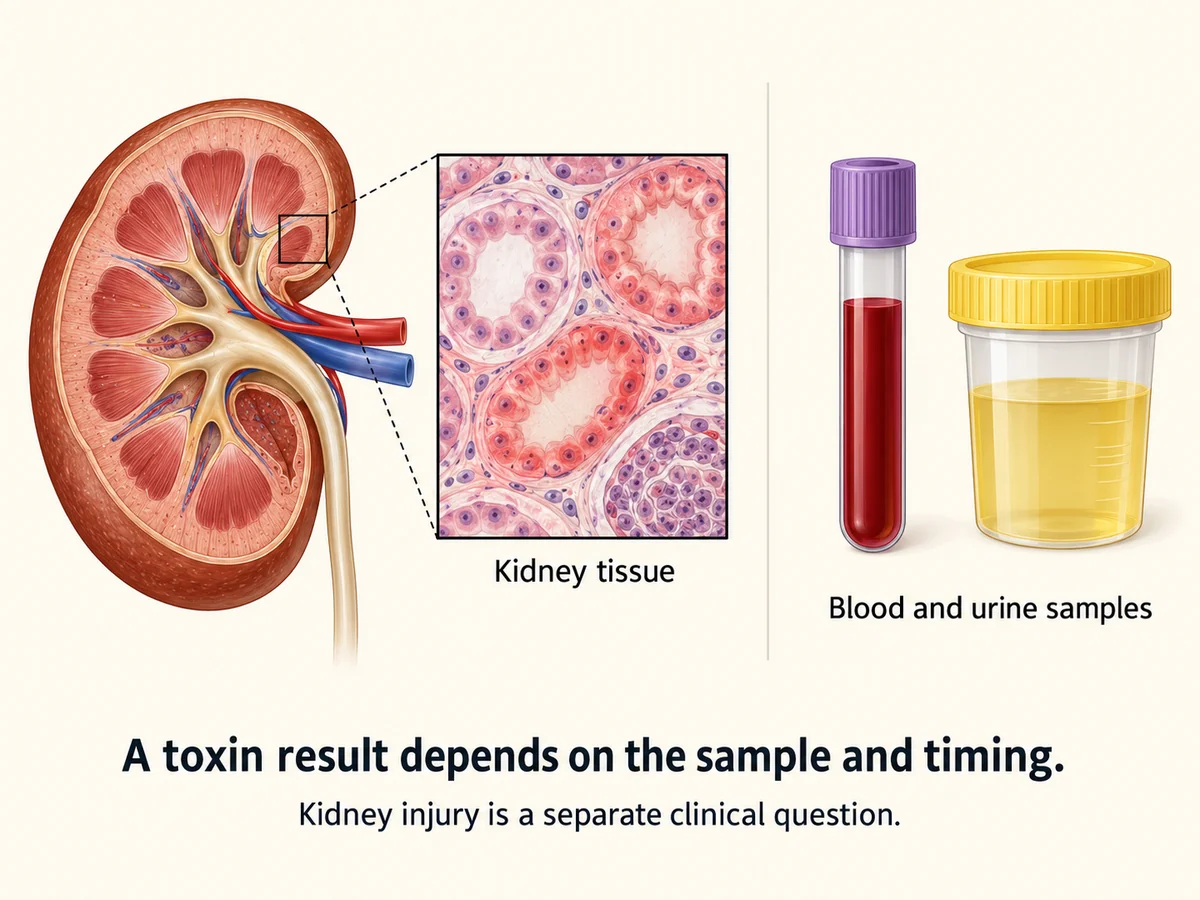
The report does not show that every negative test hides poisoning, or that every suspected exposure needs a biopsy. It explains why clinicians combine the exposure history with kidney assessment and never treat one toxin result as a complete answer. Testing leftover mushrooms answers a related question, namely what toxin-containing material the person may have eaten. That analysis can support the exposure history even when the remains no longer look like a whole mushroom.
The clinical review names no established specific antidote. Care treats kidney failure and its complications. That means dialysis when the kidneys need support, and further care when recovery is incomplete. Dialysis does the kidneys' work while they cannot. Its use does not prove that all orellanine has left the injured tissue, or that the kidneys will recover right away.
The abstract of a Swedish follow-up study describes 28 consented patient records from 39 identified cases, with 22 of those 28 patients requiring dialysis for acute kidney injury. That selected group shows how severe the poisoning can become. Even so, that share is not the chance of dialysis after a new meal. The people in a case series, their meals, and their treatment may not match every possible case.
What follows from all this is early specialist assessment of a credible exposure. Mushroom size, apparent health, and another person's recovery cannot forecast the outcome. Medication choices, repeat testing, and any biopsy decision stay with the treating team.
Mossy woodland, summer records and hidden bases
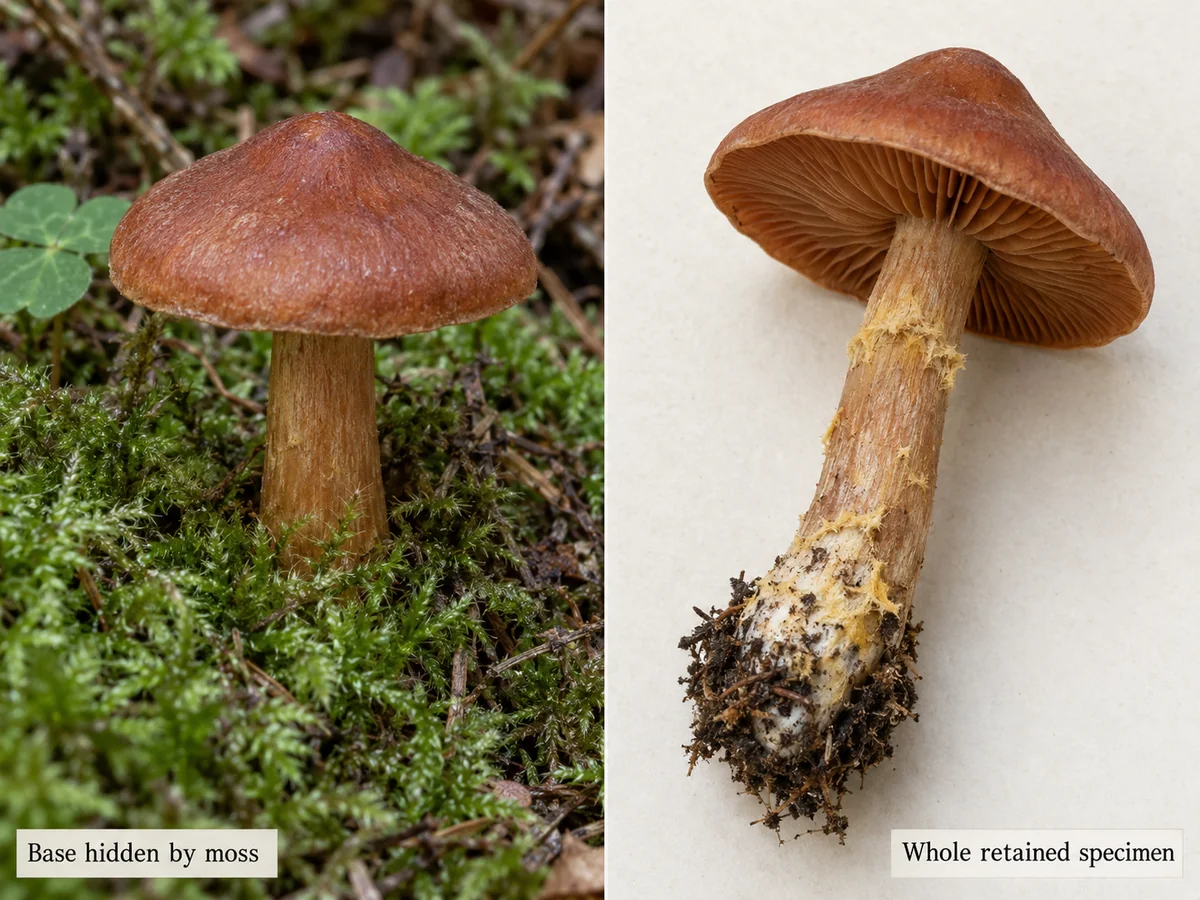
Deadly webcap belongs to the ectomycorrhizal fungi that partner with living tree roots. The mushroom you see is a temporary fruiting body, while the fungus's feeding relationship spreads through the woodland soil below. Moss makes that setting look simpler than it is. The cap may sit above a dense green layer while the lower stem and its veil remnants stay hidden, so a top-down photograph loses useful evidence.
European accounts include wet, boggy, or mossy conifer settings. The British Columbia and western Washington study also recorded specimens in Douglas-fir and western hemlock woodland, sometimes among western redcedar and vine maple. Those trees describe a recorded forest community. They do not prove that every tree beside a fruiting body was its fungal partner, and a stand that looks different does not rule the species out.
The regional account even reports fruiting on very rotten, moss-covered logs. Finding one on or beside decayed wood therefore reveals nothing certain about its feeding mode until you weigh the wider habitat and species evidence.
The study found fruiting in British Columbia and western Washington from early July into late September. Searching only in autumn would miss those summer finds. Season labels describe observations in one place and climate, and no universal calendar follows from them. The authors also revisited historical sites without finding fresh fruiting bodies on repeated searches. They suggested localized fruiting or years without mushrooms, which separates an unsuccessful search from proof that the fungus has disappeared.
Each published occurrence places the species at that site under the study's identification. It does not draw a complete current range boundary, and a map with no nearby record cannot clear an unknown mushroom.
Collection photographs are most useful when the cap, underside, whole stem, and immediate setting all belong to one specimen. In a mixed gathering, that link keeps each mushroom's evidence separate. One attractive group photo cannot stand for every mushroom in it. Location, nearby trees, and date support a specimen record, yet they cannot replace the underside or measure the toxin exposure after a meal.
Why this mushroom stays out of food
Deadly webcap has no culinary use and no safe preparation. The poison service warns that very small amounts can cause severe kidney injury, so a small mushroom is never an acceptable trial portion. Trimming, slicing, and mixing also destroy features that might have been visible in the forest. Cleaning can throw away the stem along with its veil remnants and base, while chopping strips the cap of much of its shape and underside.
The risk starts before anyone picks a recipe, because a mixed collection may already hold an unrecognized specimen. Cooking an unidentified mushroom does not identify it and gives no clearance for this species. The finished dish can also hide which mushroom each person ate. So keep the raw specimens, meal leftovers, and meal history with a suspected-exposure report. They are no longer food, but they are still evidence.
Nutrition values for edible mushrooms do not carry over to a poisonous webcap. Its resemblance to an edible woodland mushroom gives no basis for a serving size, a supplement use, or growing it at home for food.
Rubellus, its older names and a different webcap
This profile uses Cortinarius rubellus for deadly webcap. Older accounts often use Cortinarius speciosissimus or Cortinarius orellanoides, and the 2006 regional paper lists those names in its rubellus synonymy. So an older name can lead you to papers on this same mushroom. It does not point to a different food species.
Fool's webcap, Cortinarius orellanus, is a separate poisonous species. Its similar name and shared orellanine hazard do not make it interchangeable with rubellus in a specimen record. Regional accounts place orellanus mainly in mixed or hardwood forests and give it a fairly smooth stem. Rubellus often carries yellowish veil bands and grows in conifer settings. Both have brown caps and rusty gills, so telling them apart still takes the complete specimen and regional expertise.
Keep the scientific name attached to the evidence that established it. Field notes such as 'brown mushroom with a cortina' can justify keeping a mushroom out of food without justifying a definite rubellus record. Keeping the two apart serves both safety and accurate naming. In an urgent exposure report, you can name the suspected mushroom and say how sure anyone is while doctors start their assessment.

 Choice edible


 Caution

