
 Poisonous

What is a tawny webcap mushroom?
Tawny webcap grows in woodland as a dry yellow-brown mushroom, and its accepted scientific name changed in 2022. Many books and websites still list it as Cortinarius callisteus, while current taxonomy places it in Aureonarius. Both names point to the same mushroom you might find under conifers.
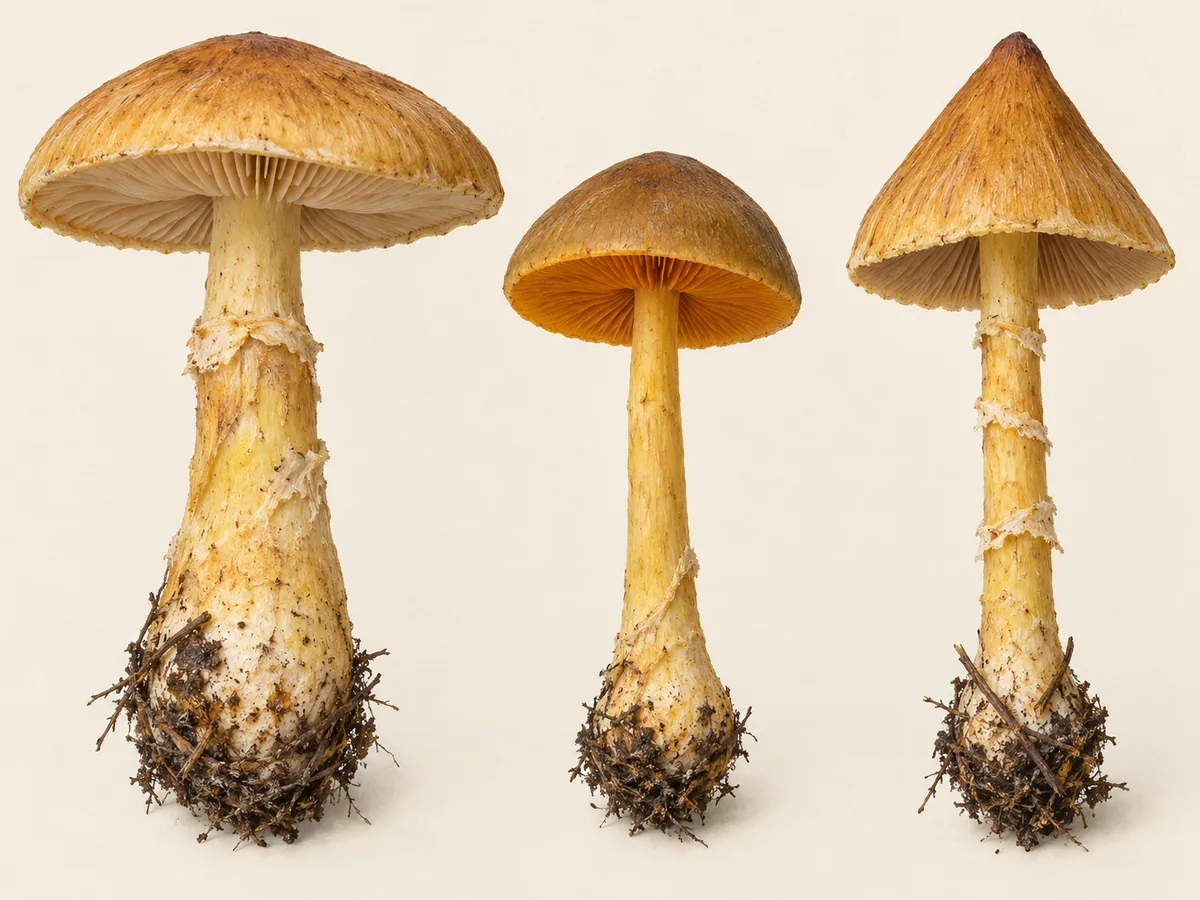
Its tawny cap tells you far less than its full color sequence. Pale young gills, a yellowish clubbed stem, colored veil zones and a rusty mature spore deposit form the pattern worth recording. Your complete field identification should keep those parts together with the host trees and the region. The common name alone cannot tell you whether a North American collection is A. callisteus or one of the other Callistei species that DNA work has split off.
Dry yellow-orange caps tempt you into judging by cap color first. Close relatives can wear the same palette, age turns pale gills brown, and handling darkens the stem. Modern Cortinariaceae taxonomy gives you a sound genus and group, yet what you can see in the field still has firm limits. The genomic revision places the species on the family tree, and no single photograph can prove the name.
On eating, the answer comes sooner: nobody has established a reliable food use, so leave tawny webcap out of the basket.
Which features identify a tawny webcap?
Photograph young and mature mushrooms before you handle them. Young undersides keep the pale gills and veil scraps, and mature caps give you the brown spore deposit.
Across the Callistei section, caps measure about 3-11 cm across. They start hemispherical and open to low-convex or nearly flat. The dry surface may look smooth, finely scaly or almost felted, in yellow, orange-yellow, yellow-brown or orange-brown.
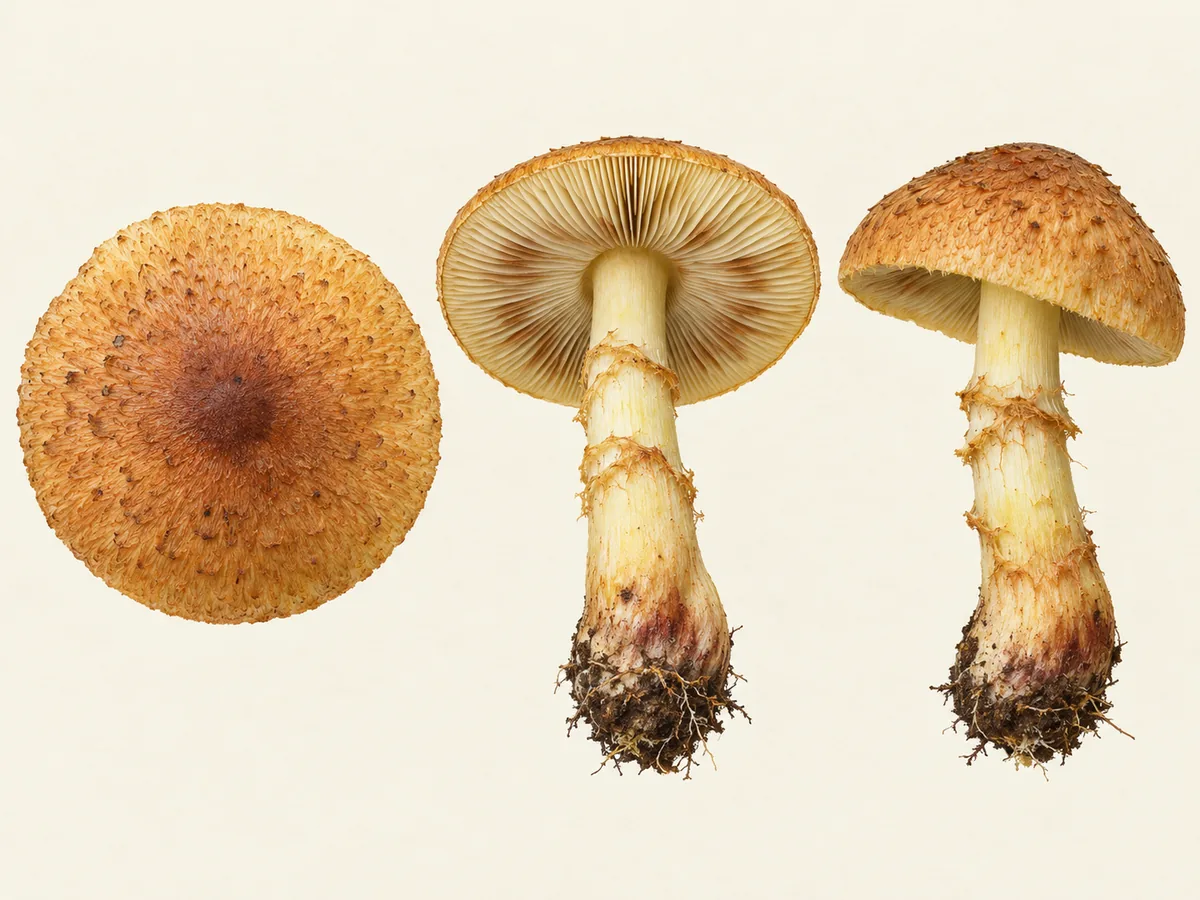
Young gills look almost white, pale yellow or yellowish brown, and they turn browner as the spores ripen. Note the gill attachment and spacing too. Close or free gills would point your identification somewhere else.
Tawny webcap's stem runs pale yellow to yellow-brown, either straight or clearly club-shaped. Yellow to yellow-brown veil fibers can form broken or complete zones on it, and age or thumb pressure may brown the surface. Those zones stay as thin fibers and never form a durable skirt-like ring. If your photo crops off the lower stem, you lose both the club shape and most of the veil evidence.
Smell can support a group-level name, though it varies. Published Callistei descriptions list apple, a recently snuffed candle, raw potato, a cellar smell, or nothing distinct. Waft the cap gently and write down what you actually smell.
Your spore print should fall in the rusty-brown range typical of the family. Under a microscope, Callistei spores look roundish to broadly ellipsoid and warted. That shape separates neighboring groups, though it may still leave the exact species open.
No single line in that checklist carries the identification; the traits only work as a set. When pale young gills and a clubbed stem fit but microscope or regional evidence is missing, "Callistei group" describes your find more honestly than a forced species name.
Safety notes on Tawny Webcap
Current taxonomy puts this species in Aureonarius, outside the lineage known to carry orellanine. The 2022 genomic revision limits that kidney toxin to Cortinarius subgenus Orellani, so we do not claim that tawny webcap contains it. You can read how the toxin works in our page on orellanine poisoning. The correction changes our reason for the warning and leaves your choice the same: a mushroom does not become edible merely because nobody has shown one famous toxin in its lineage.
After a possible ingestion, contact a poison service before waiting for mushroom poisoning symptoms. Poison Control warns that lookalikes can defeat visual identification and that symptoms from poisonous mushrooms may start late. In the United States, call 1-800-222-1222; elsewhere, use the local poison center or emergency medical service. Call emergency services immediately for collapse, trouble breathing, seizure, severe confusion or inability to wake the person.
Keep remaining mushrooms and photographs if they are already available. Do not delay care while trying to decide whether an older book calls the specimen Cortinarius or Aureonarius.
Where does tawny webcap grow?
Tawny webcap trades nutrients with living tree roots as a mycorrhizal fungus. Across the wider Callistei lineage, records come from both conifer and broadleaf forests. British and Irish records tie the older species concept to spruce and Scots pine.
What you pick is only a seasonal fruiting body. Its mycelium lives on with the roots underground, so the same patch of woodland can fruit again when moisture and temperature line up. Published group accounts put most fruiting in the cooler part of the season, often late summer into autumn, when autumn fruiting conditions return. Even so, a date cannot separate members of Callistei.
Tree records only hold within their region. One European source's spruce link says nothing certain about every yellow-brown Callistei mushroom under a North American spruce. Take one habitat photo wide enough to show the likely host trees, ground cover and drainage. Then note the place and elevation separately, so a specialist can pick the right regional key.
Key takeaway
Host, geography and young morphology travel together. Removing any one of them makes an already difficult yellow-brown group easier to misname.
What should you do after a possible ingestion?
Tawny webcap has no supported use in the kitchen. Frying, boiling, drying or pickling cannot supply the missing proof that the species is edible.
If someone may have eaten it, contact a poison service immediately. Report the time, possible amount, number of diners, symptoms and any medical details the specialist asks for. Do not induce vomiting or give a home remedy unless a medical professional tells you to. Your clinician and poison specialist need the exposure history far more than a guess about orellanine.
Save uncooked mushrooms, cooked leftovers and photographs if doing so does not delay the call. Keep finds from different sites apart, because a mixed meal may hold more than one species. Sorting out the names can wait until care has started, and the old and new genus names should never become a reason to postpone care.
Why is tawny webcap now called Aureonarius callisteus?
The current name, Aureonarius callisteus, comes from the 2022 genomic reclassification of Cortinariaceae. Index Fungorum lists Cortinarius callisteus as the former combination and the Aureonarius name as current. Nothing new appeared in the woods. Genomic evidence split the huge old Cortinarius concept into natural lineages, and Callistei landed in Aureonarius.
The same paper sharpens the safety wording. It limits the lethal kidney toxin orellanine to Cortinarius subgenus Orellani and does not place A. callisteus there. We keep both halves of that result. Do not call tawny webcap an orellanine mushroom, and do not call it edible because it lies outside Orellani.
Close names stay hard to pin down. A. neocallisteus, A. infucatus and other members share the yellow-brown colors and roundish warted spores. For a firm species record, you may need a current regional key, microscopy and sometimes DNA.


