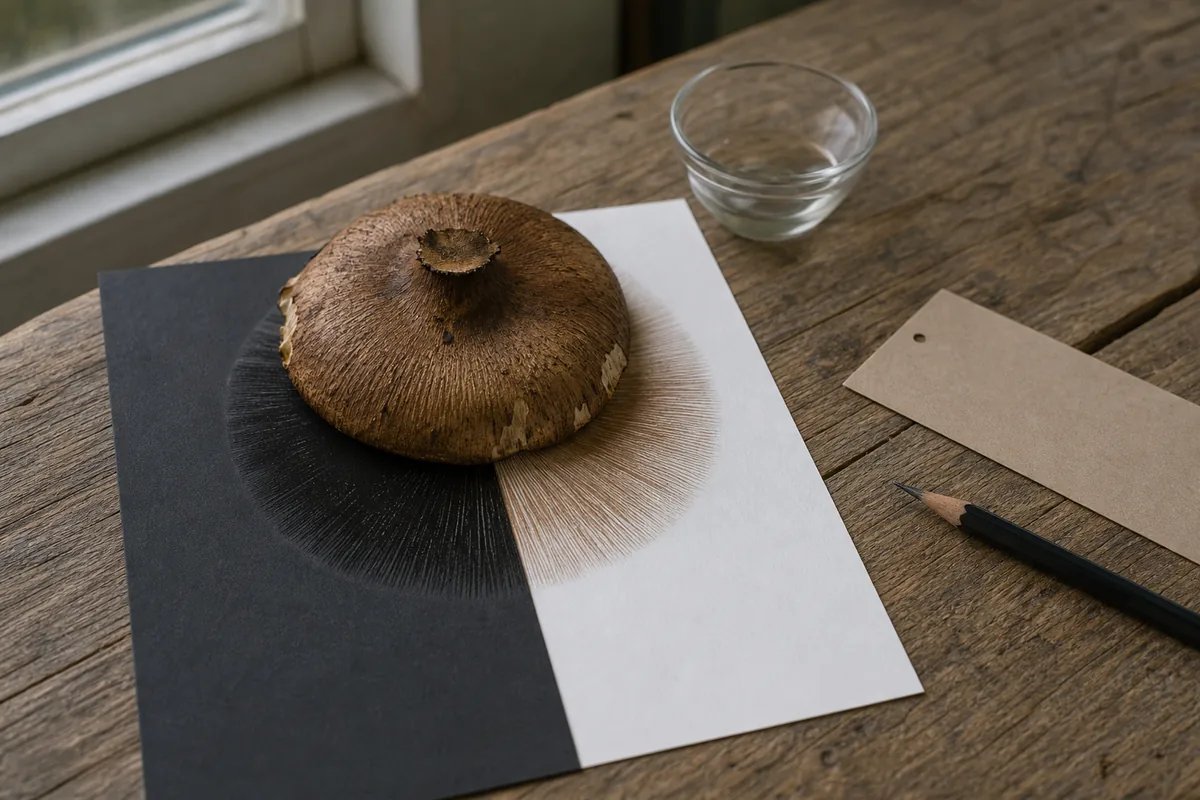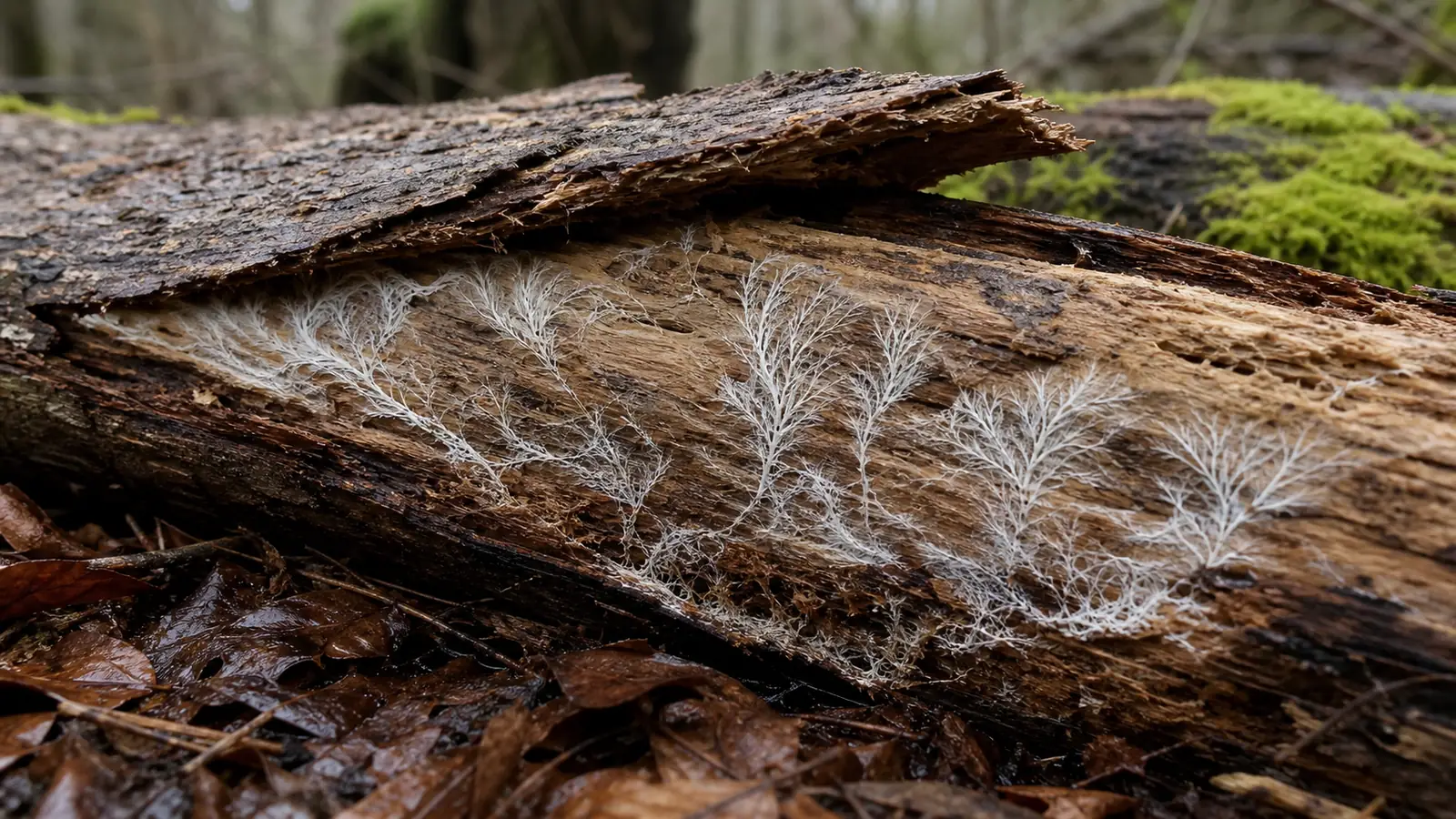
Mycelium is the branching mass of microscopic threads that forms the feeding body of most filamentous fungi. A mushroom is a temporary reproductive structure that mycelium can produce when conditions suit the species.
Most of a fungus is something you never see. When a mushroom rises from a log or forest floor, it is a temporary reproductive structure produced by a much larger living network in the wood or soil below.
What is mycelium?
In mushroom-forming fungi, mycelium is the main feeding body, a branching web of microscopic hyphae that spreads through soil, wood, grain, or leaf litter before a mushroom appears. Single-celled yeasts are an important exception, so the visible web describes filamentous fungi rather than the entire kingdom.
Each thread is a line of cells only a few micrometres wide, so a whole colony can stay invisible while it quietly covers a dinner plate or a fallen tree. When you break open a rotting log and find white cobweb strands running through the grain, you have found mycelium at work.
A hypha is one tube-like thread, while mycelium is the mass formed as those threads branch through material and reach new food.
The network changes as growing tips respond to nutrients, moisture, temperature, and chemical signals. Branches expand through useful material but slow or turn where conditions are poor.
We notice the mushroom because it is visible and often lasts only days or weeks. Mycelium can persist between fruiting events for years while suitable food and conditions remain.
The study of fungi covers their growth, reproduction, interactions, and classification, including the key distinction between a temporary mushroom and the feeding mycelium that produces it.
MycologyHow the Mushroom Life Cycle Moves From Spore to SporeHyphal tips digest food as the network grows
Fungi digest food outside their cells when hyphal tips release enzymes that break complex material into soluble compounds. They absorb those compounds through cell membranes rather than swallowing food or making sugars by photosynthesis.
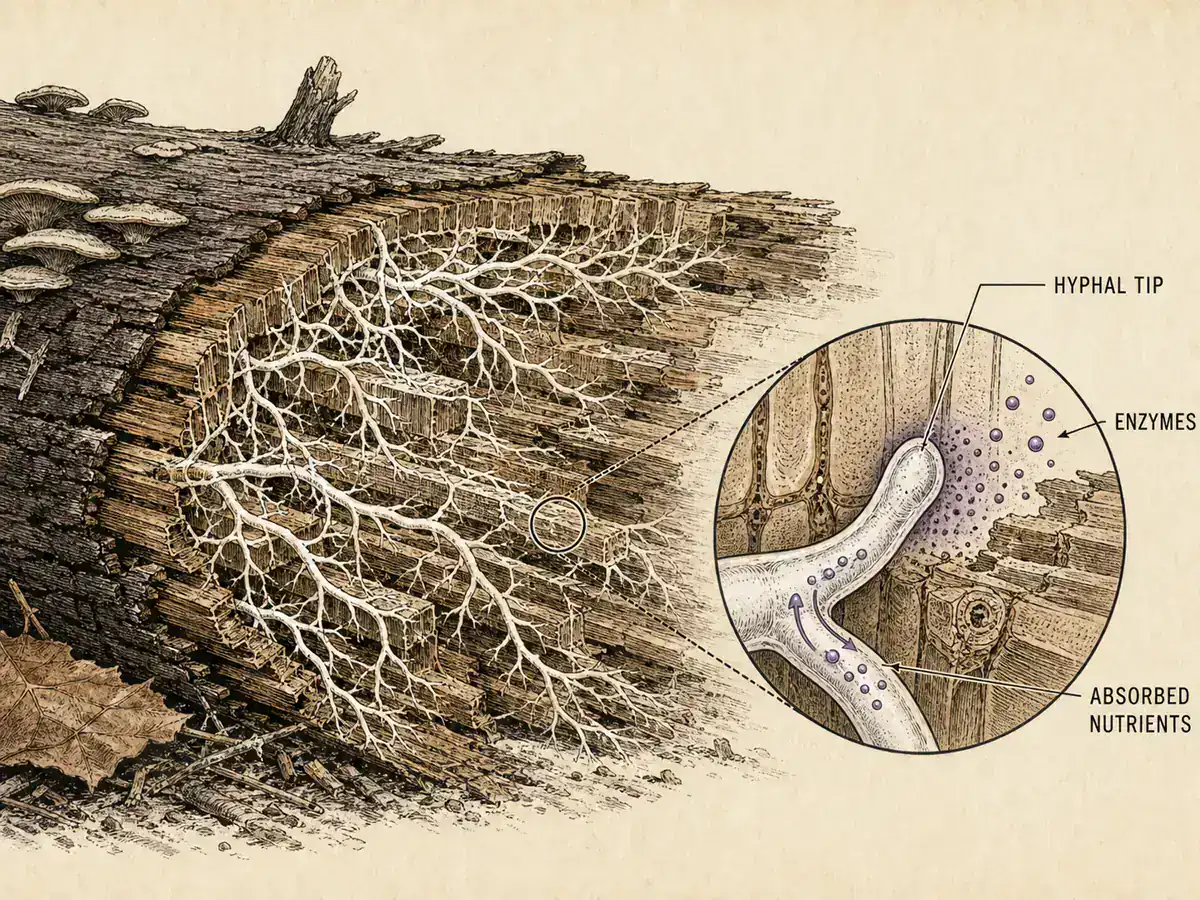
Branching gives each advancing hyphal tip a new pore to explore while older parts of the colony transport water and nutrients.
External digestion lets fungi break down wood, husks, and dead leaves that many animals cannot use. Without that work, fallen plant material would accumulate instead of returning nutrients to forest soil.
Hyphae extend at their tips and branch behind the advancing edge, while compatible threads may fuse to create alternate transport paths. Fusion varies among fungal groups and is not a universal stage for every species.
Species, food, temperature, moisture, oxygen, and competition set the growth rate, so a cultivated strain may cross prepared grain in weeks while a woodland colony advances far more slowly.
Honey fungi in the genus Armillaria can bundle hyphae into rootlike rhizomorphs that move water and nutrients across gaps. These cords are specialized structures rather than a second kind of hypha present in every mycelium.
Key takeaway
Hyphae extend at their tips, branch through suitable material, and connect into a network that can move resources between active regions.
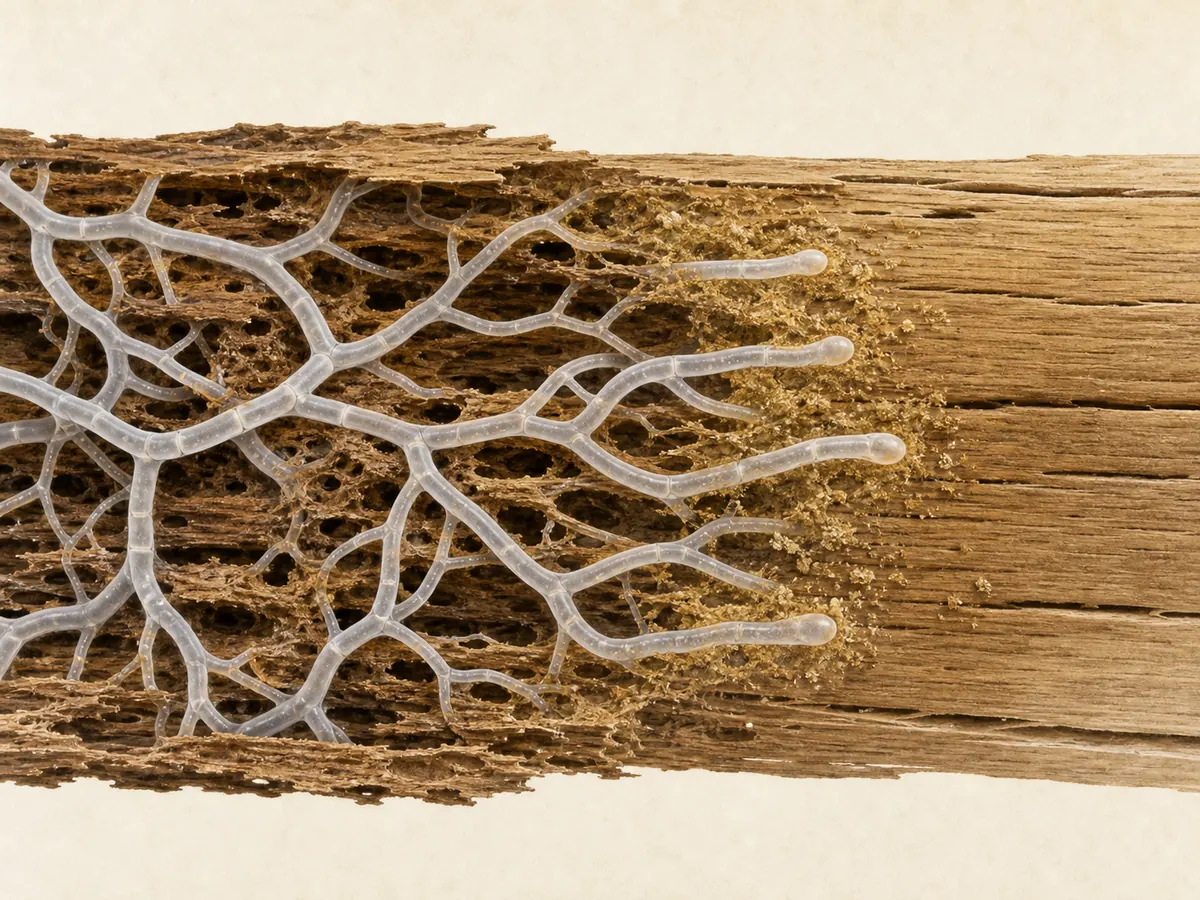
When an advancing edge meets a barrier or exhausted food, growth can slow, branch elsewhere, or redirect resources through existing connections. That flexible growth helps fungi exploit patchy material, and mushroom life cycle timing explains when some networks commit energy to fruiting bodies.
Mycelium or mushroom: which is the real organism?
Mycelium and mushroom belong to one fungus but perform the separate jobs compared in the table below.
| Feature | Mycelium | Mushroom (fruiting body) |
|---|---|---|
| Role | The living, feeding body | A short-lived spore factory |
| Lifespan | Can persist between fruitings and across years | Often a few days to a few weeks |
| Where it lives | Inside soil, wood, grain, or another food source | Usually exposed above the food source |
| Visibility | Usually hidden | Usually conspicuous when mature |
| Main job | Eat, grow, store energy | Make and release spores |
| What we usually notice | Almost never | Almost always |
The mushroom is a reproductive investment. Mushroom-forming fungi usually fruit only after the mycelium has enough resources and receives the combination of temperature, moisture, airflow, light, and seasonal signals that its species responds to.
Some fungi fruit predictably each season, while others skip years when conditions are poor. An empty trail neither proves the underlying mycelium is dead nor confirms that it remains active.
This matters for identification too. Two mushrooms that look almost identical on the surface can come from very different networks below, which is why dangerous lookalike pairs need checks beyond cap color.
Protecting occupied soil, roots, and wood matters more than preserving one fruiting body because raking, bark stripping, digging, and repeated trampling can damage the mycelial habitat.
A careful forager takes only sound specimens, leaves part of a flush to mature, and avoids disturbing the substrate. Those habits also protect insects, spores, and the local conditions that allow the patch to fruit again.
Mycelium fills different jobs in soil and wood
Mycelium performs different ecological jobs because saprotrophs digest dead material, parasites draw resources from living hosts, and mycorrhizal fungi associate closely with plant roots. The shared structure does not imply a shared relationship with the surrounding organism.
A decomposer returns nutrients to soil by releasing enzymes into dead material and absorbing the products. In a root association, the plant supplies photosynthetic carbon while fungal hyphae extend access to water and mineral nutrients.
Fungal partnerships range from mutual exchange to disease, so one universal underground communication story cannot describe every species or condition.
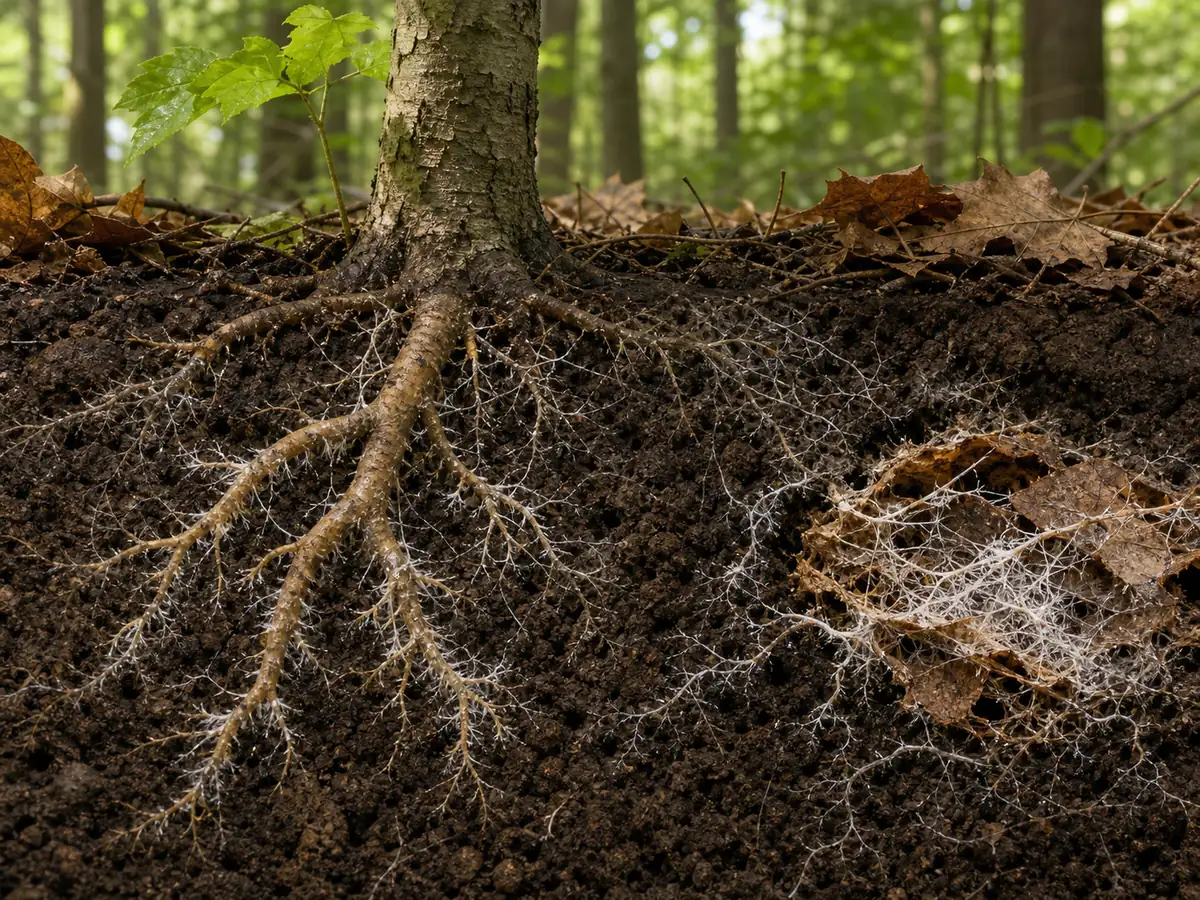
White threads alone cannot tell you which role a fungus is performing. Habitat, substrate, microscopic structures, fruiting bodies, culture behavior, and sometimes DNA are needed to identify the organism and understand what it is doing.
MycologyWhat Is Mycology, and What Do Mycologists Actually Study?How large can one mycelium get?
The scale can be enormous because a mycelium has no fixed outline. If suitable hosts or food remain available, one genetic individual can continue expanding at its edges for centuries.
In eastern Oregon, the US Forest Service describes one Armillaria ostoyae individual occupying about 2,385 acres of Malheur National Forest. Its mycelium and dark rhizomorphs spread through soil and conifer roots while causing Armillaria root disease.
Researchers confirmed the Oregon sites belonged to one fungal individual by repeatedly matching genetics from samples across the area.
A colony spanning thousands of acres still consists largely of gossamer-thin threads hidden in soil and infected roots. Fungal size measures reach across food sources rather than height or visible bulk.
A garden colony may cover only a few square feet, but the Oregon honey fungus shows how far mycelium can extend when food and habitat remain continuous. That reach helps explain why fungi shape forest growth and death and why fungi are neither plants nor animals.
Forest Service spread-rate estimates of roughly 0.7 to 3.3 feet per year make genetic matching essential before separated infection sites are called one Oregon individual.
What continuity means inside a fungal network
A connected colony can redirect water and dissolved nutrients through existing hyphae when one edge reaches poor food or a dry pocket. That transport does not make every hypha equally active because older regions may slow, recycle their contents, or lose contact as the substrate changes.
Connections also have limits. A cut log, compacted soil, drought, competing microbes, and barriers between food sources can fragment growth, while rhizomorph-forming species cross some gaps better than fungi that rely on fine local hyphae.
Resource movement follows living connections rather than a central pump, so damage to one region can redirect growth without implying that the colony shares every signal evenly across its full area.
The visible edge of a colony may advance while older interior hyphae recycle nutrients or become inactive, so a white surface alone does not show that every region has the same vigor. Growers read coverage together with odor, texture, moisture, and time.
A broken connection may later regrow across suitable material, but recovery depends on living tips, available food, moisture, oxygen, and competition at the damaged edge.
Cultivation starts with healthy mycelium
Cultivation farms mycelium first and then changes conditions to persuade that established network to fruit.
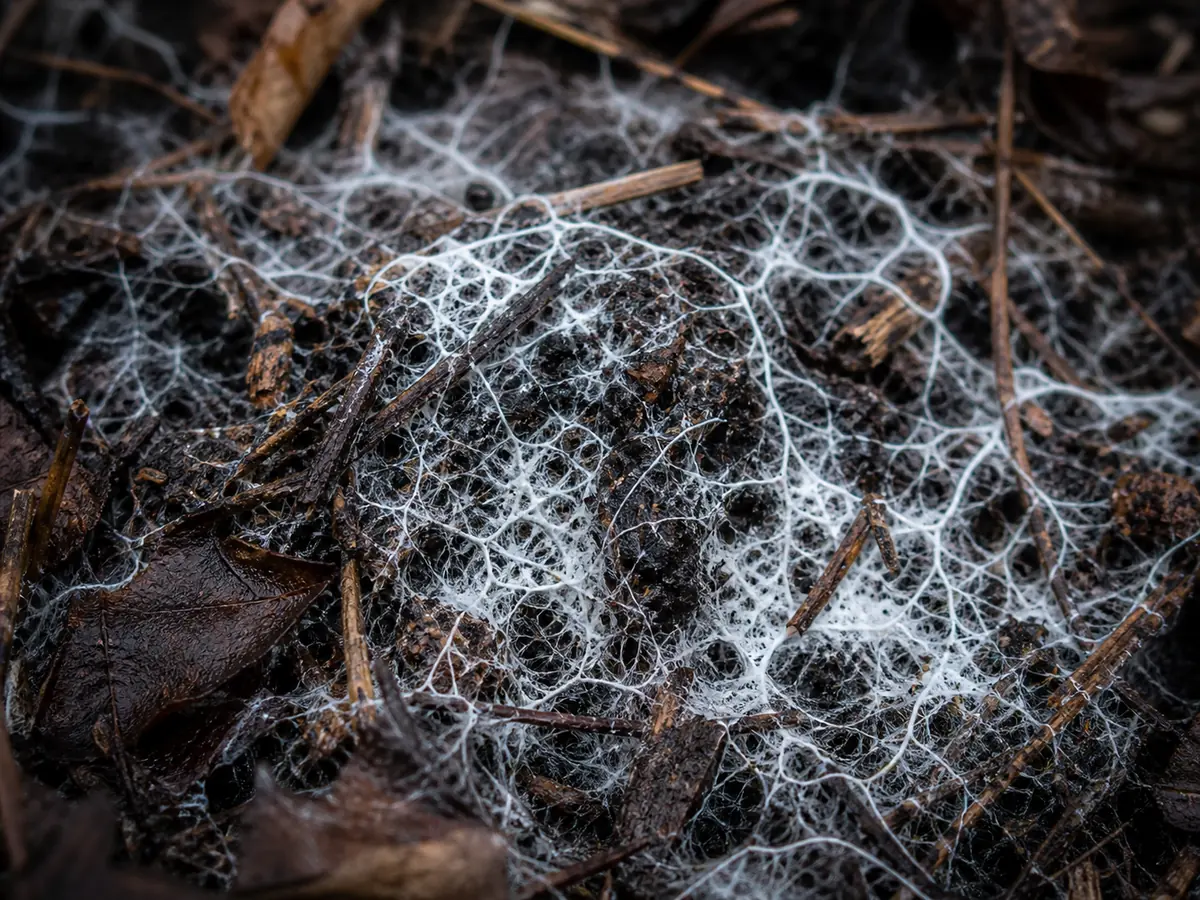
Every home grow starts by getting clean, vigorous mycelium to colonise a food source before anything else can. On grain or sawdust that means watching for the same white threads spreading edge to edge, which tells you the colony is healthy and in control of the jar.
Tip
A grow is ready for fruiting when the intended fungus has colonized the substrate in the pattern and time expected for that species. White color alone does not prove a block is clean.
Clean spawn and suitable substrate let the intended fungus establish before mould or bacteria, which makes grow room contamination easier to prevent than rescue. After colonization, changes in humidity, fresh air, light, or temperature can prompt pins and mushrooms.
Substrate choice follows the fungus because aggressive oyster strains cross straw substrate quickly, while denser lion's mane growth needs more patience and cleaner technique. This difference makes oyster mushrooms a common first cultivation species.
A bulk system such as the monotub method still protects healthy mycelium while it digests its substrate, so each clean surface, sealed lid, and careful transfer serves the same biological process.
A mushroom is the brief visible expression of a much larger fungus. Below it, mycelium continues feeding, spreading, and waiting for conditions that support another fruiting.
Sources & References
- Carris, Little, and Stiles. Introduction to Fungi. The American Phytopathological Society Hyphae, mycelium, external digestion, absorption, and apical growth.
- US Forest Service. The Malheur National Forest Area, genetic sampling, spread-rate assumptions, and age estimates for the Oregon Armillaria individual.
- Riquelme et al. Cell Biology of Hyphal Growth. Microbiology Spectrum Hyphal tip growth, network fusion, cytoplasmic flow, and nutrient translocation.