
 Poisonous

What is a cinnamon webcap mushroom?
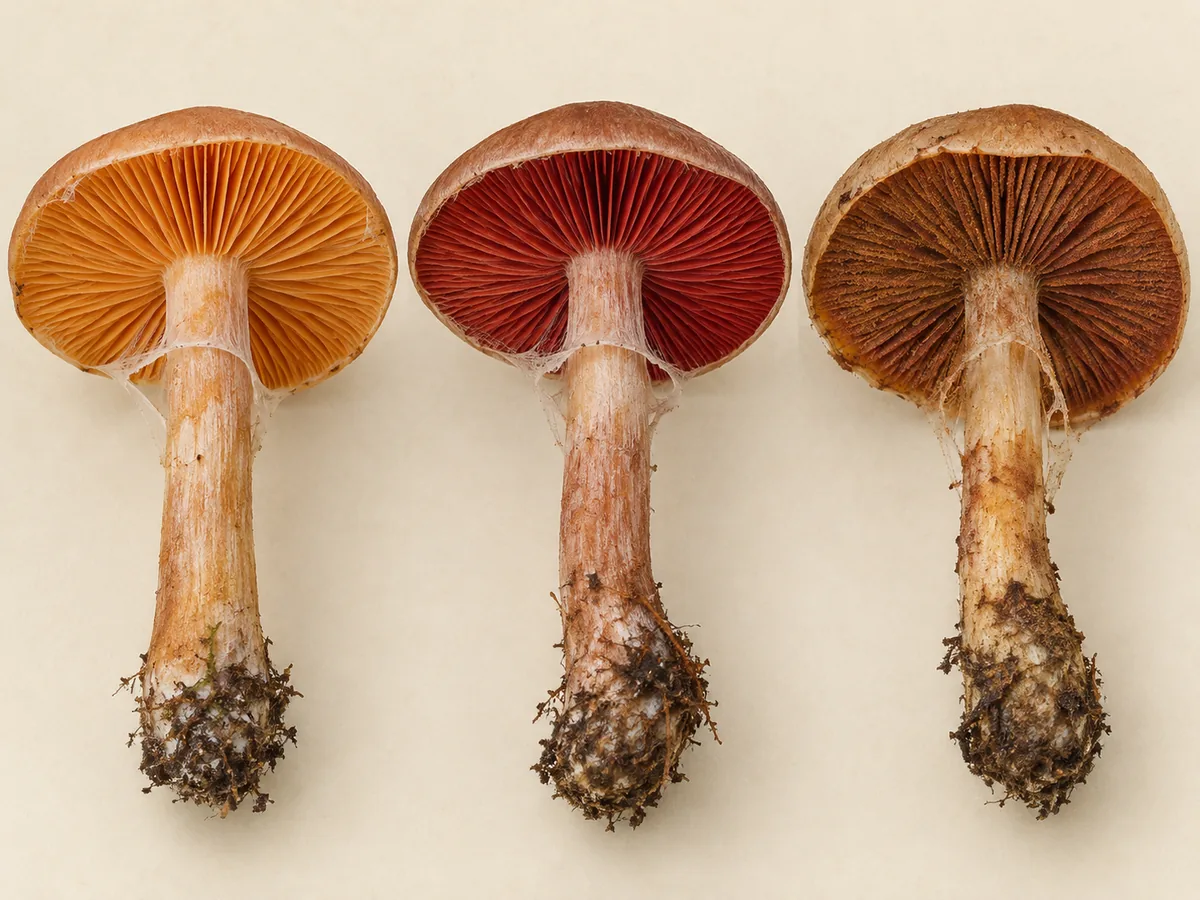
Cinnamon webcap is a small brown woodland mushroom whose underside can outshine its cap. Turn over a fresh specimen and the orange gills and yellowish stem give the most useful first impression. The common name describes the warm cap and mature gill tones, yet color alone cannot carry the identification. You need a complete field identification that keeps the cap, underside, full stem, veil remnants, spore deposit, and host trees tied to one collection.
Young mushrooms may show a delicate cortina, the cobwebby partial veil that gives webcaps their name. It collapses as the cap opens and may survive only as fine fibers dusted rusty brown by spores. These shifting features make it easy to name the mushroom from one trait. Mature specimens may lose the bright gills that first set them apart, while several unrelated or closely related mushrooms share a cinnamon-brown cap.
Modern taxonomy now uses a narrower, evidence-based concept for this species. The 2024 taxonomic reassessment found that earlier writers used the name too broadly. Older range records and casual photo IDs deserve caution as a result. Your realistic goal is a well-documented candidate, and no meal decision follows from it. No field mark in this profile makes an orange-brown webcap safe to eat.
Which features identify a cinnamon webcap?
Start with fresh mushrooms, because the young gills and cortina change quickly. Photograph a cap from above, the underside, the entire stem, and the nearby trees before transport rubs away the surface fibers. The modern European treatment puts the cap at around 1.2-6 cm across. It starts convex or umbonate and may flatten, with a dry, finely fibrillose surface in yellow-brown, orange-brown, cinnamon, and darker chestnut tones.
Look for texture as well as color. Wet caps can look smooth, and blurred photographs hide the fine fibers that belong in the species description.
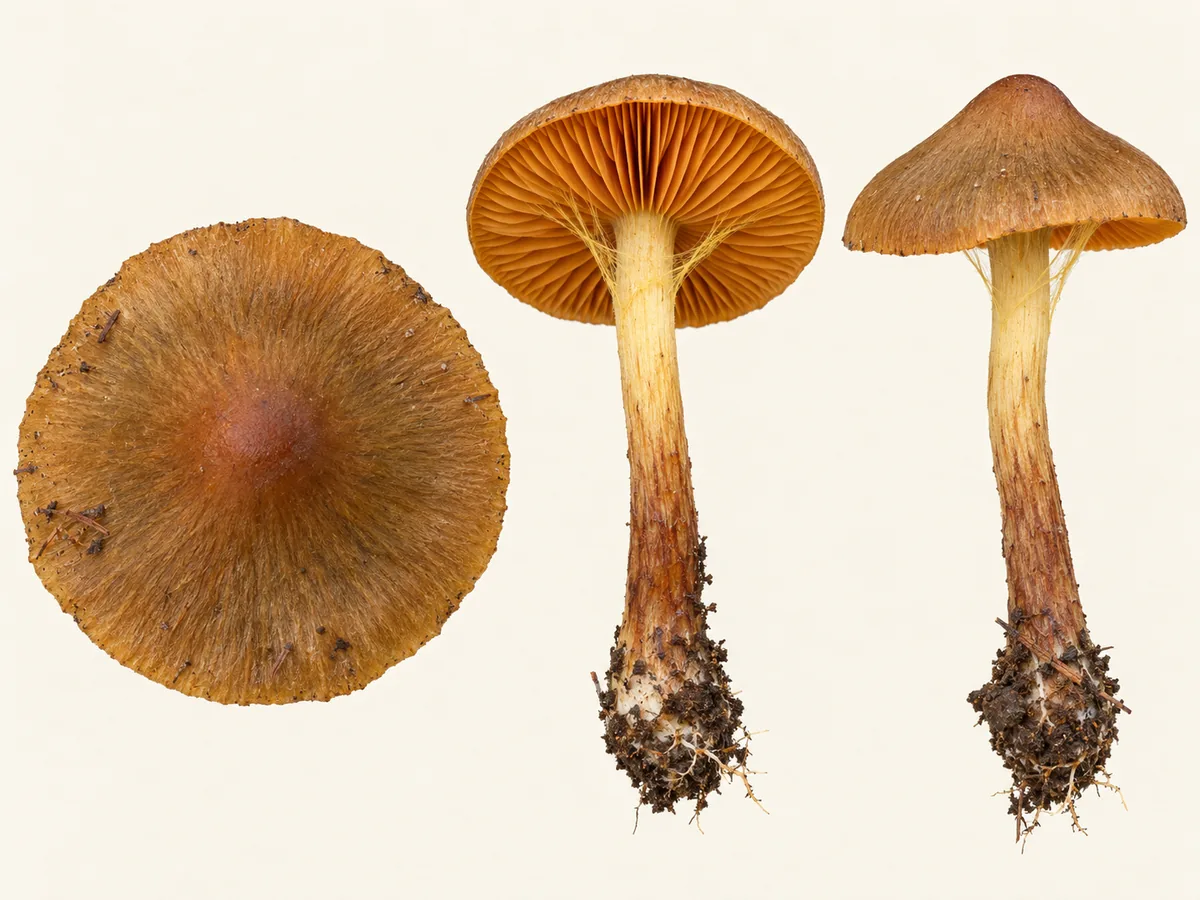
Young gills are bright orange to ochraceous orange and attach to the stem. Check how they join the stem from the side, since color seen in one slanted photograph misleads. As spores mature, the gills move toward cinnamon and rusty brown. You can print the spores on paper to confirm a rusty-brown deposit. That result places the mushroom in a broad group and stops short of this species.
The stem is slender and usually pale lemon to olive-yellow above. Orange-red felt or brownish fibrils may cover the lower part. The cortina leaves only threads or a rusty fibrous zone, with no lasting skin-like ring. Cut one specimen lengthwise if collection rules allow. The flesh should be yellow, often more ochraceous or olive near the base, and the modern treatment calls the odor indistinct, with no decisive radish smell.
Microscopy adds small, warted, ovoid to almond-shaped spores, but their measurements overlap among close relatives. Print color or spore size can support a regional key. Neither repairs a collection that has lost its young gills and host context.
Safety notes on Cinnamon Webcap
Cinnamon webcap still stays out of food. Webcaps are hard to tell apart, and the deadly webcap can share its tawny-brown colors. Uncertain toxicity next to a dangerous lookalike is reason enough to keep it off your plate.
After a possible ingestion, do not wait for mushroom poisoning symptoms. The National Capital Poison Center advises calling a poison center right away. Symptoms from poisonous mushrooms may start late, and cooking does not make a poisonous species safe.
In the United States, call Poison Control at 1-800-222-1222. Elsewhere, contact the local poison service or emergency medical system. Call emergency services for collapse, trouble breathing, seizure, severe confusion, or a person you cannot wake.
Save remaining mushrooms, cooked leftovers, and clear photographs if you already have them. Do not delay the call while you try to prove a Latin name online.
Where and when does cinnamon webcap grow?
Cinnamon webcap forms a mycorrhizal partnership with living trees. Verified evidence ties it mainly to spruce, pine, and birch on sandy soil, humus, or moss, sometimes along woodland roadsides. The caps you see are temporary fruiting structures. Most of the organism persists below ground as mycelium connected with fine roots, so mushrooms may return to the same area after suitable weather.
European collections in the modern revision fruit from summer into autumn. Cool rain and soil moisture drive fall fruiting, but the month never proves the species. Acid-looking mossy conifer habitat may point you toward the right group, yet birch partners also occur. Record all plausible host trees instead of naming the nearest trunk from a close photograph.
Modern verified records cover several European countries, while the species' true distribution remains unknown. Reports from Asia or North America may be correct, misapplied, or part of a local complex. We will not draw a confident world range from inherited names.
Key takeaway
Treat tree partner, substrate, season and region as part of the specimen. They choose the right taxonomic key and keep an old broad name from overruling newer evidence.
What should you do after a possible ingestion?
Cinnamon webcap has no supported culinary use. Cooking, drying, parboiling, or pickling cannot turn an uncertain webcap identification into a safe meal. After a possible ingestion, start first aid immediately. Give the poison specialist the time eaten, the possible amount, the number of people exposed, the symptoms, and any medical details they request.
Do not induce vomiting or give a home remedy unless a medical professional tells you to. Specialists judge an unknown webcap from the exposure history and the saved specimens. Guessing which toxin might be present adds nothing.
Keep uncooked mushrooms, cooked leftovers, and photographs apart from other collections. Mixed baskets can hold more than one species, so the most recognizable cap may not explain the whole exposure. You can keep working on the species name after the call, because medical advice should not wait for an online identification debate.
Why is the cinnamon webcap name easy to overapply?
Cortinarius cinnamomeus belongs to Cortinariaceae and has also appeared under the older genus name Dermocybe. GBIF records the accepted identity, and the modern revision keeps it within Cortinarius subgenus Dermocybe. The hard part is the boundary around the name. The 2024 reassessment says writers wrongly used C. cinnamomeus as a collective label for dermocyboid webcaps with cinnamon-yellow to orange-brown gills.
Its narrower concept combines bright orange young gills, a pale yellow stem, specific pigments, small warted spores, and spruce, pine, or birch ecology. Specialists may still need microscopy, chemistry, and DNA when neighboring taxa share the visible pattern. That caution changes how we write about distribution. We describe verified European collections and acknowledge older reports, without presenting every historical dot as a confirmed modern record.
In the field, you can record a "cinnamon webcap candidate" and preserve the evidence. Honest group-level identification beats a precise name built from cap color alone.


