Act before the mushroom name is certain
A possible death cap ingestion is an emergency before it is an identification puzzle. Call Poison Control at 1-800-222-1222 in the United States or emergency services now, even when the person feels well and the mushroom name is uncertain.
Feeling normal does not clear the exposure. Amatoxin poisoning can begin with a symptom-free interval, progress to severe vomiting and diarrhea, seem to improve, then reveal liver or kidney injury through laboratory changes. Severe cases can advance to organ failure, transplantation, or death, but an individual course cannot be predicted from a clock.
Possible ingestion
Call Poison Control or emergency services nowDo not wait for symptoms or a finished identification
Mushroom material remains
Preserve specimens, meal remnants, photographs, collection place, and meal timingKeep evidence separate from food and do not delay the call
Symptoms have started
Follow emergency and poison-specialist directionDo not induce vomiting or try a home remedy unless a clinician directs it
The 2025 to 2026 Northern California outbreak illustrates why clinicians treat the course as phases rather than a promise about one patient. The CDC reported gastrointestinal illness, an apparent recovery period, and later hepatic injury in the recognized pattern, while outcomes ranged from recovery to transplantation and death.
| Observed clinical phase | What may be happening | Why the decision does not change |
|---|---|---|
| Silent interval | The person may have no symptoms after the meal | A quiet interval cannot rule out amatoxin poisoning |
| Gastrointestinal illness | Abdominal pain, vomiting, and diarrhea can cause major fluid loss | Contact with poison specialists remains urgent |
| Apparent improvement | Stomach symptoms can ease while laboratory injury develops | Feeling better is not medical clearance |
| Liver or kidney injury | Blood tests can worsen, and severe cases can progress to organ failure | Hospital monitoring and specialist decisions determine care |
The phases describe observed cases, not a personal timetable. Mushroom poisoning symptoms vary, and neither an early symptom nor its absence identifies the species.
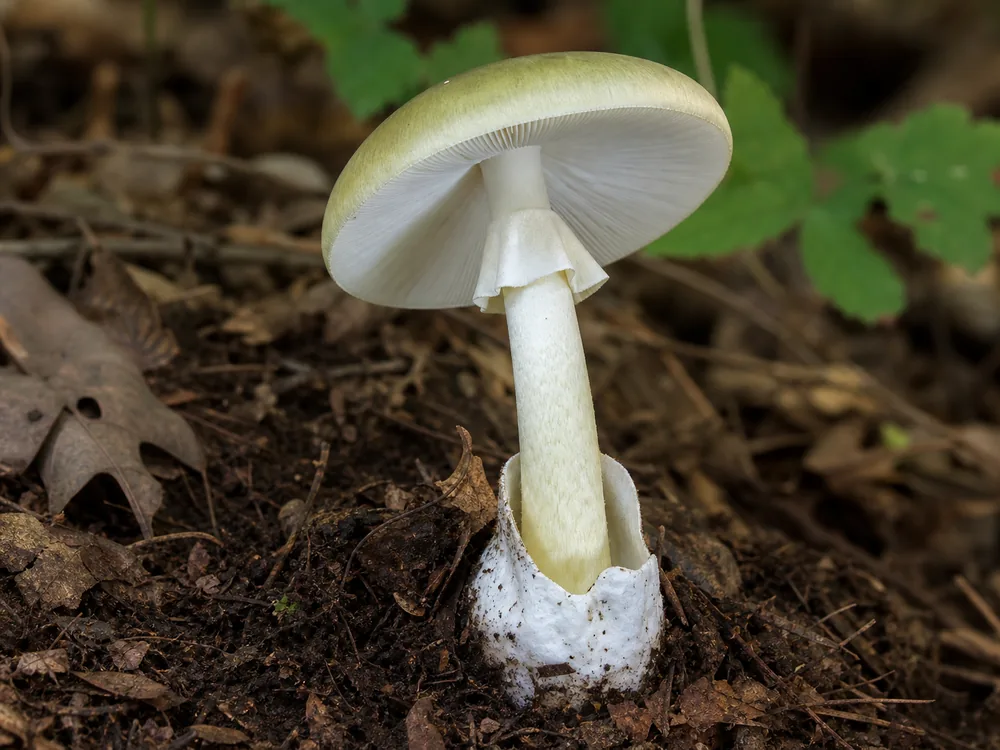
Many mistakes begin with a familiar silhouette. A closed death cap can resemble a puffball or button, while an open cap may be cream, yellow-green, olive, or bronze instead of the color a field-guide reader expected. Prevention therefore depends on the whole specimen rather than a single photograph.
Reconstruct the whole mushroom, not its cap color
Smooth and 5 to 15 cm across, initially rounded then flattening, with color ranging from nearly white through yellow-green and olive to bronze. The margin is not striate.
Broad, crowded, free gills, white when young and often cream with age.
White to off-white, 7 to 15 cm tall, usually with a fragile skirt-like ring and a swollen base enclosed by a large sack-like white volva.
White flesh. Odor is not distinctive when young and can become unpleasant or sickly sweet as the mushroom ages.
Begin with the entire fruit body and its setting. A smooth cap may be almost white, yellow-green, olive, or bronze, so color can raise suspicion but cannot finish the identification.
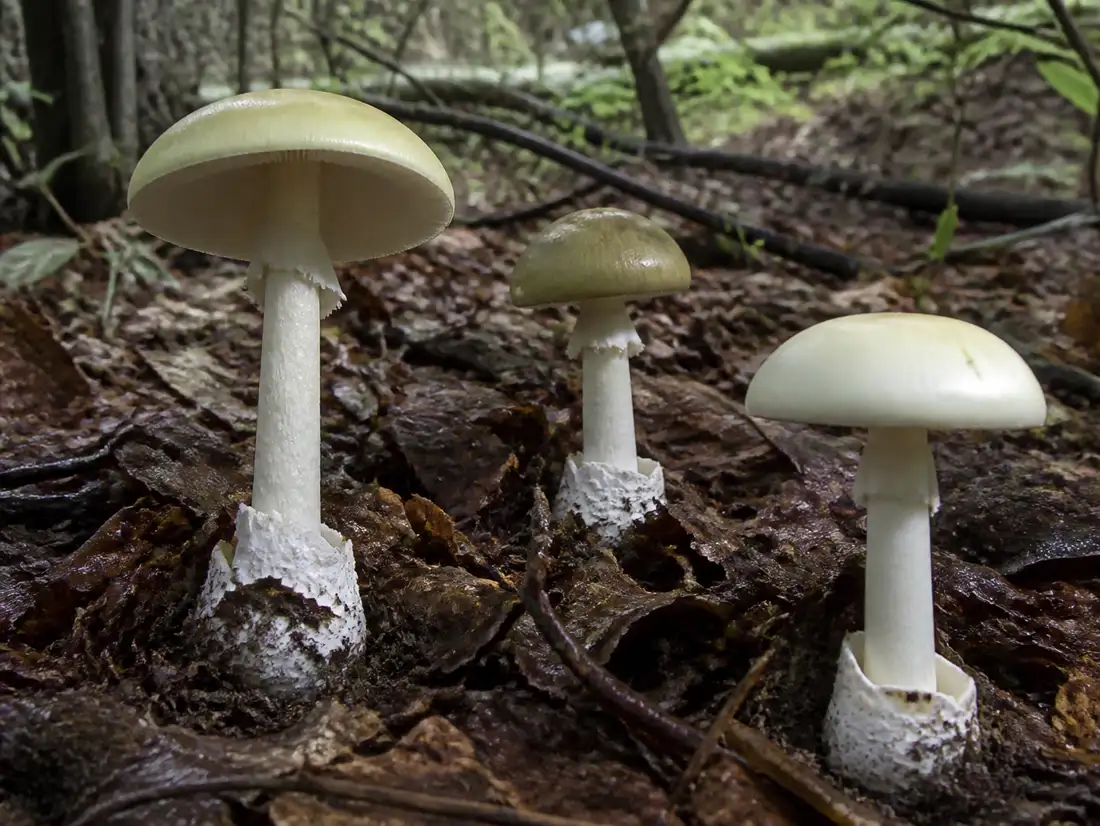
Ease the base from the soil instead of cutting the stem. The large white volva can remain underground, and a broken specimen has lost a feature that separates death cap from several superficially similar mushrooms.
| Structure | What to observe | Limit of the clue |
|---|---|---|
| Cap | Smooth, non-striate margin with variable pale, greenish, olive, or bronze color | Color alone cannot prove or exclude death cap |
| Gills | Broad, crowded, and free from the stem, white to cream with age | Other dangerous Amanitas also have pale free gills |
| Stem | White to off-white, often faintly patterned, with a fragile hanging ring | Rings can tear or disappear |
| Base | Swollen and enclosed by a large sack-like white volva | The volva may remain buried or be broken away |
| Spore deposit | White | A white print supports the assessment but does not establish edibility |
A spore print is supporting evidence after the whole specimen has been documented. It cannot rescue a missing base or turn an uncertain white-gilled Amanita into food.
Closed buttons require a different observation because their mature structures are hidden. Cut an unknown round white specimen from top to bottom. A young Amanita contains a developing cap, gills, and stem, while a true puffball is uniformly solid inside.
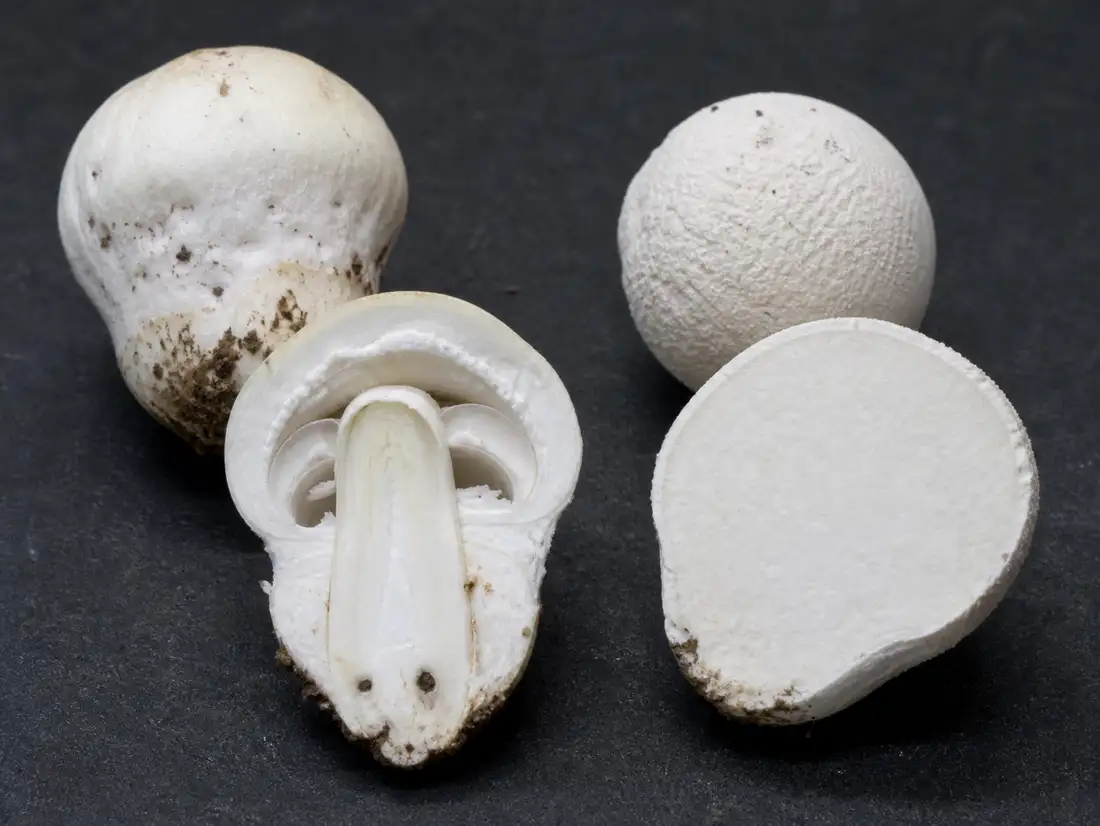
The false death cap often retains buff veil patches and has a different basal structure, but that comparison is for rejection, not meal approval. All-white destroying angels share the deadly Amanita pattern and deserve the same no-food decision.
Do not taste an unknown Amanita or rely on odor, animal feeding, insect damage, an app match, or cooking. These observations neither establish the species nor neutralize toxin.
If someone may have eaten this mushroom, act now. Call Poison Control at 1-800-222-1222 (US) or emergency services before symptoms appear, and save a piece of the mushroom for identification.
Follow the tree roots into parks and streets
Death caps are ectomycorrhizal. Their underground fungus exchanges resources with living tree roots, so fruit bodies rise from soil near a host rather than from a dead log.
Oaks are important hosts in Europe and coastal California, although other compatible broadleaved trees occur in the documented range. Record every nearby tree because the visible mushroom does not reveal which root it occupies.
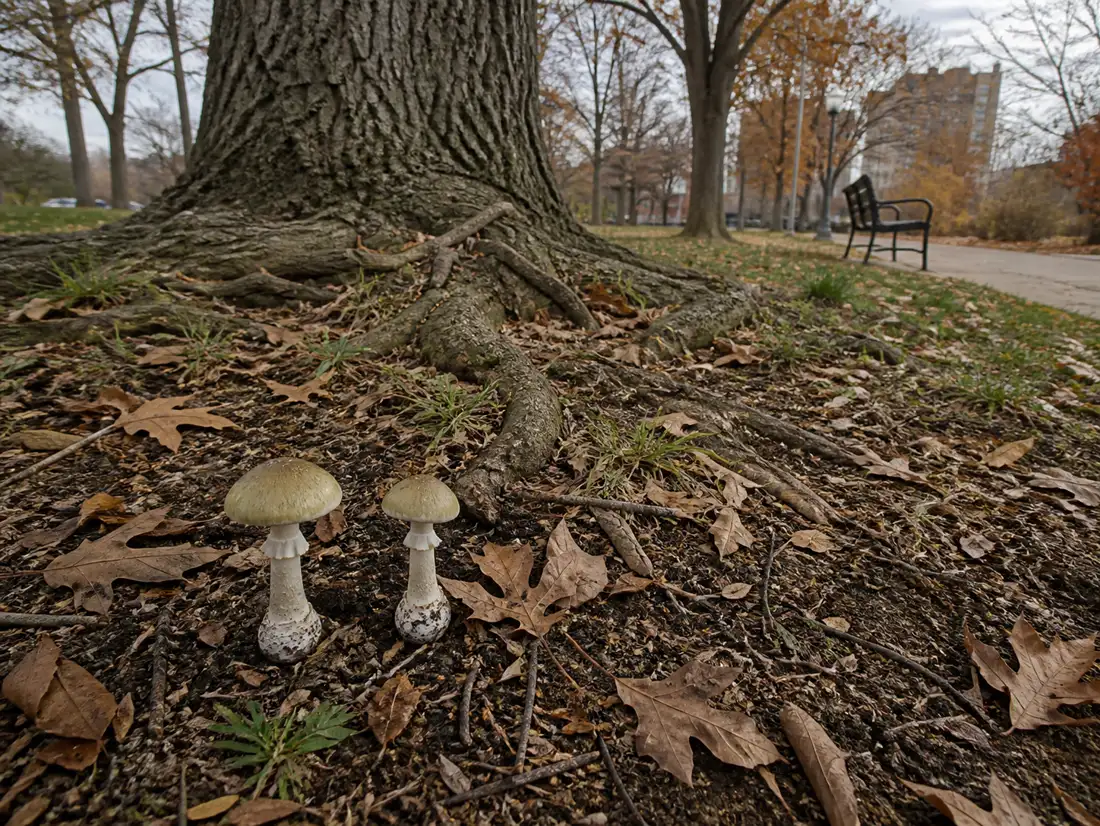
A maintained lawn is still possible death cap habitat. The important setting is a compatible living tree and suitable moisture, not whether the ground looks wild.
Genetic and field records support a European origin and introduction to western North America. Research in California documented an expanding range and a host shift to native coast live oak, which helps explain abundance beyond plantings of European trees.
Season cannot be transferred unchanged across climates. First Nature records July through November in Britain and Ireland, while the Northern California outbreak followed unusually wet conditions from late 2025 into early 2026. Rain and local host climate guide vigilance, but they do not identify an individual mushroom.
Why no cooking method makes death caps safe
Death cap has no culinary use. The CDC states that amatoxins are not denatured by cooking or other food preparation, so boiling, frying, drying, freezing, or soaking does not create a safe dish.
If a suspect specimen entered a mixed collection, stop preparing the meal and preserve every piece. Poison-control first aid begins with a call and evidence, not a kitchen test.
Warning
Never serve, taste, or cook around a suspected death cap. Keep the collection and meal remnants separate, and contact poison specialists immediately if ingestion may have occurred.
Reduce exposure without pretending the fungus is gone
Death caps are not a food or medicinal crop. Around a home, the practical job is exposure prevention because removing fruit bodies does not remove the fungus partnered with the tree roots below.
Check the same ground after rain during the local fruiting season. Remove visible mushrooms before children or pets enter the area, keep one intact specimen separately if an exposure is possible, and place the rest where they cannot be eaten.
Repeated fruiting is evidence of a persistent root partnership, not a failed cleanup. The risk to dogs is an ingestion problem, so supervision and prompt removal matter more than trying to eliminate a mature host tree.
What treatment evidence can and cannot tell you
Death cap has no safe medicinal use. Research on amatoxins and hospital therapies does not support teas, tinctures, powders, folk preparations, or self-treatment.
The 2022 review of four decades of reported amanitin cases found major limits in the treatment evidence. Reports differed in diagnosis, combinations of therapies, illness severity, and outcome reporting, which prevents a simple claim that one antidote guarantees recovery.
That uncertainty increases the value of early expert care. It does not justify a personal protocol, a dose recommendation, or waiting to see whether symptoms pass. See the hospital-level mushroom poisoning treatment overview without attempting those interventions at home.
End the food decision before the basket
Death cap provides no nutritional decision because it is never food. The final field rule is to reject an uncertain white-gilled Amanita before it reaches a basket, vehicle, or kitchen.
A cap photograph cannot show a buried volva, and a cut stem may remove it. Preserve an intact base, underside photographs, nearby-tree notes, and separate specimens when an identifier or poison specialist needs evidence.
If ingestion is possible, stop the field discussion. Call immediately, keep remaining material away from food, and let clinicians and poison specialists decide what evidence and monitoring are needed.
Taxonomy & Naming
Amanita phalloides is the European death cap, a species introduced to parts of North America. The planned Eastern American death cap route represents a separate regional identity and is not evidence that every eastern specimen belongs to A. phalloides.
The common name destroying angel covers several pale amatoxin-containing Amanitas rather than one worldwide species. Shared white gills, a ring, and a volva define a danger pattern, but geography and specialist characters still matter for a species name.
Death cap emergency questions
What makes the death cap so dangerous?
What should I do if someone eats a suspected death cap?
Can cooking make a death cap safe?
Can I identify a death cap by smell?
How long until death cap symptoms appear?
Can a small taste hurt me?
Sources & References
- First Nature, Amanita phalloides Whole-specimen morphology, cap variation, white spore print, hardwood ecology, season, and comparison with false death cap and Agaricus.
- CDC MMWR Observed poisoning phases, preparation resistance, outbreak outcomes, and the absence of a standardized regimen or FDA-approved therapy.
- Tan et al., Clinical Toxicology 2022 Systematic review of reported amanitin cases and the limits of treatment-effect evidence.
- Pringle et al., Molecular Ecology 2009 Evidence that Amanita phalloides was introduced and is expanding on the west coast of North America.
- Wolfe and Pringle, ISME Journal 2012 Geographically structured host associations and the California host shift to coast live oak.
- Poison Control Emergency poison triage route and U.S. poison help access.