What is a false death cap?
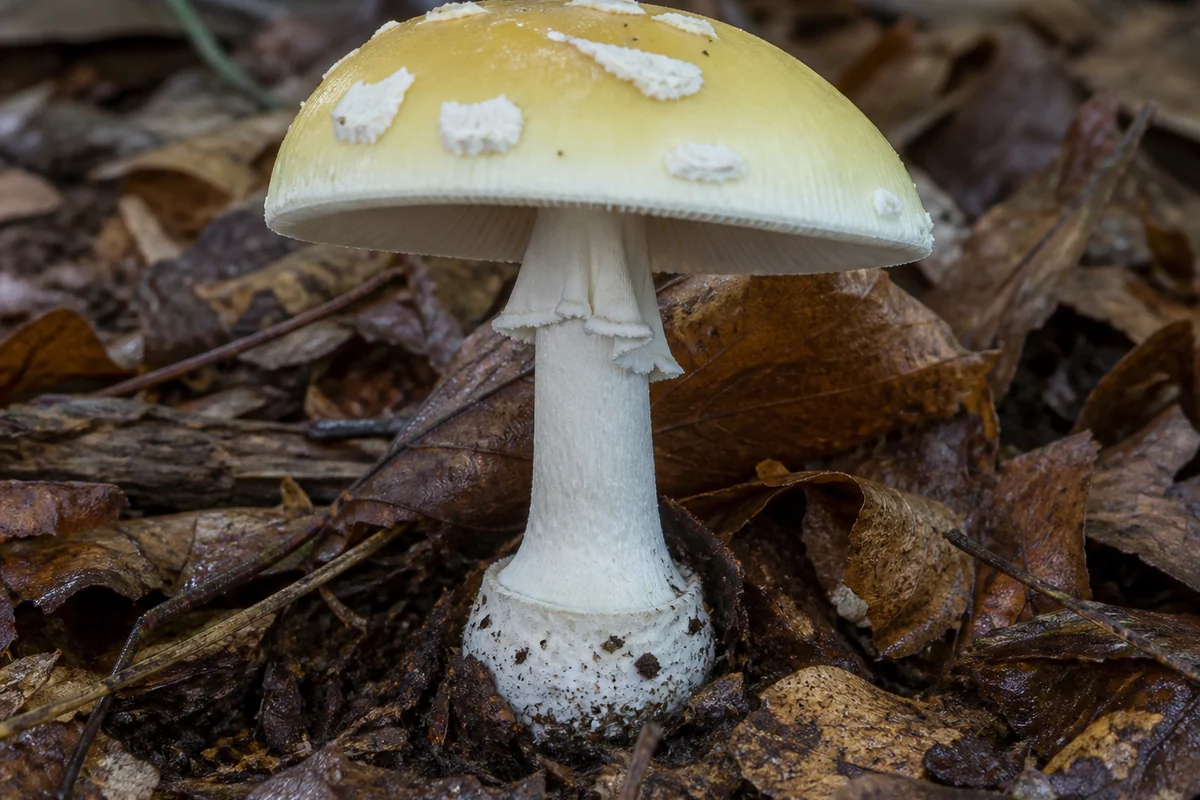
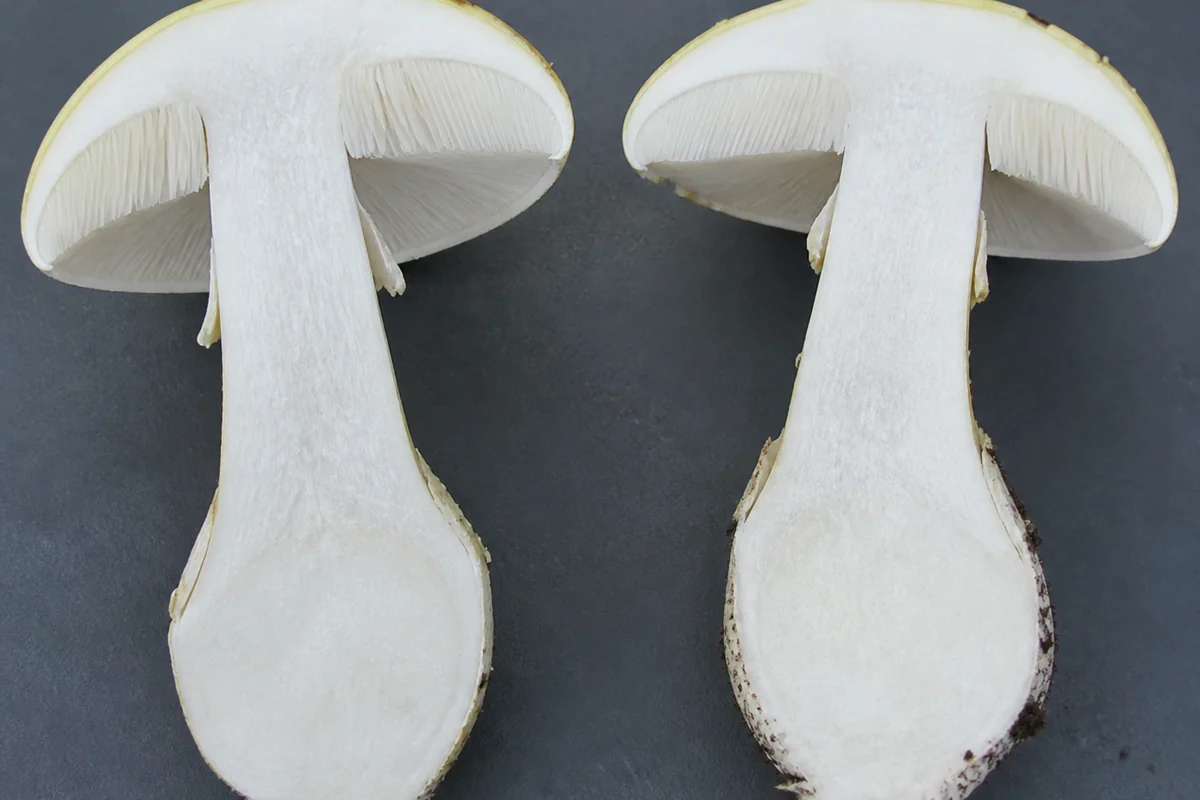
A false death cap is a pale lemon yellow gilled mushroom of beech woodland, with big white patches on the cap, white gills and a hanging white ring.
The base is where it announces itself. The stem sits on an abrupt rounded bulb wrapped in a large white sheath, and the top edge of that sheath forms a distinct rim pressed against the stem.
It is one of the commonest Amanitas in European woodland, so a reader learning the genus will meet this one long before they meet anything rare.
That commonness is the practical argument for learning it. Being able to name the ordinary one quickly is what leaves attention available for the specimen that is not ordinary.
The lemon color is soft and easily missed in poor light. It reads as off-white under a closed canopy and as a clear pale yellow once the mushroom is out in the open, which is a good reason to carry one to the edge of the wood before deciding anything.
How do you identify a false death cap?
Pale lemon yellow, 5 to 10 cm across and up to 12 cm in the white variety, carrying large brilliant white veil patches, rounded then flattening.
White, free of the stem and crowded.
White, 5 to 8 cm tall, rising from a very large white sheath around an abrupt basal bulb, and carrying a ring that hangs downward and usually stays intact.
White and unchanging, smelling distinctly of cut raw potato or radish when young and of little at all when old.
Two characters name it and both are easy once you know to check them.
The base gives the first and the smell gives the second, and neither is available on a mushroom snapped off at the litter.
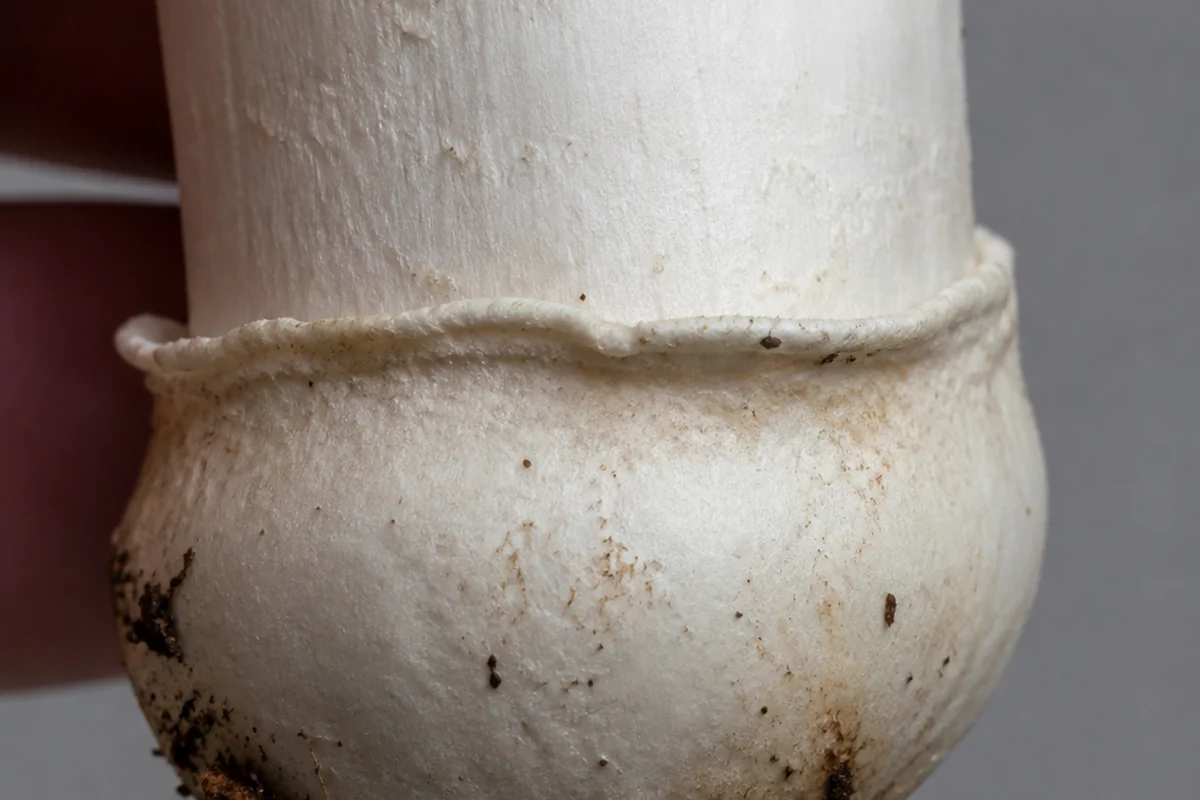
The rim is the thing to learn. It is a hard edge you can catch with a fingernail rather than a soft fold, and it is the clearest structural difference from the loose bag of a death cap.
| Character | False death cap | Note |
|---|---|---|
| Cap | 5 to 10 cm, pale lemon yellow | White variety up to 12 cm |
| Cap patches | Large, brilliant white | Wash off in heavy rain |
| Base | Abrupt bulb with a gutter-like rim | Not a loose sac |
| Smell | Cut raw potato or radish | Young specimens only |
| Spore print | White | Confirms the family, not the species |
Smelling it properly takes the same handling any smell character does. Break a piece, warm it briefly between finger and thumb, and cup it close rather than holding a whole cap up to the face.
The smell fades with age, which is worth expecting rather than being surprised by.
A young specimen is unmistakable on it and an old one may give nothing, so the smell is a character that arrives and leaves rather than one that is simply present.
The ring is worth noting as a supporting character. It hangs downward as a skirt and usually stays intact rather than collapsing or tearing away, which is more than several relatives manage.
None of these characters is rare or subtle. What makes people miss them is that the deciding one is underground, and a mushroom picked by the cap has already thrown it away.
How is a false death cap different from a death cap?
The comparison the name is built on is the death cap, and the two separate on the base above everything else.
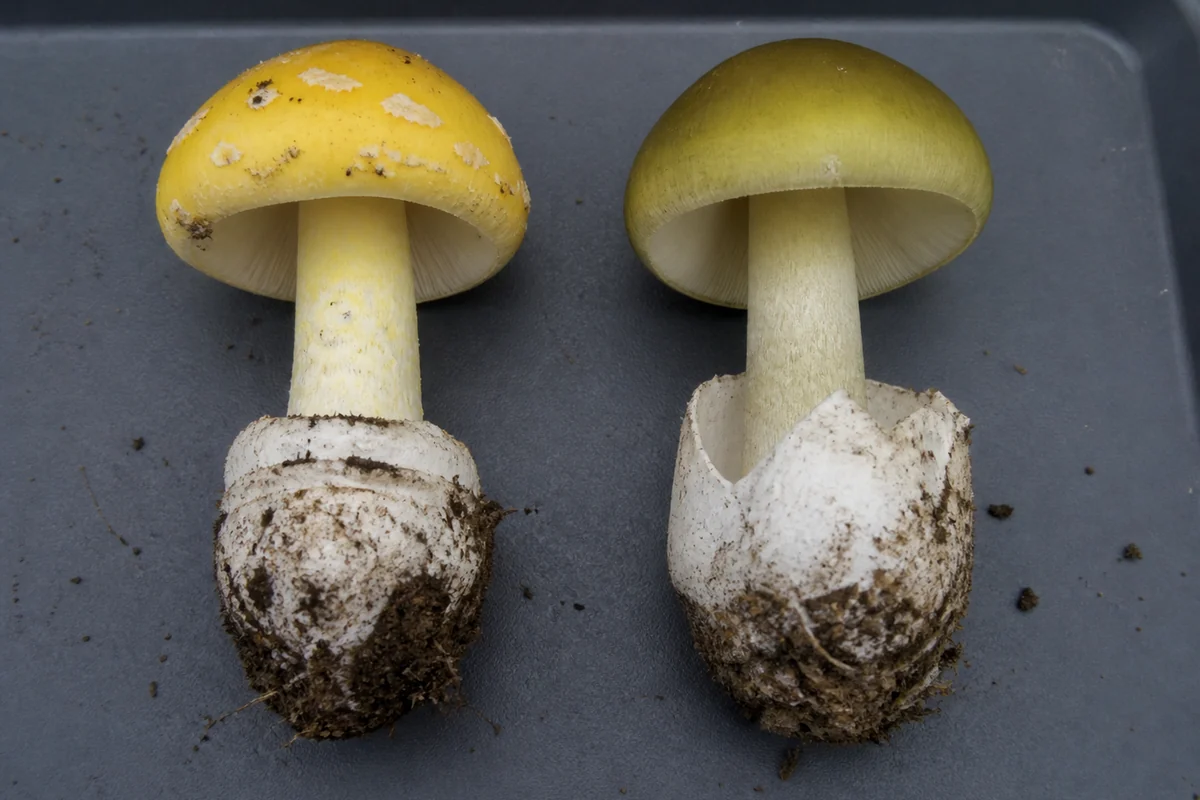
A death cap sits in a loose membranous bag that stands away from the stem, and this mushroom sits on a bulb with a tight rim.
Warning
This is a comparison for rejection rather than for the table. Neither mushroom goes in a basket, and getting the answer right only tells you which one you are looking at.
The cap helps as a supporting character. A death cap is smooth and usually greenish or olive without patches, and this one is lemon yellow with big white patches on it.
Heavy rain washes those patches off, which is exactly when the base has to do the work alone.
The destroying angel is the other serious comparison and it matters most for the white variety of this species, since both are then white mushrooms in woodland with white gills and a white ring.
The base separates those two as well. A destroying angel sits in a sac and the white false death cap keeps the same abrupt rimmed bulb the yellow form has.
There is a pattern worth taking away from all three comparisons. In this genus the base is the character that survives weather, handling and age, and the cap is the character that changes.
So the habit that keeps people safe is not learning more caps. It is refusing to name anything in this genus until the bottom of the stem is out of the ground and clean.
Warning
Never judge this group without the whole stem base out of the ground and cleaned. The rim and the sac are the characters that matter and both are underground until you dig.
Where do false death caps grow?
The false death cap is mycorrhizal, living in partnership with tree roots rather than on dead material. Beech is its strongest association, and it works with other hardwoods and with conifers too, on neutral to alkaline soils in mixed woodland.
- Partner trees
- Beech above all, other hardwoods and conifers
- Soil
- Neutral to alkaline
- Season
- August to November
- Habit
- Scattered or in loose groups, often in numbers
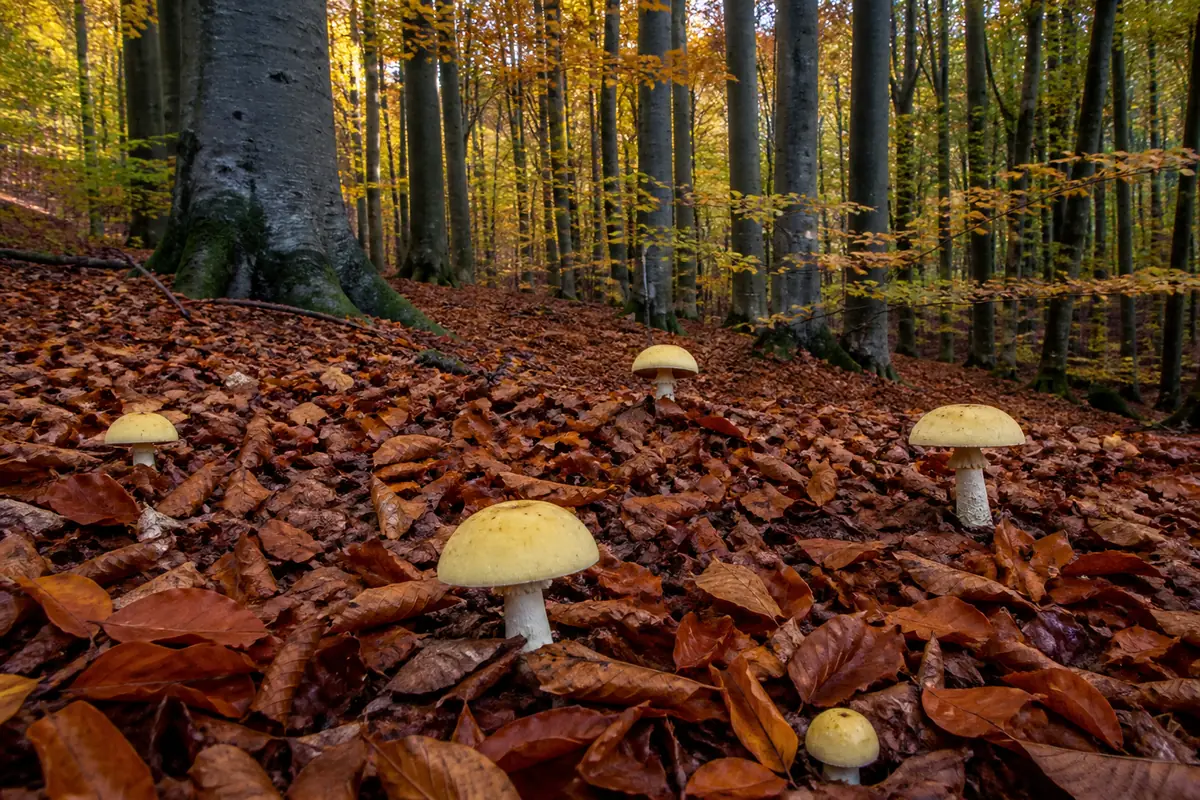
It fruits in numbers where it is established, which is part of why it is met so often.
A beech wood in October can carry dozens of them across a short walk.
The same woods produce the death cap, which is the whole reason the two are ever compared. They are not distant species meeting by accident, they are neighbours.
Being the common one has a real effect on how people read a find.
Somebody who has seen a hundred of these in a beech wood builds an expectation, and an expectation is exactly what makes an unusual specimen get filed under a familiar name.
Soil preference is a soft clue rather than a separation. Both prefer similar ground, so nobody should read an alkaline beech wood as evidence for either name.
Is the false death cap poisonous?
The false death cap is not eaten, and the reasoning is worth setting out carefully because it is easy to get backwards.
It is now known to contain alpha-amanitin, the compound responsible for death cap poisoning, and the concentration is low enough that it is unlikely to have any significant effect on a healthy adult.
Note
That sentence is not permission. A trace of the most dangerous compound in this genus is a reason to be more careful about the species rather than less, and nothing about it makes the mushroom worth cooking.
The real argument against eating it has nothing to do with its own chemistry. Somebody who eats false death caps is somebody who eats white-ringed Amanitas from beech woods, and that is a habit with a very bad tail on it.
It is inedible on this site for that reason rather than because of what it would do on its own.
Nothing about it is appealing anyway. The smell is of raw potato, the texture is unremarkable, and no tradition anywhere treats it as worth the trouble.
Somebody who has eaten one by mistake is in a different position from somebody who has eaten a death cap, and the difficulty is that neither of them knows which they are.
So the response is the same either way. Keep whatever is left of the collection, including the base, and get medical advice rather than waiting to see how the evening goes.
Amanitin poisoning has a long quiet gap between the meal and the symptoms, which is precisely why waiting is the wrong instinct with anything in this genus.
Is there any medicinal use?
There is no medicinal use of the false death cap.
It appears in chemistry and toxicology literature for its amanitin content and for other unusual compounds, which is a laboratory interest rather than a health claim.
Can false death caps be cultivated?
The false death cap cannot be cultivated, because it fruits only from a partnership with living tree roots. There would be no reason to try. It is abundant where it occurs, nobody eats it, and it has no commercial use of any kind.
Is there any nutritional information?
No nutritional information exists for this species and none would be meaningful.
Nutrition tables describe foods, and this is a mushroom whose entire practical value is as a thing to recognize and walk past.
Recognizing it quickly has a real value that no table captures, which is the attention it frees up for the specimen beside it.
Why is the false death cap sometimes all white?
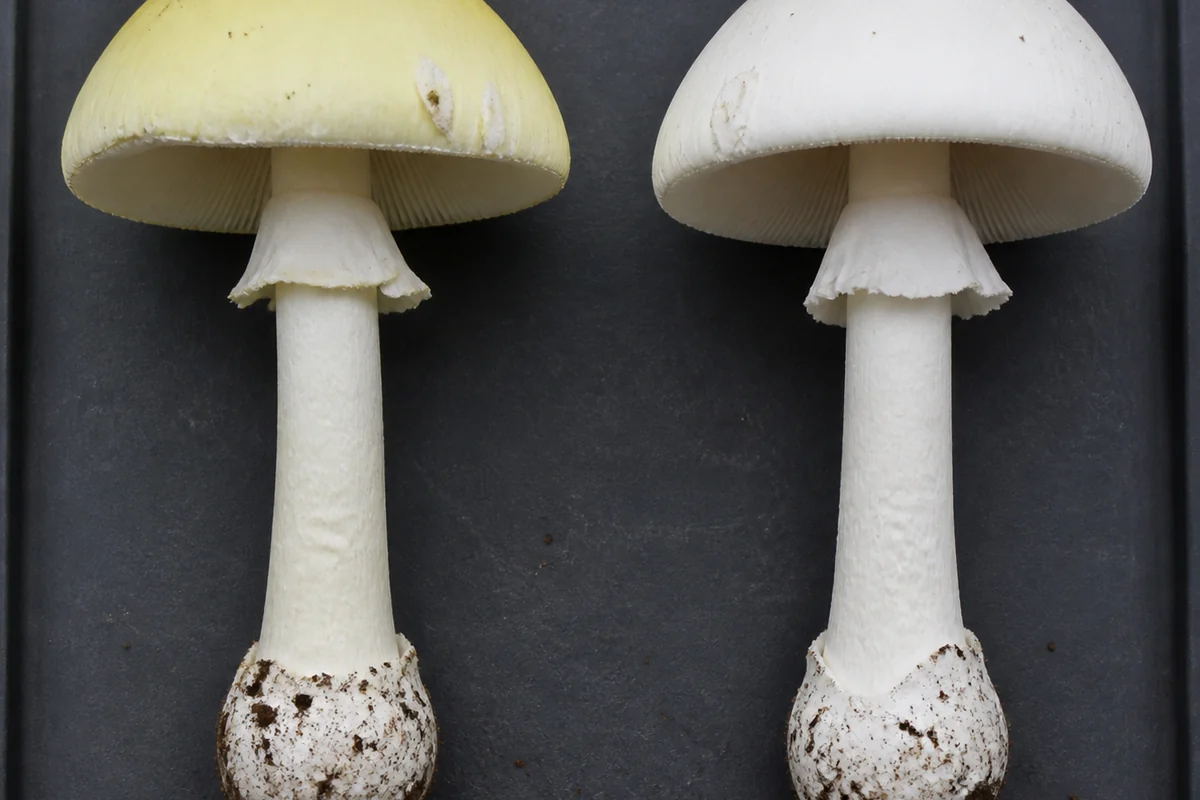
The all-white form is the thing most likely to confuse a reader working from a photograph. It turns up regularly rather than being a rarity, so it is worth expecting rather than treating as an oddity.
Amanita citrina var. alba is the same mushroom without the yellow, keeping the white cap patches, the white gills, the ring and the abrupt rimmed bulb.
Key takeaway
A variety name records a consistent difference within one species rather than a separate organism. It is a smaller claim than a species name and it is doing useful work when the difference is one people keep noticing.
The white form makes the base more useful than cap color for this comparison. A white cap with white patches puts this species in the same visual bracket as several white Amanitas including a deadly one.
Varieties in this genus have had a mixed history, and several have been raised to species or dropped entirely as molecular work has gone on.
This one has held up because the difference it records is simple and consistent, which is the pigment and nothing else.
The genus has been reorganized repeatedly and this species has stayed put through most of it, which is a quiet compliment to whoever described it. Its position among the amanitas with rimmed bulbs and white spores has been stable, and that group has turned out to be a real one rather than a convenience.
Frequently Asked Questions
Is the false death cap poisonous?
Why is it called the false death cap?
How do you tell it from a real death cap?
What does a false death cap smell like?
Is the white one a different species?
Can you eat it if you cook it thoroughly?
Sources & References
- Amanita citrina, False Deathcap mushroom Field description used for the cap dimensions and lemon yellow color with brilliant white patches, the white free gills, the very large white volva enclosing an abrupt basal bulb with a gutter-like ridge, the hanging ring, the white spore print, the cut raw potato or radish smell of young specimens, the beech and mixed woodland habitat on alkaline or neutral soil, the August to November season, the var. alba white form, and the statement that the species contains alpha-amanitin at a concentration unlikely to have any significant effect on a healthy adult.
- Amanita phalloides Death cap identification features, particularly the loose sac at the base and the smooth non-striate cap.