What is the gemmed amanita?
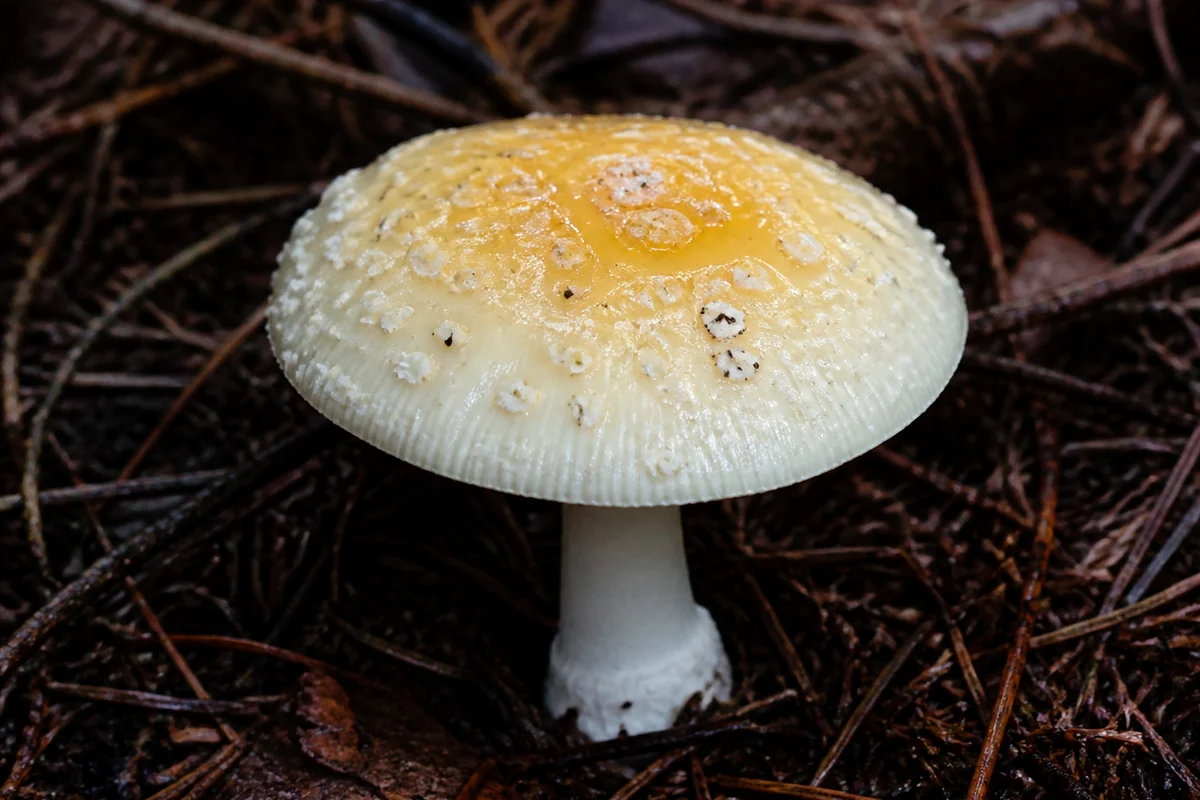
A gemmed amanita is a medium-sized gilled mushroom with a pale creamy yellow cap, soft white patches scattered across it, white gills and a white stem sitting on a rounded bulb.
The common name comes from those patches, which are the torn remains of the veil that covered the whole young mushroom and which look like small gems set into the cap surface. The older name jonquil amanita points at the same mushroom from the other direction, jonquil being a pale yellow daffodil.
Both names describe a color and a texture, which is worth noticing, because those are the two characters this mushroom is least able to keep hold of.
It belongs to the Amanita family, the group that also contains the death cap and the fly agaric, and it shares the family's basic structure of free gills, a white spore print and a veil that leaves traces at both ends of the mushroom. Those shared features identify the broader group but do not establish the species.
In North America, those features alone cannot settle the species name. Keep that uncertainty attached to any identification.
How do you identify a gemmed amanita?
Pale to moderately grayish yellow with a slightly darker center, 50 to 100 mm across, oval then convex and often with a shallow central dip, sticky when wet, and carrying scattered soft white veil patches. The margin is grooved, with small bumps along the grooves.
Free to remote from the stem, whitish to pale cream, broadest near the middle, with short gills that end bluntly rather than tapering.
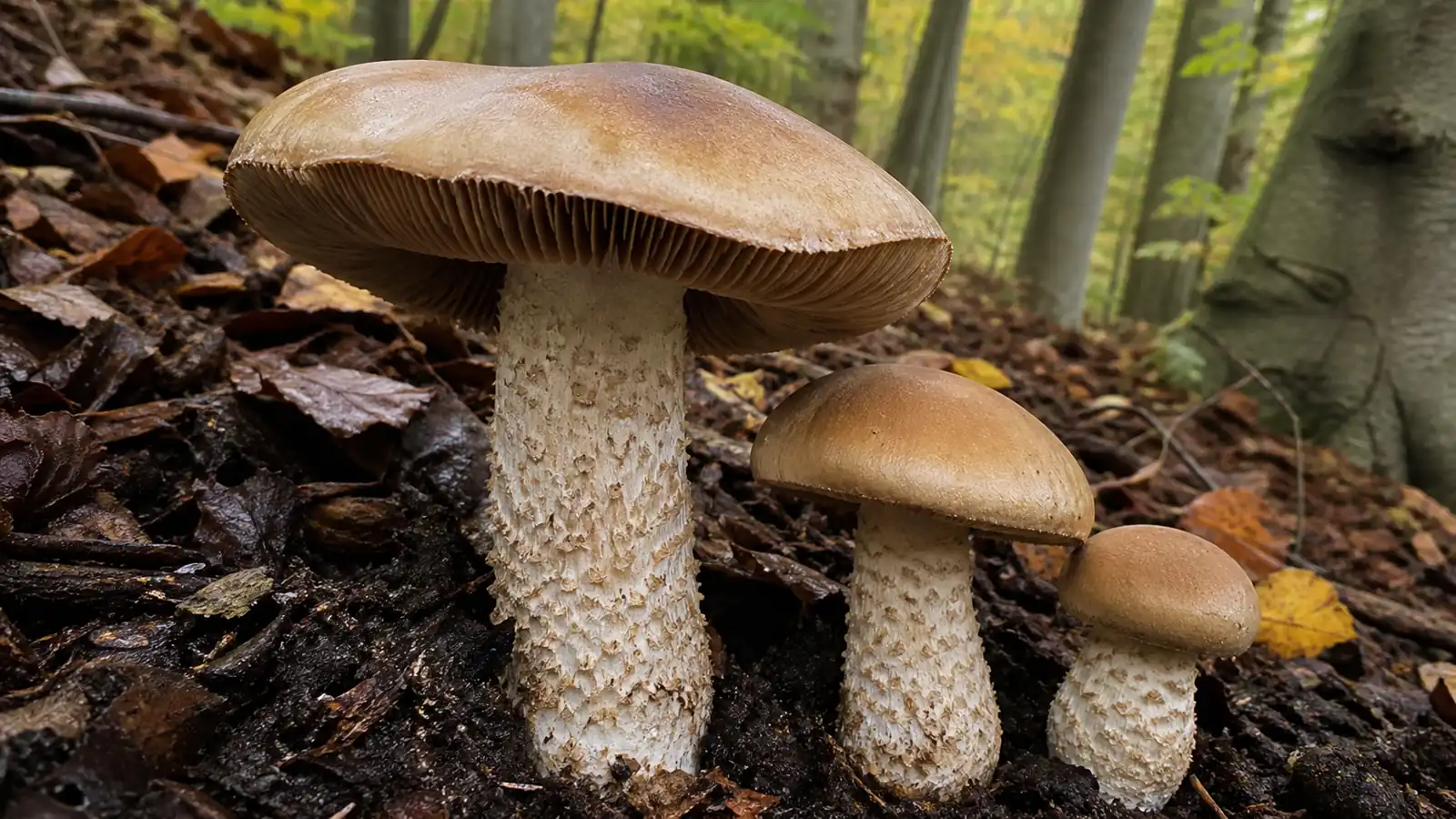
White, reaching about 110 mm long and 10 mm thick, tapering upward, stuffed at first and later hollow, with cracked or flattened scaly belts and a rounded basal bulb whose upper edge carries small flattened scales or woolly warts.
White and unchanging when cut, with no distinctive smell.
Every Amanita question starts at the base, and this one is no exception. The bulb has to come out of the ground whole, because the upper edge of the bulb carries the character that separates this group from several others.
What you are looking for there is not obvious the first time. The veil leaves a low ragged rim of small flattened scales rather than the clean free-standing collar of a panther cap or the loose bag of a death cap, and on a weathered specimen it can read as little more than a roughened band.
The measurements are unremarkable and worth having anyway, because a specimen well outside them is a different problem.
| Character | Gemmed amanita | Note |
|---|---|---|
| Cap width | 50 to 100 mm | Slightly dished in the center when mature |
| Cap color | Pale to grayish yellow, darker centered | The single most variable character |
| Cap margin | Grooved with small bumps | Shared with panther cap |
| Stem | To 110 by 10 mm, hollow when older | Scaly belts below the ring |
| Bulb | Rounded, with scales or warts at the rim | No free sac |
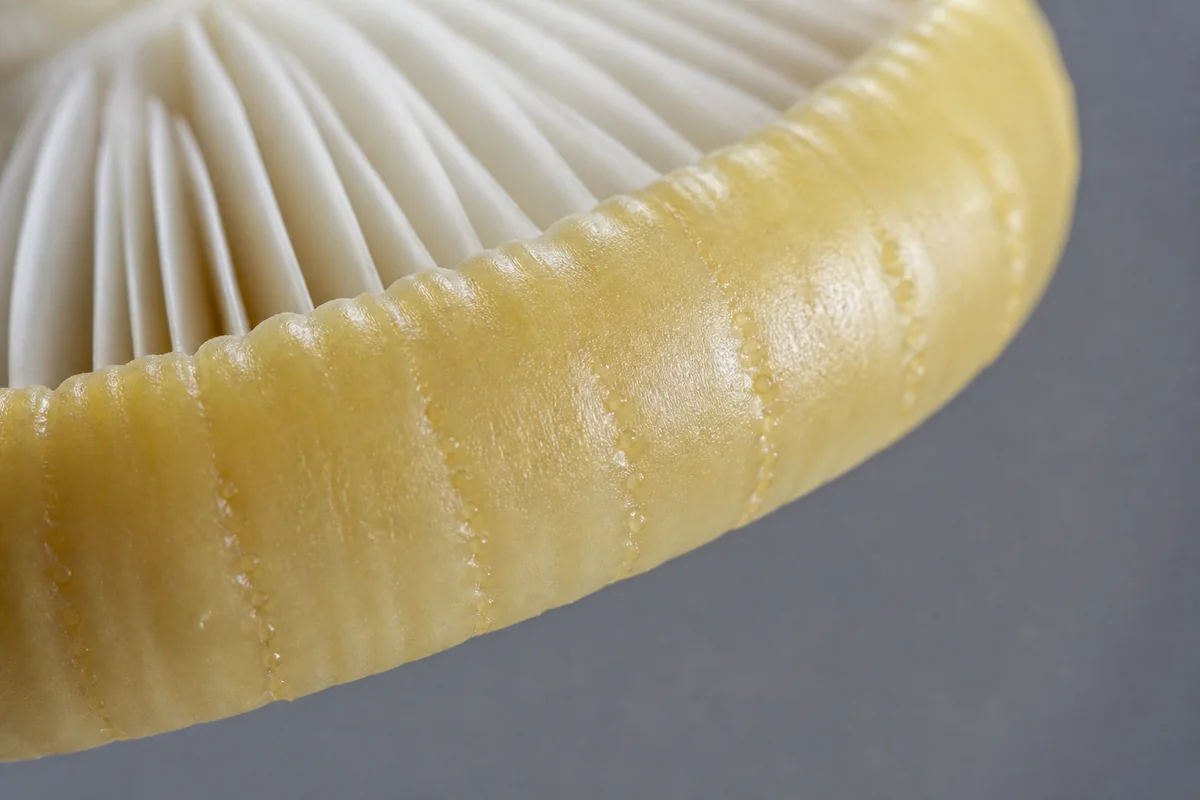
Cap color is the character people lead with and the one that fails first. The same collection can run from almost white through straw and butter yellow to a light tan, and weather, age and sunlight all move it.
That range reflects uncertainty about the species name, not simply variation within one well-defined species.

Under a microscope the spores are inamyloid, meaning they stay pale in iodine rather than darkening.
That single test separates this group cleanly from the blusher group, whose spores darken, and it is one of the few places in this part of the genus where a character gives a clean answer.
It also shows what the field characters are up against. The reliable separations here are the ones that need a microscope, and the ones available in a wood are shared with the neighbors.
That leaves a practical question, which is what to do with a specimen you cannot finish naming.
The useful answer is to record it properly rather than to guess. Photograph the cap from above, the gills and margin from below, and the base beside the hole it came out of, then note the trees within a few meters and the date.
A record like that is worth something to somebody working on the group. A name assigned by eye in the field is worth nothing to them, and it is worth less than nothing to the next person who reads it and believes it.
If someone may have eaten this mushroom, act now. Call Poison Control at 1-800-222-1222 (US) or emergency services before symptoms appear, and save a piece of the mushroom for identification.
What does the gemmed amanita get confused with?
The confusion that matters is with the panther cap, and it is not a beginner's mistake. A typical panther cap is browner, more strongly warted and has a distinct collar at the top of its bulb, and a typical gemmed amanita is paler yellow with softer patches and a scalier bulb rim.
Both of those sentences contain the word typical, and the specimens that cause trouble are the ones that are not.
Warning
Collections intermediate between the gemmed amanita and the panther cap have been reported repeatedly from northern California and the Pacific Northwest, and poisonings have followed from them. The intermediates have often been described as hybrids, and specialists doubt that explanation while agreeing the specimens are real.

Whether those mushrooms are hybrids or simply unnamed species matters a great deal to taxonomists and not at all to a forager.
Either way, a pale amanita with a grooved margin sits inside a range of possibilities whose toxic end is panther cap strength. The fly agaric is the other family member people reach for by comparison, and it is the easy one, being red or orange with white warts rather than pale yellow with white patches.
It is worth mentioning only because it carries the same class of toxins, which is the reason this group is grouped at all.
The comparison that actually protects somebody is with the death cap, because a young one is pale and a person who has decided every pale amanita is a gemmed amanita has stopped looking.
Two characters separate them and both survive a rough collection. A death cap has a smooth ungrooved cap margin and sits inside a loose membranous bag, while a gemmed amanita has a grooved margin and a bulb with a scaly rim and no bag.
Neither one goes in a basket, so this is a comparison for the record rather than for the table. It matters because the two mushrooms sit in the same woods and the consequences of the two mistakes are not the same size.
Warning
There is no edible species that a gemmed amanita is likely to be confused with, so the risk here runs in one direction. Somebody who has decided a pale amanita is a gemmed amanita has already accepted a poisonous mushroom, and the only remaining question is how strong it is.
Where does the gemmed amanita grow?
The gemmed amanita is mycorrhizal, living in partnership with tree roots, and it is most often found in conifer forest and in mixed hardwood-conifer woodland. In California it is common through both, which puts it in exactly the ground where people walk dogs and pick mushrooms in the same afternoon.
That overlap is the reason this species turns up in veterinary reports more often than in human ones.
Dogs find mushrooms by smell and eat them whole, and a small pale amanita on a trail edge is well within reach of an animal moving faster than the person holding the lead.
- Forest type
- Conifer and mixed hardwood-conifer
- Partnership
- Obligate, on living tree roots
- Fruiting
- Singly or scattered, rarely in troops
- Mild-winter season
- Autumn through into spring
Season depends on where the rain falls. In mild-winter regions it fruits from autumn right through winter and into spring, while colder climates compress it into late summer and autumn.
It fruits scattered rather than in troops, so a find is usually one mushroom or a few spread over some distance rather than a patch.
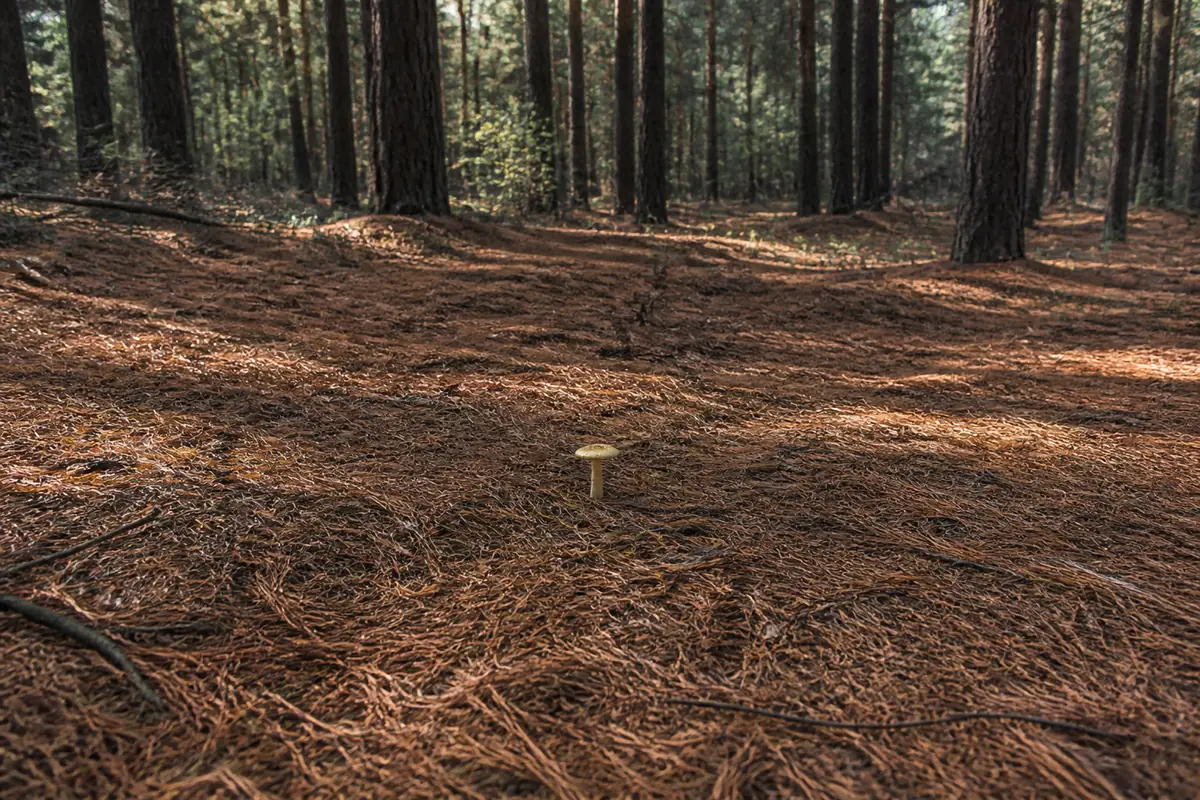
That scattered habit has a practical consequence worth naming. A person collecting a basket of pale mushrooms from a wide area is much more likely to have collected several different things than somebody working a single ring.
Can you eat gemmed amanita?
The gemmed amanita is poisonous and there is no preparation that changes that. Its toxins are ibotenic acid and muscimol, the same isoxazole compounds that make the fly agaric and the panther cap what they are.
Chemical surveys of the genus found these compounds in every specimen tested of fly agaric and panther cap, and at lower concentrations in gemmed amanita material.
Note
A lower concentration is not a safety margin. Concentration is measured per gram of mushroom, a poisoning is a matter of total dose, and neither the amount somebody eats nor the strength of a particular collection is fixed.
The effects of this toxin group are neurological rather than the liver damage that makes the death cap so dangerous. Reports describe confusion, agitation, poor coordination, drowsiness that can deepen into unconsciousness, and in some cases seizures, with the onset usually within a couple of hours.
That timing is worth holding onto, because it separates this group from the mushrooms that matter most. A delay of six hours or more before symptoms start points toward the liver toxins rather than these, and it changes what a hospital needs to do.
Neither timing is a reason to wait and see. An early onset tells you which group you are probably in and nothing at all about how severe the case will become.
Anybody who has eaten a mushroom from this group and started to feel strange needs medical assessment, and the useful thing to bring is the rest of the collection rather than a description of it.
The reason to be firm about that is the intermediates. A person who ate what they believed was the milder member of this group may not know which species they actually consumed.
Can it be cultivated?
The gemmed amanita cannot be cultivated, because it fruits only from a living partnership with tree roots and has no substrate-grown form. Nobody has a reason to attempt it either, since the mushroom has no food use and no commercial value.
Is there any medicinal use?
There is no medicinal use of the gemmed amanita.
The compounds it contains are studied as neurotoxins and as tools in laboratory neuroscience, which is a different thing from a therapeutic application, and no clinical work uses this mushroom.
Why is there no nutrition information?
No nutritional figures exist for this mushroom and none would be useful. Do not treat gemmed amanita as food.
The only number that matters for a poisonous species is dose, and dose is exactly what an unresolved species group cannot give you.
Is the gemmed amanita one species or several?
Amanita gemmata was described from Europe, and the name has been applied to North American mushrooms ever since without that application being tested properly. The California treatment of the genus states the position bluntly, saying that the North American material represents a complex of species, *none of which may be the true European Amanita gemmata***, and that much more research is needed to clarify the situation.
That is an unusual thing to find in a reference work, and it is the most useful sentence anybody has written about this mushroom.
Key takeaway
A species complex is a set of organisms that look alike enough to have shared one name and that turn out, on closer work, to be several things. Until the work is done, the name reports a resemblance rather than an identity.
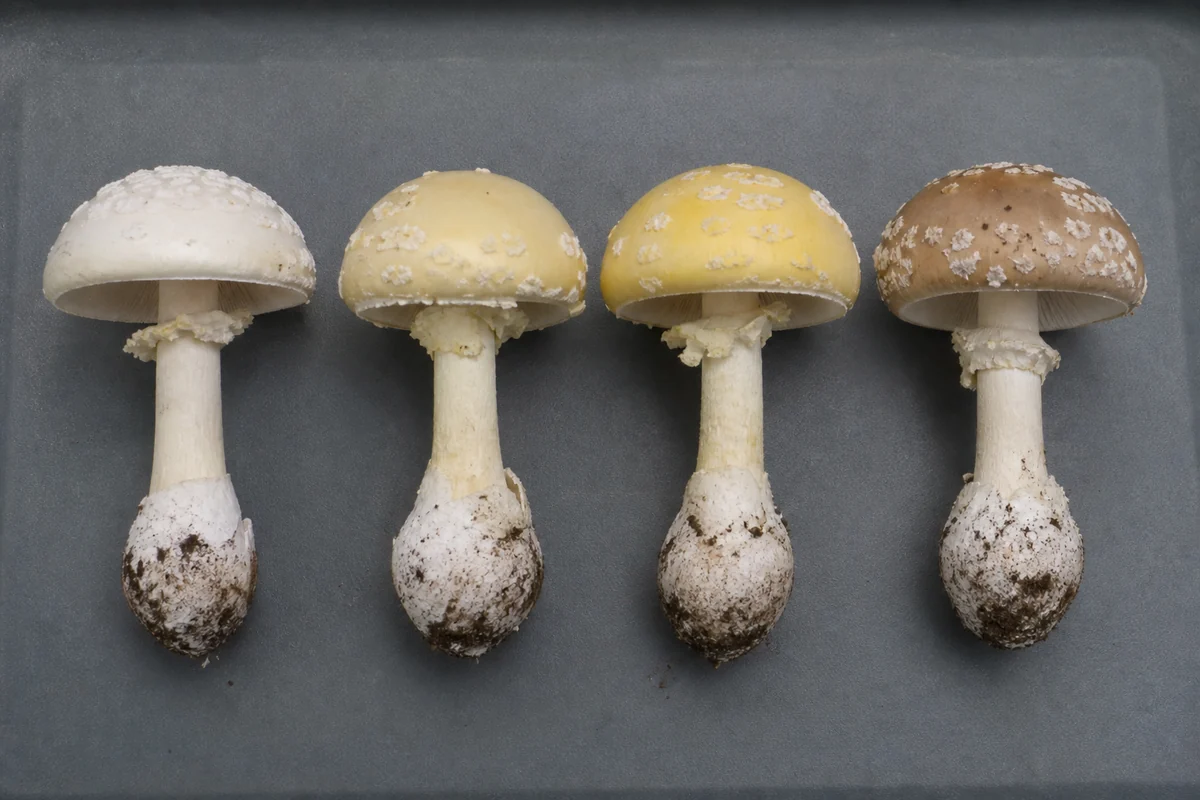
A row like that is what the argument looks like on a tray. Somebody could reasonably call all four the same thing, and somebody else could reasonably split them, and neither has the evidence to settle it.
The same problem runs through this part of the genus. The true panther cap is also thought not to occur in North America, and the western material is now treated as Amanita pantherinoides, so the gemmed amanita's naming trouble is shared with the species it is most confused with.
Those two unsettled names describe the same forests. A specimen from a Pacific Northwest conifer wood is being compared against a European species on one side and a recently separated western species on the other, and the intermediates sit in the gap between them.
Two mushrooms whose names are both unsettled, which grade into each other in the field, and which carry the same class of toxin, is not a situation that a better field character will fix.
What it changes is how a reader should treat a confident label. A field guide that names one of these to species is repeating a tradition, and a specimen photographed with its base intact and its location recorded is worth more to the people doing the work than another name would be.
That is the genuinely useful thing an ordinary person can do with this mushroom. Record it well, leave it where it grew, and treat the name as a question rather than an answer.
Frequently Asked Questions
Is gemmed amanita poisonous?
Is gemmed amanita the same as panther cap?
Why do sources disagree about the gemmed amanita?
Is the gemmed amanita hallucinogenic?
What should I do if my dog ate one?
How can I tell a gemmed amanita from a young death cap?
Sources & References
- Studies in the Amanitaceae: Amanita gemmata Specialist genus treatment used for the cap dimensions and color, the tuberculate-striate margin, the gill attachment, the stem dimensions and scaly belts, the volval scales at the bulb apex, and the inamyloid spore measurements.
- Amanita gemmata - California Fungi Regional treatment used for the toxicity, the conifer and hardwood-conifer habitat, and the statement that the North American material represents a complex of species none of which may be the true European species.
- Toxic Fungi of Western North America Reference work used for the reports of collections intermediate between the gemmed amanita and the panther cap in northern California and the Pacific Northwest, the poisonings associated with them, and the doubts about the hybrid explanation.
- Toxic metabolites of Amanita pantherina, A. cothurnata, A. muscaria and other Amanita species Chemical survey reporting ibotenic acid and muscimol in every fly agaric and panther cap specimen tested and at lower concentrations in gemmed amanita material.