What is Caesar's mushroom?
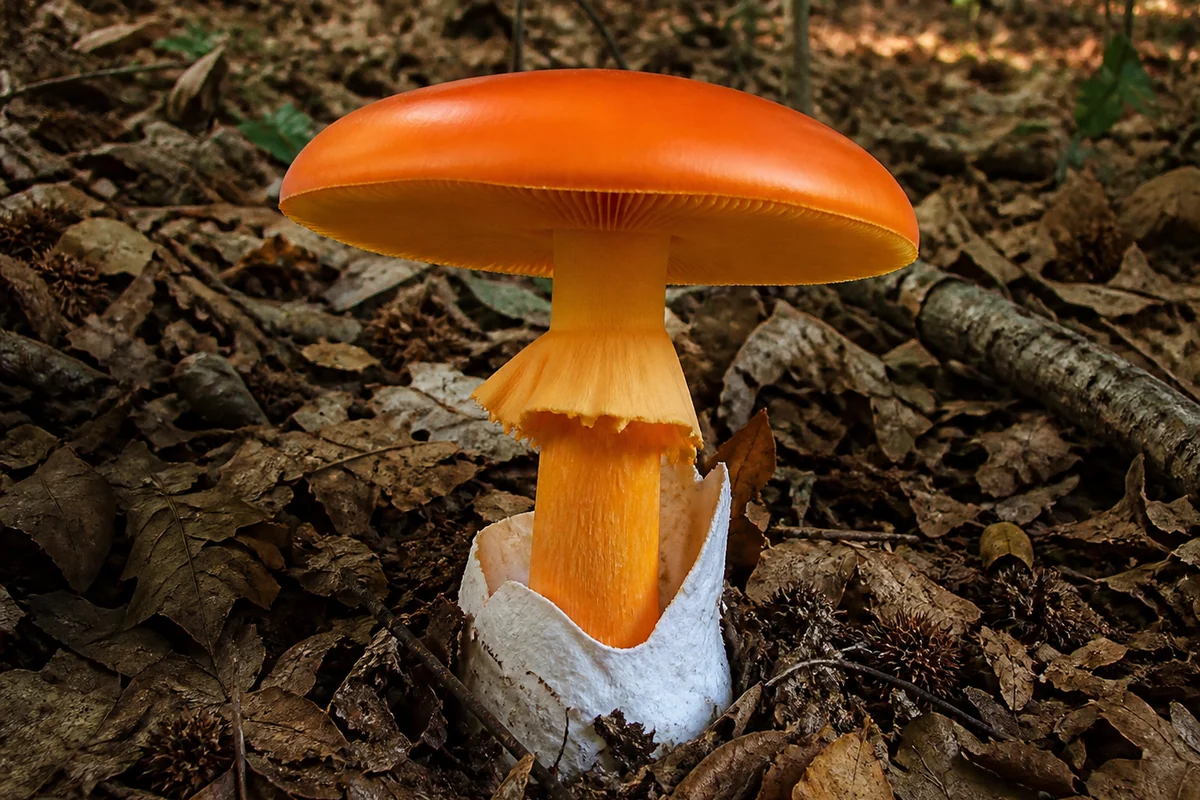
Caesar's mushroom is a bright orange gilled mushroom with yellow gills, a yellow stem and a loose white bag around its base.
The color combination is the thing to hold on to. Orange above and yellow underneath is unusual, and it is what separates a mature specimen from everything dangerous nearby.
It emerges from a white egg, splitting the outer skin as it grows, and the remains of that skin stay behind as the bag at the bottom.
The Italian names ovolo and ovoli mean little egg and point at the button stage rather than the open mushroom, which is a fair summary of how it is usually sold.
The cap edge is worth a habit of its own. A mature Caesar's cap is finely grooved around the rim, with short radial lines running in from the margin, and those lines record the gills pressed against the skin while the mushroom was still folded up.
How do you identify Caesar's mushroom?
Smooth bright orange, 6 to 18 cm across, usually free of veil patches, domed at first and flattening with a finely grooved margin.
Free of the stem, crowded, and a clear yellow to yellow-orange rather than white.
Pale to mid orange, 5 to 12 cm tall and 15 to 25 mm across, carrying a large soft pale orange ring that hangs downward.
White to pale yellow, firm, with a mild pleasant smell.
A mature Caesar's mushroom is straightforward, and the whole difficulty sits in the young ones.
Take the mature characters first, because they are the ones that teach the species.

| Character | Caesar's mushroom | Note |
|---|---|---|
| Cap | 6 to 18 cm, smooth orange | Usually without white patches |
| Gills | Yellow, free, crowded | Never white |
| Stem | Orange to yellow | Matches the gills |
| Ring | Large, soft, pale orange | Hangs downward |
| Base | Loose white bag | Not a rimmed bulb |
The gill color is the character that does the work. A death cap has white gills at every age, so a clearly yellow underside rules it out on a mature specimen.
The cap margin gives a second independent check on the same specimen. Caesar's is finely grooved around the rim and a death cap margin is not striate at all, so two unrelated characters agree before anything is picked.
Two independent characters is the standard worth holding to in this genus. One character can be misread, weathered off or argued about, and two rarely fail in the same direction.
The ring gives a third if you want it. A Caesar's ring is large, soft and pale orange, and a death cap ring is white, so the two do not match even when both are intact.
That leaves the eggs, and there the outside gives you nothing at all.

Cut every egg the long way before it leaves the wood.
The rule the button stage imposes
Cut every egg lengthwise before it goes anywhere near a kitchen.
A Caesar's egg shows an orange cap and yellow gills folded inside a white skin, and a death cap egg is white or pale green throughout with no orange anywhere in it.
The cut has to go the long way rather than across. A lengthwise cut opens the whole folded mushroom and shows the cap and the gills together, and a crosswise slice through the top can show white skin and nothing else.
The two veils are worth understanding while looking at a cut egg, because both of them are visible in there at once.
The outer skin is the universal veil and becomes the bag at the base, and the thin layer stretched across the gills is the partial veil and becomes the ring.
How do you tell Caesar's mushroom from a death cap?
Two mushrooms matter here and they matter at different stages.
The fly agaric is the mature confusion and it is the easier one. It is scarlet rather than orange, it carries white patches on the cap, and its gills and stem are white where these are yellow.
The death cap is the confusion that matters, and only at the egg stage.
Warning
A death cap egg and a Caesar's egg are not distinguishable from outside. Both are smooth white ovals in leaf litter, and people have died after collecting a basket of eggs on shape alone.
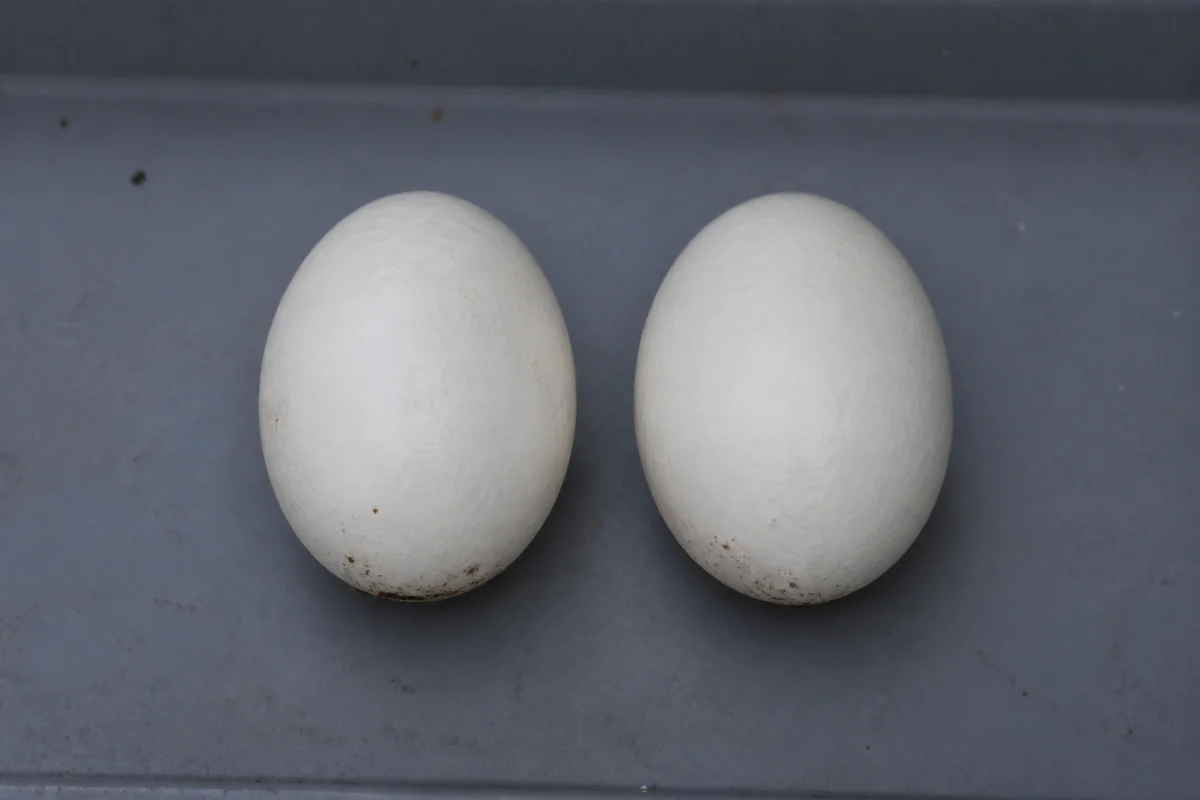
One cut settles it and the cut has to be made on every egg rather than on a sample from the basket.
A basket of eggs is a basket of unopened questions, and checking three of ten tells you about three of them.
That is not a hypothetical caution. Poisonings in this pattern happen where both species are common and eggs are collected quickly, which describes a good deal of southern Europe in autumn.
Other Amanitas in the same woods make it essential to inspect the whole stem base. The false death cap and several others sit on a rimmed bulb rather than in a loose bag, and that structure is only visible when the whole mushroom comes out of the ground.
Warning
Cut every egg. The outside of a Caesar's egg and the outside of a death cap egg are the same thing, and the inside is not.
How is Caesar's mushroom eaten?
This is one of the most highly regarded edible mushrooms in Europe, and the traditional Italian use is the one everybody quotes.
Young eggs and just-opened caps are sliced very thin and dressed raw with olive oil, lemon and salt, often with shavings of hard cheese over the top.
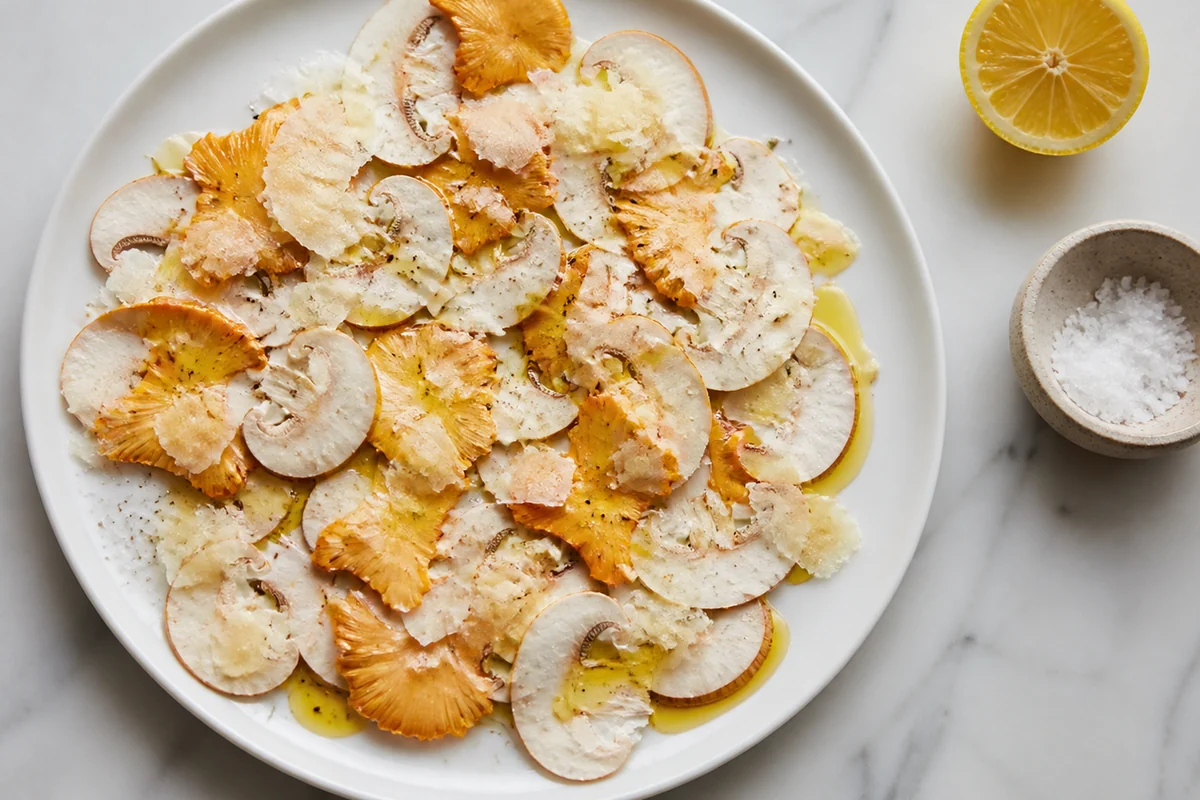
This site's position is still to cook wild mushrooms. The raw tradition exists, it is old, and it belongs to people who have handled this species all their lives in a place where it is common.
Note
A raw preparation removes the margin that cooking gives you. It is a reasonable thing for somebody who grew up with the mushroom and a poor first move for anybody who did not.
Eggs do not keep well and are usually eaten within a day. The outer skin dries and darkens quickly, and an egg that has sat for two days has lost both its texture and the clean white surface that made it worth buying.
Cooked, it is mild, firm and slightly sweet, and it holds together better than most Amanitas would.
Grilling whole caps and frying thick slices both work, and neither needs much doing to it, since the point of the mushroom is its own flavor rather than what it carries.
Can Caesar's mushroom be farmed?
Caesar's mushroom cannot be cultivated, because it fruits only from a living partnership with oak roots.
It is collected commercially in southern Europe and sold fresh in season, usually as closed eggs, which is both the preferred form and the most expensive one.
That commercial preference has an awkward consequence worth naming. The market rewards exactly the stage at which the mushroom is hardest to be certain about, which puts the responsibility on the collector rather than on the buyer.
Is it worth eating for nutrition?
Caesar's mushroom gives the ordinary profile of a firm wild gilled mushroom, with some protein, B vitamins, potassium and fiber for very few calories.
It is denser than most orange-capped mushrooms of the same size, so it delivers more on a plate than its appearance suggests.
Nobody eats it for the nutrition. It is eaten because it tastes good and because it is a seasonal occasion.
Where does Caesar's mushroom grow?
Caesar's mushroom is mycorrhizal, living in partnership with tree roots, and oak is its usual partner.
It wants warmth. This is a mushroom of southern Europe and the Mediterranean rather than of northern woodland, and it is not known from Britain or Ireland at all.
- Partner trees
- Oak above all, in warm mixed woodland
- Climate
- Warm, southern European and Mediterranean
- Season
- August to December
- Habit
- Singly or in small scattered groups
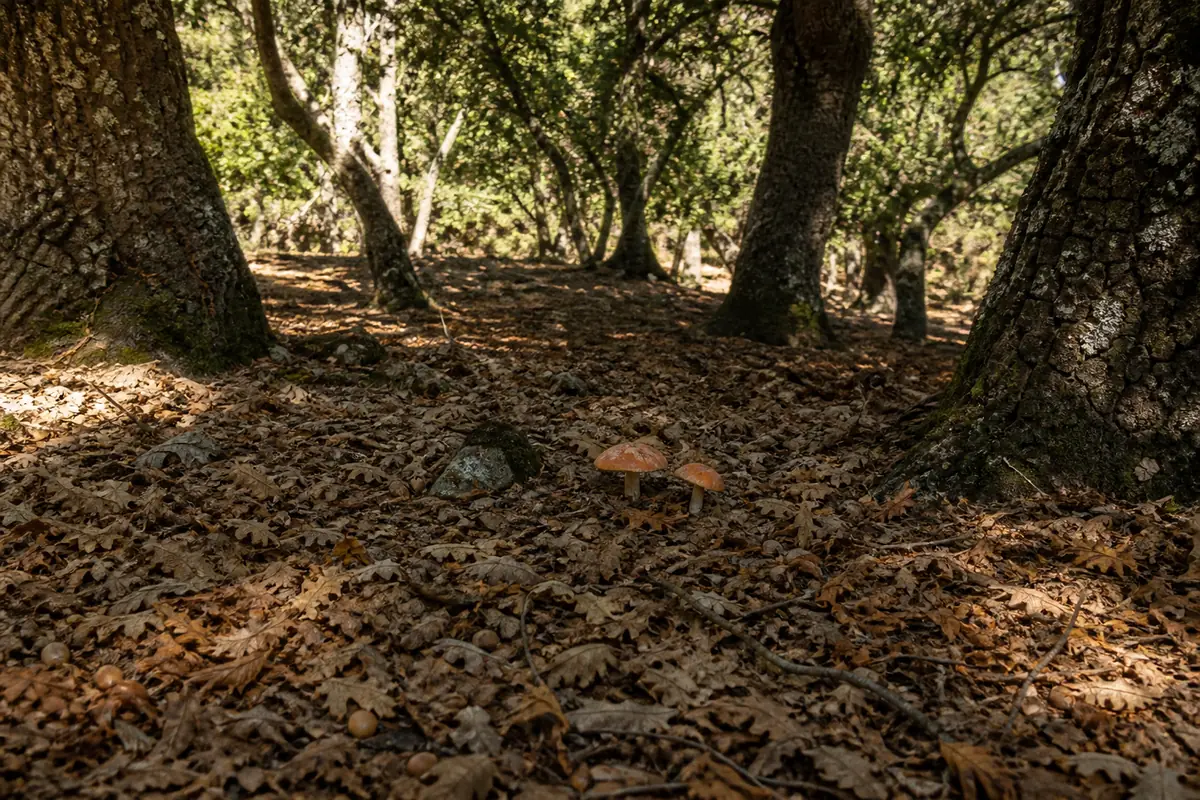
Check whether your collection falls within the known regional range. Somebody in Britain finding an orange Amanita has almost certainly found something else, and somebody in Italy or Spain has found a mushroom their neighbours have eaten for generations.
Related species carry the name in other parts of the world, particularly in North America and Asia, and they are not all the same mushroom.
Eggs are found rather than seen, in the same way matsutake are. The button pushes the leaf litter up into a small pale lump before anything breaks through, and collectors learn to read that lump instead of scanning for orange.
A local guide matters more here than on most pages, because the name has traveled further than the species has.
Is there any medicinal use?
There is no medicinal use of Caesar's mushroom and no clinical literature behind it. It is a food mushroom with a long culinary record and nothing else claimed for it.
Is it safe to eat any Amanita?
The rule most foragers learn is never to eat anything in this genus, and Caesar's mushroom is the mushroom people raise against it.
The rule deserves a better defence than repetition. It exists because the Amanita family contains the mushrooms responsible for most fatal mushroom poisonings, and because the characters that separate the good from the lethal are small and structural.
Key takeaway
A rule of thumb is a summary of a cost, not a claim about biology. Never eat an Amanita is worth following because being wrong once cancels being right a hundred times.
Caesar's mushroom does not break that logic, it sits inside it. Somebody who has learned the genus properly can carry the exception, and somebody who has not is quoting a fact they cannot use.
Learned the genus is worth spelling out rather than leaving as a compliment. It means knowing what a universal veil leaves behind and what a partial veil leaves behind, being able to tell a loose bag from a rimmed bulb with soil on both, and having dug out enough bases to know what a damaged one looks like.
None of that is exotic knowledge and none of it is quick.
It is the difference between reading a rule and being in a position to hold an exception to it.
The genus itself is well studied and still moving, and several regional mushrooms called Caesar's have been separated as their own species over the last few decades.
Amanita jacksonii in eastern North America is the example most readers will meet. It is a separate species with its own description, and it has spent a long time being called Caesar's mushroom in guides and conversation.
That is the practical reason to treat the name with care outside southern Europe. A guide written for one continent is describing a different organism from a guide written for another, and both are using the same two words.
Frequently Asked Questions
Is Caesar's mushroom safe to eat?
How do you tell a Caesar's egg from a death cap egg?
How is Caesar's mushroom different from a fly agaric?
Can you eat Caesar's mushroom raw?
Does Caesar's mushroom grow in Britain?
Why is it called ovoli?
Sources & References
- Amanita caesarea, Caesar's Mushroom Field description used for the cap dimensions and smooth orange surface, the yellow free gills, the orange stem and large pale orange ring, the white bag-like volva, the white spore print, the oak habitat, the August to December season, the absence from Britain and Ireland, and the Italian tradition of slicing young specimens raw with lemon and olive oil.
- Amanita phalloides Death cap identification features, including the white gills at every age and the loose sac at the base.